
Volleyball Court Dimensions and Space Needed
On this page13
- 01Volleyball court dimensions at a glance
- 02Volleyball court fit calculator
- 03Official indoor volleyball court size
- 04Free zone and ceiling height
- 05Attack line, front zone and back zone
- 06Service zone
- 07Net height and posts
- 08Beach volleyball court dimensions
- 09Backyard volleyball court sizes
- 10Volleyball vs tennis, pickleball and badminton size
- 11What most court guides miss
- 12Quick setup checklist
- 13Bottom line
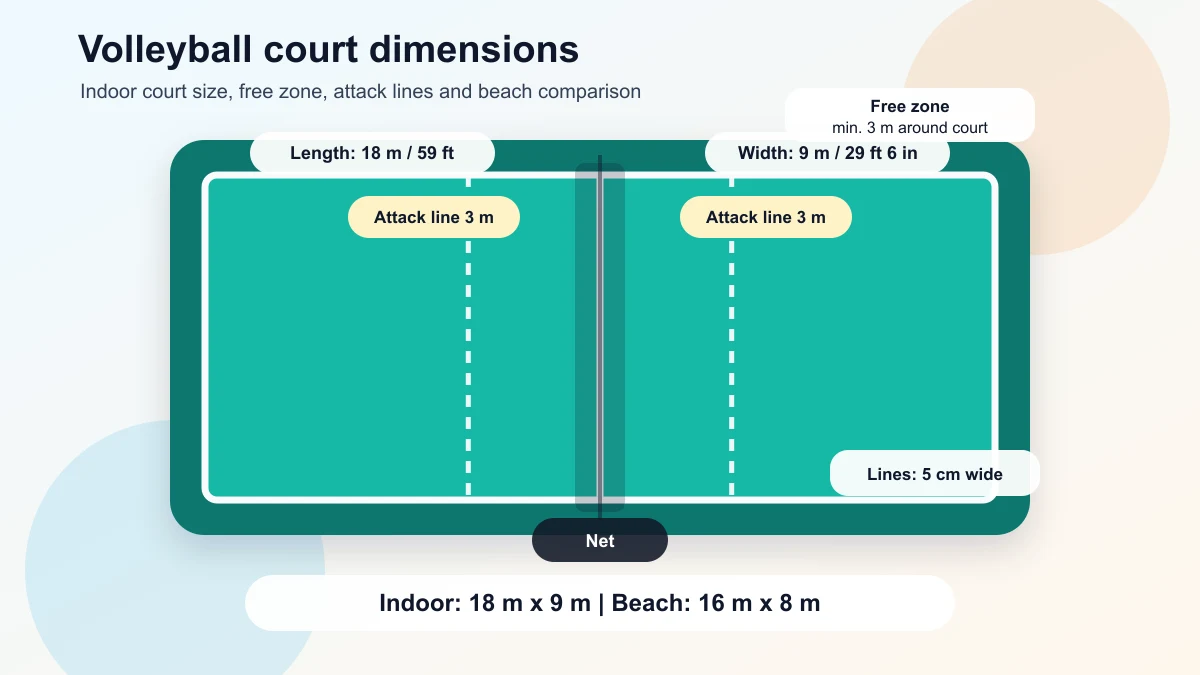
An official indoor volleyball court is 18 metres long by 9 metres wide. In U.S. court planning, that is usually rounded to about 59 feet by 29 feet 6 inches. The net divides the court into two equal 9-by-9-metre halves.
That is the painted court. The space you actually need is bigger because volleyball needs a free zone around the lines. FIVB rules set a minimum free zone of 3 metres on every side, which makes the minimum total playing area 24 by 15 metres. Use the calculator below before you tape a gym floor, price a backyard pad or mark a sand court.
Volleyball court dimensions at a glance
| Measurement | Metric | Feet / inches | What it means |
|---|---|---|---|
| Indoor court length | 18 m | 59 ft | End line to end line |
| Indoor court width | 9 m | 29 ft 6 in | Sideline to sideline |
| Each team’s court | 9 m x 9 m | 29 ft 6 in x 29 ft 6 in | One side of the net |
| Attack line from centre line | 3 m | 9 ft 10 in | Rear edge of the attack line |
| Line width | 5 cm | 2 in | Boundary and zone lines |
| Minimum free zone | 3 m all sides | 9 ft 10 in all sides | Space outside the court |
| Minimum total playing area | 24 m x 15 m | 78 ft 9 in x 49 ft 3 in | Court plus minimum free zone |
| FIVB event free zone | 5 m sides, 6.5 m ends | 16 ft 5 in sides, 21 ft 4 in ends | Larger elite event area |
| Minimum clear height | 7 m | 23 ft | Free playing space above court |
| FIVB event clear height | 12.5 m | 41 ft | Elite event overhead clearance |
| Men’s net height | 2.43 m | 7 ft 11 5/8 in | Measured at centre |
| Women’s net height | 2.24 m | 7 ft 4 1/8 in | Measured at centre |
| Beach court | 16 m x 8 m | 52 ft 6 in x 26 ft 3 in | Smaller sand court |
Boundary lines are part of the court. If a ball touches a sideline or end line, it is in. Zone lines are different: the centre line, attack line and service-zone marks mostly control player actions and positioning.
Volleyball court fit calculator
Enter your available flat space. This checks the total playing area, not only the 18-by-9-metre court.
If your space only fits the court lines, it is fine for a drill grid or casual low-speed play, but it is not a safe full playing area. Players need room to serve, chase tips, dig balls outside the sideline and slow down after a jump.
Official indoor volleyball court size
FIVB Official Volleyball Rules 2025-2028 define the indoor court as an 18-by-9-metre rectangle. The centre line divides it into two equal courts measuring 9 by 9 metres.
The court has four boundary lines:
- two sidelines, each 18 metres long
- two end lines, each 9 metres long
All lines are 5 centimetres wide and must contrast with the floor. The sidelines and end lines are drawn inside the court dimensions, so the full 18 by 9 metres includes the line width.
For rules context beyond court size, use our volleyball rules explained guide. For player alignment, see volleyball positions explained and volleyball rotation explained.
Free zone and ceiling height
The free zone is the clear area around the court. It matters because volleyball is played outside the lines as long as the ball has not hit the floor, a wall, a ceiling obstruction or another out-of-play object.
| Level | Free zone outside sidelines | Free zone behind end lines | Total playing area | Clear height |
|---|---|---|---|---|
| FIVB minimum | 3 m | 3 m | 24 m x 15 m | 7 m |
| FIVB, World and Official Competitions | 5 m | 6.5 m | 31 m x 19 m | 12.5 m |
| USA Volleyball nationally sanctioned minimum | can be 2 m | can be 2 m | varies by venue | 7 m recommended |
This is where U.S. gyms can confuse people. USA Volleyball uses the same 18-by-9-metre court, but its indoor rulebook allows a smaller free zone for many nationally sanctioned events than the FIVB minimum. For a new build, use the bigger practical space when you can. A court with just the painted rectangle has no real safety margin.
Attack line, front zone and back zone
The attack line is 3 metres from the axis of the centre line on each side. Its rear edge marks the front zone.
Each team half breaks down like this:
| Zone | Metric size | Feet / inches |
|---|---|---|
| Front zone depth | 3 m | 9 ft 10 in |
| Back zone depth | 6 m | 19 ft 8 in |
| Team court width | 9 m | 29 ft 6 in |
| One team court area | 81 sq m | about 872 sq ft |
The attack line is why back-row attacks have special rules. A back-row player can attack from behind the line, but if the ball is entirely above the top of the net, that player cannot jump from inside the front zone and complete the attack. This also explains why a setter or libero can be in a legal position one rally and restricted the next, depending on rotation.
Service zone
The service zone is 9 metres wide behind each end line. In FIVB rules, it extends to the end of the free zone. USA Volleyball adds a practical minimum depth rule for sanctioned indoor play, so a short venue may need a marked service line behind the end line.
For casual setup, preserve at least a few steps of serving space behind each end line. A server who has to stand against a wall will either foot fault, serve softly or hit something unsafe on the follow-through.
Net height and posts
Adult indoor volleyball uses the same net heights as beach volleyball:
| Division | Metric | Feet / inches |
|---|---|---|
| Men | 2.43 m | 7 ft 11 5/8 in |
| Women | 2.24 m | 7 ft 4 1/8 in |
The net height is measured at the centre of the court. The height over the two sidelines must be the same and cannot exceed the official height by more than 2 centimetres. For the full chart by age group and format, see our volleyball net height guide.
The net itself is 1 metre wide and 9.5 to 10 metres long in indoor volleyball. Antennae sit above the sidelines and mark the legal crossing space for the ball.
Beach volleyball court dimensions
Beach volleyball uses a smaller sand court: 16 metres long by 8 metres wide. It has no centre line and no attack line. That is a major difference from indoor volleyball because two players cover the whole side and can attack from anywhere.
| Measurement | Indoor volleyball | Beach volleyball |
|---|---|---|
| Court size | 18 m x 9 m | 16 m x 8 m |
| Players per side | 6 | 2 |
| Centre line | Yes | No |
| Attack line | Yes, 3 m from centre | No |
| Minimum free zone | 3 m | 3 m |
| Adult net heights | Same men’s and women’s heights | Same men’s and women’s heights |
For the rule differences beyond size, start with beach volleyball rules or the comparison guide to beach vs indoor volleyball.
Backyard volleyball court sizes
A backyard volleyball court can be official, modified or purely recreational. The mistake is pretending all three are the same.
| Setup | Court lines | Best use | Watch out for |
|---|---|---|---|
| Full indoor layout | 18 m x 9 m | Serious practice, clubs, schools | Needs a large flat area plus run-off |
| Beach-style sand court | 16 m x 8 m | Backyard doubles, mixed groups | Sand depth, drainage and anchors matter |
| Reduced casual court | Proportional smaller rectangle | Kids, parties, small yards | Not regulation and changes spacing |
| Drill court | One half or marked zones | Serving, passing and warm-ups | Not enough space for normal rallies |
If you are building outdoors, remove hard edges, rocks, posts and trip hazards first. Grass can work for casual play if it is level, but sand and hard indoor floors behave very differently. Do not copy indoor dimensions onto a rough yard and expect the same movement.
Volleyball vs tennis, pickleball and badminton size
Volleyball is shorter than tennis but much wider than many people expect once the free zone is included.
| Court | Playing lines | Practical footprint note |
|---|---|---|
| Indoor volleyball | 18 m x 9 m | Minimum 24 m x 15 m with FIVB free zone |
| Beach volleyball | 16 m x 8 m | Minimum 22 m x 14 m with 3 m free zone |
| Tennis doubles | 36 ft x 78 ft | Usually planned inside 56 x 114 or 60 x 120 ft |
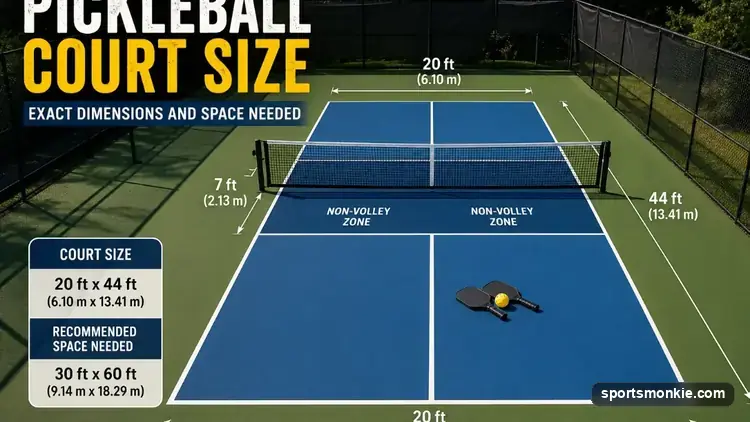
| Pickleball | 20 ft x 44 ft | 30 x 60 ft minimum, 34 x 64 ft preferred |
| Badminton doubles | 20 ft x 44 ft | Indoor hall clearance matters |
This comparison is useful for multi-sport facilities. A volleyball court may look compact on paper, but its overhead clearance and sideline movement make it a poor fit for low ceilings or tight walls.
What most court guides miss
Most volleyball dimension charts get the 18-by-9-metre answer right. The weaker ones do not explain which number you should use for your situation.
The useful distinctions are:
- Court lines are not the same thing as the total playing area.
- FIVB, USA Volleyball, school and recreational venues can use different free-zone rules.
- Indoor and beach courts are different sizes, even though adult net heights match.
- The attack line is not a boundary line. It controls player actions.
- A backyard court can be fun without being regulation, but it should be labelled honestly.
For readers, those gaps matter more than another copied dimensions table. The real planning question is whether your players have enough safe room around the ball, not whether the painted rectangle fits on paper.
Quick setup checklist
Before you mark a volleyball court:
- Confirm the format: indoor six-player, beach doubles, youth, sitting or modified recreational.
- Measure the playing court first, then measure the free zone.
- Check diagonals so the rectangle is square.
- Use 5-centimetre or 2-inch contrasting lines.
- Keep boundary lines inside the stated court dimensions.
- Mark the attack line 3 metres from the centre line for indoor volleyball.
- Leave safe serving space behind each end line.
- Set the net height for the division and measure it at the centre.
- Remove obstacles from the free zone and overhead space.
For official competition, the current rulebook and the event authority control. For home or school use, start from the official numbers, then adjust only when everyone understands the court is modified.
Bottom line
An indoor volleyball court is 18 metres by 9 metres. With the minimum FIVB free zone, plan 24 by 15 metres. For elite FIVB events, the practical footprint expands to 31 by 19 metres. Beach volleyball is smaller at 16 by 8 metres, but still needs clear space around the sand court. If you remember one thing, remember this: the lines define in and out, but the free zone defines whether the court is actually playable.
All measurements above were checked against the FIVB 2025-2028 volleyball rules, FIVB beach volleyball rules and USA Volleyball 2025-2027 indoor rulebook on September 5, 2026.
Frequently asked questions
What are the official indoor volleyball court dimensions?+
An indoor volleyball court is 18 metres long by 9 metres wide, or about 59 feet by 29 feet 6 inches. The centre line divides it into two 9-by-9-metre team courts.
How much total space do you need around a volleyball court?+
FIVB rules require a free zone of at least 3 metres on all sides, so the minimum playing area is 24 by 15 metres. For FIVB, World and Official Competitions, the free zone is 5 metres outside each sideline and 6.5 metres behind each end line.
How far is the volleyball attack line from the net?+
The attack line is 3 metres, or 9 feet 10 inches, back from the axis of the centre line on each side. Its rear edge marks the boundary between front zone and back zone.
How high is a volleyball net?+
The adult men's net is 2.43 metres, or 7 feet 11 5/8 inches. The adult women's net is 2.24 metres, or 7 feet 4 1/8 inches. The height is measured at the centre of the court.
Are beach volleyball court dimensions different?+
Yes. A beach volleyball court is 16 metres by 8 metres, smaller than the 18-by-9-metre indoor court. Beach volleyball also has no centre line and no attack line.
How wide are volleyball court lines?+
Volleyball court lines are 5 centimetres wide. Boundary lines are drawn inside the court dimensions, so a ball touching a boundary line is in.
Can I make a backyard volleyball court smaller?+
For casual play, yes, but label it as modified volleyball. Keep the court proportional, remove hard obstacles, and preserve as much run-off as possible. For official play, use the full court and the governing body's required free zone.
Sources
Play & tools
Free browser games and tools — no account, no download.
- Play today's Sports Connections — Today's Sports Connections — daily hints, answers, and play the grid.
- Play Guess the NFL Player — A new mystery NFL player every day. Eight guesses, with a clue on each — plus free unlimited mode.
- Explore all our games →
Related guides
Bowling Lane Dimensions: Length, Width, Boards and Space Needed
Regulation bowling lane dimensions from USBC: 60 ft to the head pin, 41.5 in lane width, 39 boards, approach, arrows, gutters and space calculator.
Squash Court Dimensions and Space Needed
Official squash court dimensions: 9.75m x 6.40m singles court, line heights, tin height, service boxes, clear height and build space.
Padel Court Dimensions and Space Needed
Official padel court dimensions from the 2026 FIP rules: 20m x 10m court size, net height, service lines, walls, ceiling height and build footprint.
Pickleball Court Dimensions and Space Needed
Official pickleball court dimensions: 20 x 44 ft lines, 30 x 60 ft minimum playing surface, 34 x 64 ft preferred space, kitchen, net and layout.
Tennis Court Dimensions and Space Needed
Official tennis court dimensions: 78 ft long, 36 ft wide for doubles, 27 ft for singles, plus total space needed, net height, lines and run-off.
Dressage Arena Dimensions: 20 x 60 and 20 x 40 Layouts
Dressage arena dimensions for standard and small arenas, with letter spacing, feet conversions, setup tips and a fit calculator.