
Pickleball Court Dimensions and Space Needed
On this page11
- 01Pickleball court dimensions at a glance
- 02Pickleball court fit calculator
- 03Official pickleball court dimensions
- 04How much space do you need around the court?
- 05Backyard pickleball court sizes
- 06Marking plan: how to lay out the lines
- 07Pickleball net dimensions
- 08Pickleball vs tennis vs badminton court size
- 09Converting a tennis court to pickleball
- 10What most top guides miss
- 11Quick build checklist
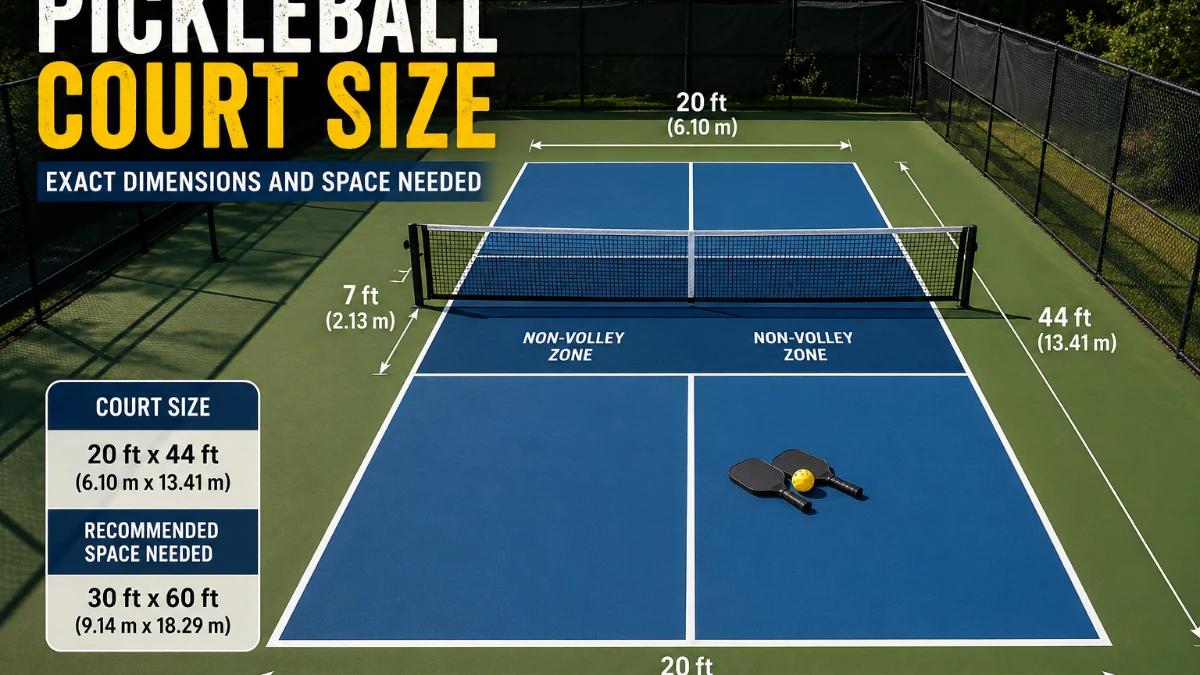
A regulation pickleball court is 20 feet wide by 44 feet long. That is the easy number. The number that saves you from building a cramped court is the larger playing surface around it: 30 by 60 feet minimum, 34 by 64 feet preferred for new builds and tournament-style play.
That distinction matters. The 20-by-44-foot rectangle tells you whether a ball is in or out. It does not give a player room to serve, recover, chase a wide dink or stop safely before hitting a fence. Use the quick fit calculator below first, then use the official dimensions and marking steps to lay the court out cleanly.
Pickleball court dimensions at a glance
| Measurement | Official / recommended size | What it means |
|---|---|---|
| Playing-court lines | 20 ft x 44 ft | Regulation court for singles and doubles |
| Minimum playing surface | 30 ft x 60 ft | USA Pickleball minimum surface area |
| New construction / tournament surface | 34 ft x 64 ft | Better run-off and the safer target for permanent courts |
| Stadium court | 50 ft x 80 ft | Large event setup with generous space |
| Kitchen / non-volley zone | 7 ft x 20 ft on each side | The no-volley zone beside the net |
| Service court | 10 ft x 15 ft each | Half of the backcourt behind each kitchen |
| Net height | 36 in sidelines, 34 in center | Measured at the court surface |
| Line width | 2 in | Contrasting line color, measured to outside edges |
The court size is identical for singles and doubles. That is different from tennis, where doubles uses a wider court.
Pickleball court fit calculator
Enter your available hard, level space. The calculator treats your entry as the total playing surface, not just the painted lines.
If your result only fits the 20-by-44-foot lines, you can still tape a casual court on a driveway or gym floor. Just do not mistake that for a comfortable permanent court. The first complaint on tight backyard courts is not the line accuracy; it is players running out of space behind the baseline or beside the sideline.
Official pickleball court dimensions
USA Pickleball’s 2026 rulebook states that the court is a 20-foot by 44-foot rectangle for both singles and doubles. Court measurements are made to the outside edge of the perimeter lines and non-volley-zone lines.
Break the length down from the net and the layout becomes easier:
| Section | Measurement |
|---|---|
| Net to baseline, each side | 22 ft |
| Kitchen / non-volley zone, each side | 7 ft |
| Kitchen line to baseline | 15 ft |
| Court width | 20 ft |
| Each service-box width | 10 ft |
| Full playing-court area | 880 sq ft |
All boundary lines are part of the court. A normal rally ball that touches a line is in. Serves are the confusing exception: a serve that lands in the kitchen or on the non-volley-zone line is out.
How much space do you need around the court?
For a permanent backyard pickleball court, plan the full surface before you price concrete, asphalt, sport tile, fencing or lights.
| Layout | Total footprint | Area | Side run-off if centered | Baseline run-off if centered |
|---|---|---|---|---|
| Lines only | 20 x 44 ft | 880 sq ft | 0 ft | 0 ft |
| Minimum playing surface | 30 x 60 ft | 1,800 sq ft | 5 ft | 8 ft |
| New construction / tournament | 34 x 64 ft | 2,176 sq ft | 7 ft | 10 ft |
| Stadium court | 50 x 80 ft | 4,000 sq ft | 15 ft | 18 ft |
The sweet spot for most serious backyard builds is 34 by 64 feet. A 30-by-60-foot court works, but it already feels like the floor. If you add fencing close to that minimum pad, the court can feel tighter than the number suggests because your backswing, follow-through and stopping room disappear at the fence line.
For budget planning, pair this dimensions guide with our pickleball court construction cost breakdown before you choose concrete, asphalt, tiles or a resurfacing contractor.
Backyard pickleball court sizes
Backyard courts live on a spectrum:
- Temporary driveway court: Tape or chalk the 20-by-44-foot lines if the surface is flat and safe. Good for casual play, not ideal for fast doubles.
- Minimum permanent court: Use a 30-by-60-foot pad. It gives functional run-off but still rewards compact movement.
- Comfortable backyard court: Use 34 by 64 feet when possible. This is the better default for a new slab or dedicated sport surface.
- Large private court: Anything wider or longer than 34 by 64 gives better recovery space, seating options and fence clearance.
Surface matters as much as size. Pickleball needs a hard, smooth, predictable bounce. Concrete, asphalt, acrylic sport surfaces, court tiles and gym floors can work. Grass does not give a normal pickleball bounce, even if the lines technically fit.
Marking plan: how to lay out the lines
Use a long tape, chalk line and two diagonal checks. Do not trust eyeballing; a tiny skew at the first baseline becomes obvious once the centerlines and kitchen lines go down.
- Mark a 20-foot baseline.
- Measure 44 feet from both baseline corners and mark the opposite baseline.
- Check diagonals corner to corner; both should match before you paint or tape.
- Mark the net line halfway between baselines, 22 feet from each end.
- Mark each kitchen line 7 feet back from the net, across the full 20-foot width.
- Mark the centerline from each kitchen line to its baseline, splitting the service courts into 10-foot-wide boxes.
- Set the net at 36 inches at the sidelines and 34 inches at the center.
Line width should be 2 inches and should contrast clearly with the playing surface. If you are sharing a court with tennis or basketball, choose a line color that players can read instantly without turning the surface into spaghetti.
Pickleball net dimensions
A pickleball net is lower than a tennis net:
| Net spec | Pickleball |
|---|---|
| Height at sidelines | 36 in |
| Height at center | 34 in |
| Net post spacing | 22 ft inside-to-inside |
| Minimum net length | 21 ft 9 in |
| Recommended net body height | At least 30 in |
Portable nets are convenient, but measure the center height. Many casual nets sit too high in the middle unless the center strap is adjusted, and that changes the feel of dinks, drops and passing shots. For the three-point measuring process and tolerance check, use the separate pickleball net height guide.
Pickleball vs tennis vs badminton court size
Pickleball borrowed the badminton-sized rectangle but plays nothing like badminton because the net is lower, the ball bounces and the kitchen changes net play.
| Spec | Pickleball | Tennis doubles | Badminton doubles |
|---|---|---|---|
| Length | 44 ft | 78 ft | 44 ft |
| Width | 20 ft | 36 ft | 20 ft |
| Playing area | 880 sq ft | 2,808 sq ft | 880 sq ft |
| Net height at center | 34 in | 36 in | 60 in |
| Wider doubles court? | No | Yes | Yes |
This is why one old tennis court can become multiple pickleball courts, but it is also why conversions need discipline. Fitting the rectangles is easy. Keeping safe run-off, clean sightlines and readable lines is the hard part.
Converting a tennis court to pickleball
A tennis court can be converted three ways:
| Conversion | Best use | Watch out for |
|---|---|---|
| One pickleball court over the tennis net | Shared recreational court | Tennis net center is normally 36 in, so it needs lowering to 34 in |
| Two pickleball courts on one tennis court | Clubs with steady pickleball demand | Shared run-off and portable nets must be planned carefully |
| Four dedicated pickleball courts | Full conversion | Works only when the surrounding tennis run-off is repurposed intelligently |
If tennis still matters on the same surface, one or two overlay courts are usually cleaner than four. Too many lines slow players down because they hesitate before calling balls in or out.
If your goal is a dedicated conversion, the separate keyword deserves its own focused page later. For now, keep the decision rule simple: preserve run-off before you maximize court count.
What most top guides miss
The top search results usually repeat the same correct official dimensions. The useful planning gaps are more practical:
- They say 20 by 44 first, but do not always warn strongly enough that this is not the build footprint.
- They mention 30 by 60, but often skip the actual run-off math.
- They recommend fencing, but do not always explain that fencing makes a minimum court feel tighter.
- They explain tennis conversion, but understate how confusing multi-sport line clutter can become.
- They rarely give a quick way to test your exact yard, driveway or slab dimensions.
That is why the calculator above starts with your available total surface and gives side and baseline run-off. The dimensions are official; the fit decision is practical.
Quick build checklist
- Confirm local setback, HOA, drainage, lighting and noise rules before pouring anything.
- Decide whether the goal is temporary play, a minimum court, a comfortable backyard court or a facility-grade court.
- Use 34 by 64 feet as the preferred target if space and budget allow.
- Orient outdoor courts north-south where possible to reduce low-sun glare.
- Keep fencing, benches, gates and lights outside the player run-off zone.
- Verify the 20-by-44-foot rectangle with matching diagonals before painting.
- Measure the net after setup: 36 inches at the sidelines, 34 inches at the center.
Once the court is marked, the game itself is quick to learn. Start with pickleball rules for beginners, then work on pickleball serving rules and the kitchen in pickleball. If you are planning a bigger backyard setup, compare the smaller footprints for cornhole distance, horseshoe pit dimensions and bocce court dimensions.
The short answer: paint the court at 20 by 44 feet, but build the surface at 30 by 60 feet minimum and 34 by 64 feet if you want a court people actually enjoy playing on.
Frequently asked questions
What are the official pickleball court dimensions?+
A regulation pickleball court is 20 feet wide by 44 feet long for both singles and doubles. USA Pickleball says measurements are made to the outside edge of the perimeter and non-volley-zone lines, so mark the outside of the boundary, not the center of the paint.
How much total space do you need for a pickleball court?+
USA Pickleball lists 30 by 60 feet as the minimum playing surface, 34 by 64 feet for new construction and tournament play, and 50 by 80 feet for a stadium court. For a backyard, 34 by 64 feels much better than squeezing the court into 20 by 44 feet.
Is a pickleball court the same size for singles and doubles?+
Yes. Pickleball uses the same 20-by-44-foot court for singles and doubles. Unlike tennis, there are no wider doubles alleys.
How big is the kitchen in pickleball?+
The kitchen, officially the non-volley zone, is 7 feet deep on each side of the net and spans the full 20-foot court width. All lines that bound the non-volley zone are part of the zone.
How high is a pickleball net?+
A pickleball net is 36 inches high where it crosses the sidelines and 34 inches high at the center. Net posts should be 22 feet apart inside-to-inside, with a net at least 21 feet 9 inches long.
Can you build a backyard pickleball court smaller than 30 by 60 feet?+
You can mark a smaller casual court if everyone agrees, but it will not give normal run-off room. A 20-by-44-foot rectangle is only the line area; without side and baseline space, players run out of room quickly.
How many pickleball courts fit on a tennis court?+
A standard tennis doubles court can usually take one comfortable pickleball overlay without much trouble. Facilities can fit two or sometimes four dedicated pickleball courts on a tennis-court footprint, but the more courts you add, the more careful you must be with run-off, nets and line confusion.
Sources
Play & tools
Free browser games and tools — no account, no download.
- Play today's Sports Connections — Today's Sports Connections — daily hints, answers, and play the grid.
- Play Guess the NFL Player — A new mystery NFL player every day. Eight guesses, with a clue on each — plus free unlimited mode.
- Explore all our games →
Related racket sports guides
View all →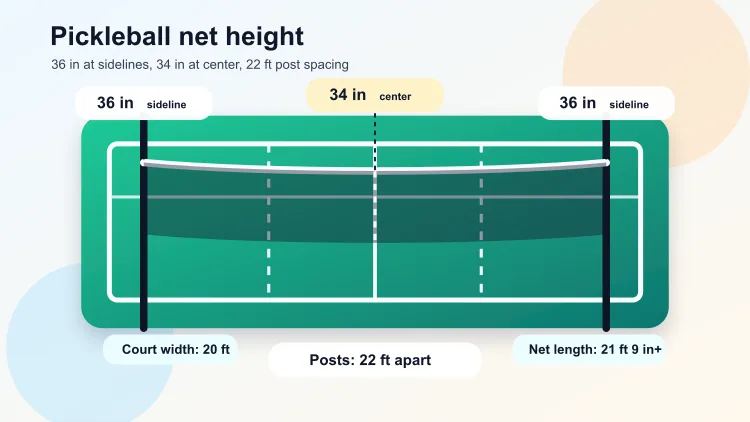
Pickleball Net Height: Official 36/34 Inch Setup
Official pickleball net height is 36 inches at the sidelines and 34 inches at the center. Check post spacing, net length, center sag and tennis-net conversions.
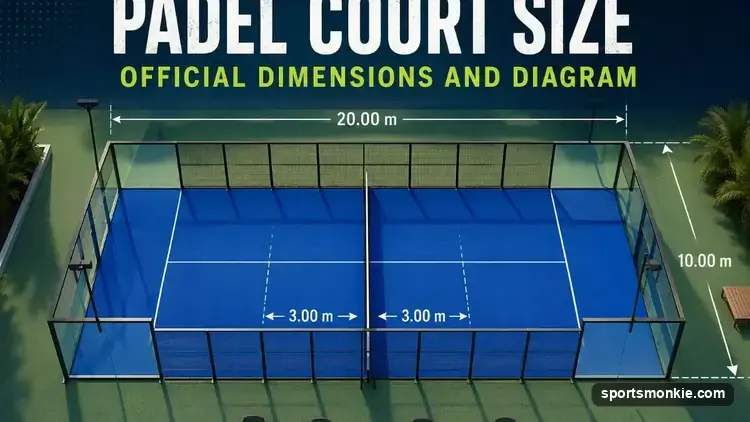
Padel Court Dimensions and Space Needed
Official padel court dimensions from the 2026 FIP rules: 20m x 10m court size, net height, service lines, walls, ceiling height and build footprint.
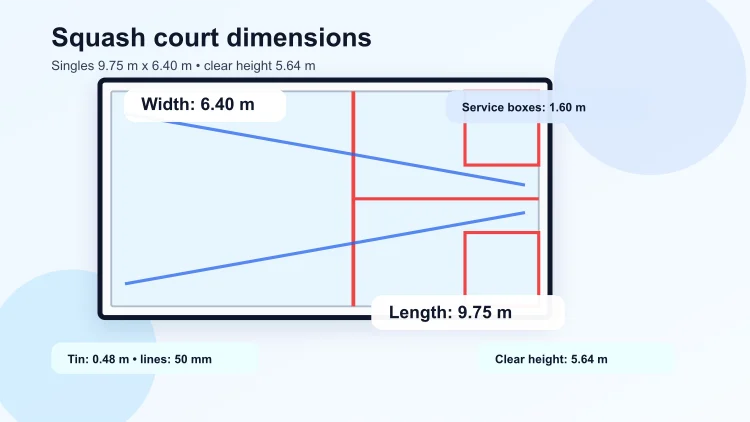
Squash Court Dimensions and Space Needed
Official squash court dimensions: 9.75m x 6.40m singles court, line heights, tin height, service boxes, clear height and build space.
How Much Does It Cost to Build a Pickleball Court?
Pickleball court construction cost runs $20,000 to $40,000 in 2026. Full breakdown by base, surface, fencing, lighting, DIY, and tennis conversion.
Racquetball Rules: Serving, Scoring, Hinders
Racquetball rules made simple: how to serve legally, sideout scoring to 15, the tiebreaker to 11, and the difference between dead-ball and penalty hinders.
Best Pickleball Paddle: How to Choose the Right One
How to pick the best pickleball paddle: control vs power vs all-court, materials, price tiers, and the new testing rules that decide what stays legal.