
What Is the Kitchen in Pickleball? The Non-Volley Zone Rule
On this page5
Newcomers to pickleball hear “stay out of the kitchen” within their first ten minutes on court and assume it is off-limits entirely. It is not. The kitchen has one specific rule, and once you understand what it actually forbids, the fear of it disappears and your net game gets far better.
What and where the kitchen is
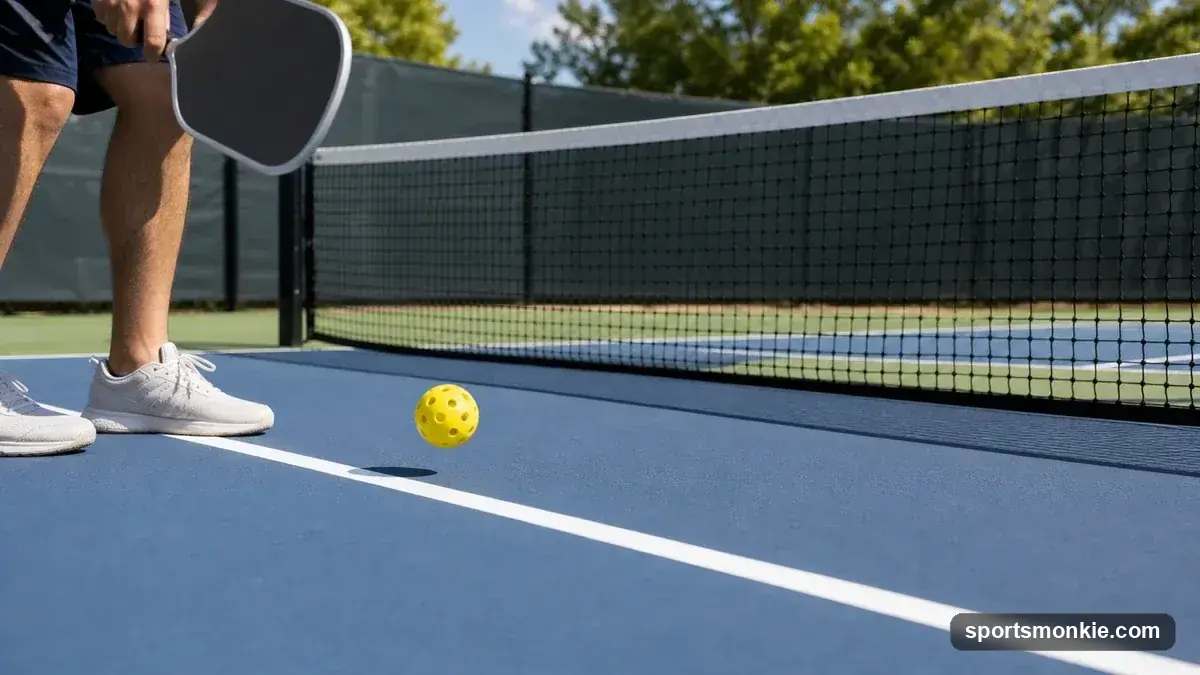
The kitchen is the everyday nickname for the non-volley zone. It is the area that runs 7 feet back from the net on both sides, stretching the full width of the court. It is usually marked with a line, and that line is part of the zone.
The name is pure slang. There is no official reason it is called the kitchen, and the rulebook only ever uses “non-volley zone.” But everyone on the court will call it the kitchen, so it is worth knowing both terms.
The one rule that matters
You cannot volley the ball while standing in the kitchen. A volley means hitting the ball out of the air before it bounces. If any part of your foot is inside the zone or touching its line when you volley, it is a fault.
That is the entire restriction. It does not stop you from entering the kitchen for any other reason. You can walk in, stand in it, and hit balls that have already bounced there. The rule targets only volleys.
The faults beginners keep committing
Most kitchen faults are not about standing in the zone. They come from momentum.
| Situation | Legal or fault? |
|---|---|
| Volleying while standing in the kitchen | Fault |
| Volleying, then momentum carries you into the kitchen | Fault |
| Touching the kitchen line while volleying | Fault |
| Stepping in to hit a ball that bounced | Legal |
| Standing in the kitchen between shots | Legal |
The momentum rule is the sneaky one. If you jump to hit a volley from just outside the line and land inside the zone afterward, it is still a fault. You must have fully re-established your feet outside the kitchen before your next volley. Your paddle or body crossing over the plane of the net does not matter for this rule, only your feet and where they land.
Why the kitchen exists
Without the non-volley zone, tall or aggressive players could crowd the net and smash every ball straight down before it bounced, ending points instantly. The kitchen pushes players back a step and forces softer, more skillful net play. This is where the “dink,” a gentle shot that arcs just over the net into the opponent’s kitchen, becomes central to the game. Good players trade dinks patiently, waiting for a ball that pops up high enough to attack safely from outside the line.
A simple way to remember it
Think of the kitchen as a “no smashing out of the air” zone rather than a place you cannot go. Bounced balls are fair game anywhere. Volleys are only legal with both feet planted behind the line.
Getting this straight is one of the biggest early jumps in pickleball skill. Master the kitchen line and the soft dinking game that lives around it, and you will win far more points at the net than raw power ever gets you.
Frequently asked questions
What is the kitchen in pickleball?+
The kitchen is the common name for the non-volley zone, a 7-foot area on each side of the net. You cannot hit a volley (a ball out of the air) while standing in it.
Can you ever step in the kitchen?+
Yes. You can step into the kitchen any time to play a ball that has bounced. The rule only forbids volleying while your feet are in the zone or touching its line.
Is it a fault if your momentum carries you into the kitchen?+
Yes. If you volley the ball and your momentum then carries you into the kitchen, or you touch the line, it is a fault even though you hit the ball from outside.
Sources
Play & tools
Free browser games and tools — no account, no download.
- Play today's Sports Connections — Today's Sports Connections — daily hints, answers, and play the grid.
- Play Guess the NFL Player — A new mystery NFL player every day. Eight guesses, with a clue on each — plus free unlimited mode.
- Explore all our games →
Related guides

Non-Volley Zone Rules in Pickleball: The Complete Reference
The full non-volley zone rulebook: what's allowed, every common kitchen fault, the momentum rule, and the edge cases players argue about most.

Pickleball Faults Explained: The Full List of Common Faults
A fault ends the rally in pickleball. Here's the full list — kitchen volleys, serve faults, out of bounds, two-bounce violations and net touches.

What Is an Erne in Pickleball? The Legal Kitchen Bypass
An erne is a pickleball shot where you jump around the outside of the kitchen to volley right at the net — legal because your feet land outside the zone.
Pickleball Rules for Beginners: A Simple Guide
New to pickleball? Learn the serve, the two-bounce rule, the non-volley kitchen zone, scoring to 11, and the faults that trip up beginners the most.
The Double-Bounce Rule in Pickleball, Explained Simply
The double-bounce (two-bounce) rule means the ball must bounce once on each side before anyone can volley. Here's why it exists and the faults it causes.
Is There a Let in Pickleball? No — the Net Serve Is Live
There is no let serve in pickleball. Since 2021 a serve that clips the net and lands in is live and played on. Here's what changed and why.