
Shuffleboard Rules: Table and Court
On this page5
Shuffleboard rules depend on which shuffleboard you mean, because there are two distinct games. Table shuffleboard is the indoor bar version, where you slide weights by hand down a 22-foot table into zones worth 1, 2 or 3 points. Deck shuffleboard, also called court shuffleboard, is the outdoor game where you use a cue to push discs down a long floor court into a triangle scored 10, 8 and 7.
Both share one core idea: only the side with the best-placed pieces scores each round. Here is how each version works, how to keep score, and which rules people most often get wrong.
Table vs deck shuffleboard: the quick comparison
If you just want the essentials before the detail, this covers both games side by side.
| Feature | Table shuffleboard | Deck (court) shuffleboard |
|---|---|---|
| Surface | 22 ft table | 39 ft court, 6 ft wide |
| You push with | Your hand | A cue stick |
| Pieces | 4 weights per side | 4 discs per side |
| Scoring zones | 1, 2, 3 (plus 4 for a hanger) | 10, 8, 7 (plus 10-off penalty) |
| Typical target score | 15 or 21 | 75 in tournaments |
| Who scores per round | Only the leading side | Only the leading side |
The dimensions above match the standard specs for table shuffleboard and deck shuffleboard. From here, each game deserves its own walkthrough.
Table shuffleboard rules
Table shuffleboard is played on a long, narrow, waxed table dusted with fine sand or “shuffleboard powder” so the weights glide. Two players or two teams take turns sliding their four weights toward the far end, aiming to land in the highest scoring zone without sliding off.
Scoring the round. The far end is divided into three zones worth 1, 2 and 3 points, with the 3 closest to the edge. After all eight weights are played, only one side scores: the side with the weight closest to the far end counts every weight of theirs that sits farther down than the opponent’s best weight. A weight overhanging the far edge without falling, a “hanger,” is worth 4.
Winning. Play continues round by round until one side reaches the target, usually 15 or 21 points. You do not have to land exactly on the number; passing it wins. Knocking opponents’ weights off the table or into lower zones is legal and central to good strategy.
Deck (court) shuffleboard rules
Deck shuffleboard is the version you have seen on cruise ships and in retirement parks. Players stand at one end of a 39-foot court and use a cue to push flat discs toward a scoring triangle at the opposite end.
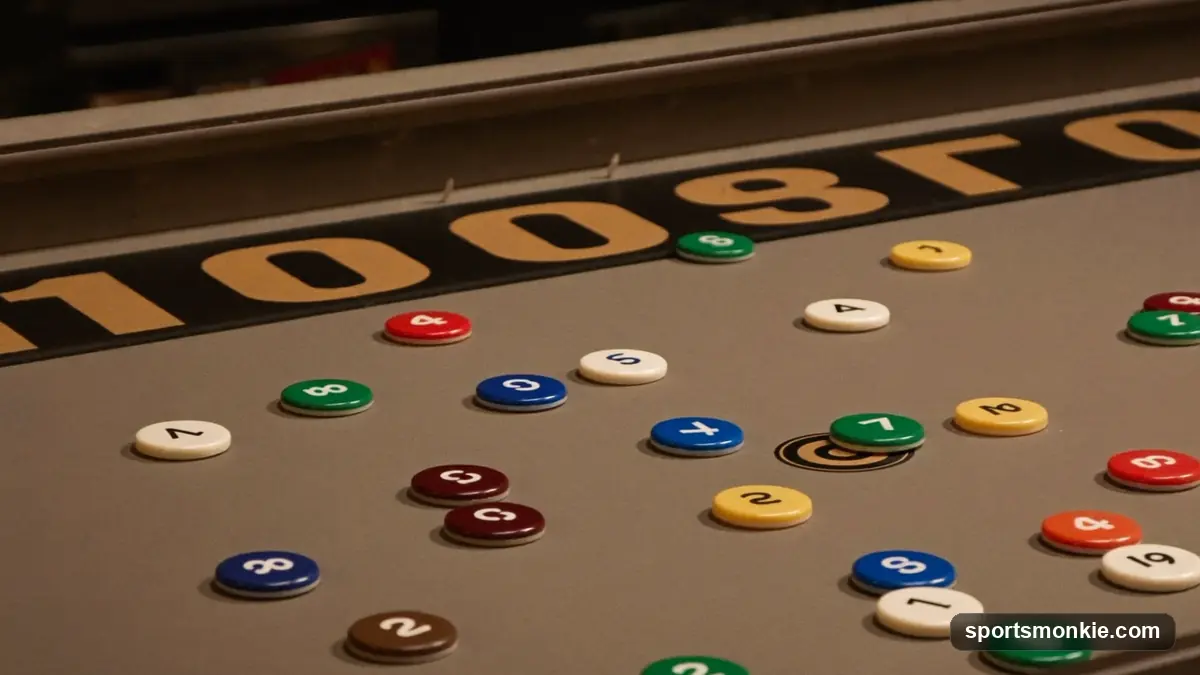
The scoring triangle. The triangle is divided into a 10 at the far tip, then two 8s, then two 7s nearer the middle. Just in front of the triangle sits a “10-off” penalty zone. A disc that stops there costs you 10 points, so overshooting is genuinely risky.
Scoring a disc. A disc counts only if it lies completely inside a zone without touching any line. Discs are usually scored after all eight are played, and knocking an opponent’s disc out of the triangle, or into the 10-off, is a legitimate tactic.
Winning. Tournament games are played to 75 points, though casual games often use 50, 75 or 100 by agreement. As with the table game, only the leading side’s scoring discs count in each frame.
The rule people get wrong
The most common confusion is assuming the two games share rules. They do not. The scoring numbers, the equipment and even how you launch the piece are different, so learning one does not automatically teach you the other.
The second frequent mistake, in the table game, is thinking you must finish on an exact score. Standard rules simply reward the first side to reach the target; the “exact 21” requirement is a bar house rule, not part of the official game. If you are playing somewhere new, ask which version of that rule is in force before the first round.
Same family, different game
Shuffleboard belongs to the same family of “get closest and knock the other side out” games as several backyard classics, which is why it clicks quickly if you already play one. If you enjoy the precision-and-blocking element, our guide to bocce ball rules covers the same logic on grass, and cornhole distance shows how spacing changes the feel of a bag-toss board.
The short version: table shuffleboard uses your hand, a 22-foot table and 1-2-3 scoring to 15 or 21; deck shuffleboard uses a cue, a 39-foot court and 10-8-7 scoring with a 10-off penalty to 75; and in both, only the leading side scores each round.
Frequently asked questions
How do you score shuffleboard played on the ground?+
In deck or court shuffleboard, discs are scored only if they sit entirely inside a scoring area without touching a line. The scoring triangle is divided into a 10 at the tip, two 8s and two 7s, with a 10-off penalty zone at the near end. A disc in the 10-off area subtracts 10 points, which is what makes the game tactical.
How do you play old-fashioned shuffleboard?+
Old-fashioned shuffleboard usually means the outdoor deck version played on cruise ships and in parks. Two players or teams use long cue sticks to slide flat discs down a 39-foot court into a scoring triangle at the far end, alternating shots. It predates the indoor table game and uses cues rather than your hand.
Do you have to hit exactly 21 in shuffleboard?+
No, not under standard rules. In table shuffleboard the first side to reach the target score (commonly 15 or 21) wins, and going over is fine. Some bars add a house rule requiring an exact finish, but that is a local variation, not part of the official game.
What is a hanger in table shuffleboard?+
A hanger is a weight that slides all the way to the far end and overhangs the edge without falling off. It is the best possible shot, worth 4 points, one more than the highest marked zone. Knocking your opponent's hanger off, or bumping it back into a lower zone, is a common defensive play.
Sources
Play & tools
Free browser games and tools — no account, no download.
- Play today's Sports Connections — Today's Sports Connections — daily hints, answers, and play the grid.
- Play Guess the NFL Player — A new mystery NFL player every day. Eight guesses, with a clue on each — plus free unlimited mode.
- Explore all our games →
Related guides
Boxing Weight Classes in Order: All 17 Divisions
Professional boxing has 17 weight classes, from minimumweight (105 lb) to heavyweight. Every division in order with limits in pounds and kilograms.
How Long Are Boxing Rounds? Length & Rest Times
Men's boxing rounds are three minutes with a one-minute rest; women's rounds are usually two minutes. Round length, rest and total fight time explained.

How Many Rounds Are in a Boxing Match?
Professional title fights are 12 rounds, non-title bouts 4–10, and amateur fights 3 rounds. Round counts explained, plus why boxing dropped 15-round bouts.
How Many Rounds Are in a UFC Fight?
Most UFC fights are three rounds of five minutes; title fights and main events are five rounds. UFC round counts, round length and rest explained.

Kickboxing Rules: Rulesets and Allowed Strikes
Kickboxing combines punches and kicks, with rules varying by org. K-1, full-contact and low-kick rulesets, plus how it differs from Muay Thai.

MMA Weight Classes Explained: Full Division List
MMA uses nine standard weight classes from strawweight (115 lb) to heavyweight (265 lb) under the Unified Rules. Full limits in pounds and kilograms.