
Cornhole Distance and Board Dimensions Guide
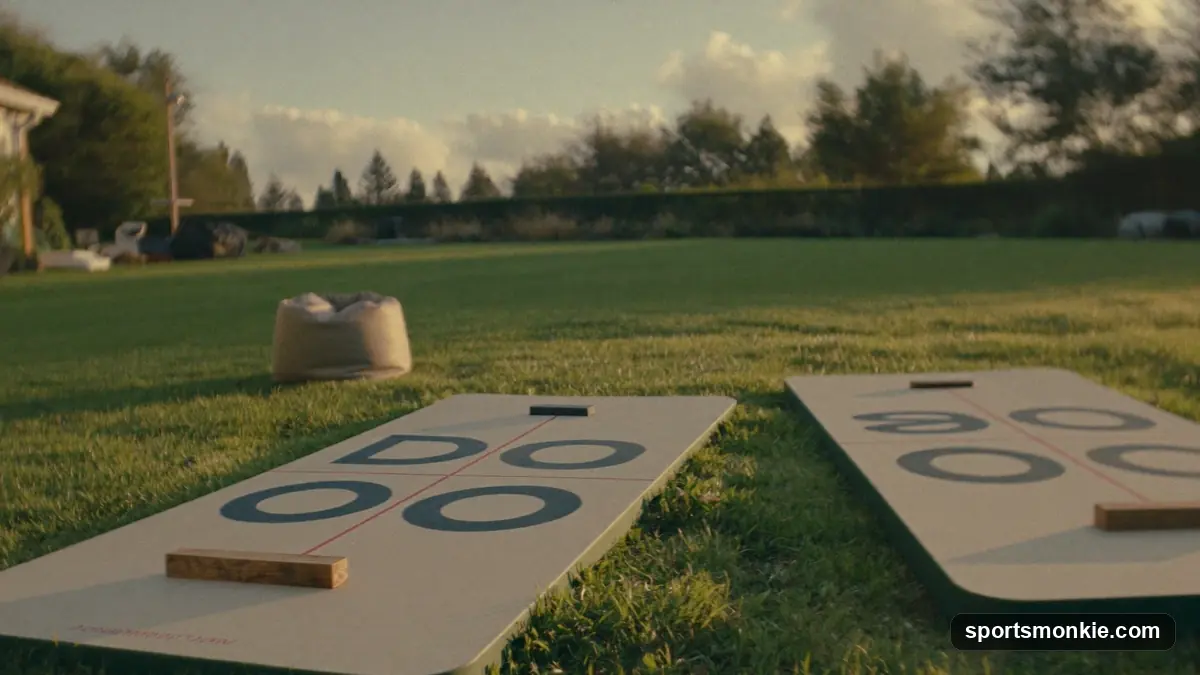
On this page9
- 01The official cornhole setup
- 02Distance calculator (ready-to-use setup blocks)
- 03Distance utility (quick calculator)
- 04How far apart do you set up the boards?
- 05Casual and youth distances
- 06Board dimensions and hole placement
- 07Why is it called cornhole?
- 08The bags matter too
- 09How do you keep score in cornhole?
Regulation cornhole distance is 27 feet, measured from the front edge of one board to the front edge of the other. That is the figure the American Cornhole League and the American Cornhole Organization both use for adult play, and it is the number that governs every sanctioned match.
Set the boards that way and the two holes end up roughly 33.5 feet apart, because each hole sits near the back of a 4-foot board. Here is the full official setup, then the casual variations, scoring and the origin of the name.
The official cornhole setup
Everything below comes from the current ACL rulebook. The board itself matters as much as the gap between boards, since the hole placement and the slope are what make a regulation throw feel right.
| Measurement | Regulation spec |
|---|---|
| Board distance (front to front) | 27 feet |
| Hole distance (center to center) | About 33.5 feet |
| Board length x width | 48 in x 24 in (4 ft x 2 ft) |
| Hole diameter | 6 inches |
| Hole placement | 9 in from the back edge, 12 in from each side |
| Front edge height | 3 to 4 inches off the ground |
| Back edge height | About 12 inches |
| Pitcher’s box | 3 ft wide x 4 ft long, beside each board |
Measure the 27 feet from the closest edges, not the centers of the boards. A tolerance of half an inch is allowed in tournament play, so a tape measure and a flat surface get you there.
Decision guide:
- Use 27 ft when you want official consistency across score, board setup, and timing.
- Use 21 ft only for beginner blocks where the full distance is unrealistic for most throws.
- Use 15 ft to 18 ft only when space is genuinely limited and everyone is playing the same house format.
Distance calculator (ready-to-use setup blocks)
If you want to run a fast check without doing math, use this starter map:
| Setup type | Target board distance | Ideal use |
|---|---|---|
| Official (regulation) | 27 ft (8.23 m) front edge to front edge | League play, tournaments, bracket matches |
| Backyard quick game | 18 ft (5.49 m) | Family play, younger groups, short driveways |
| Beginner training | 21 ft (6.40 m) | Skill building before moving up to 27 ft |
| Limited-space outdoor game | 15 ft (4.57 m) to 17 ft (5.18 m) | Small yards where full setup cannot fit |
The holes stay in the same place on each board, so once you shift board spacing you are changing only the throw length. That makes comparison easy: the board shape and hole position do not change, only the throw.
For teams that want a full rules context, see cornhole rules before locking a format for league-style games.
Distance utility (quick calculator)
How far apart do you set up the boards?
Place the two boards facing each other with 27 feet of clear space between the front edges. Players stand in the pitcher’s box to the left or right of the board on their end and pitch toward the far board. Each player throws four bags per round.
The foul line is the front of the board. You can wind up and step, but your foot cannot cross the front edge before the bag leaves your hand. Step over and the bag scores nothing for that throw.
Casual and youth distances
The 27-foot figure is the only distance the governing bodies define. Neither the ACL nor the ACO publishes a shorter “junior” standard, so anything you see for kids is a house rule rather than an official spec.
In practice, families shorten the gap so younger or newer players can reach the board. Common backyard choices land somewhere between 12 and 21 feet, picked by feel rather than by rule. If you are training to play in a league, practice at the full 27 feet, because a bag that carries 15 feet is a very different throw from one that has to travel 27.
For more on where cornhole fits among casual competition, see our look at the differences between indoor and outdoor sports.
If you want quick setup ideas that still keep games fair, check how to play darts, shuffleboard rules, bocce ball rules, and the full horseshoe pit dimensions guide for another stake-and-distance backyard game.
Board dimensions and hole placement
A regulation board is a rectangle 48 inches long and 24 inches wide. The hole is 6 inches across, centered 9 inches down from the top edge and 12 inches in from each side, which places it dead center left to right.
The board is not flat. The front edge sits 3 to 4 inches off the ground and the back rises to about 12 inches, giving the surface a gentle upward slope toward the hole. That slope is why a bag can slide up the board and drop in, and why a flat sheet of plywood on the grass never plays the same.
Why is it called cornhole?
The name comes from the filling. Traditional bags were sewn from fabric and packed with dried corn kernels, so a bag that dropped through the hole was, literally, corn in a hole. The game spread through the American Midwest, particularly Ohio and Kentucky, which is why “cornhole” stuck there while other regions called the same game bean bag toss or corn toss.
Competition bags today are usually filled with resin pellets rather than corn, because plastic resin holds its weight and shape in wet weather where real corn swells and rots. The name outlived the ingredient.
The bags matter too
The board gets the attention, but a regulation setup also specifies the bags. Under ACL rules a bag measures 6 inches by 6 inches and weighs roughly 15.5 to 16 ounces, about a pound. Each player throws four bags per round, and the two sides use different colors so scoring stays clear.
Serious players use dual-sided bags, with a faster “slick” side that slides toward the hole and a grippier “stick” side that stops on the board to block. That is a competition nuance rather than a rule, but it is why tournament bags cost far more than the filled sacks in a backyard set. For casual play, any pair of matched, similarly weighted bags works fine.
How do you keep score in cornhole?
Cornhole uses cancellation scoring, and the first side to reach 21 or more at the end of a round wins. A bag through the hole is worth 3 points. A bag that lands and stays on the board is worth 1. A bag on the ground scores nothing, even if it touched the board first and slid off.
Cancellation is the part newcomers miss. After both players throw their four bags, you compare the two totals for that round and only the higher scorer banks points, minus the opponent’s total. If Red scores 7 in a round and Blue scores 5, Red adds 2 and Blue adds 0. That back-and-forth is what keeps close games from running away.
Two casual games that share cornhole’s pub-and-backyard territory are worth a look next: how to play darts and how to rack pool balls both reward the same kind of repeatable, low-setup practice.
Get the boards 27 feet apart, keep your foot behind the front edge, and count by cancellation to 21. Those three things are the whole regulation game.
Frequently asked questions
How far apart are the cornhole holes, not the boards?+
About 33 feet 6 inches. The 27-foot measurement runs front edge to front edge. Because each hole sits 9 inches from the back of a 4-foot board, add roughly 39 inches at each end, which pushes the hole centers to about 33.5 feet apart.
Is the cornhole distance the same as a bean bag toss distance?+
Yes. Cornhole and bean bag toss are the same game, so the regulation setup is identical: boards 27 feet apart front to front. The name changes by region, but the American Cornhole League specifications do not.
Where is the foul line in cornhole?+
The foul line is the front edge of the board. A player throws from the pitcher's box beside their own board and cannot step past the front of that board before releasing the bag. Cross it and the throw is a foul, scoring zero.
Do the ACL and ACO use the same board distance?+
Yes. Both the American Cornhole League and the American Cornhole Organization set adult play at 27 feet front to front with a 4-by-2-foot board and a 6-inch hole. The two bodies differ more on bag specs and event formats than on the court itself.
Can I use any board, or does it have to be regulation size?+
For casual play any board works. For sanctioned tournaments the board must be 48 by 24 inches with the hole 6 inches across, centered 9 inches from the top edge and 12 inches from each side, with the back raised to about 12 inches. Off-size boards are fine in the backyard but not in competition.
Why do people play at 21 feet or 15 feet?+
Those figures are practical compromises, usually for youth players or small driveways. They make the game enjoyable when the full distance is too long, but they are house rules unless your whole group writes and follows them consistently. The governing bodies still describe 27 feet as the adult standard.
Does cornhole distance have to be measured to the hole center?+
No. The officially described measurement is board front edge to board front edge (27 feet in ACL/ACO adult play). Most confusion comes from people measuring to the hole centers, which is about 33.5 feet at regulation.
Sources
Play & tools
Free browser games and tools — no account, no download.
- Play today's Sports Connections — Today's Sports Connections — daily hints, answers, and play the grid.
- Play Guess the NFL Player — A new mystery NFL player every day. Eight guesses, with a clue on each — plus free unlimited mode.
- Explore all our games →
Related guides
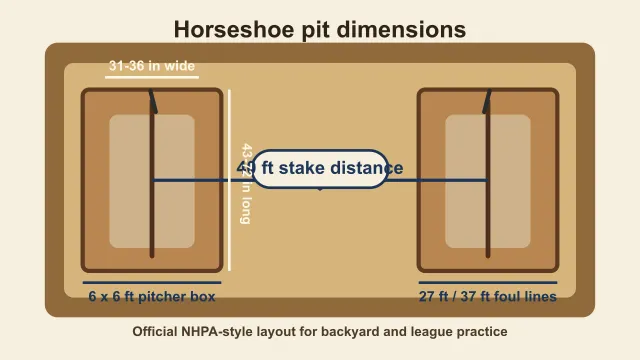
Horseshoe Pit Dimensions and Distance
Official horseshoe pit dimensions: 40-foot stake distance, 31-36 inch pit width, 43-72 inch pit length, foul lines and backyard setup.
Cornhole Rules: Scoring and How to Win
Cornhole rules explained: cancellation scoring, the official 27-foot distance, board and bag specs, and what busting means. Play a proper game.
Bocce Court Dimensions and Backyard Sizes
Bocce court dimensions explained: 91 x 13 ft U.S. competition benchmark, international ranges, backyard sizes, surfaces and space planning.
Bocce Ball Rules: How to Play and Score
Bocce ball rules explained: how to play, scoring, court size, fouls, and what happens when you hit the pallino. For backyard and league games.
Kan Jam Rules: Scoring, Dunks and Instant Wins
Kan Jam rules: 2v2 with cans 50 feet apart, score 1, 2 or 3 points per throw, and win by reaching exactly 21 or landing an Instant Win.
Kickball Rules: How to Play & Score
Kickball rules explained: kick a pitched ball and run the bases like baseball. Field setup, scoring, outs, and whether you can peg runners.