
Bocce Court Dimensions and Backyard Sizes
On this page6
A common U.S. competition bocce court is 91 feet long by 13 feet wide. That is the benchmark used by bocce.org and many American court-planning guides, but it is better to treat it as the U.S. competition standard rather than the only “official” bocce size in the world.
Bocce is forgiving for casual play. Unlike a tennis or basketball court, a backyard court can be scaled to the space as long as it stays long, narrow and level. Below are the competition benchmarks, sensible backyard sizes, the surface choices and the space checks that stop an expensive court from playing badly.
Official bocce court dimensions
For U.S.-style competition and club layouts, the familiar target is 91 by 13 feet. Other governing bodies and international references publish metric ranges, so builders should check the rulebook for their actual league before calling a court tournament legal.
| Layout reference | Court size | Notes | | --- | --- | | Common U.S. competition benchmark | 91 ft x 13 ft | Widely cited for American club and tournament-style courts | | bocce.org planning range | 60 ft x 10 ft to 95 ft x 15 ft | Practical range for court projects | | International technical references | About 26-27.5 m long, up to about 4 m wide | Varies by discipline and federation | | Backyard sweet spot | 60 ft x 10 ft to 76 ft x 12 ft | Easier to fit while keeping normal bocce shape |
The takeaway is simple: 91 by 13 feet is the safest answer for a U.S. competition-style court, but it is not a magic size for every form of bocce. If the court is for family play, the practical goal is a true roll, clear boundaries and enough length for strategy.
Backyard bocce court sizes
Most homeowners do not have 91 feet of clear, level ground to spare, and that is fine. The game scales down well. The key is to preserve the roughly 7-to-1 length-to-width ratio so the court still feels like bocce rather than a short shuffleboard lane.
- Compact: 40 by 8 feet, good for tight yards and quick games
- Standard backyard: 60 by 10 feet, a common and well-balanced size
- Near-regulation: 76 by 12 feet, close to tournament feel
- Full regulation: 91 by 13 feet, if you have the space
Whatever length you choose, keep the surface flat and level across the width. A court that tilts side to side will send every ball drifting toward the low edge.
Bocce court fit calculator
Use this quick planner to see whether your space fits a useful court before you price materials.
Surfaces and drainage
The surface is what separates a court that plays beautifully from one that feels like rolling across a lawn. Traditional courts use a compacted crushed-stone base topped with a fine layer such as oyster-shell flour or a clay-sand mixture, which produces a smooth, fast, true roll and sheds rainwater. Packed decomposed granite is a popular, cheaper alternative that still plays well.
Underneath, good drainage matters as much as the top layer. A base of several inches of compacted gravel keeps the surface from turning soft after rain and stops frost heave from warping the court over winter.
Grass is the exception that many casual players start with. A level lawn plays a slower, less predictable version of the game and requires no construction, which is fine for a family backyard. The trade-off is that balls do not roll true, and heavy use quickly wears bare patches, so serious players almost always graduate to a built surface.
The walls and side boards
A finished court is more than a flat rectangle. Regulation and most quality backyard courts are bordered by solid side walls or boards, typically made of wood, composite or concrete, that stand several inches to a couple of feet high. These do two jobs. First, they contain the balls and the surface material so nothing spills out. Second, and more importantly for gameplay, the walls are live: skilled players deliberately bank shots off the side and end boards to curl a ball around an opponent’s block and nestle it close to the pallino. If you build without walls, you lose that bank-shot dimension of the game, so most permanent courts include at least low side boards even when space is tight.
That is the biggest difference from looser lawn games. Horseshoe pit dimensions and cornhole distance depend on target spacing, while bocce also depends on the rails because they change shot selection.
How to build one, and what it costs
Construction follows the same logic as any small hardscape project: excavate, frame, drain, compact, and finish.
- Mark out the rectangle and excavate several inches down.
- Build a sturdy frame or wall along all four sides.
- Lay and compact a gravel base for drainage.
- Add and level the top playing surface.
- Compact it firmly so balls roll true.
Cost depends heavily on who does the work. A do-it-yourself backyard court is often a few hundred to a couple thousand dollars in materials. A professionally built court with engineered drainage and a premium surface can climb into the thousands or more.
The biggest cost drivers are size, site prep and the top surface. A small, flat, well-draining plot needs little excavation, while a sloped or clay-heavy yard may require significant grading and drainage work before you ever lay a base. Premium playing surfaces such as imported clay or specialty court materials add up quickly over a large area, which is why many backyard builders choose a smaller court with a decomposed-granite surface to keep the budget reasonable while still getting a true roll.
One practical tip: orient the court’s long axis roughly north-to-south if you can. That keeps the low afternoon sun out of players’ eyes as they roll toward one end, a small design choice that public and club courts pay attention to.
Once the court is ready, the game itself is quick to learn; our guide to bocce ball rules walks through scoring, fouls and how the pallino works. If you are planning a backyard games setup more broadly, see the regulation cornhole distance, shuffleboard table dimensions and pickleball court size so everything is spaced correctly. The short version: build it 91 by 13 feet for a U.S. competition-style court, scale down proportionally for the backyard, and put your effort into a flat, well-drained surface.
Frequently asked questions
What is a good size for a backyard bocce court?+
A comfortable backyard bocce court is roughly 60 to 76 feet long and 10 to 12 feet wide. That keeps the long, narrow feel without demanding a full 91-foot competition footprint. If space is tight, a 40-foot court can still work for casual games, but rolls and bank shots will feel shorter.
What is the best surface for a bocce court?+
The best traditional surface is a compacted stone base topped with a fine layer such as oyster-shell flour, stone dust or a clay-sand mix. It rolls true and drains better than lawn. Decomposed granite and synthetic turf are common backyard choices. Grass works for casual play but is slower and less predictable.
How much does it cost to build a bocce court?+
A simple do-it-yourself backyard court can run from a few hundred dollars to a couple thousand in materials, mainly base rock, edging and surface material. A professionally built court with excavation, drainage, framing, lighting or synthetic turf can cost several thousand dollars or more, depending on size and site conditions.
Does a bocce court need to be perfectly level?+
It should be level side to side so balls do not drift. A slight lengthwise grade is sometimes used for drainage, but the playing surface still needs to feel flat and consistent. A compacted, even base matters more than choosing the longest possible court.
Is 91 by 13 feet the only official bocce court size?+
No. It is the common U.S. competition benchmark and is repeated by bocce.org and many U.S. court guides, but international bocce references use metric dimensions that can differ by discipline. If you are building for a league or event, follow that organizer's current rulebook.
Can you play bocce without a built court?+
Yes. Casual bocce can be played on a flat lawn, gravel strip, beach or packed dirt area with agreed boundaries. A built court improves the roll, contains the balls and allows bank shots off the side boards, but it is not required for a family game.
How wide should a bocce court be?+
For U.S. competition-style layouts, 13 feet is the common width. Backyard courts often use 10 to 12 feet when space is limited. Avoid going too narrow if you want normal shot selection, because a tight court makes blocking and rail shots dominate the game.
Sources
Play & tools
Free browser games and tools — no account, no download.
- Play today's Sports Connections — Today's Sports Connections — daily hints, answers, and play the grid.
- Play Guess the NFL Player — A new mystery NFL player every day. Eight guesses, with a clue on each — plus free unlimited mode.
- Explore all our games →
Related guides
Bocce Ball Rules: How to Play and Score
Bocce ball rules explained: how to play, scoring, court size, fouls, and what happens when you hit the pallino. For backyard and league games.
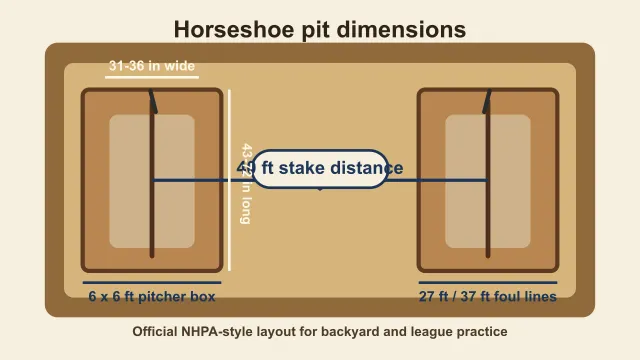
Horseshoe Pit Dimensions and Distance
Official horseshoe pit dimensions: 40-foot stake distance, 31-36 inch pit width, 43-72 inch pit length, foul lines and backyard setup.
Cornhole Distance and Board Dimensions Guide
Regulation cornhole distance is 27 feet from the front of one board to the front of the other. Full ACL board dimensions, hole placement and setup.
Dodgeball Rules: Official and Playground Play
Dodgeball rules explained: how to get players out, the opening rush, catches and boundaries, and how official USA Dodgeball differs from playground play.
Shuffleboard Rules: Table and Court
Shuffleboard rules for both versions: table shuffleboard and deck/court shuffleboard. Scoring zones, how to win, and the key differences explained.
Tetherball Rules: How to Play and Setup
Tetherball rules made simple: two players hit a roped ball opposite ways to wrap it around the pole. Court setup, serving, fouls and how to win.