
Horseshoe Pit Dimensions and Distance
On this page8
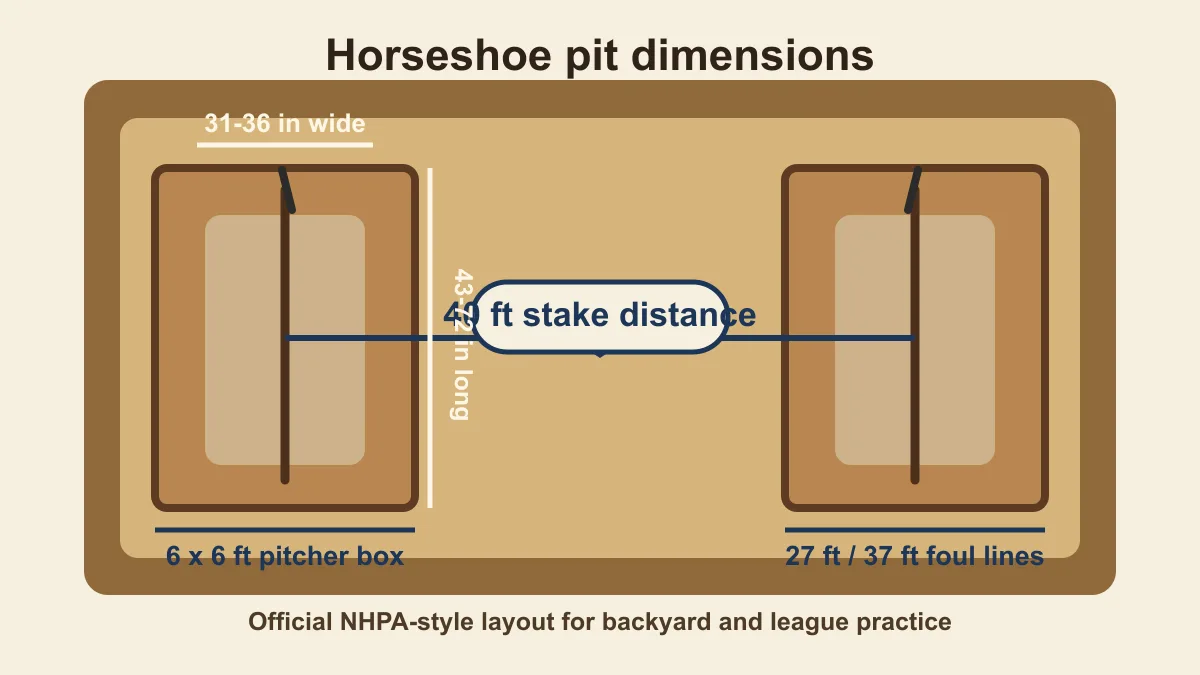
Regulation horseshoe stakes are 40 feet apart, measured from the front of one stake to the front of the other. Each stake sits in a pit that is 31 to 36 inches wide and 43 to 72 inches long, centered inside a 6-by-6-foot pitcher’s box.
That sounds simple until you start building, because the pit, the pitcher’s box, the foul lines and the safety buffer are four different measurements. Here is the full official layout, plus the backyard version that actually fits most yards.
Official horseshoe pit dimensions
The National Horseshoe Pitchers Association sets the court around two fixed targets: the stakes. The pit around each stake can vary within an official range, but the stake spacing and pitcher’s box are fixed.
| Court element | Regulation spec |
|---|---|
| Stake distance | 40 ft, front of stake to front of stake |
| Playing area | 6 ft wide x 46 ft long |
| Recommended total area with buffer | 10 ft wide x 50 ft long |
| Pitcher’s box at each end | 6 ft x 6 ft |
| Pit size | 31-36 in wide x 43-72 in long |
| Stake height | 14-15 in above platform level |
| Stake lean | About 3 in toward the opposite stake |
| Pit substance depth | 4 in minimum, 8 in recommended |
The important detail is that “pit size” does not mean the whole court. It means the filled landing rectangle around each stake. The court itself needs enough room for the two pitcher’s boxes, the 40-foot stake spacing and safe movement around both ends.
If you are planning a full backyard game area, this pairs naturally with our cornhole distance and bocce ball court dimensions guides, since all three games are won or lost by accurate setup.
Horseshoe distance calculator
Use this as a quick fit check before you buy lumber or pit fill.
Where do the foul lines go?
Horseshoe foul lines are measured from the opposite stake, not from the pit frame beside the player. Full-distance pitchers use the 37-foot foul line. Short-distance pitchers use the 27-foot foul line.
That creates the biggest beginner mix-up. The stakes remain 40 feet apart for regulation play, but not every class throws from the same line. Adult men normally pitch from 37 feet. Women, youth through 18, elders and eligible adaptive players may pitch from 27 feet under the NHPA class rules.
For a backyard court, mark both lines if you have mixed ages or abilities. It lets everyone play on one court without moving the stakes.
Stake height, lean and placement
Each stake should stand 14 to 15 inches above the pitching platform and lean about 3 inches toward the opposite stake. NHPA specifications call for a 1-inch-diameter stake made from suitable metal or approved synthetic material.
Place the stake in the center of the pit and keep at least 21 inches of pit substance between the stake and the front and back of the pit. That is why the minimum pit length is 43 inches: a shorter pit does not leave enough landing room around the target.
Anchor the stake properly. A stake driven into loose soil will wobble, lean the wrong way and throw off scoring. For a permanent yard court, set the stake into a buried timber or concrete base, then fill the landing area with clay, sand or a similar material.
Backyard pit sizes that still make sense
For casual play, the best backyard pit is usually 36 inches wide by 48 inches long. It is easy to frame with common lumber, large enough to catch most legal scoring shoes and still sits inside the official width and length range.
| Backyard setup | Stake spacing | Pit size | Best use |
|---|---|---|---|
| Regulation practice | 40 ft | 36 x 48 in or 36 x 72 in | League practice, adult competition habits |
| Mixed family play | 30-35 ft | 36 x 48 in | Adults and teens sharing one yard court |
| Compact casual | 25-30 ft | 31 x 43 in or 36 x 48 in | Tight spaces where regulation length will not fit |
| Temporary picnic setup | 20-25 ft | Marked landing zone | One-day play, kids, soft shoes only |
Shortening the court changes the game. Throws need less arc, ringers become easier and defensive shoes land differently. That is fine for a cookout, but it is not the same practice as a regulation court.
If you want another lower-space target game for the same crowd, shuffleboard rules explain the closest-weight scoring family, while bocce ball rules cover the rolling version.
Pit fill, backboards and safety
Moist blue clay is the classic fill because it catches the shoe and limits bounce. Sand is easier to buy and maintain, but it plays looser and needs regular raking. Dirt works in a pinch if it is soft enough to hold shoes and drain after rain.
Build the pit level, and plan drainage before you add the fill. A wet, sunken pit becomes a maintenance problem fast. For a permanent setup, use a compacted base, keep the fill several inches deep and rake it back around the stake after play.
Backboards are not decoration. Put one at least 3 feet behind each stake if space allows, and keep people, glass, vehicles and seating away from the throwing lane. Horseshoes are heavy, and a missed throw can travel well past the pit.
How scoring affects pit layout
A shoe scores only if it is a ringer or if it lands within 6 inches of the stake. That scoring circle is the reason pit width matters. NHPA guidance explains that a shoe can extend beyond the 6-inch scoring radius, so an inside pit width below 31 inches is too narrow for proper scoring and safety.
Ringers are worth 3 points. A closer non-ringer within 6 inches is worth 1 point, and most competitive games use cancellation scoring, where equal ringers or equal close shoes cancel before points are awarded. A good pit makes those close measurements easier because shoes stay where they land instead of bouncing into the frame.
For the same cancellation logic in a bag-toss game, see cornhole rules. The scoring is different, but the idea of canceling the opponent’s points is familiar.
Build checklist
Start with the space, then mark the court from the stakes outward.
- Mark two stake points 40 feet apart for regulation play.
- Center a 6-by-6-foot pitcher’s box around each stake.
- Frame each pit between 31-36 inches wide and 43-72 inches long.
- Set each stake 14-15 inches high with a 3-inch forward lean.
- Add at least 4 inches of clay, sand, dirt or approved synthetic pit substance.
- Mark the 37-foot and 27-foot foul lines from the opposite stake.
- Add backboards and keep a clear buffer around the throwing lane.
The short version: keep the stakes 40 feet apart, build each pit within the 31-by-43-inch to 36-by-72-inch range, use 14- to 15-inch leaning stakes, and mark both foul lines if different players share the court.
Frequently asked questions
What are regulation horseshoe pit dimensions?+
Under NHPA specifications, each pit is 31 to 36 inches wide and 43 to 72 inches long. The pit sits inside a 6-by-6-foot pitcher's box, with pitching platforms on both sides. Many backyard builds use a 36-by-48-inch pit because it is easier to frame while staying inside the legal range.
How far apart are horseshoe stakes?+
The stakes are 40 feet apart, measured from the front of one stake to the front of the other at platform level. That stake-to-stake measurement is the number people usually mean by regulation horseshoe distance. The full court is longer because the pitcher's boxes and safety buffer extend behind the stakes.
How tall should horseshoe stakes be?+
Ground-level NHPA stakes should rise 14 to 15 inches above the pitching platforms and lean about 3 inches toward the opposite stake. The stake should be 1 inch in diameter and mounted firmly enough that repeated hits do not loosen it.
Where is the foul line in horseshoes?+
NHPA courts mark foul lines at 37 feet and 27 feet from the opposite stake. Adult men normally pitch from behind the 37-foot line. Women, youth through 18, elders and eligible adaptive players may use the 27-foot line, depending on the class and event.
What is the best fill for a horseshoe pit?+
Moist blue clay is the best traditional pit substance because it holds shoes where they land and reduces bounce. Sand, loose dirt and approved synthetic materials are also legal or common, especially in casual yards. NHPA specifies at least 4 inches of pit substance, with 8 inches recommended for ground-level pits.
Can I make a smaller horseshoe court for a backyard?+
Yes for casual play, as long as everyone agrees before the game. A 30- to 35-foot stake distance works for tight yards or mixed-age groups, but it is not regulation. If you plan to practice for league play, build or mark the 40-foot stake spacing and use the correct foul line.
Do horseshoe pits need backboards?+
A backboard is strongly recommended. NHPA guidance says each pit should have a backstop at least 3 feet behind the stake and at least 1 foot high, with wider protective barriers for court complexes. In a backyard, the same idea keeps loose shoes, sand and clay contained.
Sources
Play & tools
Free browser games and tools — no account, no download.
- Play today's Sports Connections — Today's Sports Connections — daily hints, answers, and play the grid.
- Play Guess the NFL Player — A new mystery NFL player every day. Eight guesses, with a clue on each — plus free unlimited mode.
- Explore all our games →
Related guides
Bocce Court Dimensions and Backyard Sizes
Bocce court dimensions explained: 91 x 13 ft U.S. competition benchmark, international ranges, backyard sizes, surfaces and space planning.
Cornhole Distance and Board Dimensions Guide
Regulation cornhole distance is 27 feet from the front of one board to the front of the other. Full ACL board dimensions, hole placement and setup.
Bocce Ball Rules: How to Play and Score
Bocce ball rules explained: how to play, scoring, court size, fouls, and what happens when you hit the pallino. For backyard and league games.
Dodgeball Rules: Official and Playground Play
Dodgeball rules explained: how to get players out, the opening rush, catches and boundaries, and how official USA Dodgeball differs from playground play.
Tetherball Rules: How to Play and Setup
Tetherball rules made simple: two players hit a roped ball opposite ways to wrap it around the pole. Court setup, serving, fouls and how to win.
Cornhole Rules: Scoring and How to Win
Cornhole rules explained: cancellation scoring, the official 27-foot distance, board and bag specs, and what busting means. Play a proper game.