
Bocce Ball Rules: How to Play and Score
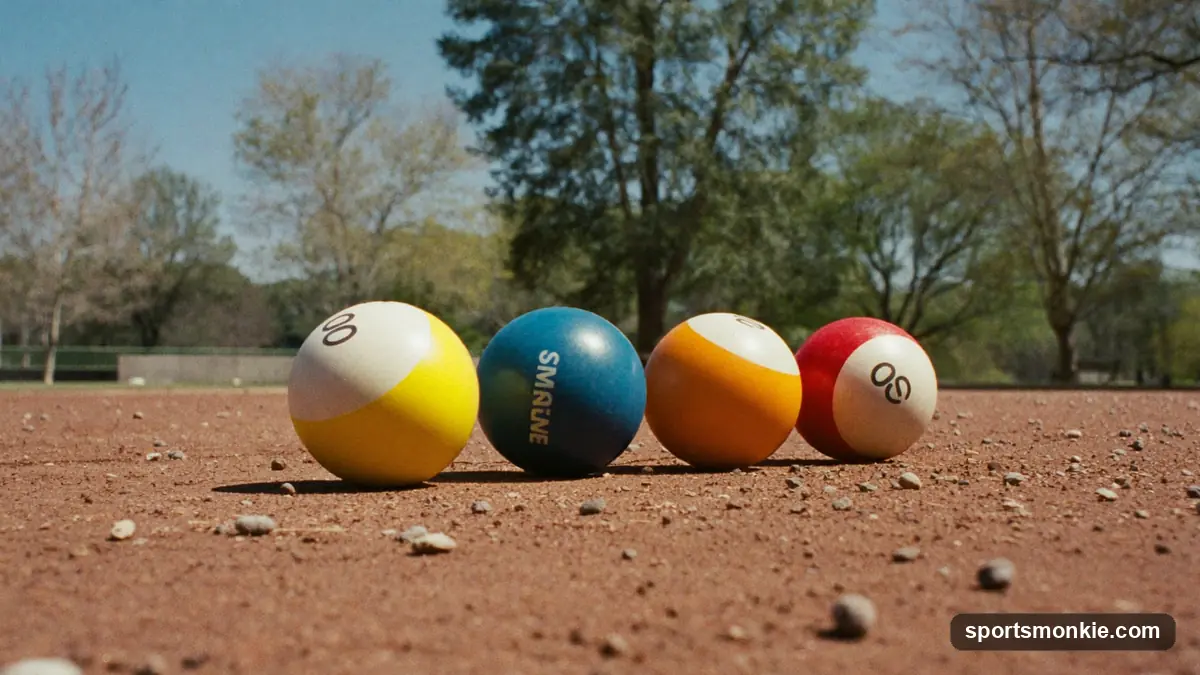
On this page6
Bocce is a target game: two teams take turns rolling weighted balls toward a small target ball called the pallino, and whoever finishes closest scores. Only one team scores per frame, earning one point for each of its balls that sits closer to the pallino than the opponent’s nearest ball. Most games are played to 12 points.
That is the whole game in two sentences, but the fun is in the tactics: hitting the pallino, knocking rivals out, and deciding when to roll close versus when to attack. Here is how to play a full game, keep score correctly, and handle the situations that confuse newcomers.
What you need
Bocce uses one set of balls and a target, on a court or any flat open space.
- 8 bocce balls, split into two sets of four by colour (commonly four red, four green).
- 1 pallino, the small target ball, usually white or yellow.
- A court, roughly 12 to 13 feet wide and 60 feet or longer for league play, with foul lines marked at each end. Backyard games can use any flat surface with agreed boundaries.
How to play, step by step
A game is a series of frames. Each frame follows the same sequence.
- Toss the pallino. One team rolls the pallino out to start the frame. Under the official rules, it must pass the centre line of the court and not hit the back wall.
- First team rolls. The team that threw the pallino rolls one bocce ball, trying to stop it as close to the pallino as possible.
- Trailing team rolls. From then on, whichever team is not closest to the pallino keeps rolling until they either get closest or run out of balls. This “nearest ball” rule drives the whole frame.
- Finish the frame. Once all eight balls are thrown, you measure and score.
That third step is what beginners miss. You do not simply alternate turns; the team that is losing the frame keeps throwing until they take the lead or empty their hand.
How scoring works
Only the team with the closest ball scores, and this table shows how it adds up.
| Situation at end of frame | Points |
|---|---|
| Your closest ball beats the opponent’s closest | 1 point |
| Two of your balls are closer than any of theirs | 2 points |
| All four of your balls are closer than theirs | 4 points (maximum) |
| Both teams’ closest balls are tied to the pallino | 0 points, replay |
Add each frame’s points to the running total. The first team to reach 12 wins, and many leagues require winning by two. Because only one team scores per frame, and only for the balls that beat the opponent’s best, a single strong frame can be worth several points.
Hitting the pallino and other balls
Both are legal and central to good bocce. You can roll gently to nestle beside the pallino, or throw with pace to knock things around.
- Hitting the pallino moves the target. Whoever is closest to its new spot is now winning, so players strike it to pull it toward their own balls. If it is knocked out of bounds, most rules declare a dead frame and replay.
- Spocking (a raffa) is hammering an opponent’s ball out of the way. It is the aggressive play in bocce, capable of turning a losing frame around, and just as capable of wasting a ball if you miss.
Deciding between a soft placement shot and an attacking spock is the strategic core of the game. As a rule of thumb, play close when you are behind by a little and attack when one opponent ball is doing all the damage.
Common fouls to avoid
Most bocce fouls come down to footwork and patience.
- Foot fouls: stepping on or over the foul line before you release the ball. This is the most frequent violation and usually voids the throw.
- Moving balls early: touching or shifting a ball before both teams agree on a measurement.
- Throwing out of turn: rolling when it is the other team’s turn under the nearest-ball rule.
Penalties differ by league, but the fair, common remedy is to remove the offending ball or let the other side reposition disturbed balls.
The same family of games
Bocce belongs to the “get closest, then knock the others out” family, which is why it feels familiar if you already play similar games. If you enjoy the placement-and-blocking element, our guides to shuffleboard rules and cornhole distance apply the same setup-first instinct to a table, a court and a bag-toss set.
The short version: roll closest to the pallino, only the leading team scores (one point per ball beating the opponent’s best), hitting the pallino and spocking are both legal, and the first team to 12 wins.
Frequently asked questions
What happens if you hit the pallino in bocce?+
Hitting the pallino is legal and often smart. If your ball knocks the pallino, it simply moves, and whoever is closest to its new position is now winning the frame. Skilled players deliberately strike the pallino to drag it toward their own balls or away from an opponent's. If the pallino is knocked out of bounds, most rules call a dead frame and replay it.
What is spocking in bocce ball?+
Spocking, sometimes spelled spocking or called a raffa, is hitting a ball hard to knock it out of position. You use it to blast an opponent's well-placed ball away from the pallino, or to scatter a cluster. It is a high-risk, high-reward shot: a good spock swings a frame, a missed one can hand your opponent points.
What are common bocce ball fouls?+
The most common foul is stepping on or over the foul line before releasing the ball, which usually voids the throw. Others include moving a ball before a measurement is agreed, throwing out of turn, and interfering with a rolling ball. Penalties vary by league, from removing the offending ball to letting the other team reposition balls.
How big is a regulation bocce court?+
Regulation courts vary, but a common size is about 13 feet wide and 91 feet long for competitive play, with foul lines marked at each end. Backyard and casual bocce is far more forgiving, and can be played on any reasonably flat grass, gravel or dirt surface with agreed boundaries.
Sources
Play & tools
Free browser games and tools — no account, no download.
- Play today's Sports Connections — Today's Sports Connections — daily hints, answers, and play the grid.
- Play Guess the NFL Player — A new mystery NFL player every day. Eight guesses, with a clue on each — plus free unlimited mode.
- Explore all our games →
Related guides
Bocce Court Dimensions and Backyard Sizes
Bocce court dimensions explained: 91 x 13 ft U.S. competition benchmark, international ranges, backyard sizes, surfaces and space planning.
Cornhole Distance and Board Dimensions Guide
Regulation cornhole distance is 27 feet from the front of one board to the front of the other. Full ACL board dimensions, hole placement and setup.
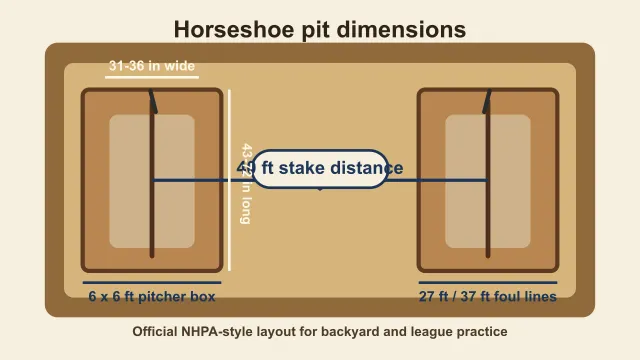
Horseshoe Pit Dimensions and Distance
Official horseshoe pit dimensions: 40-foot stake distance, 31-36 inch pit width, 43-72 inch pit length, foul lines and backyard setup.
Kickball Rules: How to Play & Score
Kickball rules explained: kick a pitched ball and run the bases like baseball. Field setup, scoring, outs, and whether you can peg runners.
Cornhole Rules: Scoring and How to Win
Cornhole rules explained: cancellation scoring, the official 27-foot distance, board and bag specs, and what busting means. Play a proper game.
Dodgeball Rules: Official and Playground Play
Dodgeball rules explained: how to get players out, the opening rush, catches and boundaries, and how official USA Dodgeball differs from playground play.