
Beach Volleyball Rules: Two Players, Sets to 21
On this page5
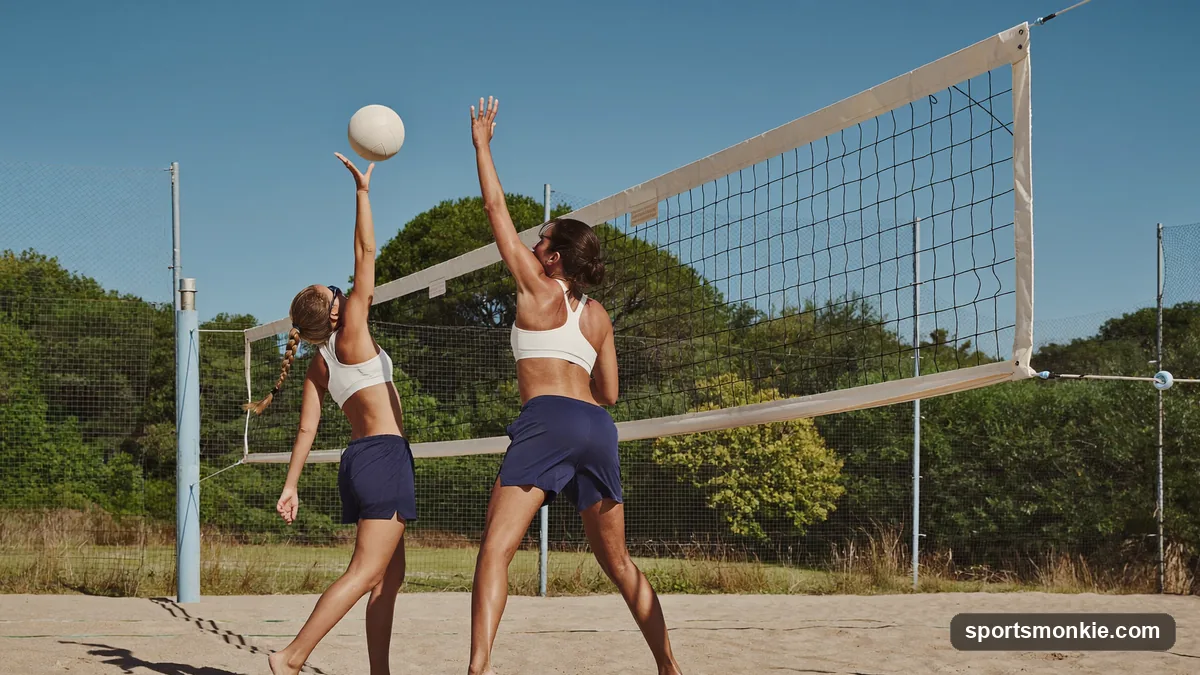
Beach volleyball is played two-a-side on a 16 by 8 metre sand court, with no rotation and no substitutes, and sets are played to 21 (the decider to 15), win by two. It shares volleyball’s three-touch DNA but strips almost everything else back: two players do every job, the court is smaller, and the hand-set rules are noticeably tougher. Here’s the full ruleset and how it differs from the indoor game.
The two-player format is what drives every other difference. With no bench and no rotation, both players have to serve, pass, set, attack and defend, so the rules are shaped around a smaller, more exposed game.
Beach vs indoor at a glance
| Element | Beach | Indoor |
|---|---|---|
| Players a side | 2 | 6 |
| Court size | 16 x 8 m | 18 x 9 m |
| Rotation | None | Clockwise on each side-out |
| Substitutions | None | Allowed |
| Set target | 21 (decider 15) | 25 (fifth set 15) |
| Match format | Best-of-three | Best-of-five |
| Open-hand tip | Illegal | Legal |
| Antennas | None | Yes |
For a fuller side-by-side on the feel and strategy of each game, our beach volleyball vs indoor volleyball comparison goes beyond the rules into how the two sports actually play.
The court and the serve
The court is 16 metres long and 8 metres wide — one metre shorter and one metre narrower on each axis than indoor — and crucially there’s no attack line, so either player can attack from anywhere. Net heights match the indoor game: 2.43 m for men, 2.24 m for women.
A rally starts with a serve from behind the end line, and as indoors, rally scoring means every rally is worth a point. With only two defenders and no antennas marking the net’s edges, a ball must cross the net entirely within the sidelines to stay in play.
Scoring: sets to 21, decider to 15
Beach volleyball matches are best-of-three.
- The first two sets are played to 21 points, win by two.
- The deciding third set (if needed) is played to 15 points, win by two.
- First team to two sets wins the match.
The win-by-two rule works exactly as it does indoors, so a set can run to 23-21 or beyond. If the general scoring framework is new to you, our how volleyball scoring works guide explains rally scoring and win-by-two in full — the only change on the beach is the target numbers.
Teams also switch ends at fixed intervals — every 7 total points in the sets to 21, and every 5 in the decider — so neither side is stuck facing the sun or wind for a whole set.
The three touches, with stricter hands
A team still gets a maximum of three contacts per side, and a block still doesn’t count as one of them. But the standard for clean contact is tighter than indoors:
- Hand-setting is judged strictly for double-contact and lift, so many players bump-set with the forearms, especially in wind.
- Setting the ball over the net with the hands is only legal if your shoulders are square to the direction of the set.
- The open-hand tip (dink) is illegal. Players attack with a hard hit, a knuckle “pokey”, or a stiff-fingertip “cobra” instead.
That last rule catches people out who cross over from indoor volleyball, where a soft open-hand tip is a routine and legal way to score a kill. On the sand, that same shot is a fault.
No rotation, no libero, no bench
Two players and no substitutes means there’s no rotation and no libero — both of which are core to the indoor game. Each player defends a half of the court and switches roles rally to rally rather than by any fixed order. That’s why beach volleyball is such a complete test: you can’t hide a weakness behind a specialist teammate.
If you’re deciding which version to play, the smaller court and two-player demands make beach the more all-round game, while indoor rewards specialists. Our beach volleyball vs indoor volleyball piece is the natural next read for choosing between them.
The short version: two players, a 16 by 8 m court, no rotation or subs, sets to 21 with a decider to 15 (win by two), no open-hand tips, and end switches to keep the elements fair. Same three-touch heart as indoor volleyball, stripped to its most demanding form.
Frequently asked questions
How big is a beach volleyball court?+
A beach volleyball court is 16 metres long by 8 metres wide, which is smaller than the 18 by 9 metre indoor court. There is no attack line, so both players can attack from anywhere. The net height is the same as indoor for each gender: 2.43 metres for men and 2.24 metres for women. The smaller court is manageable because only two players cover it.
Why is beach volleyball scored to 21 and indoor to 25?+
The two formats simply evolved with different targets. Beach uses sets to 21 with a deciding set to 15, while indoor uses sets to 25 with a fifth set to 15. Both require a two-point margin. The shorter beach sets suit a two-player game where every rally is more physically demanding, and best-of-three keeps matches to a broadcast-friendly length.
Can you set the ball with your hands in beach volleyball?+
You can, but the standard is stricter than indoors. Hand-sets are judged tightly for double-contact and lift, so many beach players bump-set with the forearms to avoid a fault, especially in wind. When setting a teammate, the ball should travel on a clean, non-spinning path. Setting the ball over the net with your hands is also only legal if your shoulders are square to the direction of the set.
Is an open-hand tip allowed in beach volleyball?+
No. Attacking the ball with open-hand fingertips, a 'dink' or 'tip', is illegal in beach volleyball. Players must attack with a hard-driven hit, a 'pokey' using the knuckles, or a 'cobra' with stiff fingertips instead. This is a key difference from indoor, where a soft open-hand tip is a common and legal attacking option.
Do beach volleyball players switch sides during a game?+
Yes. Players switch ends of the court at fixed point intervals to keep conditions fair, since sun, wind and court surface can favour one side. In the sets to 21, teams switch every 7 total points; in the deciding set to 15, they switch every 5 total points. It's a rule you won't see indoors, where the enclosed hall makes conditions equal.
Is there a libero in beach volleyball?+
No. The libero is an indoor position. With only two players a side and no rotation or substitutions in beach volleyball, there is no room for a specialist defender; both players must pass, set, attack and dig. The absence of a libero, rotation and substitutes is one of the biggest structural differences between the beach and indoor games.
Sources
Play & tools
Free browser games and tools — no account, no download.
- Play today's Sports Connections — Today's Sports Connections — daily hints, answers, and play the grid.
- Play Guess the NFL Player — A new mystery NFL player every day. Eight guesses, with a clue on each — plus free unlimited mode.
- Explore all our games →
Related guides
Beach vs Indoor Volleyball: Differences
Beach volleyball is 2v2 on sand with a smaller court and a softer, larger ball; indoor is 6v6 on a hard court. Key differences in rules, court and ball.

The 10-Point Must System Explained
The 10-point must system scores each round 10 to the winner, 9 or fewer to the loser. How it works in boxing and MMA, with 10-8 and 10-7 rounds.
How Does MMA Scoring Work? Judging Explained
MMA judges score each round 10-9 on effective striking, grappling and control. Judging criteria, decision types and how a UFC fight is scored.

Good-Looking Female Volleyball Players: The Most Striking Names
The most beautiful female volleyball players across indoor and beach volleyball, blending athletic excellence with striking looks and public appeal.

What Is a Safety in Football? The 2-Point Score
A safety in football is worth 2 points, awarded to the defense when the ball carrier is downed in his own end zone. The conceding team then free-kicks from its 20.
What Is the Red Zone in Football?
The red zone in football is the area from the defense's 20-yard line to the goal line. Scoring efficiency there — touchdowns vs. field goals — often decides games.