
The 10-Point Must System Explained

On this page4
The 10-point must system is the scoring method used in both boxing and MMA: each judge “must” award 10 points to the fighter who wins a round, and 9 or fewer to the loser. A normal round is 10-9, a knockdown or dominant round is 10-8, a one-sided round can be 10-7, and a genuinely even round is 10-10. At the fight’s end, each judge’s rounds are totalled and the scorecards compared.
The name confuses people, but it comes from a single compulsory rule: the round winner must get 10 points. Everything else — how far below 10 the loser falls — reflects how one-sided the round was. Here is how the system works, what pushes a round past 10-9, and how boxing and MMA apply the same framework differently.
How the scores break down
Three ringside judges score every round independently. The winner takes 10; the loser’s number tells you how close it was.
| Score | What it means |
|---|---|
| 10-9 | A normal round won by one fighter |
| 10-8 | A dominant round, or one with a knockdown |
| 10-7 | A completely one-sided round (rare) |
| 10-10 | An even round (used sparingly) |
The 10 is fixed for the winner. The variable is the loser’s score, which drops from 9 as the round becomes more lopsided. Most rounds are 10-9; the wider margins are reserved for real dominance or knockdowns.
Boxing and MMA use the same numbers, different criteria
The point structure is identical in boxing and MMA — both score 10-9, 10-8, 10-7 and, rarely, 10-10. What differs is how the judge decides who won the round.
In boxing, judges weigh clean punching, effective aggression, ring generalship and defence, as our guide to how boxing scoring works explains. In MMA, judges assess effective striking and grappling, control and dominance, covered in how MMA scoring works. So a boxing 10-9 and an MMA 10-9 use the same points but rest on different judgments about what won the round.
MMA also treats the 10-8 round a little more expansively. Judges are instructed to consider a 10-8 whenever a fighter wins a round with clear impact, dominance and duration — not only after a knockdown or knockout-threatening sequence, as tends to be the trigger in boxing.
When a round isn’t 10-9
Most rounds are 10-9, but two things change the maths. The first is dominance or a knockdown, which produces a 10-8, and occasionally a 10-7 for a round with multiple knockdowns or total control. The second is a point deduction: when a referee penalises a foul — a low blow, holding, or an illegal strike — that point comes off the offender’s round score. A fighter who wins a round 10-9 but loses a point for a foul ends the round 9-9, and those deductions can flip a close decision.
The 10-10 round exists but is used sparingly. Judges are generally encouraged to find a winner rather than call a round even, so 10-10 mostly appears in genuinely deadlocked rounds — and a single one can turn a narrow win into a draw.
Reading the final scorecard
At the end, each judge totals their rounds. In a 12-round boxing fight with no knockdowns, every 10-9 round shifts the margin by one, so a card of 116-112 means eight rounds to four. In a three-round MMA fight, two rounds to one on all three cards is a unanimous decision. Whether the winner comes from three matching cards or a split depends on how the judges’ totals line up — the same comparison our boxing scoring explainer walks through.
For a concrete sense of how these scores decide real fights across combat sports, our list of the greatest boxers is full of champions whose careers turned on close, round-by-round decisions.
The short version: the 10-point must system gives the round winner 10 and the loser 9 or fewer — 10-8 for a knockdown or dominance, 10-7 for a rout, 10-10 for an even round — and boxing and MMA share the numbers while judging what wins a round by different criteria.
See also how this compares in All About Water Polo Mouthguards.
Want more on the theme? Read Athletes Who Lost Their Lives in Military Service next.
For the wider context, we break down Biggest Video Game Companies in the World separately.
Frequently asked questions
What does the 10-point must system mean?+
It means the judge 'must' give 10 points to the fighter who wins each round, with the loser getting 9 or fewer. The word 'must' is the rule: 10 is compulsory for the round winner. The opponent's score then reflects how one-sided the round was — 9 for a normal round, fewer if they were knocked down or dominated. It is the standard scoring system in boxing and MMA.
What is a 10-8 round?+
A 10-8 round is one a fighter wins decisively. In boxing it usually means a knockdown, or overwhelming dominance without one. In MMA, judges are instructed to consider a 10-8 when a fighter wins the round with clear impact, dominance and duration — not only after a knockdown. It is still the winner's round, but the loser drops an extra point compared with a normal 10-9.
Is the 10-point must system used in MMA?+
Yes. MMA adopted the 10-point must system from boxing, and it is written into the Unified Rules of MMA. Judges score each round 10-9, 10-8 or occasionally 10-7, based on effective striking and grappling, control and dominance. The main difference from boxing is the criteria used to decide who won the round, not the point structure itself.
Can a round be scored 10-10?+
Yes, but it is rare. A 10-10 round means the judge saw no meaningful difference between the fighters over the round. Judges are generally encouraged to find a winner rather than score even rounds, so 10-10 is used sparingly. It becomes more significant in close fights, where a single 10-10 round can change a decision from a win to a draw.
How do point deductions affect the score?+
A referee can deduct a point for a foul such as a low blow, holding or an illegal strike, and that deduction comes off the offending fighter's round score. So a fighter who wins a round 10-9 but loses a point for a foul ends up with a 9-9 round, and a normal round with a deduction can become 10-8. Deductions can swing close fights and even flip a decision.
Who invented the 10-point must system?+
The 10-point must system developed in professional boxing over the 20th century as a standard way to score rounds and replaced older round- and point-counting methods. It was later adopted by MMA when the Unified Rules were drafted. No single inventor is credited; it evolved as sanctioning bodies and commissions converged on a consistent, round-by-round scoring framework.
Sources
Play & tools
Free browser games and tools — no account, no download.
- Play today's Sports Connections — Today's Sports Connections — daily hints, answers, and play the grid.
- Play Guess the NFL Player — A new mystery NFL player every day. Eight guesses, with a clue on each — plus free unlimited mode.
- Explore all our games →
Related guides
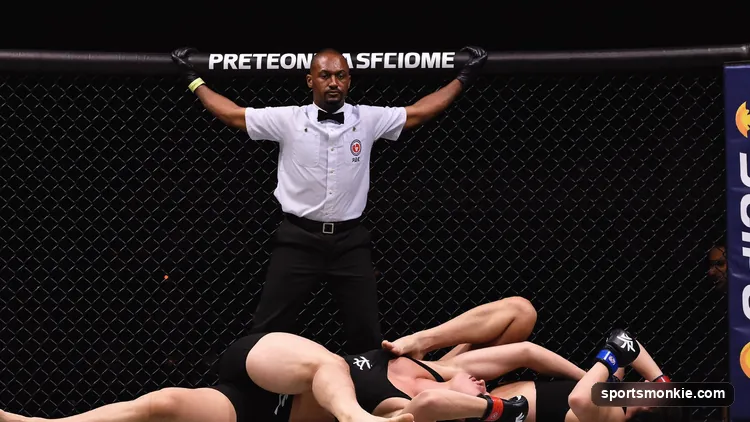
How Does MMA Scoring Work? Judging Explained
MMA judges score each round 10-9 on effective striking, grappling and control. Judging criteria, decision types and how a UFC fight is scored.

TKO vs KO: What's the Difference?
A KO is a knockout by count; a TKO is a technical knockout stopped by the referee, doctor or corner. The difference explained, plus technical decisions.
Weight Cutting in Combat Sports Explained
Weight cutting is shedding water weight to make a lower class, then rehydrating. How fighters cut weight, the risks, and rehydration explained.

Boxing Weight Classes in Order: All 17 Divisions
Professional boxing has 17 weight classes, from minimumweight (105 lb) to heavyweight. Every division in order with limits in pounds and kilograms.

How Long Are Boxing Rounds? Length & Rest Times
Men's boxing rounds are three minutes with a one-minute rest; women's rounds are usually two minutes. Round length, rest and total fight time explained.

How Many Rounds Are in a UFC Fight?
Most UFC fights are three rounds of five minutes; title fights and main events are five rounds. UFC round counts, round length and rest explained.