
Cornhole Rules: Scoring and How to Win
On this page5
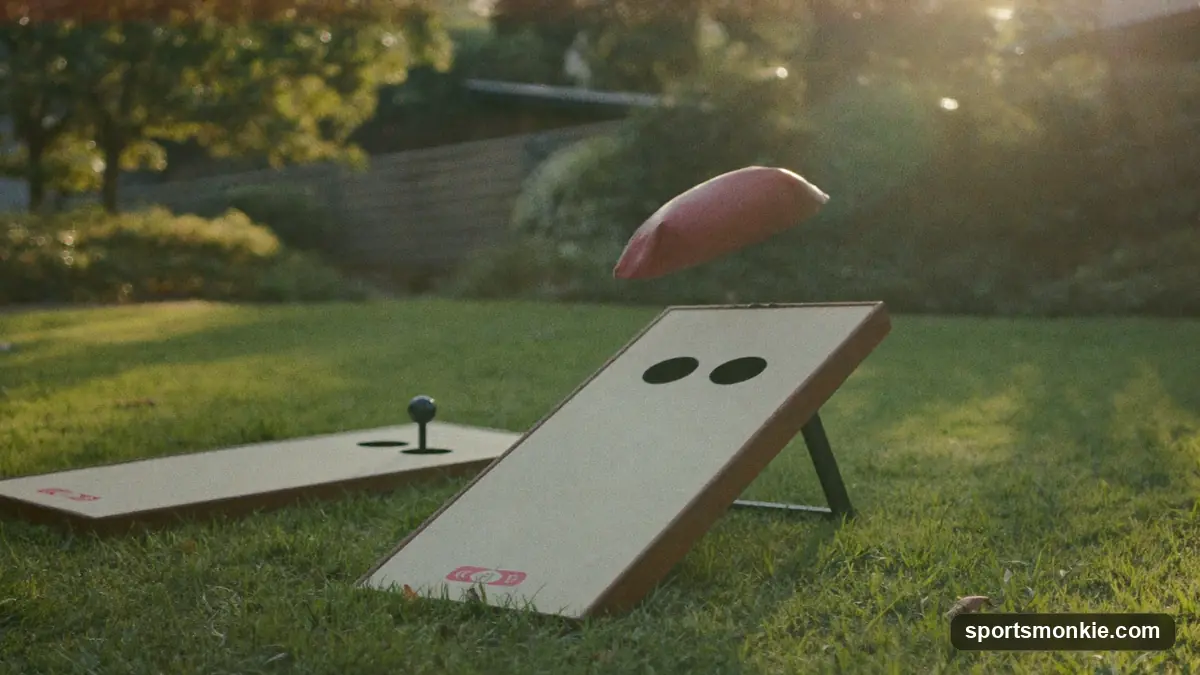
In cornhole, a bag that lands in the hole is worth 3 points and a bag that stays on the board is worth 1. But you do not simply add up your points, because cornhole uses cancellation scoring: the two players’ or teams’ totals for the round cancel out, and only the difference is scored by the higher side. That one rule is what most casual players get wrong.
The rest is straightforward once the scoring clicks. Here are the official specs, exactly how a round is scored, how to win, and what “busting” actually means.
The setup and specs
Regulation cornhole, as defined by the American Cornhole League, uses standard equipment and one key distance.
| Element | Regulation spec |
|---|---|
| Board size | 48 in long, 24 in wide |
| Hole | 6 in diameter, 9 in from top edge |
| Distance between boards | 27 ft, front edge to front edge |
| Bag size | 6 x 6 in |
| Bag weight | 15.5 to 16.5 oz |
| Target score | 21 |
For a full breakdown of the throwing distance and how to adjust it for kids or tight yards, see our dedicated guide to cornhole distance. Casual games routinely shorten the 27-foot gap, and that is fine as long as both boards match.
How a round is played
Each player (in singles) or team throws four bags per round, called a frame or inning. In singles, one player throws all four from beside one board, then the opponent throws their four. In doubles, teammates stand at opposite boards and alternate throws with their opposing player.
You must release the bag before your front foot crosses the foul line, which is the front edge of the board. A bag that touches the ground first and then slides onto the board does not count and is removed.
Cancellation scoring, step by step
This is the heart of the game. After all eight bags are thrown, you total each side’s points, then cancel.
- Score each bag: 3 for in the hole, 1 for on the board, 0 for on the ground or knocked off.
- Add each side’s total for the round.
- Subtract the smaller total from the larger. Only the side with more points scores, and only the leftover difference.
So if you score 7 in a frame (two bags in the hole for 6, plus one on the board for 1) and your opponent scores 5, you get 2 points that round and they get none. If both sides tie at 6, nobody scores. Because of cancellation, big-looking rounds often produce only a point or two.
How to win
The first side to reach 21 points wins. Under official ACL rules you just need to hit 21 or more at the end of a round, so there is no penalty for going over.
That is where house rules diverge. Two popular add-ons:
- Win by two: some groups require a two-point margin, extending the game past 21 until someone leads by two.
- Busting: in this variant you must land exactly on the target. Overshoot 21 and you “bust,” dropping back to a set number like 15 or 11. The official game has no bust, so agree on this before you start.
Our advice: play straight-to-21 ACL rules for a clean, quick game, and only add the bust rule if everyone actively wants the extra tension. It tends to drag out casual matches.
Strategy in one paragraph
Because scoring is cancellation, defense matters as much as offense. A bag parked on the board just in front of the hole blocks your opponent and can be nudged in later for 3. Knocking their scoring bags off the board erases their points for the round. Good players think about the whole frame, not just sinking every throw.
Cornhole shares its “only the leading side scores” logic with several backyard games. If you enjoy that, our guides to bocce ball rules and shuffleboard rules cover the same idea on grass and on a board.
The short version: 3 for the hole, 1 for the board, cancel the two totals so only the difference counts, boards 27 feet apart, and first to 21 wins with busting strictly optional.
Frequently asked questions
What is the official distance for cornhole bags?+
Under American Cornhole League rules, the two boards are placed 27 feet apart, measured from the front edge of one board to the front edge of the other. The foul line is the front of the board you throw toward, and you must release the bag before stepping past it. For a shorter, family-friendly setup, many people move the boards closer.
What happens when you bust in cornhole?+
Busting only exists in house rules, not the official game. In those versions, if going over the target score (usually 21) is not allowed, a player who exceeds it is knocked back down to a set number, often 15 or 11. Official ACL rules have no bust: you simply need to reach 21 or more at the end of a round to win.
What are the basic bag and board specs?+
A regulation board is 48 inches long and 24 inches wide, with a 6-inch hole centred 9 inches from the top edge. Bags are 6 by 6 inches and weigh between 15.5 and 16.5 ounces. Competition bags now use resin fill rather than corn, though the game is still nicknamed corn toss or bean bag toss.
Can you knock your opponent's bags off the board?+
Yes, and it is a core tactic. Bags that are pushed into the hole by a later throw still count as 3 points, and bags knocked off the board score nothing. Blocking the hole with a bag on the board, then knocking opponents' bags off, is a legitimate and common way to win a close frame.
Sources
Play & tools
Free browser games and tools — no account, no download.
- Play today's Sports Connections — Today's Sports Connections — daily hints, answers, and play the grid.
- Play Guess the NFL Player — A new mystery NFL player every day. Eight guesses, with a clue on each — plus free unlimited mode.
- Explore all our games →
Related guides
Cornhole Distance and Board Dimensions Guide
Regulation cornhole distance is 27 feet from the front of one board to the front of the other. Full ACL board dimensions, hole placement and setup.

Kan Jam Rules: Scoring, Dunks and Instant Wins
Kan Jam rules: 2v2 with cans 50 feet apart, score 1, 2 or 3 points per throw, and win by reaching exactly 21 or landing an Instant Win.

Bocce Ball Rules: How to Play and Score
Bocce ball rules explained: how to play, scoring, court size, fouls, and what happens when you hit the pallino. For backyard and league games.

Kickball Rules: How to Play & Score
Kickball rules explained: kick a pitched ball and run the bases like baseball. Field setup, scoring, outs, and whether you can peg runners.
Shuffleboard Rules: Table and Court
Shuffleboard rules for both versions: table shuffleboard and deck/court shuffleboard. Scoring zones, how to win, and the key differences explained.

Spikeball (Roundnet) Rules Explained
Spikeball rules made simple: 2v2 teams, rally scoring to 21, three touches to return, and why rim shots are outs. How to serve, score and win.