
Spikeball (Roundnet) Rules Explained
On this page7
Spikeball, whose official sport name is roundnet, is played 2v2 around a small circular trampoline-style net set on the ground. Teams score on every rally, play to 21 points, must win by 2, and get up to three touches to knock the ball back down onto the net before it hits the ground.
That is the whole game in one breath, but the details are where new players trip up. Below is the full rundown of serving, the three-touch rule, what makes a serve illegal, why rim shots are outs, and how to run a game when you only have three people.
How a point is played
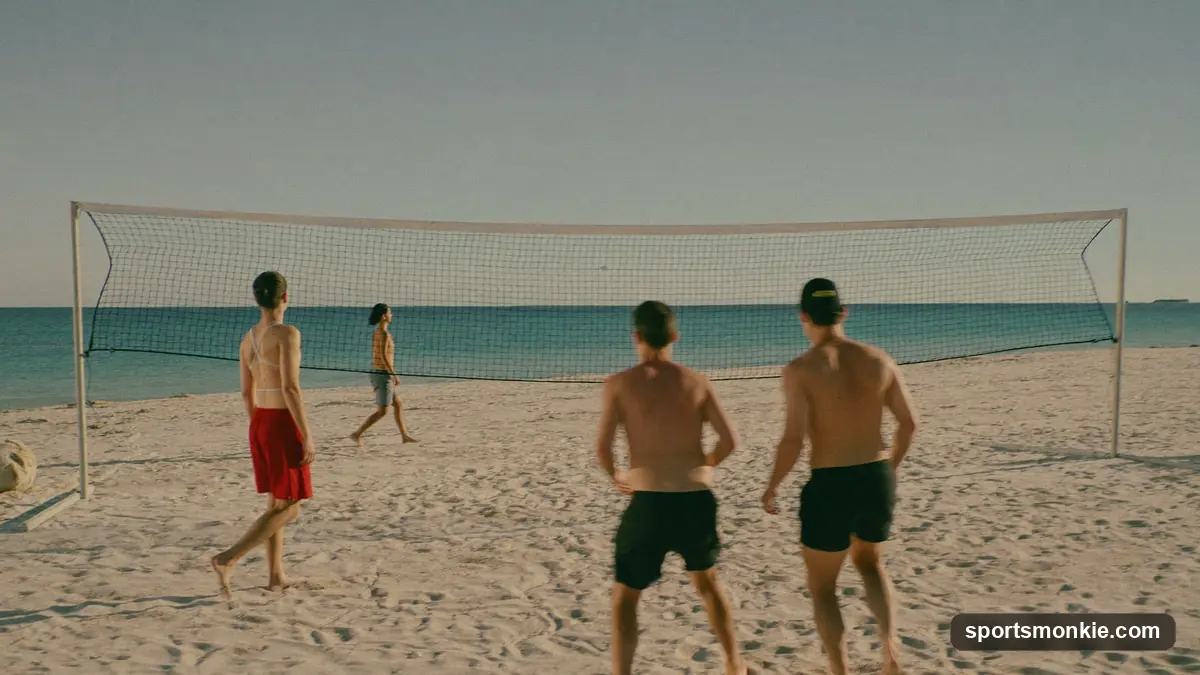
Four players form two teams of two. Members of the same team stand next to each other; the two teams face off on opposite sides of the net. There are no boundaries once the ball is served, so players can move a full 360 degrees around the net during a rally.
A point starts with a serve. The server bounces the ball off the net so it kicks up toward the receiver, who stands about six feet away. From there the receiving team has up to three touches to return the ball to the net, the same touch budget as volleyball. The ball must clear cleanly off the net back into open air, where the other team then takes its three touches.
The rally continues until one team fails to return the ball legally. A point is scored on every rally regardless of who served, which is called rally scoring. Because either team can score at any time, momentum swings fast.
The three-touch rule and hitting twice
Each possession allows a maximum of three touches to get the ball back onto the net. You do not have to use all three, but you cannot exceed them. Fewer touches is fine; a single clean return counts.
The rule players forget most: the same player cannot hit the ball twice in a row. Touches must alternate between partners. A legal sequence is player A, then player B, then player A again. An illegal sequence is player A twice back to back. So one person cannot take all three touches alone, which forces teamwork on longer rallies.
Every touch must be a clean strike. Catching, carrying, scooping or double-contacting the ball on one touch ends the rally in the opponent’s favor.
Serving rules and illegal serves
Serving is the most rule-heavy part of the game. The server stands behind a service line marked a set distance from the net and tosses the ball up at least a few inches before striking it down onto the net. The receiver picks their distance, usually around six feet, and the server must wait until the receiver is set.
A serve is illegal, counting as a fault, in these situations:
- The server steps toward or past the service line before making contact (a foot fault).
- The served ball strikes the rim of the net.
- The ball “pockets,” meaning it bounces off the net right at the rim edge and rolls or double-bounces.
- The serve is too high for the receiver to reasonably play, which the receiver may call before touching it for a replay.
As in tennis, the server gets two chances. Two faults in a row on the same point award it to the receiving team.
Why rim shots are outs
The rim is off limits during live play, not just on serves. If the ball contacts the metal rim at any point, the rally ends and the point goes to the team that did not hit the rim. This is the single most-argued call in casual games.
The reasoning is simple: a ball off the rim flies unpredictably and would make rallies impossible to officiate. Treating every rim contact as dead keeps play on the net’s flat trampoline surface, which is what the game is built around.
Quick rules reference
| Rule | Standard |
|---|---|
| Players | 2 vs 2 (teams of two) |
| Scoring | Rally scoring, every rally scores |
| Game to | 21 points, win by 2 |
| Match | Usually best of 3 games |
| Touches per possession | Up to 3 |
| Same player twice in a row | Not allowed |
| Rim contact | Dead ball, point to other team |
| Serve attempts | 2 (two faults lose the point) |
| Boundaries | None once served (360 degrees) |
Playing Spikeball with three people
There is no official 3-player format, so groups improvise. The two most common house versions:
- Two versus one. The solo player defends alone against a pair. The single player still cannot hit twice in a row, so they usually get an exception, letting them take consecutive touches. Games are often shortened to 11 points to keep it fair.
- Rotating “king of the net.” All three play individually. After each point the loser sits or rotates, and you track individual points. This works well as a warm-up before full 2v2.
Agree on the tweak before you start, since these variations are conventions rather than sanctioned rules.
From backyard to competition
Roundnet has an organized competitive circuit with sanctioned tournaments, referees and ranking systems, which is why the sport-neutral name “roundnet” exists alongside the Spikeball brand. Competitive play tightens the serve rules and hindrance calls that casual games wave off, but the core, three touches, no double hits, rim shots are outs, and rally scoring to 21, is identical whether you are on a beach or a bracket.
If you like fast backyard games with simple gear, the same crowd tends to enjoy Kan Jam rules and cornhole. If you are planning the whole yard setup, check the official cornhole distance before you mark the boards. For a running-and-catching option, kickball rules round out a full afternoon of yard games.
The short version: grab three friends, set the net, serve from behind the line, and remember that the rim is lava.
Frequently asked questions
What counts as an illegal serve in Spikeball?+
A serve is a fault if the server steps past the service line before contact, if the ball hits the rim, if it pockets (bounces off the net near the rim), or if it lands too hard and low to play. Like tennis, the server gets two attempts, and two faults in a row hand the point to the receiving team.
Can the receiving team catch or double-touch the ball?+
No. Each touch must be a clean hit, not a catch, carry or throw. A ball that visibly rests in a player's hand or scoops along the arm is a carry and ends the rally. Blocking or double-contact on a single touch is also a fault, though a hard hit that ricochets off two body parts in one motion is judged by intent.
What happens if the ball hits a pole or clip on the net?+
Play stops and the point is usually replayed. Most rulebooks treat contact with the legs, hub or clips as a hindrance rather than a live ball, so the rally is redone rather than awarded. Groups often agree on this before starting, since backyard net sets vary in how exposed the frame is.
How far should the receiver stand from the net?+
About six feet. The receiving player sets their distance and the server must serve once the receiver is ready. Standing roughly six feet back gives enough room to read the serve and start a three-touch sequence without crowding the net.
Sources
Play & tools
Free browser games and tools — no account, no download.
- Play today's Sports Connections — Today's Sports Connections — daily hints, answers, and play the grid.
- Play Guess the NFL Player — A new mystery NFL player every day. Eight guesses, with a clue on each — plus free unlimited mode.
- Explore all our games →
Related guides
Kan Jam Rules: Scoring, Dunks and Instant Wins
Kan Jam rules: 2v2 with cans 50 feet apart, score 1, 2 or 3 points per throw, and win by reaching exactly 21 or landing an Instant Win.
Kickball Rules: How to Play & Score
Kickball rules explained: kick a pitched ball and run the bases like baseball. Field setup, scoring, outs, and whether you can peg runners.
Tetherball Rules: How to Play and Setup
Tetherball rules made simple: two players hit a roped ball opposite ways to wrap it around the pole. Court setup, serving, fouls and how to win.
Bocce Ball Rules: How to Play and Score
Bocce ball rules explained: how to play, scoring, court size, fouls, and what happens when you hit the pallino. For backyard and league games.
Cornhole Rules: Scoring and How to Win
Cornhole rules explained: cancellation scoring, the official 27-foot distance, board and bag specs, and what busting means. Play a proper game.
Four Square Rules: Classic & Advanced
Four square rules explained: bounce the ball into other squares, move up as players are out, reach the top square. Classic and advanced play.