
Tetherball Rules: How to Play and Setup
On this page6
Tetherball is a fast one-on-one game where a ball hangs from a rope tied to the top of a tall pole, and two players hit it in opposite directions. The goal is to wind the rope completely around the pole in your direction before your opponent can wrap it the other way. Win the wrap, and you win the rally.
It is a playground staple precisely because the setup is so simple: one pole, one ball, one rope, and a painted circle. But there is a real set of rules underneath the chaos, covering serving, fouls and how a rally ends. Here is the full picture, from court setup to the fine points that spark playground arguments.
The setup
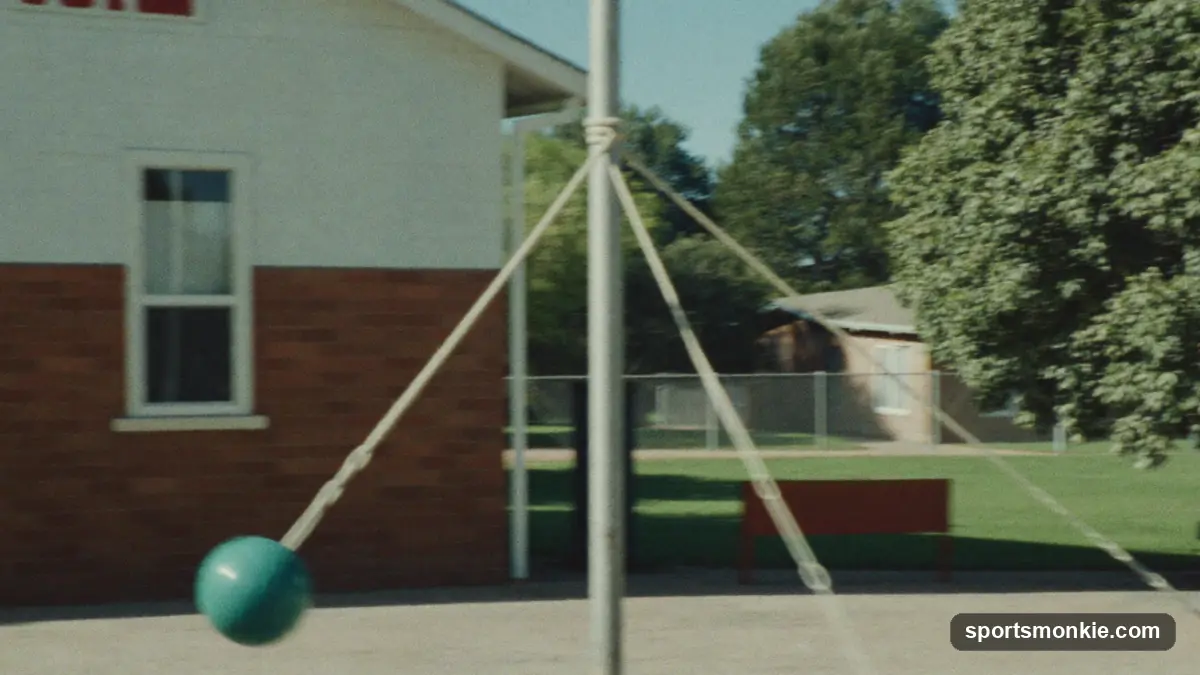
A regulation tetherball setup is easy to picture. A metal pole stands about 10 feet above the ground, with a rope fixed near the top and a ball, similar to a volleyball, attached to the rope’s free end so it hangs at a comfortable striking height.
Around the base is a circular court, divided down the middle into two halves. Each player takes one half and must stay in it. Crossing the centre line into your opponent’s side is a foul, which keeps the two players from crowding the pole.
| Element | Typical spec |
|---|---|
| Pole height above ground | About 10 feet |
| Ball | Volleyball-style, roped near the top of the pole |
| Court | Circle around the pole, split into two halves |
| Players | Two, one per half |
| Object | Wrap the rope fully around the pole in your direction |
How a game is played
One player serves by hitting the ball in their chosen direction. The opponent then tries to strike it back the opposite way, and from there it is a rally: each player hits the ball as it swings into their half, trying to advance the wrap in their own direction.
The rope slowly winds around the pole with each successful push. Whoever manages to wrap it completely, so the ball is pinned tight against the pole and cannot travel any further, wins that rally. Matches are usually played best of three or five.
The fouls that decide games
Most tetherball disputes come down to fouls, and the common ones are consistent across rulesets.
- Touching the rope with your hand or arm.
- Catching, holding or throwing the ball instead of striking it.
- Hitting the ball twice in a row on your own side (a double hit), under standard rules.
- Crossing the centre line into your opponent’s half.
- Hitting the pole or reaching around it to strike the ball early.
A foul typically stops the rally and gives the other player a free hit or the point, depending on the version you are playing. Because the rules vary from school to school and yard to yard, agreeing on the fouls before you start saves a lot of arguing, the same honor-system spirit that runs through four square rules and other self-refereed playground games.
Strategy that actually works
The winning move in tetherball is not brute force, it is angles and timing. Hitting the ball high and hard sends it around the pole faster, but a well-timed downward strike as the ball reaches you can reverse your opponent’s progress and swing momentum your way.
Good players also use the pole itself. As the rope shortens on the wrap, the ball speeds up and drops lower, so staying patient and waiting for a clean, low strike near the end of a rally often beats swinging wildly the whole time. It rewards reflexes and reading the swing, much like the quick reactions our dodgeball rules guide describes.
Why the rules matter for safety
The reason tetherball has such firm rules about staying in your half, not grabbing the ball and not crossing the line is safety as much as fairness. A swinging ball on a rope can hurt, and crowding the pole is how fingers get jammed and heads get knocked.
Those risks are exactly why some schools pulled their tetherball poles. Played within the rules, though, on a proper court with players keeping to their halves, it stays a quick, low-cost game that only needs two people and a pole.
Common variations
Because tetherball is almost always self-organised, house rules pile up fast, and knowing the common variants heads off arguments. Some yards play “no touchbacks”, where you cannot hit the ball back the way it came until it has passed you once. Others allow only open-palm hits, or only fist hits, to even out a mismatch between a taller and shorter player.
A popular casual version is “roll-em”, where after each point the loser rotates out and the next person in line steps in, keeping a big group moving through a single pole. Serving conventions vary too: some groups let the previous winner serve, others alternate, and a few make the loser serve to give them a small edge. None of this changes the core aim of wrapping the rope; it just tunes the game to the players and the space.
For another gym-class classic with a very different rhythm, our kickball rules guide is a good next stop.
The short version: two players, one roped ball on a 10-foot pole, hit it in opposite directions to fully wrap the rope your way, keep to your half, never grab the ball or rope, and the wrap or a foul ends the rally.
Frequently asked questions
Can you double hit in tetherball?+
In most standard playground rules, no. Once you hit the ball you cannot touch it again until it has passed around the pole or been struck by your opponent. Hitting it twice in a row on your own side is a double-hit foul. Some house rules relax this and allow repeated hits within your own half, so it is worth agreeing before you start.
Are you allowed to grab the ball in tetherball?+
No. Catching, holding, carrying or throwing the ball is a foul in every standard ruleset. You may only strike the ball with your hands or forearms. Grabbing the rope is also a foul. Both rules exist to keep the game a continuous back-and-forth rather than a stop-start wrestle for the ball.
Why was tetherball banned at some schools?+
Many schools removed tetherball over injury and liability concerns rather than any single incident. The swinging ball can strike a player in the face, wrists and fingers get jammed, and crowding around the pole leads to collisions. Combined with the strangulation worry some administrators raise about the rope, that risk profile led certain districts to pull the poles.
What counts as winning a game of tetherball?+
You win a rally by wrapping the rope completely around the pole in your own direction, so the ball is pinned against the pole and cannot travel further. You can also win when your opponent commits a foul, which usually hands you a free hit or the point depending on the ruleset. Matches are often played as best of three or five rallies.
Sources
Play & tools
Free browser games and tools — no account, no download.
- Play today's Sports Connections — Today's Sports Connections — daily hints, answers, and play the grid.
- Play Guess the NFL Player — A new mystery NFL player every day. Eight guesses, with a clue on each — plus free unlimited mode.
- Explore all our games →
Related guides
Kickball Rules: How to Play & Score
Kickball rules explained: kick a pitched ball and run the bases like baseball. Field setup, scoring, outs, and whether you can peg runners.

Gaga Ball Rules: How to Play the Pit Game
Gaga ball rules explained: a softer, faster dodgeball played in a pit. Hit opponents below the knee to get them out, and no double touches.
Four Square Rules: Classic & Advanced
Four square rules explained: bounce the ball into other squares, move up as players are out, reach the top square. Classic and advanced play.
Kan Jam Rules: Scoring, Dunks and Instant Wins
Kan Jam rules: 2v2 with cans 50 feet apart, score 1, 2 or 3 points per throw, and win by reaching exactly 21 or landing an Instant Win.

Spikeball (Roundnet) Rules Explained
Spikeball rules made simple: 2v2 teams, rally scoring to 21, three touches to return, and why rim shots are outs. How to serve, score and win.

Dodgeball Rules: Official and Playground Play
Dodgeball rules explained: how to get players out, the opening rush, catches and boundaries, and how official USA Dodgeball differs from playground play.