
Dodgeball Rules: Official and Playground Play
On this page5
Dodgeball rules come down to two ideas: hit an opponent with a thrown ball to get them out, and avoid being hit or having your throw caught, which gets you out. A caught throw is doubly costly, eliminating the thrower and bringing one of the catcher’s eliminated teammates back onto the court. Everything else is detail layered on top of those basics.
There are two worlds of dodgeball, though. The official version run by bodies like USA Dodgeball uses foam balls, set team sizes and referees, while the gym-class and backyard versions run on honesty and local house rules. The mechanics rhyme; the strictness does not. Here is how both work.
The five things you actually need to know
Strip dodgeball down and there are five core rules that hold in almost every version of the game.
- Hit to eliminate. Hit an opposing player with a live thrown ball, below the shoulders, and they are out.
- Get hit, get out. If a live ball hits you, you leave the court.
- Catches flip the script. Catch an opponent’s throw and the thrower is out; you also bring a teammate back in.
- Stay in bounds. Cross a boundary line and you are out, whether dodging or retrieving a ball.
- Dead balls do not count. A ball that has hit the floor, wall or another object is dead and cannot get anyone out until it is picked up again.
A “live” ball is the whole hinge of the game: it only eliminates someone between leaving a thrower’s hand and touching anything else. Once it bounces, it is harmless until repossessed.
The opening rush
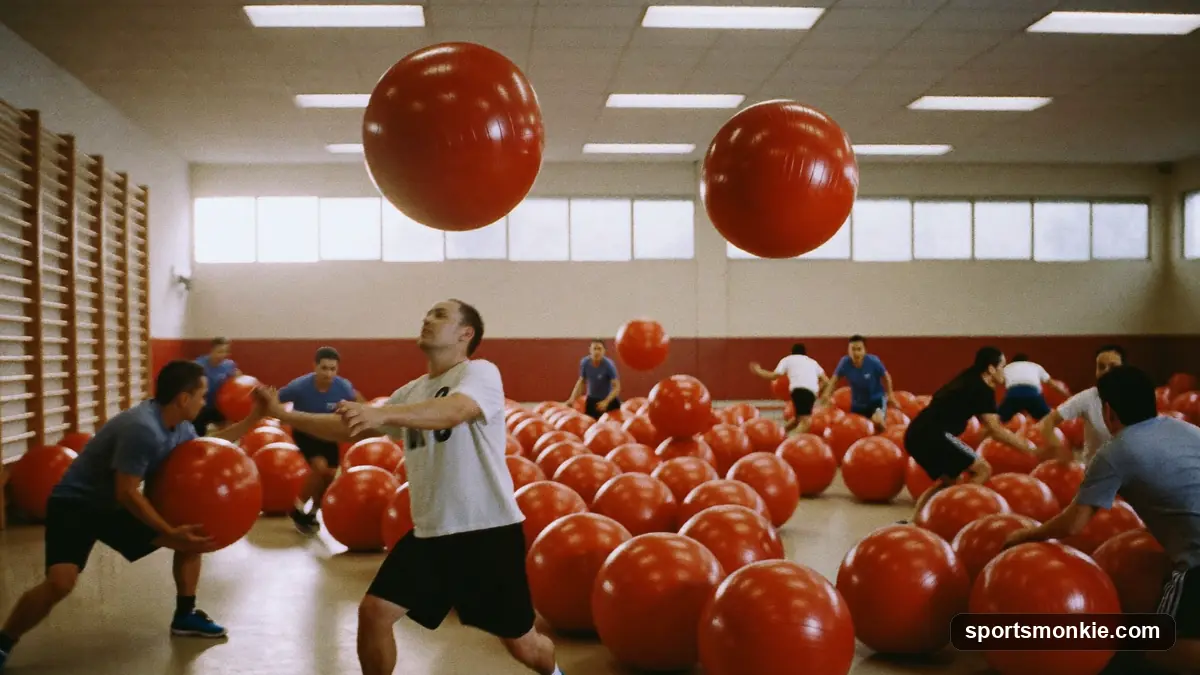
Most games start the same dramatic way. The balls are lined along the centre line, teams stand on their own back lines, and on the whistle both sides sprint to grab them. In official play, a retrieved ball usually has to be carried back behind a designated line before it can be legally thrown, which stops players from firing point-blank at the centre.
The rush rewards speed and nerve, but charging in also leaves you exposed. Experienced teams send a couple of fast players for the balls while the rest hang back to dodge the first wave.
Official rules vs playground rules
The biggest gap between codes is who enforces them and what you throw. This table lays out the common differences.
| Element | Official (USA Dodgeball) | Playground / gym class |
|---|---|---|
| Ball type | Foam or cloth, standardised | Rubber, foam, whatever is available |
| Team size | Fixed, often six per side | Whatever fits the class |
| Officiating | Referees | Honor system, self-calling |
| Headshots | No-count or penalty | Often banned for safety |
| Bringing players back | Catches return teammates | Varies by house rule |
| Match format | Timed sets, best of a series | First team eliminated loses |
Neither version is more “correct.” Official rules exist to make competition fair and safe, while playground rules exist to keep a big group moving and having fun. If you like the honor-system style of game, you will recognise it in four square rules and other self-officiated schoolyard staples.
Ways to get out, in full
Beyond a straight hit, there are a few less obvious ways to be eliminated that trip up new players.
- Your throw is caught. The thrower is out, so a wild heave into a crowd is a real risk.
- You drop a held ball when hit. In many rulesets, if a ball you are holding is struck by a thrown ball and you drop it, you are out. Block cleanly or you pay for it.
- You step out of bounds. Crossing the sideline or centre line eliminates you even if you were only dodging.
Blocking, holding a ball in front of you to deflect throws, is legal in most codes precisely because dropping the block ball on a hit gets you out. It rewards timing and punishes panic.
Strategy that follows from the rules
Because catches bring teammates back, good teams do not throw carelessly. They throw in pairs, so a catch attempt on one ball leaves the target facing a second, and they back each other up to catch on defense. The tempo is closer to a fast, chaotic version of kickball than most people expect, with quick reads and constant movement.
The winning play is often patience: keep your feet moving, force the other team to waste throws, and pick them off when they are low on live balls. A team that hoards balls and refuses to feed the other side can also stall, which is why timed formats and ball-limit rules exist in official play.
Positioning matters as much as throwing. Good teams spread across the width of the court so a single throw cannot threaten two players at once, and they keep at least one strong catcher back to punish wild throws. The endgame, when only one or two players remain per side, often turns on stamina and nerve: a lone player with several live balls can pin an opponent by throwing one to force a dodge and following immediately with a second. For another gym-class classic with a completely different rhythm, our tetherball rules guide covers a one-on-one game built on the same honor-system spirit.
The short version: hit below the shoulders to eliminate, catches turn the tables and revive a teammate, dead balls are safe, and the only real difference between codes is how strictly all of that is enforced.
Frequently asked questions
What is the golden rule of dodgeball?+
In casual play the golden rule is honesty: if a ball hits you, you call yourself out and walk off, because most schoolyard games have no referee. Self-officiating only works when everyone accepts a clean hit. Official matches replace this with referees, but the spirit, own your hits, is still treated as the game's core courtesy.
Are headshots illegal in dodgeball?+
In most official foam-ball rules a hit to the head does not put the targeted player out, and repeatedly aiming high can be penalized as dangerous play. Many school and playground versions ban headshots outright for safety. The details vary by ruleset, so headshots are best treated as either a no-count or a foul depending on where you play.
Can you catch a ball thrown at a teammate?+
Yes. Any live thrown ball can be caught by any player on the target's team, not only the person it was aimed at. A clean catch eliminates the thrower and, in most rulesets, returns one previously eliminated teammate to the court. This is why players often cluster to back each other up on hard throws.
What happens if two players catch the same ball?+
If the ball is controlled cleanly by the catching team it counts as a catch, even if a teammate helped by deflecting or tipping it first, as long as it never touched the floor. If it hits the ground before being secured, it is a dead ball and no one is out. Refs judge whether possession was truly controlled.
Sources
Play & tools
Free browser games and tools — no account, no download.
- Play today's Sports Connections — Today's Sports Connections — daily hints, answers, and play the grid.
- Play Guess the NFL Player — A new mystery NFL player every day. Eight guesses, with a clue on each — plus free unlimited mode.
- Explore all our games →
Related guides
Tetherball Rules: How to Play and Setup
Tetherball rules made simple: two players hit a roped ball opposite ways to wrap it around the pole. Court setup, serving, fouls and how to win.
Horseshoe Pit Dimensions and Distance
Official horseshoe pit dimensions: 40-foot stake distance, 31-36 inch pit width, 43-72 inch pit length, foul lines and backyard setup.

Bocce Court Dimensions and Backyard Sizes
Bocce court dimensions explained: 91 x 13 ft U.S. competition benchmark, international ranges, backyard sizes, surfaces and space planning.

Bocce Ball Rules: How to Play and Score
Bocce ball rules explained: how to play, scoring, court size, fouls, and what happens when you hit the pallino. For backyard and league games.
Kickball Rules: How to Play & Score
Kickball rules explained: kick a pitched ball and run the bases like baseball. Field setup, scoring, outs, and whether you can peg runners.
Cornhole Rules: Scoring and How to Win
Cornhole rules explained: cancellation scoring, the official 27-foot distance, board and bag specs, and what busting means. Play a proper game.