
Shuffleboard Table Dimensions: Sizes, Room Space and Fit Calculator
On this page10
- 01Shuffleboard table dimensions at a glance
- 02Shuffleboard room size calculator
- 03Regulation vs home shuffleboard sizes
- 04Playfield, cradle, width and height
- 05How much clearance do you need?
- 06Room size chart by table length
- 0712 ft vs 14 ft vs 16 ft shuffleboard table
- 08Foul lines and scoring layout
- 09Climate adjusters, wax and delivery access
- 10How shuffleboard compares with other home-game footprints
Shuffleboard tables are sold by length first. The usual indoor table sizes are 9, 12, 14, 16, 18, 20 and 22 feet. A 22-foot table is the regulation tournament size, but that does not make it the best home size. For most homes, 12 or 14 feet is the cleaner choice because it leaves enough room to stand at the ends and actually shoot.
Do not size the room from the table length alone. Players stand behind the table at both ends, so a 12-foot table in a 13-foot room is technically present but miserable to play. Start with your clear room length, subtract the end clearance, then choose the longest table that still leaves comfortable shooting space.
Shuffleboard table dimensions at a glance
| Table length | Minimum room length | Comfortable room length | Typical overall width | Best fit |
|---|---|---|---|---|
| 9 ft | 13 ft | 15 ft | 24 to 30 in | Apartment, den, tight room |
| 12 ft | 16 ft | 18 ft | 24 to 30 in | Most home game rooms |
| 14 ft | 18 ft | 20 ft | 28 to 31 in | Better home feel if the room allows |
| 16 ft | 20 ft | 22 ft | 28 to 32 in | Serious home players |
| 18 ft | 22 ft | 24 ft | 30 to 32 in | Dedicated game room |
| 20 ft | 24 ft | 26 ft | 30 to 32 in | Bar, club or large home room |
| 22 ft | 26 ft | 28 ft | 31 to 36 in with some scoring units | Regulation tournament length |
The minimum room length above uses 2 feet behind each end. The comfortable number uses 3 feet behind each end. Width is less exact because cabinet, cradle, gutter and scorer designs vary, but most home buyers should think in the 6 to 7.5-foot room-width range if both sides need walking space.
Shuffleboard room size calculator
Use this as a first tape-measure check. It does not replace the exact drawing from the table maker, especially if the table has a scoring unit, dining top, wide cradle, two-piece playfield, stair delivery or a wall on one side.
If the calculator recommends a 14-foot table in an 18-foot room, that means “minimum playable,” not spacious. If that room has a doorway swing, bar stools, low pendant light or a wall tight to one side, dropping to 12 feet may be the smarter buy.
Regulation vs home shuffleboard sizes
Tournament table shuffleboard uses the 22-foot board as the regulation reference. The Table Shuffleboard Association hosts tournament-rule material, while the Shuffleboard Federation’s rule pages cover competition procedures, weights, board care and scoring. That tournament world is useful, but most home buyers are solving a different problem: which table will fit, arrive safely and get played often.
| Use case | Sensible size range | Why |
|---|---|---|
| Apartment or compact den | 9 ft | Keeps end clearance without taking over the room |
| Typical home game room | 12 to 14 ft | Good touch, manageable delivery and enough playing feel |
| Large basement or dedicated rec room | 14 to 18 ft | More control and speed without full tournament length |
| Bar, club or serious home room | 18 to 22 ft | Closer to competition rhythm and longer lag shots |
| Tournament practice | 22 ft | Matches the regulation-length target |
A shorter table is not fake shuffleboard. It just changes the game. On a 9-foot table, pucks reach the scoring end easily, so knockoffs and simple weight control dominate. On a 16 or 22-foot table, the same puck needs better touch, wax control and patience.
Playfield, cradle, width and height
The advertised size usually refers to the outside cabinet or cradle length, not the exact sliding surface. The playfield sits inside the cradle, with gutters along the sides and an end area around the scoring zones. That is why two “14-foot” tables can have slightly different playable lengths and widths.
| Part | Common measurement | What to check |
|---|---|---|
| Table length | 9 to 22 ft | Usually outside cabinet length |
| Playfield width | about 16 to 20 in | Entry-level tables are often narrower; regulation-style boards are wider |
| Overall table width | about 24 to 32 in | Some 22-foot tables or scorer setups are wider |
| Table height | about 30 in to top of playfield | Confirm if children, seating or accessibility matter |
| 22-foot regulation-style playfield | about 20 ft 8 in by 20 in on a common championship model | Useful benchmark, but verify the exact model |
The 16-inch vs 20-inch playfield difference matters. A wider board gives more room to hide a puck, pass a guard and control lanes. A narrow board can still be fun at home, but it plays more crowded.
How much clearance do you need?
End clearance is the one buyers miss. A player stands at the end, leans forward slightly and pushes the weight down the board. The player does not need a pool-cue backswing, but they do need enough floor to stand naturally.
| Clearance area | Minimum | Better target | Notes |
|---|---|---|---|
| Behind each end | 2 ft | 3 ft | Three feet feels easier for most adults |
| Each open side | 18 to 24 in | 2 to 3 ft | More useful if spectators or two players stand nearby |
| Wall-side gap | a few inches to 1 ft | 1 ft or more | One long side can sit near a wall in tight rooms |
| Overhead / scorer space | model-specific | model-specific | Check electronic scorers and lights |
| Delivery path | exact path required | extra turning room | Stairs and corners can decide the real table size |
The Shuffleboard Federation FAQ says 2 feet at each end is the minimum and 3 to 4 feet is better. Several manufacturer guides land in the same practical range. SportsMonkie uses 2 feet as the minimum fit line and 3 feet as the more comfortable recommendation.
Room size chart by table length
| Table length | Minimum room size | Comfortable room size | If the room is tight |
|---|---|---|---|
| 9 ft | 13 x 6 ft | 15 x 7.5 ft | Good first choice for small rooms |
| 12 ft | 16 x 6 ft | 18 x 7.5 ft | Best default for many homes |
| 14 ft | 18 x 6.5 ft | 20 x 7.5 ft | Works if the room has a clean long wall |
| 16 ft | 20 x 6.5 ft | 22 x 7.5 ft | Check delivery before you fall in love with it |
| 18 ft | 22 x 7 ft | 24 x 8 ft | Needs a real game-room footprint |
| 20 ft | 24 x 7 ft | 26 x 8 ft | Mostly for large rooms and commercial spaces |
| 22 ft | 26 x 7 ft | 28 x 8 ft | Regulation length, not a casual space saver |
If your room falls between two sizes, choose the smaller table when the room also has furniture, columns, doors, low lights or traffic behind one end. A table that fits on paper but blocks the room will not get used.
12 ft vs 14 ft vs 16 ft shuffleboard table
These three sizes cause the most buyer hesitation.
| Size | Choose it when | Avoid it when |
|---|---|---|
| 12 ft | You want a real home game in a 16 to 18-foot room | You have a long dedicated room and want more touch challenge |
| 14 ft | You have around 20 feet of room length and want a step up | The table would leave only 2 feet at each end in a busy room |
| 16 ft | You have a purpose-built room and care about longer lag shots | Delivery path, stairs or seating make the space feel cramped |
My practical take: if the room is normal, 12 feet is safe and playable. If the long wall is clean, 14 feet is the best home upgrade. If you can fit 16 feet without stealing circulation, it starts to feel like a serious table.
Foul lines and scoring layout
Shuffleboard table size also changes the line layout. The Shuffleboard Federation FAQ explains that 9, 12 and 14-foot tables often use a single foul line in the middle of the playing surface. Longer 16, 18, 20 and 22-foot tables use two foul lines, commonly 6 feet from each end.
| Table length group | Common foul-line layout | Why it matters |
|---|---|---|
| 9, 12 and 14 ft | One center foul line | Short boards need a simpler legal-distance line |
| 16, 18, 20 and 22 ft | Two foul lines near the shooting ends | Longer boards give more room for guards, lag shots and deeper strategy |
A puck that does not clear the correct foul line is a dead weight and comes off the board. This is one reason a longer table does not only feel “bigger.” It gives the game more tactical room.
For the basic scoring and frame flow after you choose a table, use our shuffleboard rules guide.
Climate adjusters, wax and delivery access
Dimensions tell you what fits. Build details tell you whether it will keep playing well.
Climate adjusters sit underneath many serious playfields. They help installers correct a board that reacts to humidity by crowning, cupping or drifting. Longer boards need more adjustment points, and some smaller budget tables skip them altogether.
Wax, also called powder or sand, controls speed. Shorter tables usually use slower powder. Longer tables can use faster powder because the puck has more distance to travel. A board that is too fast for its length turns every shot into a fly-off; a board that is too slow makes the game feel sticky.
Delivery access matters as much as the room. A long cabinet or playfield has to pass through doors, stairs and turns before it reaches the game room. Many longer tables use two-piece cradles, and some models offer two-piece playfields, but you should confirm that before buying. Measure the route, not just the final wall.
How shuffleboard compares with other home-game footprints
Shuffleboard is long and narrow. That makes it easier than a pool table in some rooms and impossible in others.
| Game | Main space problem | Good fit when |
|---|---|---|
| Table shuffleboard | Long wall and end clearance | The room is narrow but long |
| Pool | Cue stroke around all sides | The room is wide enough on every side |
| Foosball | Side rods and players | The room has short open side space |
| Cornhole | Long throwing distance | You have a yard, driveway or open rec area |
| Bocce | Long court footprint | You have outdoor length and a buildable surface |
If you are planning a broader backyard or rec-room setup, compare the distance logic in cornhole distance, horseshoe pit dimensions and bocce ball court dimensions. The shared lesson is boring but useful: measure the playing space, then add the human space around it.
Sources
Frequently asked questions
What is the standard size for a shuffleboard table?+
For tournament table shuffleboard, the standard regulation length is 22 feet. For homes, the most common practical sizes are usually 12, 14 and 16 feet because they still feel like real shuffleboard but fit ordinary game rooms more easily.
How much room do you need for a 12 foot shuffleboard table?+
A 12-foot shuffleboard table needs about 16 feet of room length at the bare minimum if you allow 2 feet behind each end. A room around 18 feet long feels better because each shooter gets about 3 feet. Width depends on the cabinet, but 6 to 7.5 feet gives enough walking room for most home setups.
Is a 9 ft shuffleboard table too small?+
A 9-foot table is not too small for casual home play, apartments or tight game rooms. It is easier and faster than a longer board, so touch matters less than it does on a 16 or 22-foot table. If the room is short, a 9-foot table that leaves good end clearance is better than a 12-foot table that forces players to shoot sideways.
How wide is a shuffleboard table?+
Many home shuffleboard tables are about 24 to 32 inches wide overall. The playfield is often around 16 inches wide on smaller entry-level tables and around 20 inches wide on regulation-style tables. Always check the exact cabinet width because gutters, scoring units and decorative cradles vary by model.
Can a shuffleboard table go against a wall?+
Yes, one long side of a shuffleboard table can sit close to a wall if space is tight, but leave enough room to avoid scraping the cradle and to retrieve pucks comfortably. The end clearance matters more because players shoot from the ends.
What is the difference between table length and playfield length?+
The advertised length is usually the outside cabinet or cradle length. The actual playfield is shorter because the cradle surrounds the board. On a full 22-foot table, a common regulation-style playfield is about 20 feet 8 inches long and 20 inches wide.
Sources
Play & tools
Free browser games and tools — no account, no download.
- Play today's Sports Connections — Today's Sports Connections — daily hints, answers, and play the grid.
- Play Guess the NFL Player — A new mystery NFL player every day. Eight guesses, with a clue on each — plus free unlimited mode.
- Explore all our games →
Related guides
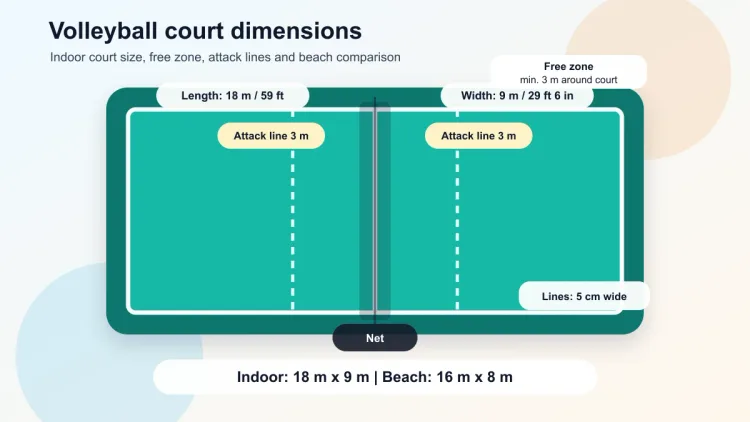
Volleyball Court Dimensions and Space Needed
Official volleyball court dimensions: indoor court size, beach court size, attack line, service zone, free zone, net height and backyard setup.
Bocce Court Dimensions and Backyard Sizes
Bocce court dimensions explained: 91 x 13 ft U.S. competition benchmark, international ranges, backyard sizes, surfaces and space planning.
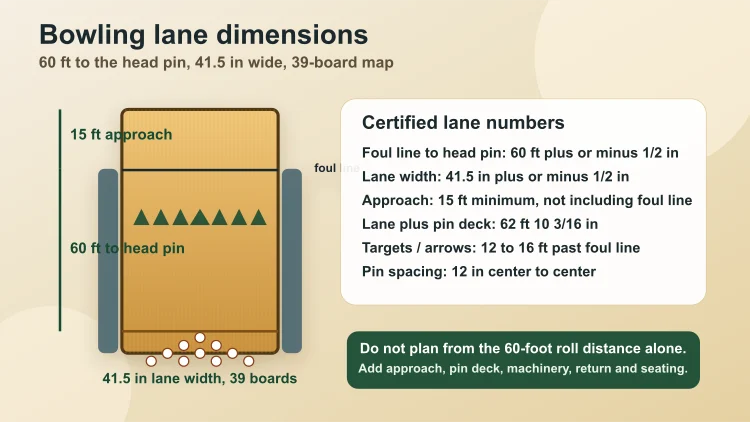
Bowling Lane Dimensions: Length, Width, Boards and Space Needed
Regulation bowling lane dimensions from USBC: 60 ft to the head pin, 41.5 in lane width, 39 boards, approach, arrows, gutters and space calculator.
Pool Table Sizes: 7ft, 8ft and 9ft
Pool table sizes explained: 7ft, 8ft and 9ft playing surfaces, the room size you need for each, and how to tell an 8-foot from a 9-foot table.
Shuffleboard Rules: Table and Court
Shuffleboard rules for both versions: table shuffleboard and deck/court shuffleboard. Scoring zones, how to win, and the key differences explained.
Climbing Shoes for Beginners: What to Buy and How They Should Fit
The best climbing shoes for beginners are flat, neutral, and snug, not painful. Here's how to size them, rent vs buy, and 5 real 2026 models with prices.