
Pool Table Sizes: 7ft, 8ft and 9ft
On this page4
Pool tables come in three common sizes: 7-foot, 8-foot and 9-foot, measured by the playing surface inside the cushions. A 7-foot table has a 39 by 78 inch playing area, an 8-foot table is 44 by 88 inches, and a 9-foot table is 50 by 100 inches. The 9-foot is the tournament regulation size; the 8-foot is the usual home pick.
The size that is right for you depends less on skill and more on your room, because every table needs clearance around it for the cue. Here is the full chart, the room space each one demands, and how to identify a table by its size.
Pool table size chart
Playing-surface dimensions below follow the World Pool-Billiard Association equipment specifications. A table counts as “regulation” when the surface is exactly twice as long as it is wide, so all three sizes qualify.
| Table size | Playing surface | Best for |
|---|---|---|
| 7 ft | 39 x 78 in | Bars, leagues, tight rooms |
| 8 ft | 44 x 88 in | Home game rooms (most popular) |
| 9 ft | 50 x 100 in | Tournament regulation play |
There are smaller novelty tables sold as 6-foot, common in UK pubs, but they sit below regulation and are built for casual play rather than serious pool.
How much room do you need?
This is where most buyers get caught out. The table is only half the footprint; you also need space to draw the cue back on every shot. The rule is straightforward.
Minimum room size = playing area + twice the cue length on each side.
A standard cue is 58 inches, so you add roughly 116 inches (about 9 feet 8 inches) to both the length and width of the playing surface. In practice, Brunswick’s room size guide recommends the following minimums.
| Table size | Minimum room | Comfortable room |
|---|---|---|
| 7 ft | 13’ x 16’ | 14’ x 17’ |
| 8 ft | 13’6” x 17’ | 14’6” x 18’ |
| 9 ft | 14’ x 18’ | 15’ x 19’ |
If your room is tight on one side, you can use a shorter cue for those shots, but planning for full clearance keeps every angle playable. Measure your room before you fall in love with a 9-footer.
Which size should you buy?
Our honest take: for almost every home, the 8-foot table is the right buy. It plays close enough to regulation to build real skill, yet fits a normal spare room or basement without forcing you into a shorter cue on half your shots.
Go 9-foot only if you have a dedicated room and you are practising for tournament play, because that is the size you will compete on and the extra length exposes weaknesses a smaller table hides. Choose 7-foot if space is genuinely limited or you want the fast, forgiving games you get in a bar. There is no shame in the small table; it is what most people actually play on.
Once your table is in, the next thing to get right is the setup. See our guide to how to rack pool balls for a tight break every time, and if you are not sure which game to play on it, the different types of pool games walks through eight-ball, nine-ball and more.
Telling 8-foot and 9-foot tables apart
If you are buying secondhand and the listing does not say, measure the playing surface from the nose of one cushion to the nose of the opposite one. An 8-foot table reads 44 by 88 inches; a 9-foot table reads 50 by 100 inches. That 6-inch difference in width and 12-inch difference in length is the reliable tell.
The overall cabinet is larger than the playing surface, so do not measure the outer frame and assume it is the table size. When in doubt, the cushion-to-cushion measurement is the one that matches the size on the label, and it is how the pros classify a table too. To see the game played on the full 9-foot stage, our roundup of the best pool players shows what regulation-size mastery looks like.
The short version: 7-foot for bars, 8-foot for homes, 9-foot for tournaments, and always leave about 5 feet of cue clearance on every side.
Frequently asked questions
What is the standard size for a pool table?+
There is no single standard, but the 8-foot table is the most common choice for homes, and the 9-foot is the official tournament size recognised by the World Pool-Billiard Association. In American bars and leagues the 7-foot table is standard. All three are 'regulation' as long as the playing surface is exactly twice as long as it is wide.
Is a 7ft pool table too small?+
Not for casual play. A 7-foot table is the standard in bars and delivers fast, fun games in a room where a bigger table would not fit. Serious players find the tight layout easier than a 9-footer, so it can actually flatter your game. If you want to practise for tournaments, though, the shorter table hides the long-shot errors a 9-foot table exposes.
How can I tell if a table is 8ft or 9ft?+
Measure the playing surface from cushion nose to cushion nose. An 8-foot table is 44 by 88 inches; a 9-foot table is 50 by 100 inches, so the 9-footer is 6 inches wider and a foot longer. If you can only reach the outer frame, a 9-foot table's overall length is usually around 100 inches plus the rail width.
Are UK pub pool tables 6ft or 7ft?+
British pub tables are usually 6ft or 7ft, smaller than the American bar box. The 7ft version is the size used in English blackball and pool leagues. These tables also use smaller balls than American pool, which is a separate difference from the table size itself.
Sources
Play & tools
Free browser games and tools — no account, no download.
- Play today's Sports Connections — Today's Sports Connections — daily hints, answers, and play the grid.
- Play Guess the NFL Player — A new mystery NFL player every day. Eight guesses, with a clue on each — plus free unlimited mode.
- Explore all our games →
Related guides
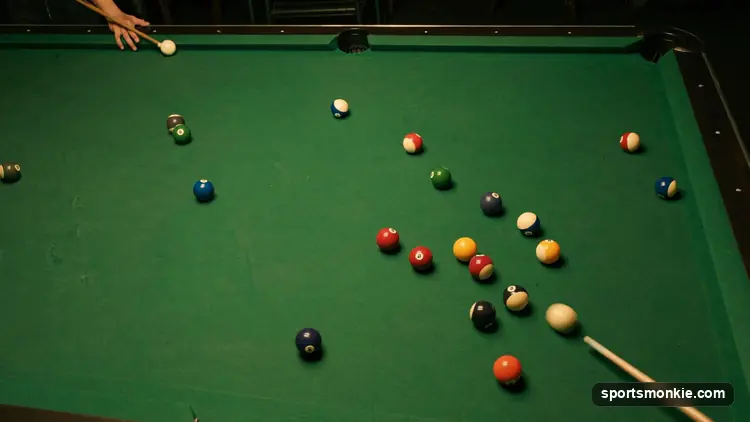
How to Rack Pool Balls: 8-Ball & 9-Ball
How to rack pool balls the right way: 8-ball, 9-ball and 10-ball setups from the WPA rules, with the exact fixed positions and a tight-rack trick.
Best Pool Players of All Time: The Greatest in Billiards
The greatest pool players of all time include Efren Reyes, Earl Strickland, Ralph Greenleaf and Shane Van Boening — ranked by world titles, U.S. Open wins and longevity at the top of the pro game.
Types of Pool Games: 8-Ball, 9-Ball, Snooker & More
There are many types of pool games with different rules and objectives. The most popular are 8-ball, 9-ball, straight pool, one-pocket and snooker.
8-Ball Rules: Racking, Breaking & Winning
8-ball rules: pot all seven of your group (solids or stripes), then legally sink the called 8-ball to win. Scratch on the 8-ball and you lose the game.
How Many Laps in a Mile Swimming? Pool Math Explained
How many laps in a mile swimming? A true mile is 70.4 lengths of a 25-yard pool; the swimmers mile is 1,650 yards (66 lengths). Full pool-by-pool math inside.
How Long Is an Olympic Pool? Size & Lanes
An Olympic pool is 50 meters long, 25 meters wide, with 10 lanes and a 2-meter minimum depth. Full dimensions, lane specs, and format comparisons.