
Types of Pool Games: 8-Ball, 9-Ball, Snooker & More
On this page7
Walk into a bar with a pool table and you’ll usually see the same game: 8-ball, solids against stripes, first to sink the black. Turn on a televised tournament and it’s almost always something else entirely, balls numbered 1 through 9, a completely different scoring logic, sometimes a completely different table. Pool isn’t one game with one set of rules. It’s a family of games that share a cue and a set of pockets and not much else.
The main types of pool games
| Game | Balls Used | Objective | Skill Level |
|---|---|---|---|
| 8-Ball | 15 object balls + cue | Pot your group (solids/stripes), then the 8-ball | Beginner–Intermediate |
| 9-Ball | Balls 1–9 + cue | Pocket balls in numeric order; pot the 9 to win | Intermediate–Advanced |
| 10-Ball | Balls 1–10 + cue | Like 9-ball but must call your shots | Advanced |
| Straight Pool (14.1) | 15 object balls + cue | Reach a target score by pocketing any ball | Advanced |
| One-Pocket | 15 object balls + cue | Score 8 balls into your designated pocket | Advanced |
| Bank Pool | 15 object balls + cue | All pots must be banked off a cushion first | Advanced |
| Snooker | 21 object balls + cue | Score points in sequence; red, then colour | Intermediate–Advanced |
| Cutthroat | 15 object balls + cue | Multiplayer; eliminate opponents’ groups | Beginner–Intermediate |
8-ball: the format everyone learns first
Players split the 15 object balls into two groups after the break, solids (1 to 7) and stripes (9 to 15). Each side has to clear its own group before touching the 8-ball. Pot the 8-ball early, or on the wrong call, and the game is over on the spot. The rules are simple enough to pick up in a few minutes, which is exactly why 8-ball ended up as the default game in pubs, rec centers, and amateur leagues almost everywhere.
9-ball: the professional standard
Televised professional pool almost always means 9-ball. Only the balls numbered 1 through 9 are in play, and a player has to contact the lowest numbered ball on the table first on every shot. The 9-ball itself can drop at any point, including off the break, and win the rack instantly. That combo possibility is what makes 9-ball fast and occasionally chaotic to watch. Most major WPA tournaments run on this format.
Straight pool (14.1 continuous)
In straight pool, a player can pot any ball in any order, but has to call the shot first. Once 14 balls are down, the table gets re-racked and play continues without a break in the count. Games run to a pre-agreed score, often 100 or 150 in professional matches. Willie Mosconi once ran over 500 balls consecutively in an exhibition, which gives some sense of how deep the ceiling is once you take away the safety net of a small rack.
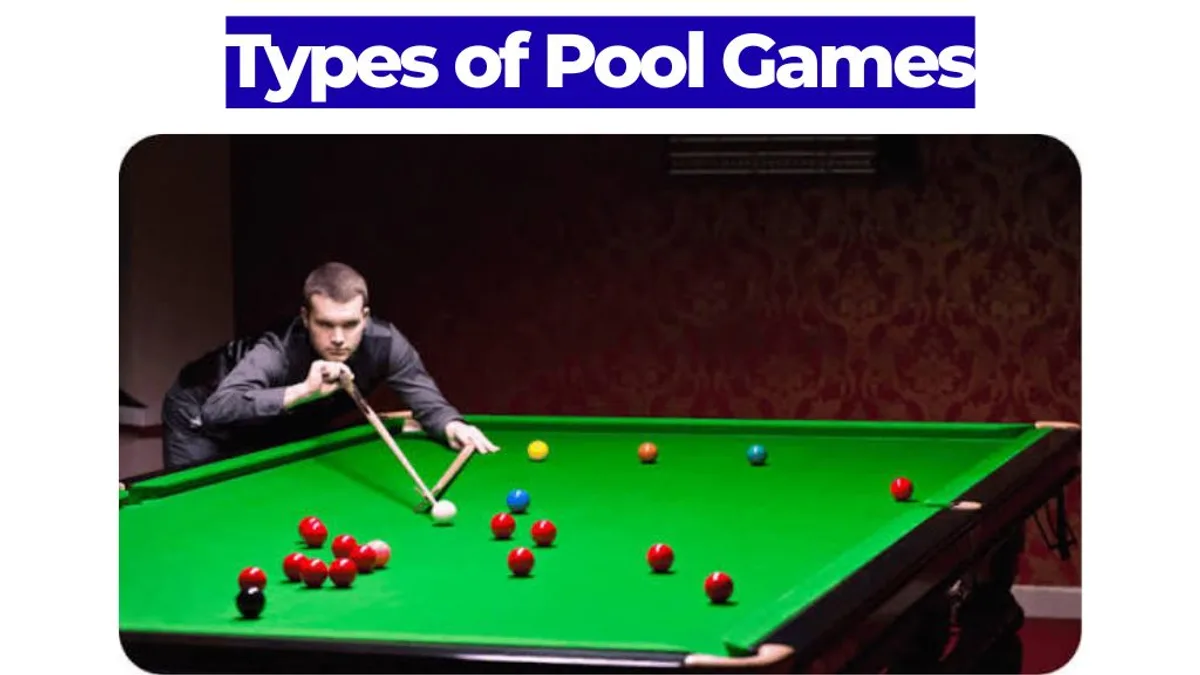
Snooker: a separate tradition
Snooker moves to a 12-foot table with smaller pockets and 22 balls, 15 reds plus six colours (yellow, green, brown, blue, pink, black). Play alternates between potting a red, worth 1 point, and nominating a colour worth 2 to 7. The World Snooker Championship at the Crucible in Sheffield draws huge audiences across the UK and Asia every spring, and it runs on rules different enough from pool that a strong 8-ball player can still look lost at a snooker table.
Carom billiards: no pockets at all
Carom billiards drops pockets entirely. A player scores by making the cue ball contact both object balls in one shot, a carom. Straight rail, three-cushion billiards, and artistic billiards are the main variants, and three-cushion is the hardest of the three: the cue ball has to hit at least three cushions before it can complete the carom.
One-pocket and bank pool
In one-pocket, each player is assigned one of the two corner pockets at the foot of the table, and the only way to win is to sink eight balls into that single pocket. Raw potting ability matters less here than ball control and safety play; a good one-pocket player spends half the match hiding the cue ball rather than shooting. Bank pool removes the direct shot altogether: every pot has to rebound off at least one cushion first, which means the player needs a real feel for angles and how fast the table plays before they can compete.
Related guides
Frequently asked questions
What is the most popular type of pool game?+
8-ball is the most widely played pool game in the world, found in bars, clubs, and homes across virtually every country. It uses all 15 object balls and is the format used in most amateur leagues.
What is the difference between pool and snooker?+
Pool is played on a smaller table (typically 7–9 feet) with 15 or fewer balls, while snooker is played on a much larger 12-foot table with 22 balls and different pocket sizes and scoring rules.
How many types of billiards games are there?+
There are dozens of billiards variants worldwide. The main categories are pocket billiards (pool), carom billiards (no pockets), and snooker. Within pocket billiards alone, common formats include 8-ball, 9-ball, 10-ball, straight pool, one-pocket, and bank pool.
Sources
Play & tools
Free browser games and tools — no account, no download.
- Play today's Sports Connections — Today's Sports Connections — daily hints, answers, and play the grid.
- Play Guess the NFL Player — A new mystery NFL player every day. Eight guesses, with a clue on each — plus free unlimited mode.
- Explore all our games →
Related guides
How to Rack Pool Balls: 8-Ball & 9-Ball
How to rack pool balls the right way: 8-ball, 9-ball and 10-ball setups from the WPA rules, with the exact fixed positions and a tight-rack trick.
8-Ball Rules: Racking, Breaking & Winning
8-ball rules: pot all seven of your group (solids or stripes), then legally sink the called 8-ball to win. Scratch on the 8-ball and you lose the game.

Best Pool Players of All Time: The Greatest in Billiards
The greatest pool players of all time include Efren Reyes, Earl Strickland, Ralph Greenleaf and Shane Van Boening — ranked by world titles, U.S. Open wins and longevity at the top of the pro game.

Snooker Ball Values: Colours and Points Chart
Snooker ball values in one chart: red 1, yellow 2, green 3, brown 4, blue 5, pink 6, black 7. What each colour is worth, where it sits, and how it scores.
How Snooker Scoring Works: Points, Breaks and Frames
How snooker scoring works: reds score 1, colours 2 to 7, a break is your total in one visit, and most points wins the frame. With a scoring table.

How to Play Snooker: A Beginner's Guide
Learn how to play snooker: setting up the table, the break-off, taking a turn, and the pot-a-red-then-a-colour sequence, step by step for beginners.