
7 Best Gymnasts in the World: All-Time Ranking

On this page12
- 01The greatest gymnasts at a glance
- 02Simone Biles (USA)
- 03Kohei Uchimura (Japan)
- 04Larisa Latynina (Soviet Union)
- 05Nadia Comaneci (Romania)
- 06Vitaly Scherbo (Unified Team/Belarus)
- 07Rebeca Andrade (Brazil)
- 08Daiki Hashimoto (Japan)
- 09How we ranked the best gymnasts
- 10How gymnastics is scored
- 11Why cross-era comparison is hard
- 12The current era after Paris 2024
Ranked by sustained all-around dominance across multiple Olympic cycles first, then by records that reset the sport (perfect 10s, career medal counts, original skills) and results delivered under the highest pressure. A single Games haul counts, but it is weighed below gymnasts who stayed on top while rivals studied and chased them.
The greatest gymnasts at a glance
| Rank | Gymnast | Country | Strongest legacy |
|---|---|---|---|
| 1 | Simone Biles | United States | Most decorated gymnast ever |
| 2 | Kohei Uchimura | Japan | Eight-year all-around reign |
| 3 | Larisa Latynina | Soviet Union | Historic Olympic medal record |
| 4 | Nadia Comaneci | Romania | First Olympic perfect 10 |
| 5 | Vitaly Scherbo | Belarus | Six golds at one Olympics |
| 6 | Rebeca Andrade | Brazil | Modern all-around great |
| 7 | Daiki Hashimoto | Japan | Olympic and three-time World all-around champion |
- Most decorated ever
Simone Biles (USA)
Biles owns the two numbers the rest of this list is measured against: 30 World Championship medals (23 gold) and 11 Olympic medals (7 gold), the most of any gymnast, man or woman. Multiple original elements across vault, beam and floor carry her name in the Code of Points, meaning she competed skills no one had landed before.
She ranks above the male greats below her not on medal math alone but on difficulty distance: at her peak the gap between Biles and the field was the widest any gymnast has held in the scoring era. After withdrawing from most of Tokyo 2020 with the "twisties," she returned at Paris 2024 to win team, all-around and vault gold — a comeback that settled the greatest-ever debate rather than reopening it.
Country: USA · Discipline: women's all-around · Career hardware: 30 World + 11 Olympic medals · Defining edge: skills named after her on three apparatus
- Greatest male gymnast
Kohei Uchimura (Japan)
Uchimura won every Olympic and World all-around title available from 2009 to 2016 — six straight World all-around golds from 2009 to 2015, a record no gymnast of either sex has approached, plus back-to-back Olympic all-around crowns in 2012 and 2016. He was the first man in 44 years to repeat as Olympic all-around champion.
He sits above Latynina and Comaneci here because his dominance ran through the modern six-apparatus format and the harder open-ended Code of Points, where hiding a weak event is impossible. Rivals and coaches treated his execution, not just his medal count, as the benchmark. He retired in 2022 with 21 World Championship medals.
Country: Japan · Discipline: men's all-around · Streak: 6 consecutive World all-around titles · Olympics: all-around gold 2012 & 2016
- Career medal record
Larisa Latynina (Soviet Union)
Latynina won 18 Olympic medals across the 1956, 1960 and 1964 Games — the most by any gymnast, and a total that stood as the all-time record across every Olympic sport for 48 years until swimmer Michael Phelps passed it in 2012. Nine of the 18 were gold.
She ranks just below Uchimura because she competed before the open-ended scoring era raised the technical ceiling, but her longevity is the harder feat to dismiss: medaling at three separate Olympics in a sport built on split-second landings, while also winning the individual all-around at two straight Games.
Country: Soviet Union · Discipline: women's all-around · Record: 18 Olympic medals (9 gold) · Span: three Olympic Games, 1956–1964
- Changed the scoring
Nadia Comaneci (Romania)
Comaneci scored the first perfect 10.0 in Olympic history at the 1976 Montreal Games, on the uneven bars. The scoreboards were not built to display a 10, so hers read 1.00. She earned seven perfect 10s at those Games and left with three golds, including the individual all-around at age 14.
She places behind Latynina on career volume — five Olympic golds across 1976 and 1980 — but her impact on the sport is arguably larger than anyone's below Biles: the 10.0 barrier she broke reset what judges and coaches demanded from a routine for a generation.
Country: Romania · Discipline: women's all-around · Milestone: first Olympic perfect 10.0 (1976) · Haul: 5 Olympic golds, 1976 & 1980
- Single-Games record
Vitaly Scherbo (Unified Team/Belarus)
Scherbo won six gold medals at the 1992 Barcelona Olympics — four of them on a single day — the largest one-Games gold haul in gymnastics history. He built it across individual apparatus and the all-around, not by leaning on a team result.
He ranks below the all-around dynasties above him because his peak was concentrated rather than sustained: injuries and a car accident cut into his prime, and he never repeated the Barcelona run. But no gymnast has matched that six-gold week, which is why he clears the modern-era names that follow.
Country: Unified Team / Belarus · Discipline: men's all-around · Record: 6 golds at one Olympics (1992) · Note: four golds in a single day
- Modern great
Rebeca Andrade (Brazil)
Andrade became the first gymnast to beat Simone Biles in a floor final at a major championship, scoring 14.166 to edge Biles by 0.033 at Paris 2024. She left Paris with four medals — floor gold plus all-around and vault silver and a team medal — making her Brazil's most decorated Olympian.
She ranks ahead of Hashimoto among the active names because she has pushed Biles directly in head-to-head finals rather than winning in her absence. Coming back from three ACL surgeries to reach that level is the detail that separates her career arc from almost everyone here.
Country: Brazil · Discipline: women's all-around · Paris 2024: floor gold, 3 more medals · Milestone: first to beat Biles in a floor final
- Three-time World champion
Daiki Hashimoto (Japan)
Hashimoto won the Olympic men's all-around gold at Tokyo 2020 at age 19, then anchored Japan's comeback for team gold at Paris 2024. In 2025 he reclaimed the World all-around title, defeating Zhang Boheng to become the second Japanese man after Uchimura to win three consecutive World all-around championships.
He rounds out the ranking because he has not yet matched the multi-cycle medal volume of the six above him. A pommel horse fall ended his Paris 2024 all-around defense, but the 2025 World title showed that defeat was an interruption rather than the end of his reign.
Country: Japan · Discipline: men's all-around · Olympic all-around: 2020 gold · World all-around: 2021, 2022, 2025 gold
Reader interaction
Build your ranking
Drag the names into the order you think is right — or use the arrows — then submit to see how your list compares with everyone else's.
- Simone Biles (USA)
- Kohei Uchimura (Japan)
- Larisa Latynina (Soviet Union)
- Nadia Comaneci (Romania)
- Vitaly Scherbo (Unified Team/Belarus)
- Rebeca Andrade (Brazil)
- Daiki Hashimoto (Japan)
Audience ranking
How everyone ranked them
Built from reader rankings using position-based points.
Simone Biles is our choice as the best gymnast in history. Her 41 combined Olympic and World medals set the career benchmark, but the ranking is not a simple medal table. Kohei Uchimura’s eight-year all-around reign, Larisa Latynina’s longevity, and Nadia Comaneci’s scoring legacy each require a different kind of comparison.
How we ranked the best gymnasts
Placement rewards sustained all-around dominance first. Winning once takes talent; staying on top across four or more years of World Championships and Olympic Games — while every rival studies your routines and chases your difficulty — is far rarer, and it is what separates the top of this list from a one-Games standout.
After dominance, we weighed three things: records that reset the sport (a first perfect 10, a career medal count no one has passed, original skills entered into the Code of Points), results delivered under maximum pressure, and margin over the field in each gymnast’s own era. Where two careers were close, head-to-head results and longevity across cycles broke the tie — which is why a concentrated six-gold Games ranks below a seven-year all-around reign.
How gymnastics is scored
Judges evaluate two components. A difficulty score (the D-score) adds up the value of the skills a gymnast attempts and is open-ended — there is no ceiling. An execution score (the E-score) starts at a perfect 10 and deducts for form, wobbles, steps on landing and technical errors. The two are combined for the total, which is why raising difficulty only pays off if execution stays clean.
Women compete four apparatus — vault, uneven bars, balance beam and floor exercise — while men compete six, adding pommel horse and rings to floor, vault, parallel bars and horizontal bar. The all-around combines every apparatus and is treated as the ultimate individual honor because it rewards range, not a single specialty. Sustaining all-around dominance is hard precisely because each apparatus rewards a different physical profile.
Why cross-era comparison is hard
The scoring system Comaneci and Latynina competed under capped every routine at a perfect 10.0. That system was scrapped in the mid-2000s for the open-ended Code of Points used today, where difficulty can climb without limit. A floor routine that won Olympic gold in 1996 might not qualify for an event final now.
That break makes raw scores meaningless across eras, so the ranking above leans on relative dominance — how far ahead of their contemporaries each gymnast finished — rather than comparing numbers that were never measured the same way. For the women’s side in depth, see our fuller list of the greatest female gymnasts of all time.
The current era after Paris 2024
Difficulty scores keep climbing, and the modern era already has its own established names. Biles and Andrade turned the Paris 2024 floor final into a showdown decided by 0.033 of a point. On the men’s side, Japan’s grip on the all-around passed from Hashimoto to Shinnosuke Oka at the Olympics, keeping the country’s post-Uchimura dynasty intact.
The 2025 World Championships added another chapter. Hashimoto won his third consecutive men’s World all-around title, while Angelina Melnikova reclaimed the women’s all-around crown. Kaylia Nemour won uneven bars silver and balance beam silver, and Zhang Qingying took the beam title. Los Angeles 2028 will show whether this group can build the multi-cycle dominance required to enter the all-time seven. For wider medal context, see the most decorated Olympians across all sports and our full ranking of the greatest female gymnasts.
Frequently asked questions
Why is Simone Biles ranked above the greatest male gymnasts?+
Placement here rewards the widest margin over a gymnast's field, and Biles held a larger scoring gap over her rivals than any man managed over his. She also has more combined World and Olympic medals than any gymnast of either sex — 41 in total — and multiple named skills. Uchimura's all-around sweep is close, but his winning margins were tighter, which is why he sits second.
How do you compare gymnasts from different eras fairly?+
You cannot do it cleanly, because the rules changed. The perfect-10 system Comaneci and Latynina competed under was replaced in the mid-2000s by an open-ended Code of Points that rewards ever-higher difficulty. A routine that won gold in 1976 would not reach an event final today. That is why this ranking weighs dominance relative to each gymnast's own era — how far ahead of contemporaries they were — rather than raw scores across time.
Who is the greatest male gymnast, Uchimura or Scherbo?+
Uchimura, by a clear margin on this list. Scherbo's six golds at the 1992 Barcelona Olympics are the best single-Games haul in history, but that peak was concentrated in one week. Uchimura sustained the top of the sport for roughly seven years, winning six straight World all-around titles and two Olympic all-around golds. Longevity across cycles outweighs one extraordinary Games in how we rank gymnasts.
What skills are named after Simone Biles?+
Biles has original elements named after her on floor, vault and balance beam, including a double-double dismount off beam and a Yurchenko double pike on vault so difficult that few other women attempt it. A skill earns your name by being successfully competed at a major international event before anyone else lands it. Having them across three apparatus, rather than one, is part of why she tops this ranking.
Why did Larisa Latynina's 18 Olympic medals matter beyond gymnastics?+
Her 18 medals were the most won by any athlete in any Olympic sport for 48 years, from her final Games in 1964 until swimmer Michael Phelps passed the mark in 2012. For nearly half a century, the all-time Olympic medal record belonged to a gymnast. That cross-sport longevity, spread over three Games, is why she ranks above gymnasts with more iconic single moments.
Which younger gymnasts could join this list after 2024?+
Japan's Shinnosuke Oka is the clearest candidate after winning the Paris 2024 men's all-around, although Daiki Hashimoto answered with his third World all-around title in 2025. Algeria's Kaylia Nemour and China's Zhang Qingying are among the leading apparatus stars of the new cycle. Any newcomer still needs what the names above share: sustained results across major championships, not one breakout meet.
Sources
- Federation Internationale de Gymnastique (FIG) — Results and Records
- Olympics.com — Simone Biles all Paris 2024 medals and records
- Olympics.com — Rebeca Andrade captures floor exercise gold ahead of Simone Biles
- Britannica — Kohei Uchimura
- World Gymnastics — Hashimoto wins third consecutive World all-around title
Play & tools
Free browser games and tools — no account, no download.
- Play today's Sports Connections — Today's Sports Connections — daily hints, answers, and play the grid.
- Play Guess the NFL Player — A new mystery NFL player every day. Eight guesses, with a clue on each — plus free unlimited mode.
- Explore all our games →
Related records & rankings guides
View all →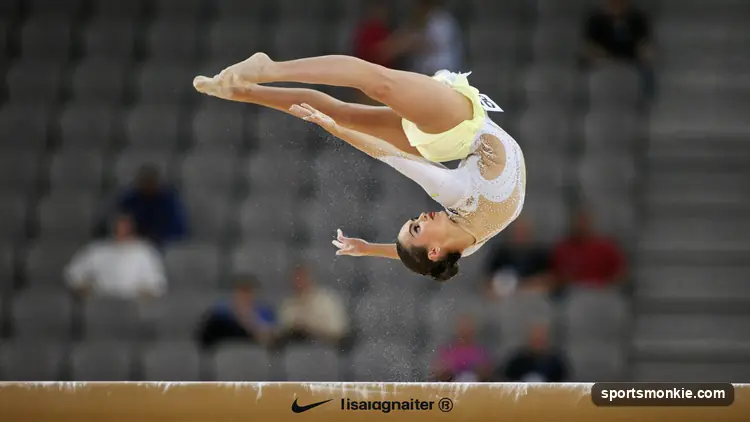
Greatest Female Gymnasts of All Time, Ranked by Medals
The greatest female gymnasts ranked on Olympic golds, total medals and named skills: Simone Biles, Larisa Latynina, Vera Caslavska, Nadia Comaneci and more.

The Most Difficult Sports to Master, Ranked and Explained
Some sports demand a rare blend of athleticism, precision, and mental toughness that makes mastery nearly impossible. Here are the hardest sports and why.

Olympic Heptathlon History, Records and Legends
A concise history of the Olympic heptathlon, from the pentathlon switch in 1984 to Joyner-Kersee, Thiam, Klüft, Ennis-Hill, Hall and records.
Best VNL Players: The Top Stars of the Nations League
The best VNL players, named and ranked: Wilfredo León, Yuji Nishida, Paola Egonu, Tijana Bošković, Gabi and more — with why each one made the list.

Most Marketable Athletes: Who Earns Most Off the Field
Shohei Ohtani earned $125m off the field in 2026, per Forbes. The most marketable athletes ranked by endorsement income, and why marketability differs from pay.

Highest-Paid WWE Women Wrestlers: What We Actually Know
The highest-paid WWE women wrestlers earn a reported $1m-$3m a year. Here are the figures that trace to real reporting, and how WWE contracts pay.