
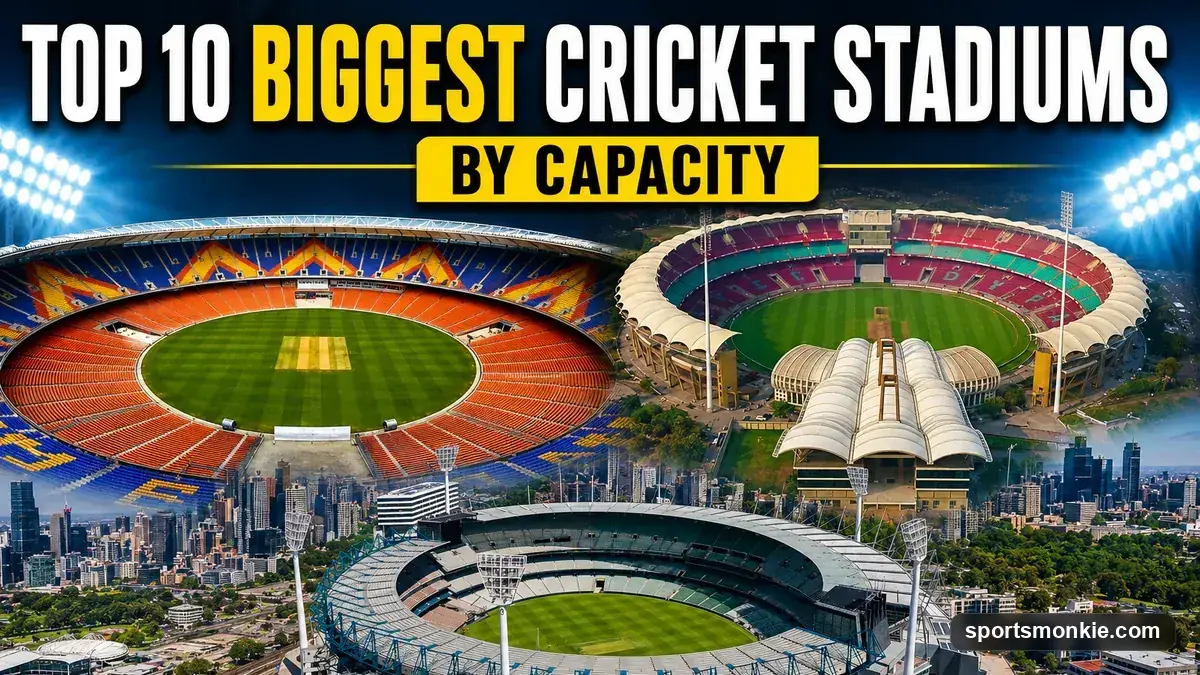
Biggest Cricket Stadiums in the World: Top 10 by Capacity
On this page15
- 01The biggest cricket stadiums at a glance
- 02Narendra Modi Stadium, Ahmedabad
- 03Melbourne Cricket Ground (MCG)
- 04Eden Gardens, Kolkata
- 05Shaheed Veer Narayan Singh Stadium, Raipur
- 06Optus Stadium (Perth Stadium)
- 07Rajiv Gandhi International Stadium, Hyderabad
- 08Adelaide Oval
- 09Greenfield International Stadium, Thiruvananthapuram
- 10Ekana Cricket Stadium, Lucknow
- 11DY Patil Stadium, Navi Mumbai
- 12How we ranked the biggest cricket stadiums
- 13Why India dominates the list
- 14At a glance: capacity comparison
- 15English and other notable grounds
Every place is decided by one number only: permanent seating capacity for cricket, taken from the most widely cited official and reference figures. Playing-area size does not factor in, since a cricket field varies little; where sources disagree, the more conservative capacity wins.
The biggest cricket stadiums at a glance
| Rank | Stadium | Approx. capacity |
|---|---|---|
| 1 | Narendra Modi Stadium | 132,000 |
| 2 | Melbourne Cricket Ground | 100,024 |
| 3 | Eden Gardens | 68,000 |
| 4 | Shaheed Veer Narayan Singh Stadium | 65,000 |
| 5 | Optus Stadium | 61,000 |
| 6 | Rajiv Gandhi International Stadium | 55,000 |
- World's largest
Narendra Modi Stadium, Ahmedabad
At around 132,000 seats, this is the biggest cricket stadium in the world and the highest-capacity stadium of any sport anywhere. Rebuilt from the ground up and reopened in 2020 in the Motera area of Ahmedabad, it hosted the final of the 2023 ICC Men's Cricket World Cup and is owned by the Gujarat Cricket Association.
It clears the second-place MCG by roughly 32,000 seats, a bigger gap than separates the MCG from the venue in tenth place. That margin is why no other ground is close to challenging its title, and it is scheduled among the hosts for the 2026 ICC Men's T20 World Cup.
City: Ahmedabad, India · Capacity: ~132,000 · Opened (rebuild): 2020 · Signature: 2023 World Cup final
- Historic giant
Melbourne Cricket Ground (MCG)
The MCG seats 100,024, making it the second-largest cricket venue and the biggest stadium in Australia across every sport. It hosts the annual Boxing Day Test, a fixture that regularly draws crowds above 80,000 across its opening days.
It ranks above Eden Gardens on capacity by more than 30,000 seats, and it is the only non-Indian ground in the top tier. The stadium doubles as the spiritual home of Australian Rules Football, which is why its capacity dwarfs purpose-built cricket grounds elsewhere.
City: Melbourne, Australia · Capacity: 100,024 · Signature: Boxing Day Test · Also hosts: AFL
- Oldest and loudest
Eden Gardens, Kolkata
Eden Gardens holds roughly 68,000 and dates to 1864, making it India's oldest major ground. Safety-driven renovations trimmed it from a far larger figure in earlier decades, but it remains the third-largest cricket venue on earth.
It edges out Raipur despite only a few thousand more seats because of its settled international pedigree: it has staged a World Cup final, countless Tests, and IPL fixtures, where Raipur is a newer entrant to the big-match rotation. Its reputation rests on crowd noise loud enough to unsettle touring sides.
City: Kolkata, India · Capacity: ~68,000 · Established: 1864 · Note: India's oldest Test ground
- Central India's arena
Shaheed Veer Narayan Singh Stadium, Raipur
Built in the planned city of Naya Raipur and seating around 65,000, this Chhattisgarh venue is among the largest in India by capacity. It gave central India its first genuine big-match arena.
It sits below Eden Gardens because its international schedule is still light by comparison, but it has increasingly hosted bilateral internationals and IPL matches since expanding its fixture list, closing the gap in profile if not in seats.
City: Naya Raipur, India · Capacity: ~65,000 · Region: Chhattisgarh · Use: internationals & IPL
- Modern multi-purpose
Optus Stadium (Perth Stadium)
Optus Stadium opened in 2018 and seats about 61,000 in its oval cricket configuration, expandable further for marquee events. It has become Western Australia's premier venue for Test and limited-overs cricket, taking over from the older WACA Ground.
It ranks above Hyderabad's Rajiv Gandhi Stadium on raw capacity by roughly 6,000 seats. Its retractable, flexible seating means the headline figure shifts between oval and rectangular setups, which is why published numbers for it vary.
City: Perth, Australia · Capacity: ~61,000 · Opened: 2018 · Formats: Tests, ODIs, T20Is
- IPL fortress
Rajiv Gandhi International Stadium, Hyderabad
Reported at around 55,000, the Uppal ground is the home of IPL side Sunrisers Hyderabad and a regular international host in southern India.
It slots below Optus because its capacity, while large, is a step down, and its figure is one of the more disputed on this list — some sources cite a reduced number after seating reconfigurations. Treated conservatively, it still comfortably clears the 50,000 line.
City: Hyderabad, India · Capacity: ~55,000 · IPL home: Sunrisers Hyderabad · Area: Uppal
- Redeveloped classic
Adelaide Oval
Adelaide Oval holds 53,583 after a major redevelopment completed in the 2010s that added grandstands while keeping its heritage scoreboard and northern hill.
Its distinct credential is pink-ball cricket: it staged the first-ever day-night Test in November 2015 and has anchored Australia's pink-ball schedule since. That history separates it from similarly sized Indian grounds lower on the list.
City: Adelaide, Australia · Capacity: 53,583 · Signature: first day-night Test, 2015
- South India newcomer
Greenfield International Stadium, Thiruvananthapuram
Greenfield opened in 2015 with a capacity around 50,000 and was built on a public-private partnership model, unusual for an Indian cricket ground.
It ranks just ahead of Lucknow's Ekana on the strength of its Kerala catchment and growing international slate, though the two are effectively tied on seats. It has hosted internationals across formats since its debut.
City: Thiruvananthapuram, India · Capacity: ~50,000 · Opened: 2015 · State: Kerala
- Franchise home
Ekana Cricket Stadium, Lucknow
The BRSABV Ekana Stadium seats roughly 50,000 and serves as the home of IPL franchise Lucknow Super Giants since their 2022 debut.
It shares eighth-ninth territory with Greenfield on capacity; it lands ninth here because its international history is shorter, having opened later and built its fixture list largely around the IPL and recent bilateral series.
City: Lucknow, India · Capacity: ~50,000 · IPL home: Lucknow Super Giants
Reader interaction
Build your ranking
Drag the entries into the order you think is right — or use the arrows — then submit to see how your list compares with everyone else's.
- Narendra Modi Stadium, Ahmedabad
- Melbourne Cricket Ground (MCG)
- Eden Gardens, Kolkata
- Shaheed Veer Narayan Singh Stadium, Raipur
- Optus Stadium (Perth Stadium)
- Rajiv Gandhi International Stadium, Hyderabad
- Adelaide Oval
- Greenfield International Stadium, Thiruvananthapuram
- Ekana Cricket Stadium, Lucknow
- DY Patil Stadium, Navi Mumbai
Audience ranking
How everyone ranked them
Built from reader rankings using position-based points.
The cards above rank the ten largest cricket grounds by seating capacity. The sections below explain how the order was set, why India supplies most of the list, and where the smaller but famous grounds fit.
How we ranked the biggest cricket stadiums
One metric decides everything here: permanent seating capacity configured for cricket. Playing-area size is deliberately excluded, because a cricket field varies only within a permitted range and does not swing dramatically from ground to ground. Capacity, by contrast, ranges from around 25,000 at a mid-size Test venue to 132,000 in Ahmedabad.
Three practical factors make those numbers slippery, so where reports conflicted we used the more conservative figure:
- Permanent versus temporary seating. Some grounds bolt on stands for marquee events, then strip them out, which moves the headline number.
- Safety and planning rules. Older grounds, Eden Gardens among them, have shed capacity over the decades as crowd-safety codes tightened.
- Configuration. Multi-purpose venues such as Optus Stadium seat different totals in oval and rectangular setups.
Why India dominates the list
Seven of the ten grounds are Indian, and that concentration is no accident. Cricket’s following in India is large enough to fill 50,000-plus arenas for domestic and franchise cricket, not only internationals, so state associations and the IPL have funded venues on a scale most countries cannot justify. Newer grounds in Raipur, Lucknow, and Thiruvananthapuram were built or expanded specifically to spread big-match cricket beyond the traditional metros. For contrast at the other end of the scale, see the smallest cricket stadium in the world.
At a glance: capacity comparison
| Rank | Stadium | City | Country | Approx. capacity |
|---|---|---|---|---|
| 1 | Narendra Modi Stadium | Ahmedabad | India | ~132,000 |
| 2 | Melbourne Cricket Ground | Melbourne | Australia | 100,024 |
| 3 | Eden Gardens | Kolkata | India | ~68,000 |
| 4 | Shaheed Veer Narayan Singh Stadium | Naya Raipur | India | ~65,000 |
| 5 | Optus Stadium | Perth | Australia | ~61,000 |
| 6 | Rajiv Gandhi International Stadium | Hyderabad | India | ~55,000 |
| 7 | Adelaide Oval | Adelaide | Australia | 53,583 |
| 8 | Greenfield International Stadium | Thiruvananthapuram | India | ~50,000 |
| 9 | Ekana Cricket Stadium | Lucknow | India | ~50,000 |
| 10 | DY Patil Stadium | Navi Mumbai | India | ~45,000 |
Figures are approximate and can vary with event configuration; the ranking uses the more conservative capacity where sources disagree.
English and other notable grounds
English venues are modest in size but heavy on prestige. Lord’s leads the country at roughly 31,000, with The Oval, Old Trafford, and Edgbaston in the 25,000 to 27,500 band. Outside England, Pakistan’s National Stadium in Karachi and the Gaddafi Stadium in Lahore hold in the region of 27,000 to 35,000. None reach the 50,000-plus figures common among the Indian and Australian grounds above, which is why the global top ten skews so heavily to those two countries.
For more on the sport itself, our guides to what a cricket bat is called and what a powerplay is in cricket cover the equipment and rules you will see in play at these venues.
Frequently asked questions
Is the Narendra Modi Stadium the biggest stadium of any sport, not just cricket?+
Yes. At around 132,000 seats it is the highest-capacity sports stadium in the world, ahead of the largest association-football, American-football, and athletics venues. Most of those top out in the 80,000 to 110,000 range, so Ahmedabad's ground is in a category of its own. Its capacity can shift slightly depending on the event configuration, but no other stadium currently comes close to matching it.
What is the largest cricket ground in England?+
Lord's in London is the biggest by seating capacity, holding roughly 31,000. The Oval, Old Trafford, and Edgbaston follow in the 25,000 to 27,500 range. That keeps every English ground well outside this global top ten, which is why none appear in the ranking above. English venues trade on heritage and prestige rather than size, with Lord's still regarded as the traditional home of the game.
Which country has the most of the biggest cricket stadiums?+
India, by a wide margin. Seven of the ten grounds here are Indian, led by the Narendra Modi Stadium and including Eden Gardens, Raipur, Hyderabad, Thiruvananthapuram, Lucknow, and Navi Mumbai. The pattern reflects the sport's enormous following and heavy stadium investment across the country. Australia supplies the other three top-ten venues, while England, Pakistan, and South Africa have historic but smaller grounds.
How does the biggest cricket stadium compare to the biggest football stadium?+
The Narendra Modi Stadium, at about 132,000, is larger than essentially any football stadium in the world. Below that outlier, though, the sports are broadly comparable: the biggest association-football and American-football venues cluster in the 80,000 to 110,000 range, which is roughly where the MCG sits. So cricket owns the single largest venue, but not a general size advantage across the board.
Why do reported cricket stadium capacities vary between sources?+
Grounds add or remove temporary seating for major events, and safety regulations often cut official figures over time. Day-night matches and T20 fixtures can also use different seating setups than five-day Tests. Multi-purpose venues like Optus Stadium change between oval and rectangular configurations. For those reasons, most published capacities are approximate, and this ranking uses the more conservative figure where sources disagree.
What is the largest cricket stadium outside India and Australia?+
Once you leave the top two cricket nations by stadium size, capacities drop sharply. England's Lord's leads at roughly 31,000. Pakistan's major grounds, the National Stadium in Karachi and the Gaddafi Stadium in Lahore, hold in the region of 27,000 to 35,000 depending on configuration. South Africa's largest venues sit in a similar band. None approach the 50,000-plus figures common among Indian and Australian grounds.
Sources
Play & tools
Free browser games and tools — no account, no download.
- Play today's Sports Connections — Today's Sports Connections — daily hints, answers, and play the grid.
- Play Guess the NFL Player — A new mystery NFL player every day. Eight guesses, with a clue on each — plus free unlimited mode.
- Explore all our games →
Related cricket guides
View all →
Smallest Cricket Stadium in the World: Bready Ground, 3,000 Capacity
Bready Cricket Club Ground in Northern Ireland (capacity 3,000) is the smallest venue to host international cricket, ranked against 7 other tiny ODI/T20I grounds.
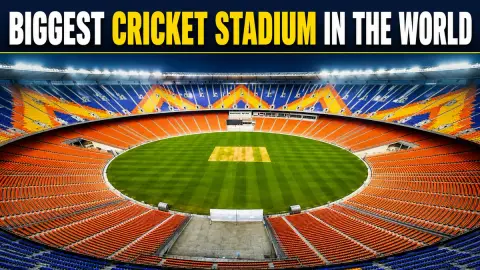
Biggest Cricket Stadium in the World: Narendra Modi Stadium (132,000)
The Narendra Modi Stadium in Ahmedabad holds 132,000 fans, making it the biggest cricket stadium in the world. See the full ranked list of the 12 largest grounds.
Longest Sixes in Cricket: The Biggest Hits Ever Recorded
The 12 longest sixes ever measured in cricket, ranked by distance — from Shahid Afridi's 153m strike at the Wanderers to Tim David's 129m hit in 2025.
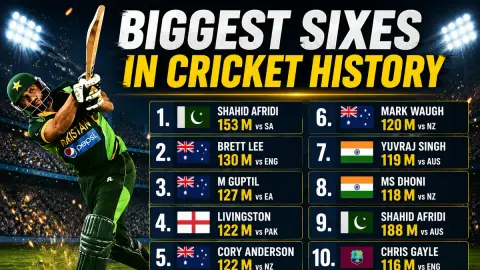
Biggest Sixes in Cricket History: The Longest Hits Ever Recorded
Shahid Afridi's 153m strike in Johannesburg tops most lists of the biggest sixes in cricket history. See the full leaderboard, the disputed measurements, and who's still chasing the record in 2026.

Most Successful Cricket Teams in History: The All-Time Rankings
Every major cricket nation ranked by ICC titles: Australia's 10 trophies, the West Indies dynasty, India's seven, and South Africa's 2025 WTC breakthrough.
Fastest Bowlers in Cricket History: Verified Speeds
Shoaib Akhtar's 161.3 km/h at the 2003 World Cup is still cricket's fastest recorded ball. All 12 quickest bowlers ever, ranked by speed, year, and venue.