
Longest Sixes in Cricket: The Biggest Hits Ever Recorded
On this page17
- 01Longest sixes in cricket at a glance
- 02Shahid Afridi
- 03Brett Lee
- 04Tim David
- 05Martin Guptill
- 06Liam Livingstone
- 07Corey Anderson
- 08Mark Waugh
- 09Yuvraj Singh
- 10MS Dhoni
- 11Shivam Dube
- 12Chris Gayle
- 13Ijaz Ahmed
- 14How six distance is actually measured
- 15Longest sixes in cricket, at a glance
- 16What makes a six travel far
- 17How we ranked them
Ranked strictly by the distance figure most consistently attributed to each hit across broadcasters and cricket outlets — not by a batter's overall reputation. Where sources diverged by a few metres, we used the number cited most often and flagged it as an estimate; older pre-ball-tracking hits are held to the same 'most-cited' standard, not upgraded.
Longest sixes in cricket at a glance
| Rank | Batter | Most-cited distance | Match context |
|---|---|---|---|
| 1 | Shahid Afridi | About 153m | Pakistan vs South Africa, 2013 |
| 2 | Brett Lee | About 130m | Australia vs West Indies, 2005 |
| 3 | Tim David | About 129m | Australia vs India, 2025 |
| 4 | Martin Guptill | About 127m | New Zealand vs South Africa, 2012 |
| 5 | Liam Livingstone | About 122m | England vs Pakistan, 2021 |
| 6 | Corey Anderson | About 122m | New Zealand vs India, 2014 |
- The 153m benchmark
Shahid Afridi
Afridi's six off South Africa at the Wanderers in the third ODI of March 2013 is the hit almost every "longest six" list puts at number one, cited at 153 metres and by some broadcasts as high as 158. It came inside an 88 off 48 balls, and the number sits so far clear of the rest of this list that even the conservative reading of it stays on top.
It ranks above Brett Lee's hit not just on distance but on setting: the Wanderers sits above 1,700m of altitude, where thinner air cuts drag and adds carry. The margin over everything below is why it survives even the heavy skepticism the bigger 158m figure attracts.
Team: Pakistan · Match: vs South Africa, Wanderers, Johannesburg, 2013 (3rd ODI) · Cited distance: ~153m (up to 158m) · Edge: hit at altitude
- Longest by a No. 10
Brett Lee
Lee is the outlier that makes this list interesting: a fast bowler batting in the tail, not a specialist hitter, credited with a roughly 130m six off Daren Powell during the 2005 Test against the West Indies at the Gabba. The ball cleared the stand roof and reached the practice area outside, which is why the figure held up.
He ranks second — above genuine power hitters like Guptill and Livingstone — purely on the number attached to that strike. It's the clearest evidence on this page that raw distance is a product of bat speed and clean contact, not batting order or run-scoring pedigree.
Team: Australia · Match: vs West Indies, Gabba, Brisbane, 2005 (Test) · Cited distance: ~130m · Note: hit as a No. 10
- Newest top-three hit
Tim David
David is the most recent name to crack the very top of this list, with a six off Axar Patel measured at 129 metres in the third T20I against India at Hobart in November 2025. It landed inside a 74 off 38 and briefly rivalled numbers set two decades earlier.
He edges Guptill for third on the raw figure, and the placement matters for another reason: it shows the modern game still produces hits that stand next to the historic benchmarks rather than just clustering in the 110s. David has built his IPL, Big Bash, and international career specifically around this finishing power.
Team: Australia · Match: vs India, Hobart, 2025 (3rd T20I) · Bowler: Axar Patel · Cited distance: ~129m
- Roof of the stand
Martin Guptill
Guptill's six off Lonwabo Tsotsobe in a 2012 T20I against South Africa, cited at about 127 metres, hit the roof of the stand and is regularly called the biggest in T20 international cricket. It arrived inside an unbeaten 78 built on hitting straight through the line rather than improvising.
He sits fourth because his figure trails David's by a couple of metres, but no batter below him held the "longest since" tag for as long: his 127m stood as the benchmark modern hit for years until Livingstone's 122m in 2021 was measured as the biggest recorded internationally in the interim.
Team: New Zealand · Match: vs South Africa, 2012 (T20I) · Bowler: Lonwabo Tsotsobe · Cited distance: ~127m
- Cleared the Headingley roof
Liam Livingstone
Livingstone's six off Haris Rauf in the second T20I against Pakistan at Headingley in 2021 cleared the stadium roof and landed on the rugby pitch next door, measured at about 122 metres. It was widely reported as the biggest hit recorded in international cricket since Guptill's 127m in 2012.
He ranks fifth, level on the figure with Corey Anderson but placed ahead because the distance isn't a one-off: he's been tracked past 110m repeatedly across T20Is, The Hundred, and franchise cricket, in almost any direction he chooses.
Team: England · Match: vs Pakistan, Headingley, 2021 (2nd T20I) · Bowler: Haris Rauf · Cited distance: ~122m
- Level on the number
Corey Anderson
Anderson's six against India in 2014 lands at roughly 122 metres, matching Livingstone's figure on most published lists. He arrived at that hit already holding what was then the fastest ODI century (36 balls, in 2014), so the raw power behind the strike was no surprise.
He's placed just below Livingstone despite the identical distance because his big-hitting resume is thinner — the fastest-hundred record and this six are the standout data points, rather than a decade of repeat 110m-plus carries.
Team: New Zealand · Match: vs India, 2014 · Cited distance: ~122m · Context: then-fastest ODI century holder
- Pre-tracking era
Mark Waugh
Waugh's six against New Zealand at the WACA in 1997, cited at about 120 metres, is the oldest hit high on this list and predates modern ball-tracking almost entirely. The WACA's fast, bouncy surface and open outfield made it a ground where the ball carried, and the strike is still referenced as one of the longest of its decade.
It ranks seventh on the estimate alone, but carries the biggest asterisk above it: the measurement methods of the late 1990s were far rougher than today's graphics, so the 120m figure is a period estimate rather than a tracked reading.
Team: Australia · Match: vs New Zealand, WACA, Perth, 1997 · Cited distance: ~120m · Caveat: pre-ball-tracking estimate
- Six-sixes tournament
Yuvraj Singh
Yuvraj's six against Australia at the 2007 T20 World Cup, cited at around 119 metres, came in the same tournament where he hit six sixes in an over off Stuart Broad. Among all his big hits that September, this is the one singled out for distance rather than sequence.
He edges Dhoni for eighth because the figure is a metre longer, and it fits a wider pattern: Yuvraj was the destructive middle-order hitter of that India side, the batter opponents planned the death overs around.
Team: India · Match: vs Australia, T20 World Cup, 2007 · Cited distance: ~119m · Same event: six sixes off Stuart Broad
- Flat and far
MS Dhoni
Dhoni's six against New Zealand in 2009, cited at about 118 metres, is notable for how little it looked like maximum effort — a flat, wristy strike rather than a full swing. It ranks among the longest ever recorded by an Indian batter.
He sits ninth, a metre behind Yuvraj, and the placement suits the contrast: where Yuvraj generated distance through bat speed and a big backswing, Dhoni relied on balance and wrist strength — the same finishing method that defined the next decade of his white-ball career.
Team: India · Match: vs New Zealand, 2009 · Cited distance: ~118m · Style: flat, wrist-driven strike
- Out of the stadium
Shivam Dube
Dube's six off Adam Zampa in the 2025 T20I series against Australia — struck at Carrara, not the Hobart leg where Tim David hit his — is cited around 117 metres and cleared the stadium entirely. It's one of the most recent entries here and a sign India's middle order keeps producing genuine distance.
He ranks tenth, just behind Dhoni, and the near-miss on the older Indian figures is the point: Dube has built his international case largely on exactly this kind of closing-overs power against spin.
Team: India · Match: vs Australia, 2025 (T20I series) · Bowler: Adam Zampa · Cited distance: ~117m
- World Cup opener
Chris Gayle
Gayle's six against India at the 2010 T20 World Cup, cited at about 116 metres, is one of many huge hits across a career built almost entirely around clearing the rope. By total sixes, he remains one of the leading six-hitters in international cricket.
He ranks eleventh here because this list measures a single distance, not volume — and on that one metric his longest-cited strike trails the hitters above him, even though his career six count dwarfs most of theirs.
Team: West Indies · Match: vs India, T20 World Cup, 2010 · Cited distance: ~116m · Known for: career six volume
- Before the T20 era
Ijaz Ahmed
Ahmed's six against India in 1999, cited at roughly 115 metres, is the second-oldest hit on this list after Waugh's and the most easily overlooked, because it predates the T20 boom that turned distance hitting into a specialist skill.
He closes the list on the smallest of the cited figures, but the entry earns its place as a corrective: big power existed well before modern bats and franchise cricket made it routine — Ahmed simply didn't have broadcast tracking to put a number on the screen.
Team: Pakistan · Match: vs India, 1999 · Cited distance: ~115m · Note: pre-T20-era hit
Reader interaction
Build your ranking
Drag the names into the order you think is right — or use the arrows — then submit to see how your list compares with everyone else's.
- Shahid Afridi
- Brett Lee
- Tim David
- Martin Guptill
- Liam Livingstone
- Corey Anderson
- Mark Waugh
- Yuvraj Singh
- MS Dhoni
- Shivam Dube
- Chris Gayle
- Ijaz Ahmed
Audience ranking
How everyone ranked them
Built from reader rankings using position-based points.
A cricket ball struck off the middle of a modern bat can travel more than two car-lengths past the boundary rope. That’s the scale involved when broadcasters flash a number past 120 metres on screen after a huge six. No single body certifies these distances — they come from broadcast ball-tracking that varies between leagues and eras — but a small group of hits are consistently cited as the biggest ever measured. The ranking above uses the figure most often attributed to each.
How six distance is actually measured
There is no standardized, cross-cricket system for measuring a six. Broadcasters and leagues rely on ball-tracking and graphics overlays, and both the technology and the method differ between competitions and decades. That’s why more than one figure sometimes attaches to the same shot — Afridi’s Wanderers hit alone is reported anywhere from 153 to 158 metres. Every distance in the ranking is the leading estimate, not a certified reading, and the order reflects the best available evidence rather than an official record book.
Longest sixes in cricket, at a glance
| Rank | Batter | Team | Distance | Match |
|---|---|---|---|---|
| 1 | Shahid Afridi | Pakistan | ~153m | vs South Africa, Wanderers, 2013 |
| 2 | Brett Lee | Australia | ~130m | vs West Indies, Gabba, 2005 |
| 3 | Tim David | Australia | ~129m | vs India, Hobart, 2025 |
| 4 | Martin Guptill | New Zealand | ~127m | vs South Africa, 2012 |
| 5 | Liam Livingstone | England | ~122m | vs Pakistan, Headingley, 2021 |
| 6 | Corey Anderson | New Zealand | ~122m | vs India, 2014 |
| 7 | Mark Waugh | Australia | ~120m | vs New Zealand, WACA, 1997 |
| 8 | Yuvraj Singh | India | ~119m | vs Australia, T20 World Cup, 2007 |
| 9 | MS Dhoni | India | ~118m | vs New Zealand, 2009 |
| 10 | Shivam Dube | India | ~117m | vs Australia, 2025 |
| 11 | Chris Gayle | West Indies | ~116m | vs India, T20 World Cup, 2010 |
| 12 | Ijaz Ahmed | Pakistan | ~115m | vs India, 1999 |
What makes a six travel far
- Bat speed and timing. Hitting the sweet spot at maximum bat speed matters more than anything else here, which is why modern cricket bats with bigger sweet spots have shifted average distances upward.
- Launch angle. Too flat or too steep both cost distance; the productive window sits roughly between 25 and 35 degrees.
- Altitude. Grounds at elevation, like the Wanderers in Johannesburg, sit in thinner air that adds metres — a factor that recurs among the biggest sixes in cricket on record.
- Ground dimensions. Cricket grounds vary widely in size and shape, part of why comparing distances across venues is inexact.
- Wind. A following wind can add real distance on its own, on top of everything the batter does technically.
How we ranked them
The list is built from the distance figures most consistently cited by broadcasters, statisticians, and cricket outlets for each hit, cross-checked where sources diverged. Six distances have never been an ICC-certified statistic, so where numbers disagreed by a few metres we used the figure appearing most often and marked it as an estimate. Ranking is by that estimated distance, not by a batter’s overall power-hitting reputation — which is why some feared hard hitters with enormous career six counts don’t appear here despite being built for exactly this shot. Older hits from Mark Waugh and Ijaz Ahmed carry the widest margin of error, because the measurement tools of their era were far rougher than today’s ball-tracking graphics.
Frequently asked questions
Who hit the longest six in cricket history?+
Shahid Afridi's six against South Africa at the Wanderers in Johannesburg in 2013 is the figure most widely cited as the longest on record, listed at 153 metres and by some broadcasts as high as 158. Because six distances are read off broadcast ball-tracking graphics rather than certified by any governing body, different outlets attach slightly different numbers to the same swing, so treat 153m as the leading estimate.
Are six distances officially recorded by the ICC?+
No. The ICC keeps no official register of six distances, and there is no certified 'longest six' record. Every figure on this page — and on any similar list — comes from broadcasters' ball-tracking and graphics systems, which differ in method between leagues, grounds, and eras. That's why the same hit can be reported at several different lengths. Read all of these numbers as the best available estimate rather than a ratified record.
Does altitude really make sixes travel farther?+
Yes, measurably. Grounds at elevation sit in thinner air with less aerodynamic drag, so a well-struck ball carries several extra metres compared with the same shot at sea level. The Wanderers in Johannesburg, where Afridi hit his 153m six, sits above 1,700 metres and is one of the reasons that strike stands so far clear of the rest. Wind and ground dimensions add further variation between venues.
What is the longest six in T20 World Cup history?+
Yuvraj Singh's roughly 119-metre six against Australia at the 2007 T20 World Cup and Chris Gayle's 116-metre hit against India at the 2010 tournament are the two most commonly cited as the biggest on the World Cup stage. Both figures come from broadcast tracking rather than an official record, so they're best read as the leading estimates for the event rather than certified marks.
How far does a typical T20 six travel?+
Most sixes in professional T20 cricket land in the 70 to 95 metre range. Clearing 100 metres puts a batter in a much smaller group, and the very longest hits ever recorded sit between roughly 115 and 153 metres. In other words, the strikes on this list are extreme outliers — often 30 to 60 metres beyond an ordinary maximum, which is why they get their own on-screen graphic.
Why do modern batters seem to hit sixes farther than past generations?+
Two things changed. Modern bats carry thicker edges and larger sweet spots, and players now train specifically for rotational power and bat speed rather than treating big hitting as a bonus. T20 field restrictions also reward attacking shots, so batters practice clearing the rope far more than earlier generations did. The tracking is newer too, so older hits like Mark Waugh's 1997 six carry rougher, harder-to-compare estimates.
Sources
Play & tools
Free browser games and tools — no account, no download.
- Play today's Sports Connections — Today's Sports Connections — daily hints, answers, and play the grid.
- Play Guess the NFL Player — A new mystery NFL player every day. Eight guesses, with a clue on each — plus free unlimited mode.
- Explore all our games →
Related cricket guides
View all →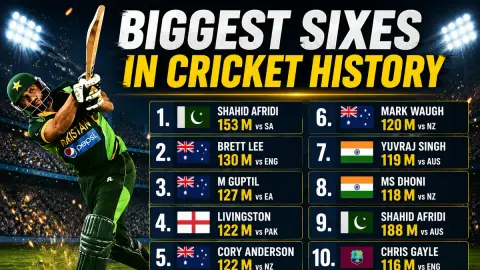
Biggest Sixes in Cricket History: The Longest Hits Ever Recorded
Shahid Afridi's 153m strike in Johannesburg tops most lists of the biggest sixes in cricket history. See the full leaderboard, the disputed measurements, and who's still chasing the record in 2026.
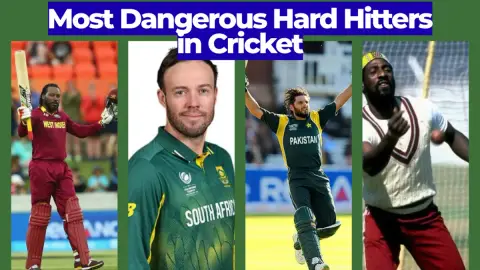
Most Dangerous Hard Hitters in Cricket, Ranked
The 12 most dangerous hard hitters in cricket, ranked with six counts, strike rates, and records — from Viv Richards and Chris Gayle to Rohit Sharma and Andre Russell.

Biggest Cricket Stadiums in the World: Top 10 by Capacity
The biggest cricket stadiums ranked by seating capacity, from India's 132,000-seat Narendra Modi Stadium and the MCG to Eden Gardens, Raipur, and Perth's Optus.
Most Sixes in International Cricket (All-Time List)
Rohit Sharma holds the record for most sixes in international cricket, passing Chris Gayle's 553 in 2023. Full all-time list across Tests, ODIs and T20Is.

Longest Six in Cricket History: Shahid Afridi's Disputed 153m Claim, Ranked
Shahid Afridi's 153–160m six at the Wanderers in 2013 is the most-cited longest six in cricket history, but independent remeasurement puts it closer to 100–120m. Every major claim from 1856 to 2026, ranked and fact-checked.

Most Sixes in T20I Cricket: All-Time Records and Top Hitters
Rohit Sharma and Martin Guptill lead the way for most sixes in T20 Internationals. See the biggest hitters, key records, and what defines T20I six-hitting.