
Fastest Bowlers in Cricket History: Verified Speeds

On this page18
- 01The fastest bowlers at a glance
- 02Shoaib Akhtar (Pakistan)
- 03Brett Lee (Australia)
- 04Shaun Tait (Australia)
- 05Jeff Thomson (Australia)
- 06Mitchell Starc (Australia)
- 07Andy Roberts (West Indies)
- 08Fidel Edwards (West Indies)
- 09Mitchell Johnson (Australia)
- 10Mohammad Sami (Pakistan)
- 11Shane Bond (New Zealand)
- 12Lasith Malinga (Sri Lanka)
- 13Dale Steyn (South Africa)
- 14How We Ranked This List
- 15How Bowling Speed Is Actually Measured
- 16The Pre-Radar Era Caveat
- 17League Speeds vs International Speeds
- 18Pace That Turned Into Wickets
We rank each bowler by their single fastest delivery officially recorded in international cricket (Test, ODI, or T20I), taken from the match's speed-gun reading and cross-checked against ESPNcricinfo. Radar-era readings outrank 1970s photo-sonic estimates, and league-only speeds are noted separately rather than folded into the ranking.
The fastest bowlers at a glance
| Rank | Bowler | Fastest recorded delivery |
|---|---|---|
| 1 | Shoaib Akhtar | 161.3 km/h |
| 2 | Brett Lee | 161.1 km/h |
| 3 | Shaun Tait | 161.1 km/h |
| 4 | Jeff Thomson | About 160.6 km/h; estimated |
| 5 | Mitchell Starc | 160.4 km/h; Test record |
| 6 | Andy Roberts | About 159.5 km/h; estimated |
- The record
Shoaib Akhtar (Pakistan)
Akhtar's 161.3 km/h (100.2 mph) ball to England's Nick Knight at Newlands, Cape Town, is the only delivery ever officially confirmed above 100 mph in international cricket, and it has stood since the 2003 World Cup. He ranks first not on a single freak reading but on the whole over: 153.3, 158.4, 158.5, 157.4, 159.5, then 161.3 km/h, averaging above 158.
That over separates him from Brett Lee and Shaun Tait below, who each hit 161.1 km/h in isolation but never strung together a comparable sequence. Injuries limited how often the "Rawalpindi Express" played, but at full tilt he set the ceiling the sport still measures pace against.
Country: Pakistan · Speed: 161.3 km/h (100.2 mph) · When: 2003 World Cup vs England, Cape Town · Note: only ratified 100 mph ball
- Fastest Australian
Brett Lee (Australia)
Lee's 161.1 km/h (100.1 mph) delivery in Napier in 2005 came inside an over that included two balls above 160 km/h, making him the quickest Australian ever measured. He edges Shaun Tait for second on longevity: Lee sat near the top of the speed charts for more than a decade, not a single season.
What has never happened is ratification past Akhtar, despite recurring "Lee bowled the fastest ever" headlines. His fastest confirmed reading remains 0.2 km/h short of the record.
Country: Australia · Speed: 161.1 km/h (100.1 mph) · When: 2005 ODI vs New Zealand, Napier
- Comeback thunderbolt
Shaun Tait (Australia)
Tait matched Lee's 161.1 km/h (100.1 mph) at Lord's in 2010, bowling it after returning to the Australian side from a long injury lay-off. He ranks below Lee despite the identical top speed because his career was shorter and repeatedly interrupted by the physical cost of slinging at extreme pace.
His action was a genuine slingshot, generating that speed from a lower release than most, which made him awkward as well as fast in the shortest formats.
Country: Australia · Speed: 161.1 km/h (100.1 mph) · When: 2010 ODI vs England, Lord's
- Pre-radar estimate
Jeff Thomson (Australia)
A 1975 University of Western Australia study using photo-sonic cameras clocked Thomson at roughly 160.6 km/h (99.8 mph) against the West Indies at the WACA in Perth. On raw number he would sit near the top, and many argue he was the fastest ever.
He ranks fourth here, not higher, because the measurement predates standardized radar by more than two decades. Most record-keepers treat the figure as a strong historical estimate rather than a like-for-like peer of post-1999 readings, so it cannot outrank the confirmed radar marks above it.
Country: Australia · Speed: ~160.6 km/h (99.8 mph, estimated) · When: 1975 photo-sonic study, WACA Perth
- Test-match record
Mitchell Starc (Australia)
Starc's 160.4 km/h (99.7 mph) yorker to New Zealand's Ross Taylor at the WACA in November 2015 is a separate Guinness-recognized sub-record: the fastest ball ever bowled in a Test match. The four faster confirmed deliveries — Akhtar, Lee, Tait — all came in one-day cricket.
That makes him the outlier on this list: the others peaked in the white-ball formats that reward raw speed, while Starc hit his top number in the format that most rewards control.
Country: Australia · Speed: 160.4 km/h (99.7 mph) · When: 2015 Test vs New Zealand, WACA Perth · Note: fastest in Test cricket
- Pre-radar estimate
Andy Roberts (West Indies)
The same 1975 WACA study timed Roberts at around 159.5 km/h (99.1 mph) against Australia, placing him just behind fellow subject Jeff Thomson. He is the fastest West Indian on record and the leading edge of that side's fearsome 1970s–80s pace battery.
Like Thomson, his figure carries the photo-sonic asterisk: significant, but measured differently enough from modern radar that it sits below the confirmed sub-160 readings for ranking purposes.
Country: West Indies · Speed: ~159.5 km/h (99.1 mph, estimated) · When: 1975 photo-sonic study, WACA Perth
- Radar-era West Indian
Fidel Edwards (West Indies)
Edwards reached 157.7 km/h (98.0 mph) in 2003 against South Africa, the fastest ball recorded by a West Indian under modern radar. He ranks above the mid-150s group on that reading alone.
His round-arm slinging action, closer to Malinga's than to a classical high release, let a bowler of modest height generate top-tier pace, though it also contributed to a career punctuated by injury.
Country: West Indies · Speed: 157.7 km/h (98.0 mph) · When: 2003 vs South Africa
- Series-defining spell
Mitchell Johnson (Australia)
Johnson clocked 156.8 km/h (97.4 mph) during the 2013–14 Ashes, a series in which his pace and steep bounce reshaped the result and took 37 wickets. He edges the bowlers below because that speed came in sustained hostile spells, not a lone quick ball.
His left-arm angle across right-handers, combined with that raw velocity, is why the number mattered on the scoreboard and not just on the speed gun.
Country: Australia · Speed: 156.8 km/h (97.4 mph) · When: 2013–14 Ashes vs England
- Tied — mid-150s
Mohammad Sami (Pakistan)
Sami hit 156.4 km/h (97.2 mph) against Zimbabwe in Sharjah in 2003, one of the quickest deliveries by a Pakistani after Akhtar. He shares ninth with Shane Bond on an identical reading from the same year.
Sami's career never fully matched that raw speed with consistent wicket-taking, which is part of why he is remembered more for the radar number than for a dominant record.
Country: Pakistan · Speed: 156.4 km/h (97.2 mph) · When: 2003 vs Zimbabwe, Sharjah
- Tied — mid-150s
Shane Bond (New Zealand)
Bond matched 156.4 km/h (97.2 mph) at the 2003 World Cup against India, in a spell remembered for rattling Sourav Ganguly and Virender Sehwag. He shares ninth with Mohammad Sami on the same figure.
Bond ranks as New Zealand's fastest and among its most effective when fit, but a run of back injuries and an ICL ban cut his international appearances to a fraction of his talent.
Country: New Zealand · Speed: 156.4 km/h (97.2 mph) · When: 2003 World Cup vs India
- Tied — slinger
Lasith Malinga (Sri Lanka)
Malinga's 155.7 km/h (96.8 mph) came against New Zealand at the 2011 World Cup in Mumbai. He shares 11th with Dale Steyn, but generated his pace from a distinctive low, round-arm slingshot rather than a classical action.
That release made his yorker one of the hardest balls to read at the death, turning raw speed into a specialist white-ball weapon rather than pure express bowling.
Country: Sri Lanka · Speed: 155.7 km/h (96.8 mph) · When: 2011 World Cup vs New Zealand, Mumbai
- Tied — complete quick
Dale Steyn (South Africa)
Steyn's career-best sits at 155.7 km/h (96.8 mph), tying Malinga, though the exact fixture is reported inconsistently across sources, so we flag it rather than assign a match we cannot confirm. His placement here is about top speed, not overall standing.
By wickets and skill he outranks most of this list — 439 Test wickets at an elite average — but this ranking measures peak pace, where his best reading lands in the mid-150s.
Country: South Africa · Speed: 155.7 km/h (96.8 mph) · When: career-best (exact match disputed)
Reader interaction
Build your ranking
Drag the names into the order you think is right — or use the arrows — then submit to see how your list compares with everyone else's.
- Shoaib Akhtar (Pakistan)
- Brett Lee (Australia)
- Shaun Tait (Australia)
- Jeff Thomson (Australia)
- Mitchell Starc (Australia)
- Andy Roberts (West Indies)
- Fidel Edwards (West Indies)
- Mitchell Johnson (Australia)
- Mohammad Sami (Pakistan)
- Shane Bond (New Zealand)
- Lasith Malinga (Sri Lanka)
- Dale Steyn (South Africa)
Audience ranking
How everyone ranked them
Built from reader rankings using position-based points.
The cards above rank every bowler by their fastest officially measured delivery. This section explains how those numbers are captured, why two 1970s readings sit lower than their raw figures suggest, and how league speeds compare.
How We Ranked This List
Each bowler is placed by their single fastest delivery officially recorded in an international match — Test, ODI, or T20I — using the speed-gun or radar figure captured at the time and cross-checked against ESPNcricinfo and contemporaneous reporting. Confirmed radar-era readings take priority. Where two bowlers share an identical top speed, we break the tie on the surrounding evidence: the sequence of the over, longevity at that pace, and the format the speed was set in. Jeff Thomson and Andy Roberts, whose only figures come from a 1975 photo-sonic study, are ranked below the confirmed sub-160 marks even though their estimated numbers are higher, because the measurement is not directly comparable.
How Bowling Speed Is Actually Measured
Modern broadcast systems clock the ball with a radar gun or camera-based tracking positioned near the sight screen, timing it shortly after it leaves the hand. Because a cricket ball decelerates through the air, the released speed is always higher than the speed at the batter, and the on-screen number reflects that early reading. This standardization only arrived around 1999–2003, which is the dividing line for this ranking. Anything measured before it — including the celebrated 1970s WACA tests — used academic equipment under different conditions, so those results are treated as estimates, not ratified records.
The Pre-Radar Era Caveat
Thomson and Roberts are cricket’s great “what if” cases. The 1975 University of Western Australia study genuinely suggests both bowled at or above 159 km/h, and plenty of contemporaries insist Thomson was the fastest they ever faced. But photo-sonic cameras, a single test session, and no repeatable calibration make the figures impossible to slot cleanly alongside a broadcast radar reading from Cape Town or Napier. That is why they carry an estimate flag here rather than a top-two ranking — a judgment about measurement, not about how frightening they were.
League Speeds vs International Speeds
Franchise T20 leagues produce eye-catching numbers, but venue radar calibration varies enough that we keep them out of the main ranking. The table below shows how the quickest recent league deliveries stack up against the international ceiling.
| Reading | Bowler | Speed | Where |
|---|---|---|---|
| International record | Shoaib Akhtar | 161.3 km/h | 2003 World Cup |
| Fastest in a Test | Mitchell Starc | 160.4 km/h | 2015, Perth |
| Fastest in IPL | Shaun Tait | 157.7 km/h | IPL (franchise) |
| Fastest by an Indian (IPL) | Umran Malik | 157.0 km/h | IPL 2022 |
| Notable recent (IPL) | Mayank Yadav | 156.7 km/h | IPL 2024 |
Even the quickest league spells of the past few years land roughly 4 km/h short of Akhtar’s international mark, which is the clearest sign the record is about a biological ceiling, not a lack of trying.
Pace That Turned Into Wickets
Bowling 150-plus km/h once is rare; doing it spell after spell, staying fit, and hitting a testing length at that speed is rarer still. Every bowler ranked above turned raw pace into wickets rather than radar-gun trivia — the same quality that defines the sport’s greatest fast bowlers. For who is quickest across formats today, see our breakdown of the current fastest bowlers; for the mechanics behind extreme pace, read how bowlers train to bowl faster and the different types of bowling in cricket.
Frequently asked questions
How is bowling speed measured in cricket?+
Since the early 2000s, broadcast radar guns and camera-based tracking systems positioned near the sight screen clock the ball shortly after release, and that reading is the number shown on TV. Speed drops between release and the batter, so the figure captures the fastest point of the delivery. Earlier eras relied on slower, less standardized academic studies, which is why some historic top speeds remain disputed rather than officially ratified.
Why has no one beaten Shoaib Akhtar's record since 2003?+
Human anatomy caps how fast an arm can rotate, and most bowlers plateau in the mid-150s because pushing past it sharply raises injury risk. Akhtar sat at the extreme edge of that ceiling and paid for it with recurring breakdowns. Modern sports science has improved fitness and workload management, but it has not moved the biological limit, so radar readings have clustered just below 161 km/h for two decades rather than climbing past it.
How fast did Jeff Thomson really bowl?+
A 1975 University of Western Australia study using photo-sonic cameras clocked Thomson at roughly 160.6 km/h against the West Indies at the WACA in Perth. That predates radar-gun cricket by more than two decades, so most record-keepers treat it as a strong estimate rather than a confirmed equal of post-1999 readings. It is why he appears fourth here rather than challenging Akhtar for the outright top spot despite the higher raw figure.
What is the fastest ball ever bowled in a Test match?+
Mitchell Starc's 160.4 km/h (99.7 mph) yorker to New Zealand's Ross Taylor at the WACA in Perth in November 2015 is the fastest delivery officially recorded in Test cricket, per Guinness World Records. It is a separate sub-record because the quicker balls from Akhtar, Lee, and Tait all came in one-day cricket. Test speeds tend to run lower because the red-ball format rewards sustained control and length over one-off maximum pace.
Is anyone in 2026 bowling close to the record?+
No. As of 2026 no active international bowler has been officially clocked above 158 km/h. The quickest recent deliveries have come in T20 leagues rather than international cricket: Umran Malik reached 157 km/h in the 2022 IPL and Anrich Nortje 156.2 km/h in the 2020 IPL, both still around 4 km/h short of Akhtar. Occasional readings above 160 km/h circulate online but are usually uncalibrated or later corrected.
Do IPL and franchise-league speeds count on this list?+
We keep them separate. League radar calibration varies by venue and tournament, and a reading taken on one ground's equipment is not directly comparable to an ICC international fixture. Fast league deliveries — Umran Malik's 157 km/h and Mayank Yadav's 156.7 km/h in IPL 2024 — are noted as context but not folded into the international ranking, so every entry above is judged on the same class of measurement.
Sources
Play & tools
Free browser games and tools — no account, no download.
- Play today's Sports Connections — Today's Sports Connections — daily hints, answers, and play the grid.
- Play Guess the NFL Player — A new mystery NFL player every day. Eight guesses, with a clue on each — plus free unlimited mode.
- Explore all our games →
Related cricket guides
View all →
Tallest Bowlers in Cricket History
Mohammad Irfan, at 7 ft 1 in, is the tallest bowler in cricket history. Here are the giants of fast bowling and how their height turned into steepling bounce.

Most Successful Cricket Teams in History: The All-Time Rankings
Every major cricket nation ranked by ICC titles: Australia's 10 trophies, the West Indies dynasty, India's seven, and South Africa's 2025 WTC breakthrough.

Greatest Batsmen in Cricket History, Ranked
The 12 greatest batsmen in cricket history ranked — Bradman, Tendulkar, Lara, Richards, Sobers, Kohli and more, with the averages, runs and records behind each name.
Fastest Century in Cricket (Every Format)
AB de Villiers holds the fastest ODI century at 31 balls. The fastest hundreds in T20, ODI and Test cricket explained, with the record-holders for each format.
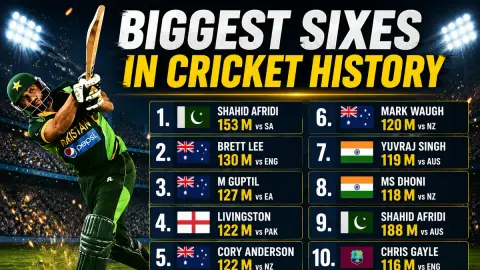
Biggest Sixes in Cricket History: The Longest Hits Ever Recorded
Shahid Afridi's 153m strike in Johannesburg tops most lists of the biggest sixes in cricket history. See the full leaderboard, the disputed measurements, and who's still chasing the record in 2026.

Longest Six in Cricket History: Shahid Afridi's Disputed 153m Claim, Ranked
Shahid Afridi's 153–160m six at the Wanderers in 2013 is the most-cited longest six in cricket history, but independent remeasurement puts it closer to 100–120m. Every major claim from 1856 to 2026, ranked and fact-checked.