
Biggest Cricket Stadium in the World: Narendra Modi Stadium (132,000)
On this page6
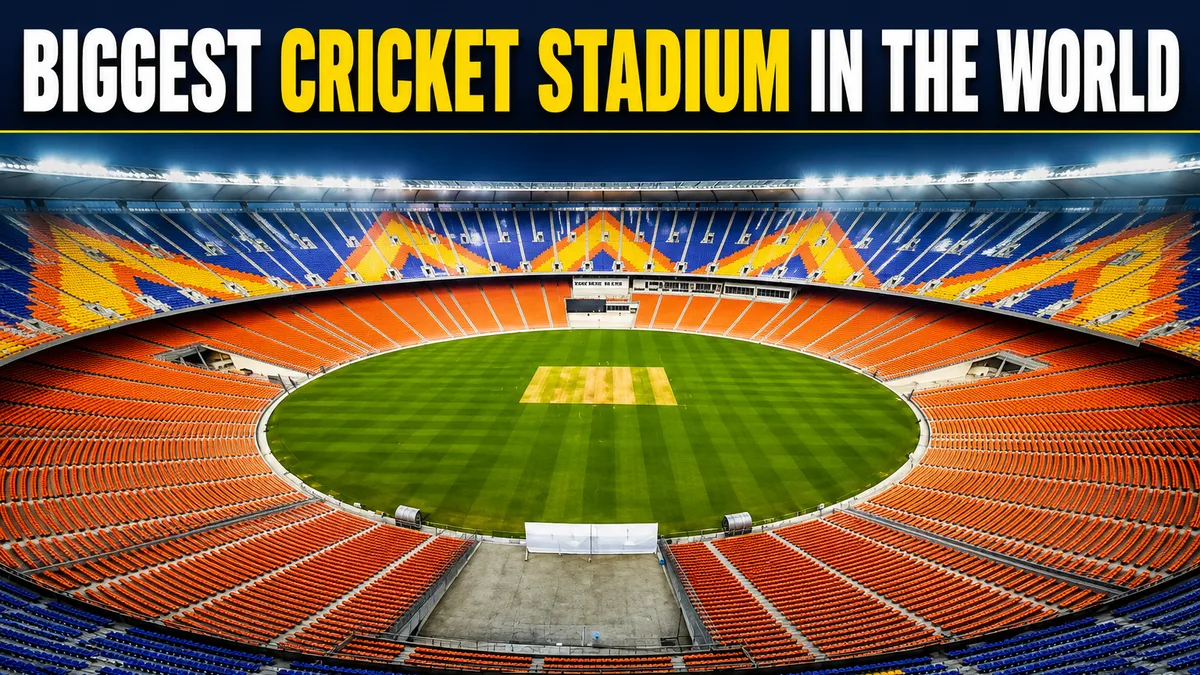
The biggest cricket stadium in the world is the Narendra Modi Stadium in Ahmedabad, India, with an official seating capacity of 132,000. That single number puts it not just at the top of cricket’s own leaderboard but ahead of every other stadium on the planet, cricket or otherwise. Second place, the Melbourne Cricket Ground, seats 100,024, a gap of roughly 32,000 seats that no other ground in the sport comes close to closing.
Quick Facts: Narendra Modi Stadium at a Glance
| Detail | Information |
|---|---|
| Location | Motera, Ahmedabad, Gujarat, India |
| Official capacity | 132,000 |
| Rank among all sports stadiums | 1st in the world |
| Reopened (current structure) | February 2020 |
| Previous name | Sardar Patel Stadium / Motera Stadium |
| Owner | Gujarat Cricket Association |
| Home franchise | Gujarat Titans (IPL) |
| Practice pitches | 11 |
| Dressing rooms | 4 |
The World’s Biggest Cricket Stadiums, Ranked
Capacity in cricket swings far more than the playing area does, since the field itself sits within a fairly narrow permitted range. What separates a 30,000-seat ground from a 130,000-seat one is stands, tiers, and how much a region has been willing to build. Here are the 12 largest cricket venues on earth by seating capacity, verified against ESPNcricinfo, Wikipedia, and official team or venue sources.
| Rank | Stadium | City, Country | Capacity | Opened / Rebuilt |
|---|---|---|---|---|
| 1 | Narendra Modi Stadium | Ahmedabad, India | 132,000 | 2020 |
| 2 | Melbourne Cricket Ground (MCG) | Melbourne, Australia | 100,024 | 1853 (current form) |
| 3 | Eden Gardens | Kolkata, India | ~66,000–68,000* | 1864 |
| 4 | Shaheed Veer Narayan Singh Intl. Stadium | Naya Raipur, India | ~65,000 | 2008 |
| 5 | Optus Stadium (Perth Stadium) | Perth, Australia | 61,266 (~55,000 for cricket)* | 2018 |
| 6 | Rajiv Gandhi Intl. Cricket Stadium | Hyderabad, India | 55,000 design cap.* | 2003 |
| 7 | Greenfield International Stadium | Thiruvananthapuram, India | ~50,000–55,000* | 2015 |
| 8 | Adelaide Oval | Adelaide, Australia | 53,500 | Renovated 2013 |
| 9 | Sydney Cricket Ground (SCG) | Sydney, Australia | 48,000 | Est. 1848 |
| 10 | Arun Jaitley Stadium | Delhi, India | ~41,000–48,000* | Est. 1883 |
| 11 | M.A. Chidambaram Stadium | Chennai, India | ~38,000 | Est. 1916 |
| 12 | Wankhede Stadium | Mumbai, India | 33,108 | Renovated 2011 |
*Figures marked with an asterisk are genuinely disputed or configuration-dependent across otherwise reliable sources; see the methodology note below.
India supplies eight of the twelve biggest grounds, a direct reflection of the sport’s scale there. Australia holds the rest of the top ten, and once the list drops below roughly 48,000 seats, England’s Lord’s (around 31,000) and The Oval (around 25,500) enter the picture, but neither cracks this top 12.
How This List Is Ranked
Every entry here is ranked by official or most-commonly-cited seating capacity, cross-checked against at least two independent sources: ESPNcricinfo ground profiles, Wikipedia venue pages, official cricket board or stadium sites, and ICC tournament venue listings. Where sources disagreed, that is flagged in the table rather than smoothed over. Three recurring reasons for the disagreement:
- Design capacity versus matchday capacity. Rajiv Gandhi International Stadium in Hyderabad has a design capacity of 55,000, but reported matchday configurations for international fixtures have run closer to 39,000.
- Multi-sport configuration. Perth’s Optus Stadium seats 61,266 in full multi-purpose mode but is more often cited around 55,000 for cricket’s oval layout.
- Renovation history. Wankhede Stadium’s 33,108 seats today are down sharply from roughly 45,000 before its 2011 World Cup-driven rebuild, so older sources still float the larger number.
Inside the Narendra Modi Stadium: History and Rebuild
Motera has hosted international cricket since the 1980s, but nothing about today’s stadium resembles the ground that once stood there. The original structure was demolished entirely, and a new 132,000-seat stadium rose in its place at an estimated cost of ₹800 crore, reopening in February 2020. The launch event was itself a political spectacle: a state visit from then-US President Donald Trump for the “Namaste Trump” rally introduced the world’s biggest cricket venue to a global audience before a single ball was bowled there in a Test. That came a year later, in 2021, when India hosted England in a day-night Test that packed the new stands for the first time. The venue was renamed after Prime Minister Narendra Modi in February 2021.
What Makes It the World’s Biggest Cricket Ground
Scale alone would be a feat, but the design choices behind it explain how Ahmedabad supports a crowd nobody else in cricket can match:
- Fast drainage. Engineered to clear standing water quickly, which keeps rain delays from eating into a full day’s play.
- Four dressing rooms. Enough capacity to host more than two teams without reshuffling logistics, unusual even among major venues.
- An on-site cricket academy for player development, plus a clubhouse and indoor hall that make the complex closer to a sporting campus than a single-purpose ground.
- 132,000 seats arranged in tight, steep tiers, so that even fans in the upper bowl sit closer to the field, relatively speaking, than at many far smaller grounds.
Narendra Modi Stadium in 2026: Current Status
As of 2026, the Narendra Modi Stadium’s position at the top has not been seriously challenged. It hosted the final of the 2023 ICC Men’s Cricket World Cup between India and Australia, and on 8 March 2026 it staged the final of the ICC Men’s T20 World Cup, co-hosted by India and Sri Lanka, where India beat New Zealand. It also set a non-cricket attendance record in January 2025, drawing 111,989 fans for a Coldplay concert, the largest crowd the venue has verifiably held to date. No stadium currently under construction anywhere, cricket or otherwise, is planned at a scale that would threaten its lead; India’s next major project, the Anil Agarwal International Cricket Stadium in Jaipur, is being built for roughly 75,000, less than 60% of Ahmedabad’s capacity.
For more on how this ground stacks up against every stadium on earth, not just cricket ones, see our breakdown of the largest stadiums in the world. At the opposite end of the scale, our guide to the smallest cricket stadium in the world covers grounds that seat only a few thousand fans yet still host top-level cricket.
Want more on the theme? Read What Is a Nightwatchman in Cricket? next.
For the wider context on Indian cricket’s biggest icons, we break down Sachin Tendulkar’s Jersey Number separately.
Frequently asked questions
What is the biggest cricket stadium in the world?+
The Narendra Modi Stadium in Ahmedabad, India, is the world's largest cricket stadium, with an official seating capacity of 132,000. Rebuilt from scratch and reopened in February 2020, it overtook Australia's Melbourne Cricket Ground (100,024) to become the biggest cricket venue, and the biggest stadium of any sport, on the planet.
What is the second-biggest cricket stadium in the world?+
The Melbourne Cricket Ground (MCG) in Australia ranks second, with an official capacity of 100,024. It held the title of cricket's biggest venue for decades until the rebuilt Narendra Modi Stadium reopened in 2020 with roughly 32,000 more seats. The MCG remains the largest stadium in the Southern Hemisphere.
How many people can the Narendra Modi Stadium hold?+
The stadium's official seating capacity is 132,000, per Wikipedia and ICC venue records. It drew about 111,989 fans for a January 2025 Coldplay concert, the highest verified attendance in its history, which shows the figure reflects genuine full-house capacity rather than a rounded marketing number.
What was the Narendra Modi Stadium called before?+
Before its 2015-2020 rebuild, the venue was known as the Sardar Patel Stadium, commonly called Motera Stadium after its Ahmedabad suburb. Builders demolished the old ground entirely and put up a new 132,000-seat stadium on the same site, reopening it in February 2020 and renaming it in February 2021.
Which is the biggest cricket stadium outside India?+
The Melbourne Cricket Ground in Australia, with 100,024 seats, is by far the largest cricket venue outside India, nearly 32,000 seats bigger than any other non-Indian ground. Perth's Optus Stadium (about 61,000) and Adelaide Oval (about 53,500) are Australia's next-largest venues; England's Lord's tops out around 31,000.
How does Eden Gardens compare to the Narendra Modi Stadium?+
Eden Gardens in Kolkata seats roughly 66,000 to 68,000 depending on the source, making it the third-largest cricket ground in the world but still less than half the Narendra Modi Stadium's 132,000. India's oldest major cricket venue, Eden Gardens opened in 1864, more than 150 years before Ahmedabad's rebuild.
What major matches has the Narendra Modi Stadium hosted?+
The stadium hosted the 2023 ICC Men's Cricket World Cup final between India and Australia, and the 2026 ICC Men's T20 World Cup final between India and New Zealand on 8 March 2026. It also stages regular IPL matches as home ground of the Gujarat Titans and hosted a 2021 India-England Day-Night Test.
Are cricket stadium capacity figures always exact?+
No. Reported capacities are approximate and shift with temporary seating, safety-driven reductions, or event configuration, since cricket, football, and concert setups often use different seat counts at the same venue. Even the Narendra Modi Stadium's 132,000 figure is sometimes cited as 'over 130,000' across otherwise reliable sources.
Sources
Play & tools
Free browser games and tools — no account, no download.
- Play today's Sports Connections — Today's Sports Connections — daily hints, answers, and play the grid.
- Play Guess the NFL Player — A new mystery NFL player every day. Eight guesses, with a clue on each — plus free unlimited mode.
- Explore all our games →
Related cricket guides
View all →
Biggest Cricket Stadiums in the World: Top 10 by Capacity
The biggest cricket stadiums ranked by seating capacity, from India's 132,000-seat Narendra Modi Stadium and the MCG to Eden Gardens, Raipur, and Perth's Optus.

Smallest Cricket Stadium in the World: Bready Ground, 3,000 Capacity
Bready Cricket Club Ground in Northern Ireland (capacity 3,000) is the smallest venue to host international cricket, ranked against 7 other tiny ODI/T20I grounds.
Biggest Sixes in Cricket History: The Longest Hits Ever Recorded
Shahid Afridi's 153m strike in Johannesburg tops most lists of the biggest sixes in cricket history. See the full leaderboard, the disputed measurements, and who's still chasing the record in 2026.
Fastest Century in Cricket (Every Format)
AB de Villiers holds the fastest ODI century at 31 balls. The fastest hundreds in T20, ODI and Test cricket explained, with the record-holders for each format.
Most Centuries in International Cricket
Sachin Tendulkar has the most international centuries with 100, across Tests and ODIs. The all-time century-makers ranked, with Virat Kohli closing in.
Most Runs in International Cricket (All Formats)
Sachin Tendulkar has the most runs in international cricket with 34,357 across Tests, ODIs and T20Is. The all-time aggregate run-scorers ranked.