
Greatest Golfers of All Time: The Legends Who Defined the Sport
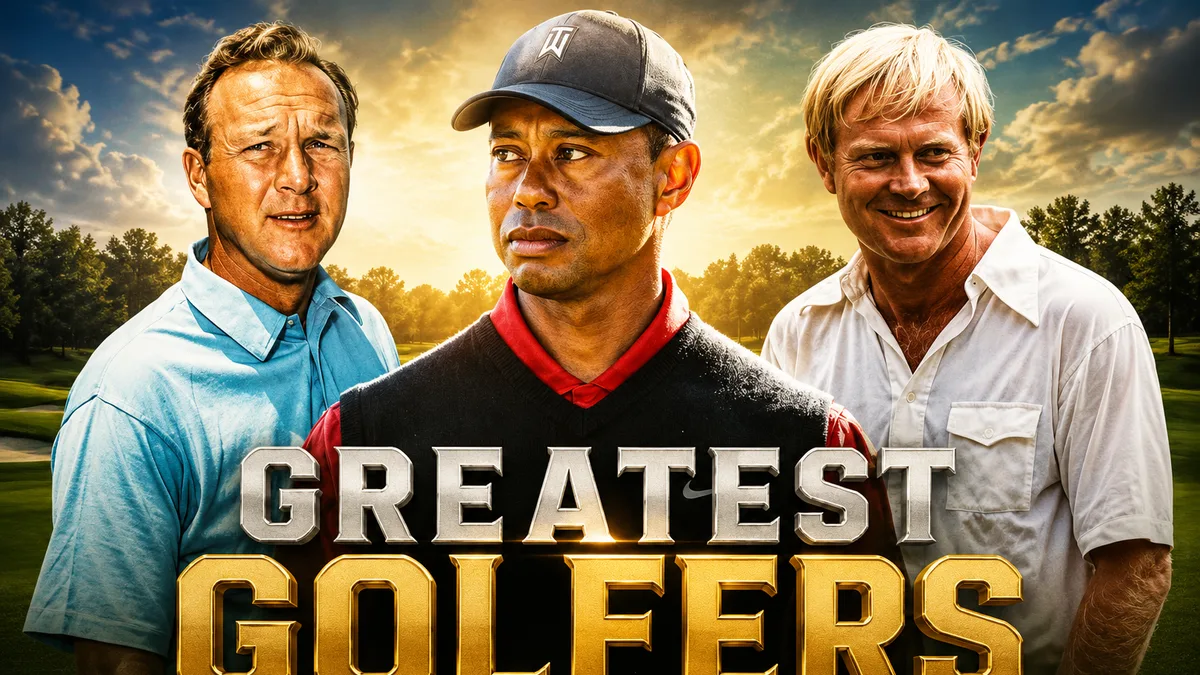
On this page13
We weigh four things, in order: professional majors won (the heaviest factor), peak dominance over a player's contemporaries, career longevity, and lasting influence on how golf is taught, played, and watched. Sheer major count decides the top two; below them, dominance and influence break ties that raw totals cannot.
Greatest golfers of all time at a glance
| Rank | Golfer | Professional majors | Strongest ranking argument |
|---|---|---|---|
| 1 | Jack Nicklaus | 18 | Record major total plus 19 runner-up finishes |
| 2 | Tiger Woods | 15 | Highest modern peak and the Tiger Slam |
| 3 | Ben Hogan | 9 | Six post-crash majors and historic 1953 season |
| 4 | Bobby Jones | 7 (13 including amateurs) | Completed the 1930 Grand Slam as an amateur |
| 5 | Gary Player | 9 | Career Grand Slam and exceptional global reach |
| 6 | Walter Hagen | 11 | Five PGA titles and transformed professional golf |
- The benchmark
Jack Nicklaus
Nicklaus holds the number every other golfer is measured against: 18 professional majors, won across 24 years from the 1962 US Open to the 1986 Masters. No one else has reached 16. He ranks first not only on that total but on the depth behind it — a record 19 runner-up finishes in majors, which means he was a genuine threat in roughly 37 of the biggest events he entered.
That combination of winning and contending, sustained across three distinct generations of rivals, is why he sits above Woods here despite Woods's higher peak. Nicklaus was still winning majors at 46; longevity is the tiebreaker built into our criteria, and no one clears that bar by more.
Country: USA · Era: 1962–1986 · Majors: 18 · Defining feat: Record major haul plus 19 runner-ups
- Peak dominance
Tiger Woods
Woods earns second on the strength of the highest peak the sport has recorded. His 15 majors trail Nicklaus, but his margins do not: a 15-stroke rout at the 2000 US Open at Pebble Beach and an eight-stroke win at that year's Open Championship are two of the most lopsided major results ever. The "Tiger Slam" — holding all four major trophies at once across 2000–01 — has not been repeated.
He ranks above Hogan and the rest because his dominance reshaped the business of the game, not just its record book. Fields got deeper, courses got longer, and prize money multiplied in direct response to him. His last major came at the 2019 Masters, a comeback win that added a final chapter to the peak.
Country: USA · Era: 1997–2019 · Majors: 15 · Defining feat: Tiger Slam and record No. 1 tenure
- Ball-striking master
Ben Hogan
Hogan ranks third on technical dominance and one of sport's great comebacks. In February 1949 a Greyhound bus hit his car head-on; doctors doubted he would walk again. He won six of his nine majors after the crash, including a 1953 season in which he took the Masters, US Open, and Open Championship in his only appearance at the last.
He places above Jones and Player because his ball-striking set a standard instructors still teach from — his book Five Lessons remains a coaching staple 70 years on. The knock is volume: nine majors is fewer than Hagen's 11, but the quality and difficulty of Hogan's wins carry more weight under our dominance measure.
Country: USA · Era: 1946–1953 · Majors: 9 · Defining feat: Six post-crash majors and the 1953 triple
- The amateur
Bobby Jones
Jones is the hardest player to rank because he never turned professional and quit at 28. In 1930 he won the Grand Slam of his era — the US Open, Open Championship, US Amateur, and British Amateur in a single year — then retired at the peak. Counting the amateur championships of the day, his tally reaches 13 major titles across 1923–1930.
He ranks fourth, above longer-careered pros, because his influence extended past playing: he co-founded Augusta National and created the Masters, one of the four events every golfer below now chases. Few athletes in any sport shaped their game's future architecture as directly.
Country: USA · Era: 1923–1930 · Majors: 7 pro (13 total) · Defining feat: 1930 Grand Slam as an amateur
- Global ambassador
Gary Player
Player completed the career Grand Slam and won nine majors while doing it the hard way — commuting from South Africa to compete when transcontinental travel was a genuine handicap, logging more miles than any player of his generation. His major wins spanned 19 years, from the 1959 Open Championship to the 1978 Masters.
He edges Hagen and Watson here on breadth: only five men had won all four majors before him, and none had chased them across as many continents. Player's fitness-first approach also outlasted his career, normalizing training regimens that were unusual for golfers of the 1960s.
Country: South Africa · Era: 1959–1978 · Majors: 9 · Defining feat: Career Grand Slam and global reach
- First superstar
Walter Hagen
Hagen owns more majors than anyone ranked below him — 11, including five PGA Championships when that event was match play — yet sits sixth because those 1920s fields were shallower than the ones his successors beat. His US Open and Open Championship wins are the sturdiest lines on his résumé.
His real claim is off the scorecard: Hagen was the first golfer to earn a fortune from the professional game and forced clubs to treat pros as equals rather than hired help. Every touring professional who followed, including the men ranked above him, competes for a living he helped legitimize.
Country: USA · Era: 1914–1929 · Majors: 11 · Defining feat: Five PGA titles; made pro golf lucrative
- Links master
Tom Watson
Watson won eight majors, five of them Open Championships, mastering the wind-and-bounce golf of British links better than any American of his time. He beat Nicklaus head-to-head in the 1977 "Duel in the Sun" at Turnberry, trading closing 65 and 66 to win by a stroke — often cited as the finest final-round duel in major championship history.
He ranks seventh, just behind Hagen, because his prime was shorter and more concentrated than the players above. But at 59 he nearly won the 2009 Open, missing a playoff by one putt — proof his links craft aged better than almost anyone's.
Country: USA · Era: 1975–1983 · Majors: 8 · Defining feat: Five Opens; 1977 Duel in the Sun
- TV-era icon
Arnold Palmer
Palmer's seven majors are the fewest in this group, and he never completed the career Grand Slam — the PGA Championship eluded him. He ranks eighth on playing résumé alone, but his influence is why he belongs here at all rather than just outside.
Palmer arrived as television did, and his aggressive, go-for-broke style turned golf into appointment viewing for a mass audience that had never watched before. The galleries known as "Arnie's Army" and the prize-money boom of the 1960s trace directly to his popularity — a commercial legacy that, alongside Nicklaus and Player, formed the sport's "Big Three."
Country: USA · Era: 1958–1964 · Majors: 7 · Defining feat: Brought golf to the television age
Reader interaction
Build your ranking
Drag the names into the order you think is right — or use the arrows — then submit to see how your list compares with everyone else's.
- Jack Nicklaus
- Tiger Woods
- Ben Hogan
- Bobby Jones
- Gary Player
- Walter Hagen
- Tom Watson
- Arnold Palmer
Audience ranking
How everyone ranked them
Built from reader rankings using position-based points.
The order above blends record and reputation. The narrative below explains how the ranking was built, why the top two are effectively locked, and where the current generation actually stands against the legends.
How we ranked the greatest golfers
Majors are the spine of any serious golf ranking, so professional major count carries the most weight here. It settles the top two cleanly: Nicklaus (18) and Woods (15) are the only players clear of everyone else, and no active golfer is within nine of Woods.
Below them, raw totals stop being decisive. Hagen’s 11 majors do not lift him above Hogan’s nine, because the depth of fields, the difficulty of the wins, and a player’s dominance over his own contemporaries matter more than the number alone. Longevity breaks further ties — a player who contended for two decades outranks one whose prime burned brighter but shorter. Influence is the final lever, and it is why Bobby Jones and Arnold Palmer rank as highly as their trophy counts alone would not justify.
Because equipment, agronomy, and travel have changed the game so completely across a century, none of these comparisons is exact. That imperfection is the point: the debate stays alive precisely because no metric closes it.
Majors at a glance
| Golfer | Country | Era | Pro majors | Career Grand Slam |
|---|---|---|---|---|
| Jack Nicklaus | USA | 1962–1986 | 18 | Yes |
| Tiger Woods | USA | 1997–2019 | 15 | Yes |
| Walter Hagen | USA | 1914–1929 | 11 | No |
| Ben Hogan | USA | 1946–1953 | 9 | Yes |
| Gary Player | South Africa | 1959–1978 | 9 | Yes |
| Tom Watson | USA | 1975–1983 | 8 | No |
| Arnold Palmer | USA | 1958–1964 | 7 | No |
| Bobby Jones | USA | 1923–1930 | 7* | Pre-modern |
*Jones won seven professional majors as an amateur; counting the amateur championships of his era raises the total to 13 under the pre-modern major structure.
The Nicklaus vs. Woods debate
This is the argument that actually decides the top of the list, and both sides carry real weight.
The case for Nicklaus is volume and durability. His 18 majors span 1962 to 1986, and his 19 runner-up finishes mean he was a live threat far more often than any rival. He was not merely peaking — he was contending across three separate generations of challengers.
The case for Woods is peak. At his best, no one in the sport’s history did what he did to a golf course: the 15-stroke Pebble Beach win, the Tiger Slam, and a record stretch at world No. 1. He also changed the economics and athleticism of the tour in ways still visible today. Our ranking gives Nicklaus the edge because longevity is baked into the criteria, but the gap is the narrowest on this list.
The modern generation (2025–2026)
Two players define the current game, though neither is close to the giants above. Rory McIlroy completed the career Grand Slam at the 2025 Masters — his long-awaited fifth major — then repeated at Augusta in 2026, edging Scottie Scheffler by a stroke to reach six majors and become the first back-to-back Masters champion since Woods.
Scheffler has been the steadiest force in the sport, holding world No. 1 for well over 150 consecutive weeks, one of the longest reigns since Woods, while building four majors: the Masters (2022, 2024), the 2025 PGA Championship, and the 2025 Open Championship. A US Open would complete his own career Grand Slam.
The rest of the elite is deep and unpredictable: Jon Rahm and Xander Schauffele are multiple-major winners, while Wyndham Clark’s 2026 US Open and Aaron Rai’s 2026 PGA Championship show how open any given week has become. Whether Scheffler or McIlroy climbs toward the Woods and Nicklaus tier comes down to one thing — winning majors, repeatedly, for another decade. It remains the steepest climb in golf.
Frequently asked questions
Where does Sam Snead rank among the greatest golfers?+
Snead sits just outside most top-fives and is arguably the best player to never win a US Open, where he finished runner-up four times. He shares the all-time PGA Tour wins record with Tiger Woods at 82 and won seven majors, yet that career US Open gap keeps him below the pure Grand Slam names. On raw victory count, though, few match him.
Who has won the most PGA Tour events?+
Sam Snead and Tiger Woods are tied for the record at 82 official PGA Tour wins each. Snead set the mark across the 1930s to 1960s; Woods matched it in 2019 at the Zozo Championship. Jack Nicklaus is third with 73. Tour-win totals reward longevity and consistency rather than majors, which is why the leaderboard differs from any all-time greatness ranking.
What was golf's 'Big Three'?+
The Big Three refers to Arnold Palmer, Jack Nicklaus, and Gary Player, who dominated golf through the late 1950s and 1960s and collectively won 34 professional majors. The term, coined by Palmer's manager Mark McCormack, captured a rivalry that anchored the sport's first television boom. Their combined star power did as much to grow golf commercially as any trio in its history.
How do you compare golfers from completely different eras?+
You cannot do it cleanly, which is why rankings weigh dominance over contemporaries rather than raw scores. Equipment, course setup, and field depth have changed so much that a 1930 score means little against a 2026 one. The fairer question is how far a player stood above his own rivals — a measure that lets Bobby Jones and Scottie Scheffler be judged on the same terms.
Will Scottie Scheffler or Rory McIlroy catch Nicklaus or Woods?+
It is a steep climb. As of 2026, McIlroy leads active players with six majors and Scheffler has four, both far short of Woods's 15 and Nicklaus's 18. Catching either would require winning majors at an elite clip deep into their late thirties. Scheffler's record run at world No. 1 shows the ceiling is high, but the totals above remain historically secure.
Who is the greatest female golfer of all time?+
There is no single answer, but three names lead the debate: Kathy Whitworth holds the record for professional tour wins with 88, Mickey Wright is praised for the finest swing of her era, and Annika Sorenstam dominated the 2000s with 10 majors and 72 LPGA titles. Patty Berg's 15 women's major championships remain the most of anyone, male or female.
Sources
Play & tools
Free browser games and tools — no account, no download.
- Play today's Sports Connections — Today's Sports Connections — daily hints, answers, and play the grid.
- Play Guess the NFL Player — A new mystery NFL player every day. Eight guesses, with a clue on each — plus free unlimited mode.
- Explore all our games →
Related golf guides
View all →
Golfers With the Most Holes in One: Ranked Career & Tour Records
Mancil Davis's documented 51 aces are the accepted record; Norman Manley's disputed 59 sits above it. Ranked: the 10 golfers with the most holes in one.
The Oldest Golf Courses in the World
The oldest golf courses in the world sit in Scotland: Musselburgh Old Links has documented play from 1672, while St Andrews traces golf to the 1400s.
Greatest Cyclists of All Time: Legends Who Defined the Sport
The greatest cyclists ever, from Eddy Merckx's Grand Tour dominance to modern icons like Tadej Pogacar and Marianne Vos who redefined the sport.
Best Celebrity Golfers, Ranked by Handicap
The best celebrity golfers ranked by verifiable game, from Tony Romo and Steph Curry to Kenny G and Alice Cooper, plus why most celebrity handicaps are self-reported.

Greatest Motocross Riders of All Time: MX Legends Ranked
The greatest motocross riders ever, ranked. Stefan Everts, Ricky Carmichael, Antonio Cairoli and more, weighed by premier-class titles and career dominance.
Greatest Swimmers of All Time, Ranked: Pool and Open-Water Legends
The greatest swimmers of all time, ranked: Michael Phelps's 23 Olympic golds, Katie Ledecky's distance reign, plus Mark Spitz, Ian Thorpe and Caeleb Dressel.