
How Long Is an Olympic Pool? Size & Lanes
On this page7
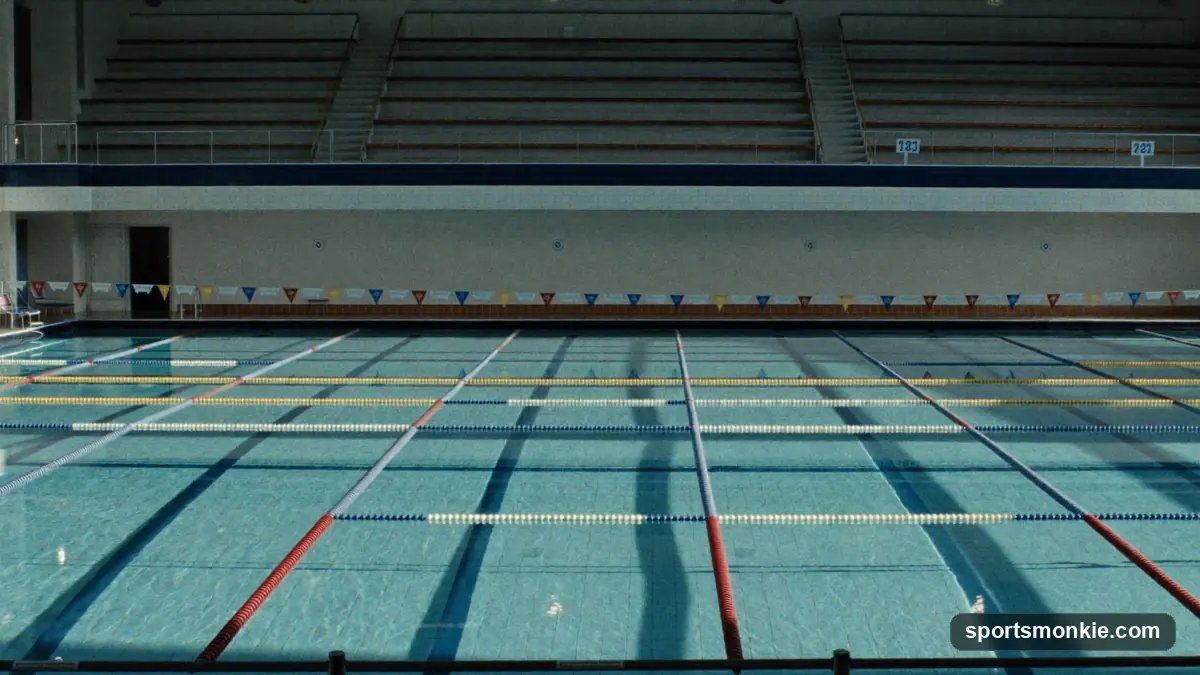
An Olympic swimming pool is 50 meters long, which is roughly 164 feet. It is 25 meters wide, holds 10 lanes, and must be at least 2 meters deep under World Aquatics rules.
Because it measures 50 meters, an Olympic pool is called a long-course pool. That single number is what separates it from the 25-meter and 25-yard pools most people actually swim in. Below are the full dimensions, why the lanes are built the way they are, and how the Olympic pool stacks up against the other sizes you will encounter.
The exact dimensions
World Aquatics, the international governing body for the sport, sets the specifications for pools used at the Olympics and World Championships. The headline numbers are clean and consistent.
| Measurement | Olympic pool |
|---|---|
| Length | 50 meters (about 164 feet) |
| Width | 25 meters (about 82 feet) |
| Lanes | 10 |
| Lane width | 2.5 meters each |
| Minimum depth | 2 meters (3 meters recommended) |
The length is the strict part. For sanctioned competition, a 50-meter pool must measure a full 50 meters, and when automatic touch-pad timing is installed the pool can only be built slightly long, never short. That precision is why world records require certified facilities.
Why 10 lanes but 8 swimmers
An Olympic pool has 10 lanes, but a typical race features 8 swimmers. The two outside lanes are usually left empty during finals. Keeping them clear reduces the turbulence and wave wash that bounce off the pool walls, so the swimmers in the racing lanes get calmer, fairer water.
Each lane is 2.5 meters wide, another detail aimed at keeping one swimmer’s wake from disrupting the next. Lane ropes with floating discs are designed to absorb and break up waves for the same reason. The whole layout is engineered to make the water as fast and as fair as possible.
Depth and why it matters
The minimum depth for an Olympic pool is 2 meters, and World Aquatics now recommends 3 meters. Deeper water is faster water. When a pool is deep, the waves a swimmer creates dissipate downward instead of bouncing off the bottom and back up to the surface, which cuts the turbulence that slows everyone down.
That is why purpose-built championship pools trend toward the deeper end of the range. It is not about safety alone; a few extra feet of depth measurably reduces drag-inducing chop, which can be the difference in races decided by hundredths of a second.
How it compares to other pools
The Olympic pool is one of three sizes you will run into most often, and the differences are the source of a lot of confusion.
- Long-course meters (50 m): the Olympic and World Championship standard.
- Short-course meters (25 m): common in Europe and for many club meets; a separate set of world records exists for it.
- Short-course yards (25 yd): the US high school and college standard, measured in yards rather than meters.
This is why a 25-yard pool is not an Olympic pool, and why times are not directly comparable across formats. A 25-yard pool is shorter than an Olympic pool by more than half, and it uses yards instead of meters entirely. Elite American swimmers train and race in 50-meter pools precisely because that is what the Olympics use.
What else is on the pool deck
The 50-meter length gets the headlines, but a competition pool is defined by more than its dimensions. Several features are standardized so that races are fair wherever they are held.
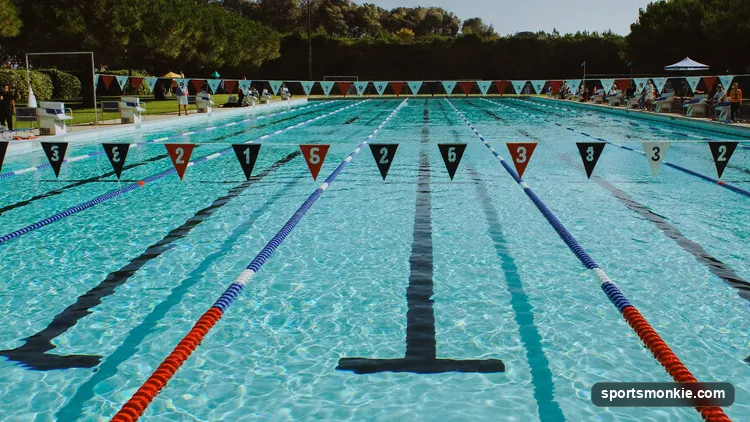
- Lane lines: floating ropes strung with discs that spin to absorb waves and keep each swimmer’s water calm.
- Touch pads: electronic panels at the wall that record a swimmer’s finish to the hundredth of a second when they touch.
- Backstroke flags: pennants strung across the pool near each end so backstrokers, who race face-up, can judge how close they are to the wall.
- Starting blocks: raised platforms at one end where swimmers begin most races with a dive.
- Water temperature: kept within a controlled range so conditions are consistent and comfortable for racing.
These details are why a certified competition pool is a precise piece of sporting infrastructure, not just a very long swimming pool. The turbulence-reducing lane lines and the exact touch-pad timing are what make a record-eligible race possible.
Doing the lap math
Because an Olympic pool is 50 meters, distance conversions are simple once you fix what a “lap” means. Counting each 50-meter trip as one length: a mile (about 1,609 meters) is roughly 32 lengths, and 2 miles (about 3,219 meters) is roughly 64 lengths. The classic distance race, the 1,500-meter freestyle known as the metric mile, is 30 lengths of an Olympic pool.
Just be careful with the word “lap.” Some swimmers count a lap as down and back, or 100 meters, which halves those numbers. The pool length never changes; only the counting convention does.
The short version
An Olympic pool is 50 meters long, 25 meters wide, and has 10 lanes at least 2 meters deep, all set by World Aquatics. It is a long-course pool, distinct from the 25-meter and 25-yard pools used elsewhere, which is why a 25-yard pool does not qualify as Olympic. For more on the sport and its stars, see our features on the greatest swimmers of all time and tips to start swimming.
Frequently asked questions
Is a 25-yard pool an Olympic pool?+
No. A 25-yard pool is a short-course yards pool, common in US high schools and colleges, and it is neither Olympic length nor even metric. An Olympic pool is exactly 50 meters, more than twice as long. The two are used for different competition formats, so times set in each are tracked separately.
How many laps is 2 miles in an Olympic pool?+
About 64 lengths if you count each 50-meter trip as one length, since 2 miles is roughly 3,219 meters. If you define a lap as down and back (100 meters), it is about 32 laps instead. The confusion almost always comes from that lap-versus-length distinction, not from the pool size, which is fixed at 50 meters.
Why are US pools 25 yards?+
Many US pools are 25 yards because American high school and college swimming, governed on a yards basis, has historically raced short-course yards. It is a practical fit for existing facilities and school competition. International and Olympic swimming, by contrast, use metric distances, which is why elite US swimmers also train in 50-meter pools.
How long is a high school pool?+
Most US high school pools are 25 yards long for short-course competition, though some newer facilities are built at 25 meters or even 50 meters. The 25-yard standard is the most common because it matches the format used by US high school and college governing bodies.
Sources
Play & tools
Free browser games and tools — no account, no download.
- Play today's Sports Connections — Today's Sports Connections — daily hints, answers, and play the grid.
- Play Guess the NFL Player — A new mystery NFL player every day. Eight guesses, with a clue on each — plus free unlimited mode.
- Explore all our games →
Related guides
Individual Medley Order: The 4 Strokes in Turn
The individual medley order is butterfly, backstroke, breaststroke then freestyle. Why the order is set that way and how it differs from the medley relay.
Flip Turn in Swimming: How to Master the Tumble Turn Step by Step
Master the flip turn swimming technique: the approach, tuck, plant, and streamline push-off used in freestyle and backstroke, plus fixes for common mistakes.
Medley Relay Explained: Stroke Order, Exchanges & Strategy
The medley relay swims backstroke, breaststroke, butterfly, then freestyle. Learn the medley relay swimming order, exchange rules, and race strategy.
Sidestroke Swimming: Technique, Scissor Kick, and Lifesaving Use
Sidestroke swimming is a relaxed, on-your-side stroke built for endurance and rescue. Learn the arm pull, scissor kick, and why lifeguards rely on it.
Types of Swimming Strokes: Freestyle, Backstroke, Breaststroke & More
The main types of swimming strokes are freestyle, backstroke, breaststroke, butterfly, sidestroke, and elementary backstroke — each built for a different job.
What Is the Individual Medley in Swimming? Order, Distances & Rules
Individual medley swimming has one swimmer race all four strokes in a fixed order: butterfly, backstroke, breaststroke, freestyle. Here's how it works.