
How Long Does It Take to Swim a Mile?
On this page7
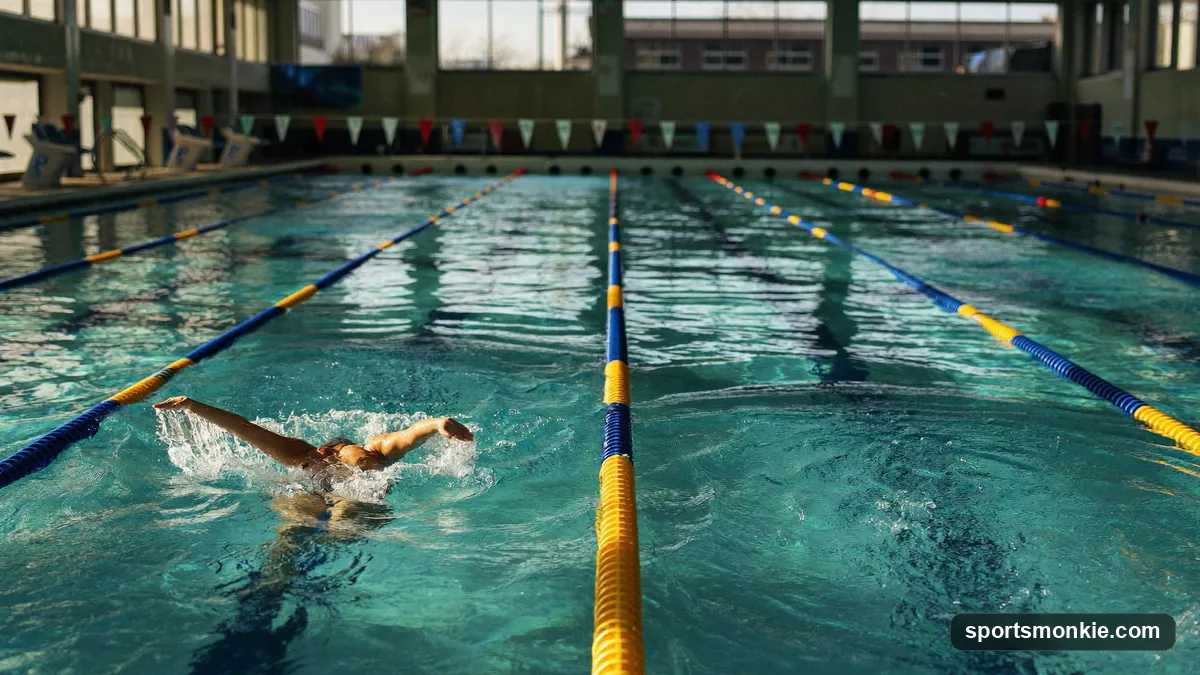
Most beginners swim a mile in 40 to 50 minutes, intermediate swimmers in 30 to 35 minutes, and advanced swimmers in 22 to 28 minutes. The single biggest factor is your pace per 100, followed by how often you rest at the wall. Below are full pace tables for every level, the exact pool-length math for a mile, and the fastest ways to bring your time down.
The Quick Answer by Skill Level
Here is how long a one-mile swim takes across the four common fitness levels, assuming freestyle in a 25-yard pool. Times include realistic wall rest for the lower levels.
| Level | Pace per 100 yd | Mile time (1,650 yd) | Rest style |
|---|---|---|---|
| True beginner | 2:45–3:15 | 45–55 min | Frequent stops |
| Recreational | 2:15–2:45 | 37–45 min | Rest every few lengths |
| Intermediate | 1:45–2:10 | 29–36 min | Occasional rest |
| Advanced | 1:20–1:40 | 22–27 min | Mostly continuous |
| Competitive | under 1:15 | under 21 min | Nonstop |
If you are still building your base, start with our guide on how to swim for beginners before chasing a fast number. Efficiency beats effort at every level.
What a “Mile” Actually Means in the Pool
The word “mile” is used loosely in swimming, and getting the distance right changes your expected time. A true statute mile is 1,609 meters, or 1,760 yards. Almost nobody swims exactly that. Instead, swimmers use rounded distances that divide cleanly into pool lengths.
- The swimmer’s mile (short-course yards): 1,650 yards, which is exactly 66 lengths of a 25-yard pool (33 laps down-and-back).
- The metric mile: 1,500 meters, which is 30 lengths of a 50-meter pool or 60 lengths of a 25-meter pool.
- A true mile: 1,760 yards is 70.4 lengths of a 25-yard pool. In a 25-meter pool, 1,609 meters is 64.4 lengths. In a 50-meter pool it is 32.2 lengths.
Because the swimmer’s mile is 110 yards shorter than a true mile, it shaves roughly one to two minutes off your total compared with the full 1,760 yards. When someone quotes a mile time, they almost always mean 1,650 yards or 1,500 meters. If you want the deeper breakdown of lengths versus laps, see how many laps is a mile in swimming.
Beginner Mile Times: What to Expect
If you have just learned continuous freestyle, your first mile will likely land between 45 and 55 minutes. That is completely normal, and the limiting factor is almost never your legs or your heart. It is breathing rhythm and drag.
New swimmers waste enormous energy fighting the water: heads too high, hips sinking, arms slapping instead of catching. Fix those and your time drops five to ten minutes with no change in fitness. The fastest wins for beginners are a relaxed exhale underwater and a longer, quieter stroke. Our freestyle breathing technique guide walks through the exhale timing that stops the panic-breath cycle that forces early rest stops.
Break the mile into manageable chunks at first. Swimming 6 x 275 yards (11 lengths each) with 30 seconds rest feels far easier than staring down 66 straight lengths, and it trains the same aerobic system.
Intermediate and Advanced Pace Math
Once you can swim continuously, your mile time becomes simple arithmetic: your pace per 100 multiplied by 16.5 (there are 16.5 hundreds in 1,650 yards). Use this table to project a time from a pace you can already hold.
| Pace per 100 | Mile time (1,650 yd) | Metric mile (1,500 m, same pace/100) |
|---|---|---|
| 1:15 | 20:38 | 18:45 |
| 1:30 | 24:45 | 22:30 |
| 1:45 | 28:53 | 26:15 |
| 2:00 | 33:00 | 30:00 |
| 2:15 | 37:08 | 33:45 |
| 2:30 | 41:15 | 37:30 |
The catch is that most swimmers cannot hold their 100 sprint pace for 66 lengths. Expect to add 15 to 25 seconds per 100 to your fresh sprint speed when you stretch it over a mile. A swimmer who cruises a single 100 in 1:35 will more likely average 1:55 to 2:00 across the full distance. Building that endurance is exactly what swimming faster trains through threshold sets and negative splits.
The Biggest Factors That Change Your Time
Two swimmers with identical fitness can post mile times 15 minutes apart. Here is what actually moves the number, ranked by impact:
- Stroke efficiency (drag). The number one lever. A streamlined body position lets you cover more distance per stroke, so you take fewer strokes and burn less energy. Reducing drag matters more than getting stronger.
- Pacing discipline. Going out too hard in the first 400 yards is the classic mistake. It spikes your heart rate, forces rest stops, and can add five minutes. Even or slightly negative splits are almost always faster overall.
- Rest breaks. Every 20-second wall stop adds up. Ten stops is over three minutes of standing still. Continuous swimming, even slower, usually beats stop-start.
- Stroke choice. Freestyle is fastest. Breaststroke adds 25 to 40 percent. All the times on this page assume freestyle.
- Pool length and turns. Turns are free speed. A 25-yard pool gives you 65 push-offs in a mile versus 29 in a 50-meter pool, and each push-off is faster than swimming, so short-course times run a bit quicker.
Refining your freestyle swimming technique attacks factors one and two at the same time, which is why technique work delivers the fastest improvement per hour of practice.
How to Bring Your Mile Time Down
You do not get faster by grinding out slow miles. You get faster by improving efficiency and adding structured intervals.
- Swim intervals, not just distance. Sets like 10 x 100 on a fixed send-off (say, 2:00) teach your body to hold pace and control rest. This is the single most effective distance-building workout.
- Count your strokes per length. Try to lower your stroke count by one or two per length while holding the same speed. Fewer strokes means less drag and a more sustainable mile.
- Practice negative splits. Swim the second half of a set faster than the first. It trains pacing so you stop blowing up early.
- Add a weekly technique session. Drills fix the flaws that steady swimming just reinforces. Beginners should start with swimming drills for beginners such as catch-up and single-arm freestyle.
Progress compounds fast at first. Many adults who commit to two or three focused sessions a week knock five to eight minutes off their mile within a month. If you are returning to the water later in life, the pacing and patience mindset in learn to swim as an adult will keep you consistent enough to see those gains. For the full picture of body position, breathing, and stroke mechanics, our swim technique guide ties every piece together.
Bottom Line
A mile takes most beginners 40 to 55 minutes, intermediate swimmers around 30 to 35 minutes, and advanced swimmers 22 to 28 minutes. Pin down whether you are swimming a true mile, a swimmer’s mile of 1,650 yards, or a 1,500-meter metric mile, then use the pace tables above to set a realistic target. Chase efficiency first, pacing second, and the clock takes care of itself.
Frequently asked questions
How long does it take the average person to swim a mile?+
The average recreational adult swims a mile in roughly 40 to 50 minutes, including short rest breaks at the wall. That works out to a pace of about 2:30 to 3:00 per 100 yards. If you can swim nonstop with a relaxed freestyle, expect the lower end. Frequent stopping to catch your breath, or switching to breaststroke, pushes the total closer to an hour.
Is swimming a mile in 30 minutes good?+
Yes, a 30-minute mile is a solid intermediate benchmark that most swimmers reach after several months of consistent training. It requires holding about 1:45 to 2:00 per 100 yards without long rest breaks. Competitive high-school and masters swimmers typically go faster, around 22 to 26 minutes, but 30 minutes signals genuine aerobic fitness and efficient stroke mechanics for a non-competitive adult.
How many laps is a mile in swimming?+
In a standard 25-yard pool, a true mile (1,760 yards) is 70.4 lengths, or about 35 laps if a lap means down and back. Most swimmers instead count the 'swimmer's mile' of 1,650 yards, which is exactly 66 lengths or 33 laps. In a 50-meter Olympic pool, a metric mile of 1,500 meters is 30 lengths, or 15 laps.
How fast can a beginner realistically swim a mile?+
A true beginner who has just learned continuous freestyle usually needs 45 to 55 minutes for a mile, with several stops to rest. The bottleneck is rarely leg strength; it is breathing rhythm and stroke efficiency. As you smooth out your catch and bilateral breathing over a few weeks, times drop quickly, often by five to ten minutes without any gain in raw fitness.
What is the difference between a mile and a swimmer's mile?+
A true statute mile is 1,609 meters or 1,760 yards. The 'swimmer's mile' is a rounded training and racing distance of 1,650 yards (66 lengths of a 25-yard pool) in short-course yards, or 1,500 meters, the 'metric mile,' in the pool. Both are slightly short of an actual mile but are used because they divide cleanly into standard pool lengths.
Does stroke choice change how long a mile takes?+
Significantly. Freestyle is the fastest and most efficient stroke, so mile times are almost always quoted for freestyle. Breaststroke typically adds 25 to 40 percent to your time because of its slower turnover and glide. A mile of continuous breaststroke that would take 32 minutes in freestyle can stretch past 45 minutes. Backstroke sits between the two for most recreational swimmers.
Sources
Play & tools
Free browser games and tools — no account, no download.
- Play today's Sports Connections — Today's Sports Connections — daily hints, answers, and play the grid.
- Play Guess the NFL Player — A new mystery NFL player every day. Eight guesses, with a clue on each — plus free unlimited mode.
- Explore all our games →
Related guides
How Many Laps in a Mile Swimming? Pool Math Explained
How many laps in a mile swimming? A true mile is 70.4 lengths of a 25-yard pool; the swimmers mile is 1,650 yards (66 lengths). Full pool-by-pool math inside.

How Long Does 9 Holes of Golf Take? Times by Group Size
Nine holes of golf takes about 2 to 2.5 hours for a foursome, and closer to an hour on your own. See how long 9 holes take by group size and cart use.

What Does MVP Mean in Sports?
MVP means Most Valuable Player, an award for the athlete judged to have the greatest value to a team or competition under its voting rules.
What Does Rookie Mean in Sports?
A rookie is a first-year or newly eligible player, with the exact definition set by the sport, league or competition.
How to Swim: Complete Technique Guide for All 4 Strokes
Learn how to swim with correct technique for freestyle, breaststroke, backstroke, and butterfly. Body position, breathing, kick, and drills to swim farther and faster.
Libero in Volleyball: What the Position Actually Does
The libero volleyball role: the back-row defensive specialist who passes, digs and reads hitters. Origin, skills, jobs and the players who define it.