
How to Learn to Swim as an Adult: A Step-by-Step Guide
On this page8
You learn to swim as an adult by building water comfort first and technique second: get used to your face in the water, blowing bubbles, and floating before you ever try to move. Work through ordered steps, breath control, floating, gliding, kicking, then a full stroke, and stay in water you can stand up in the whole time. Fear fades through repetition, not willpower, so keep every step easy enough to succeed on the first try.
Start With Fear, Not Freestyle
Almost every adult who “can’t swim” is really fighting a fear response, not a fitness problem. Your body is naturally buoyant; the panic that makes you sink is caused by bracing, breath-holding, and thrashing. So the first job is not a stroke, it’s teaching your nervous system that water is safe.
Begin in chest-deep water where you can stand flat-footed with your shoulders under. Hold the wall or gutter with one hand as your anchor. Spend your first session just moving around: walk across the pool, bounce gently, splash your own face, and let water run over your head. This sounds trivial, but it rewires the alarm bell. If you are starting completely from zero, pair this with our full walkthrough on how to swim for beginners, which covers the same early stages in more depth.
Rules for every session:
- Stay in water you can stand in until strokes are reliable.
- Never practice alone, have a lifeguard on duty or a strong swimmer within arm’s reach.
- End each step on a success, not a scare.
Step 1: Master Breathing and Bubbles
Breath control is the single most important skill, and it’s the one panicking adults skip. The instinct is to hold your breath and hope. That’s backwards. Water pushes into your nose only when you stop exhaling.
Stand in the shallow end, take a normal breath, lower your mouth and nose to the surface, and hum out slowly so a steady stream of bubbles rises. When you’re out of air, lift your face and breathe. Repeat 15 to 20 times.
Progress the drill:
- Bubbles at the surface (mouth and nose in).
- Full face under, eyes open behind goggles, exhaling the whole time.
- Bob down until you’re crouched underwater, exhale, and push off the bottom to stand.
The rhythm you want is breathe in through the mouth above water, breathe out through the nose and mouth under water, continuously. Never hold your breath and never try to exhale and inhale at the same time. This same exhale-first rhythm carries into every stroke, and we break it down further in our guide to how to breathe while swimming.
Step 2: Learn to Float and Trust Your Buoyancy
Once bubbles feel automatic, prove to yourself that you float. Floating is the platform every stroke sits on.
Back float first, because your face stays in the air. In chest-deep water, keep one hand near the wall, tilt your head back until your ears are submerged, push your hips and belly up toward the surface, and spread your arms and legs wide like a starfish. Relax your breathing, tension sinks you, calm floats you. A helper’s hand under your back for the first few tries removes the fear.
Then the front float. Take a breath, put your face in, and let your arms and legs hang loose while you float face-down. Stand up by pulling your knees to your chest, pressing your hands down, and planting your feet. Practice the stand-up recovery until it’s boring, because knowing you can always get your feet under you is what kills panic.
Hold each float for a slow count of ten before adding anything else.
Step 3: Glide, Then Add the Kick
A glide is a float that travels. Stand with your back to the wall, take a breath, put your face down, place one foot on the wall behind you, and push off gently into a streamlined front float, arms extended in front, head tucked between your biceps. Let the glide carry you and stand up when you slow.
That streamlined shape, arms squeezed straight, body long and flat, is the position you’ll hold in freestyle, so learning it now pays off later. Our freestyle swimming technique guide builds directly on this glide.
Now add the flutter kick:
- Kick from the hips, not the knees, with long, loose legs.
- Point your toes so your feet act like fins.
- Keep the kick small and fast, not big and splashy.
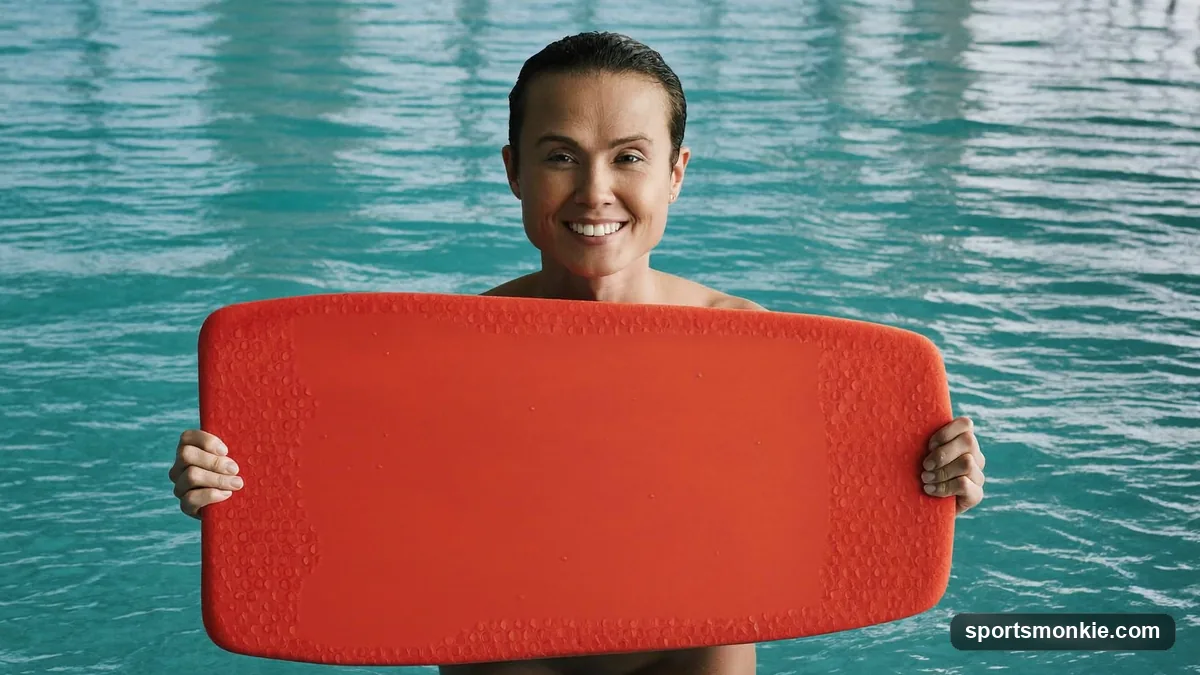
Practice the kick holding the wall, then holding a kickboard, then during your push-off glide. A kickboard lets you isolate the legs without worrying about arms or breathing.
Step 4: Add Arm Strokes and Coordinate
With floating, breathing, gliding, and kicking in place, you’re ready to combine them into a moving stroke. Two strokes are friendliest for beginners.
| Stroke | Why it suits beginners | Watch out for |
|---|---|---|
| Front crawl (freestyle) | Fast, efficient, and the natural next step from a streamlined glide | Side breathing takes practice, learn it early |
| Breaststroke | Head can stay up longer; symmetrical and calm | Timing the pull, breathe, kick, glide sequence |
For freestyle, start with the “catch-up” style: one arm stays stretched forward while the other pulls back to your hip and recovers over the water to meet it. Kick continuously underneath. When you need air, roll your head to the side, rather than lifting it forward, and grab a breath timed to the recovering arm. Building that side-breathing habit early is the whole game, and it has its own dedicated walkthrough in freestyle breathing technique.
If turning your face to breathe still feels stressful, start with breaststroke technique instead. Its head-up rhythm lets many anxious adults swim a full length sooner, then they add freestyle later.
Step 5: Build Distance and Real Confidence
Once you can link a few strokes together, shift from “can I do it” to “can I repeat it.” Endurance and calm come from volume, not intensity.
A simple three-week build:
- Week 1: Push-off glides with kick, then 5-yard swims. Stand and reset as needed.
- Week 2: 10 to 15 yards continuous, focusing on relaxed exhaling.
- Week 3: Attempt a full 25-yard length, then rest and repeat.
Aim for two or three 30-minute sessions a week. Short and frequent beats long and rare, your nervous system needs repeated proof, not one heroic effort. Structured swimming drills for beginners keep these sessions focused instead of aimless lap-splashing.
Keep progress honest with small numbers. A 25-yard pool is the standard American short-course length, so four lengths equals 100 yards. A “swimmer’s mile” is 1,650 yards (66 lengths of a 25-yard pool), while an actual land mile is 1,760 yards, roughly 64.4 lengths of a 25-yard pool. Don’t chase mileage yet, but knowing the pool-length math helps you set realistic goals as you improve.
Common Mistakes That Keep Adults Stuck
- Holding your breath. The root of nearly all panic. Exhale continuously underwater.
- Lifting the head to breathe. Dropping your hips and legs. Keep the head low and roll or extend, don’t crane upward.
- Relying on arm bands or vests. They teach an upright, vertical body, the opposite of the flat, horizontal line you need.
- Kicking from the knees. Bicycling the legs stalls you. Drive from the hips with long legs.
- Practicing in deep water too soon. Stay where you can stand until strokes are automatic; depth adds fear without adding skill.
- Skipping steps. Trying to swim before you can float guarantees frustration. Master each stage first.
Your Path From Here
You now have the full progression: manage fear, master bubbles, float, glide, kick, then stroke, and build distance in small, repeatable sessions. Treat it as a ladder, and don’t climb the next rung until the current one feels easy.
When you’re ready to sharpen individual skills, the complete swim technique guide is your hub for every stroke and drill, and once you can swim a length comfortably, tips on how to swim faster will help you turn survival swimming into smooth, efficient laps. The water was never the problem, the panic was, and you’re already teaching yourself out of it.
Frequently asked questions
Is it harder to learn to swim as an adult than as a child?+
It is not harder physically, but it feels harder because adults carry fear and self-consciousness that kids usually don't. Your body floats and moves the same at any age. The real obstacle is the nervous system, not muscle memory. Adults actually learn technique faster once fear is managed, because you can follow verbal cues, count breaths, and self-correct. Expect real progress within four to eight consistent sessions.
How long does it take an adult to learn to swim?+
Most adults reach basic water competence, floating, gliding, and swimming a short distance unaided, in eight to twelve lessons spread over four to eight weeks. Swimming a continuous 25-yard length usually takes two to three months of twice-weekly practice. Timelines vary with fear level and pool access. Consistency beats session length: three 30-minute practices weekly progresses you faster than one long, stressful hour.
How do I stop panicking when my face is in the water?+
Panic comes from holding your breath and bracing. Reverse it by exhaling. Stand in shallow water, lower your mouth and nose, and hum out slowly so bubbles stream continuously. When you run out of air, lift and breathe. Repeat 15 to 20 times until steady exhaling feels automatic. Controlled exhaling keeps water out of your nose and signals your brain that you are safe and in control.
Do I need to know how to float before I can swim?+
Yes, floating is the foundation every stroke is built on. If you can relax into a front or back float, you already have buoyancy and body position handled, so strokes become propulsion added to a stable platform. Practice back floats first because your face stays clear of the water. Once you can hold a relaxed float for 10 seconds, you are ready to add gliding and kicking.
Should I take lessons or teach myself to swim as an adult?+
A few lessons with a qualified instructor are the safest and fastest route, especially for anxious beginners, because an instructor manages depth, spotting, and pacing. Self-teaching works for water-comfortable adults using shallow water and a wall, but never practice alone. Always have a lifeguard present or a capable swimmer within arm's reach. Combine a starter lesson block with solo practice to lock in the skills.
What equipment do I actually need as a beginner?+
Very little. A well-fitting swimsuit, comfortable goggles, and access to a pool with a shallow end are the essentials. Goggles matter most, seeing clearly underwater removes a major source of fear. A kickboard helps isolate leg drills, and a swim cap keeps hair out of your face. Skip flotation vests and arm bands, which teach a vertical, upright body position that works against real swimming.
Sources
Play & tools
Free browser games and tools — no account, no download.
- Play today's Sports Connections — Today's Sports Connections — daily hints, answers, and play the grid.
- Play Guess the NFL Player — A new mystery NFL player every day. Eight guesses, with a clue on each — plus free unlimited mode.
- Explore all our games →
Related guides
How to Swim for Beginners: First Steps in the Water
Learn how to swim as a beginner with a step-by-step plan: get comfortable, float, blow bubbles, kick, and swim your first freestyle strokes safely.
How to Put On a Swim Cap Without Tearing or Slipping
Learn how to put on a swim cap the easy way: silicone vs latex, keeping long hair tucked in, avoiding tears, and stopping it from sliding off mid-swim.
How to Swim Faster: Streamline, Stroke & Turn Tips
Learn how to swim faster with proven fixes: tighter streamlines, more distance per stroke, quicker turns, and smarter tempo. A coach-built guide to real speed.
Hack Squat Form: How to Use the Machine Safely, Step by Step
Hack squat form means feet mid-platform and shoulder-width, back and shoulders flat against the pads, knees tracking over the toes, and a controlled drop to thighs-parallel — here are the cues, depth, and mistakes.
Overhead Press Form: Grip, Bar Path, and Lockout, Step by Step
Overhead press form comes down to a stacked bar path: grip just outside the shoulders, brace hard, move your head back so the bar travels straight up past your face, then finish with the bar over the mid-foot.
Proper Bench Press Form: A Step-by-Step Guide to a Safe, Stronger Press
Proper bench press form starts with a shoulder-width-plus grip, retracted shoulder blades, a slight arch, and a bar path that touches the lower chest. Here is how to set up, press, and avoid the mistakes that stall your bench and hurt your shoulders.