
Differences Between Indoor and Outdoor Sports: Full Breakdown
On this page5
Watch a badminton rally and then a rugby scrum and you’d be forgiven for thinking they belong to different planets, not just different categories. One happens on a surface that never changes, under lights that never flicker. The other is played on mud, or in a crosswind, or under a sun that’s been baking the pitch since morning. That single variable, control versus exposure, explains most of what separates indoor sports from outdoor ones.
The Core Distinction
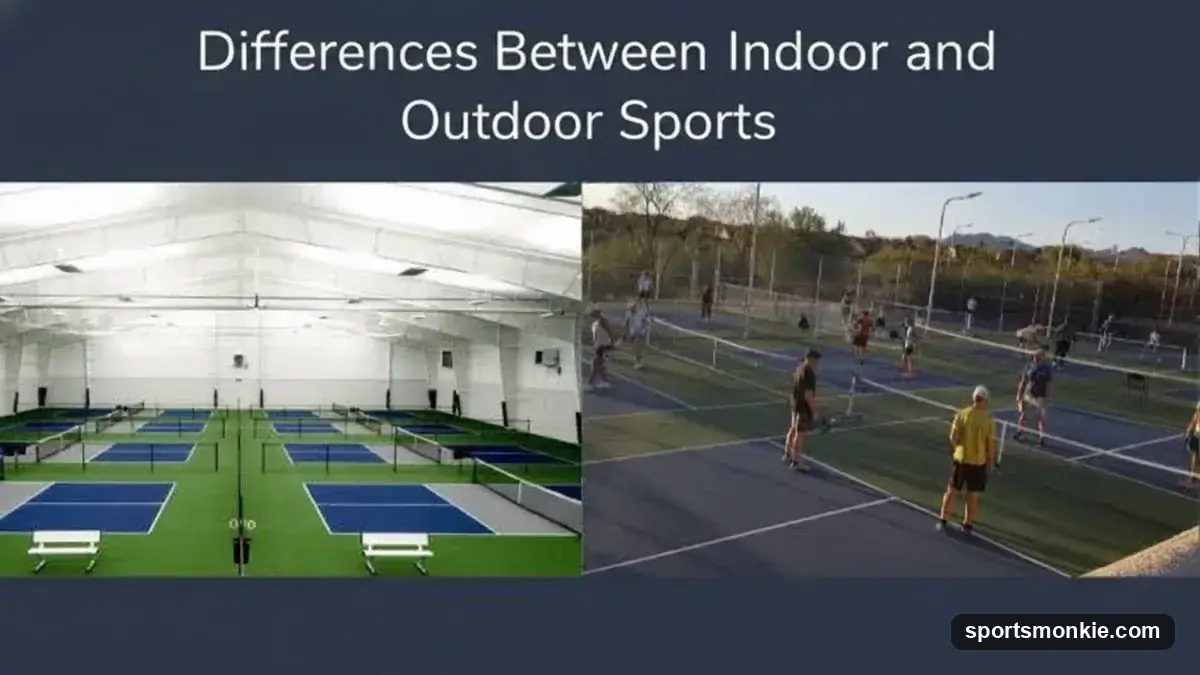
An indoor basketball arena has the same lighting, temperature, and floor every single game, home or away. An outdoor football pitch is never quite the same twice: it changes with the season, the week’s rainfall, how much the grass has been cut. That one difference, environmental control, works its way into equipment choices, tactics, and how athletes train.
Side-by-Side Comparison
| Factor | Indoor Sports | Outdoor Sports |
|---|---|---|
| Weather | No impact | Wind, rain, heat, cold all matter |
| Surface | Consistent (hardwood, rubber, synthetic) | Variable (grass, clay, turf, dirt) |
| Lighting | Artificial, controlled | Natural light (varies by time and season) |
| Crowd proximity | Often closer to playing area | More varied, often further away |
| Equipment | Often lighter, tuned for fast indoor play | Designed for durability and conditions |
| Season | Year-round | Often season-dependent |
| Noise dynamics | Enclosed acoustics amplify crowd noise | Sound dissipates in open air |
Examples of Each Category
Indoor sports: Basketball, volleyball, badminton, table tennis, gymnastics, ice hockey, boxing, wrestling, weightlifting, squash, handball.
Outdoor sports: Football (soccer), rugby, cricket, golf, tennis (most events), athletics (track and field), cycling, rowing, triathlon, American football, field hockey, baseball.
Sports with both: Volleyball (beach vs. indoor), tennis (grass, clay, outdoor hard vs. indoor hard), athletics (outdoor track vs. indoor track), basketball (outdoor courts vs. indoor arenas).
How Environment Shapes the Sport
Weather as a Factor
Outdoor athletes adjust in real time, whether they like it or not. A batsman treats a wet outfield completely differently from a dry one. Golfers read the wind before every shot, not just the tee shots. Cyclists deal with heat, humidity, and elevation changes across a single race. Indoor athletes never face any of that; their only adjustment is to a setting that stays the same match after match.
Surface and Movement
Indoor courts tend to be hard, smooth, and quick, which rewards sharp reactions and precise footwork over raw endurance. Outdoor surfaces vary far more. Grass courts play slower with a higher bounce than hard courts. Natural grass compacts differently than artificial turf. Rugby on a muddy pitch is a different game entirely from rugby on a dry one. Players who move between surfaces, tennis pros switching from clay to grass, for instance, have to relearn their timing and footwear almost from scratch.
Equipment Differences
Indoor balls are built for predictable bounce off hard floors. Outdoor balls have to survive wind, moisture, and rough ground. Football boots carry studs for grip on grass or turf; indoor five-a-side shoes use flat rubber soles instead. Cricket whites suit outdoor conditions, while indoor cricket switches to a lighter ball built for enclosed nets.
Physical and Tactical Demands
Indoor venues are usually tighter spaces, which forces faster decisions and shorter bursts of acceleration. Basketball’s half-court sets, squash’s rebounding angles, and volleyball’s compact rotations all come from that constrained geometry. Outdoor sports tend to open things up, rewarding endurance and the ability to read conditions that keep shifting under an athlete’s feet.
Hybrid and Transitional Sports
A few sports deliberately run both formats to stretch their season or reach new athletes. Indoor athletics lets competitors chase world records in the 60m, 1500m, and long jump through the winter months, when an outdoor track would be frozen or unusable. Beach volleyball started as an outdoor spinoff of the indoor game and has since grown into its own Olympic discipline, with a different rhythm and skill set from the sport it came from.
Frequently asked questions
What is the main difference between indoor and outdoor sports?+
The primary difference is the playing environment. Indoor sports take place in enclosed venues with controlled conditions, consistent surfaces, and no weather variables. Outdoor sports are played in open environments where weather, terrain, and light conditions are variable.
Are indoor sports easier than outdoor sports?+
Not inherently. Indoor sports remove weather as a variable, but they have their own demands — faster surfaces, tighter spaces, and different tactical requirements. Both formats can be played at very high intensity and skill levels.
Which sports have both indoor and outdoor versions?+
Several sports have official indoor and outdoor variants, including volleyball (beach vs. indoor), basketball (outdoor courts vs. NBA arenas), tennis (clay/grass/hard outdoors vs. indoor hard courts), and athletics (track and field).
Sources
Play & tools
Free browser games and tools — no account, no download.
- Play today's Sports Connections — Today's Sports Connections — daily hints, answers, and play the grid.
- Play Guess the NFL Player — A new mystery NFL player every day. Eight guesses, with a clue on each — plus free unlimited mode.
- Explore all our games →
Related guides
Indoor Sports: Popular Indoor Games and Competitions
Indoor sports are played in enclosed venues and include some of the world's most popular events, from basketball and volleyball to gymnastics and boxing.

The Most Athletic Indoor Sports, Ranked by Full-Body Demand
Boxing, gymnastics, basketball, wrestling and squash top our ranking of the most athletic indoor sports, weighed by ESPN difficulty and Forbes fitness data.
Beach vs Indoor Volleyball: Differences
Beach volleyball is 2v2 on sand with a smaller court and a softer, larger ball; indoor is 6v6 on a hard court. Key differences in rules, court and ball.

How Many D1 Lacrosse Teams Are There? Full Breakdown
There are about 75 D1 men's lacrosse teams and over 120 D1 women's teams. See the full breakdown by division, men vs women, plus what going D1 takes.
AFL vs Rugby: Key Differences
AFL is Australian rules football on an oval with marks and 6-point goals; rugby is a rectangular tackling game with tries and scrums. The key differences compared.
Futsal vs Indoor Soccer: Differences
Futsal is FIFA's 5-a-side game on a hard court with a low-bounce ball; indoor (arena) soccer is played with walls. The key differences, side by side.