
Indoor Sports: Popular Indoor Games and Competitions
On this page4
A rink in Toronto stays frozen in July. A gymnasium in Manila runs the same lighting rig in monsoon season as in the dry months. That’s the whole point of indoor sport: take weather out of the equation, and basketball, volleyball, gymnastics, boxing, and ice hockey can all run on a fixed schedule, in a controlled building, regardless of what’s happening outside.
Why the indoor/outdoor distinction matters
The physical environment of a sport shapes its equipment, rules, and competitive character. Indoor sports generally allow:
- Year-round competition, unaffected by seasons or weather
- Standardised playing surfaces (hardwood courts, rubberised floors, ice, or matting) that can be precisely maintained
- Spectator capacity concentrated in controlled venues, which supports large crowds and commercial broadcasting
- Consistent lighting that allows high-speed TV production
Major indoor sports by category
Court sports
| Sport | Surface | Governing body |
|---|---|---|
| Basketball | Hardwood | FIBA |
| Volleyball | Hardwood / synthetic | FIVB |
| Badminton | Synthetic / wood | BWF |
| Table tennis | Hard table | ITTF |
| Squash | Synthetic / plaster | World Squash Federation |
| Indoor tennis | Various | ITF |
Combat sports
Boxing, wrestling (freestyle and Greco-Roman), judo, taekwondo, and fencing are all conducted indoors and feature prominently at the Olympic Games. Each uses its own surface, boxing canvas, wrestling mat, tatami for judo, with rules built around close-contact competition in a controlled space.
Gymnastics
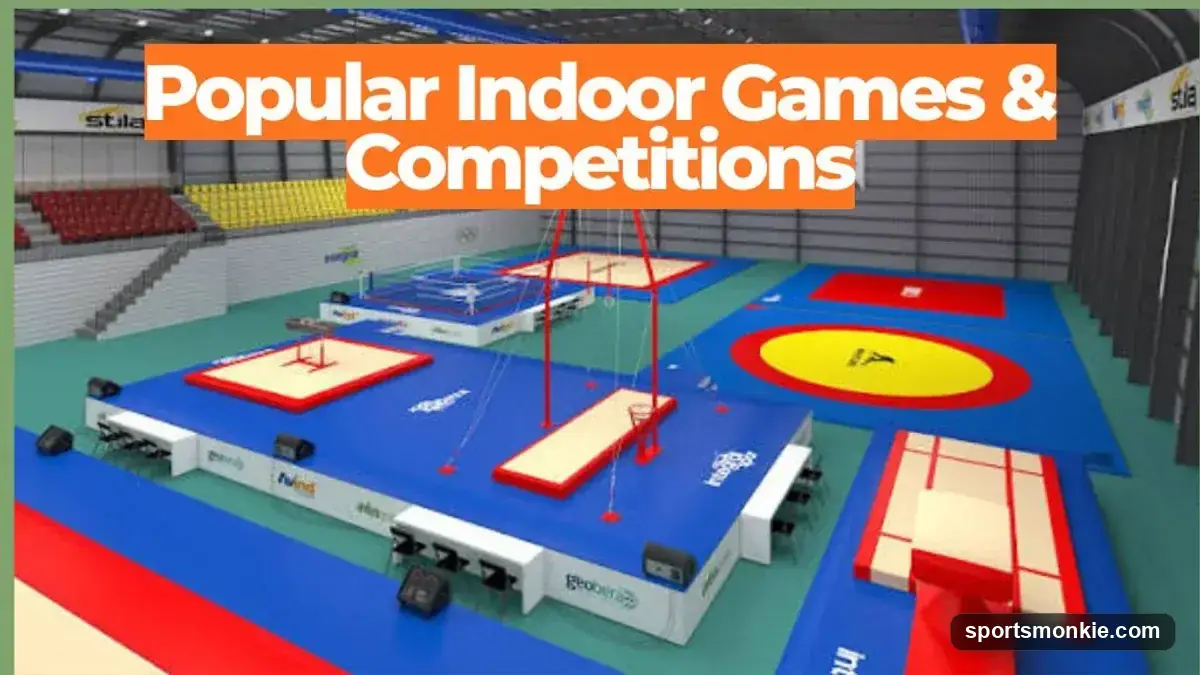
Artistic gymnastics, rhythmic gymnastics, and trampoline gymnastics all take place in large indoor arenas. The apparatus (vault, uneven bars, balance beam, and floor for women; floor, pommel horse, rings, vault, parallel bars, and high bar for men) needs precise environmental control for both safety and accurate performance measurement.
Ice sports
Ice hockey, figure skating, speed skating, and curling all need artificially maintained ice, which makes them indoor pursuits by necessity at the competitive level. Ice hockey in particular draws huge broadcast audiences across North America, Scandinavia, Russia, and Central Europe.
Athletics (track and field)
While athletics is primarily an outdoor sport at the highest level, indoor athletics is a well-established discipline with its own World Championships. Events include sprints (60m rather than 100m), middle distance, pole vault, long jump, triple jump, shot put, and pentathlon. The IAAF Indoor World Championships are held every two years.
Indoor sports participation worldwide
Basketball and volleyball post some of the largest participation numbers of any sport worldwide. The NBA sits among the highest-revenue sports leagues on the planet, and the FIVB World Championships pull serious global attention. Badminton, especially across Asia, and table tennis both claim recreational participation figures that few other sports can match.
Benefits and accessibility
Indoor sports are often easier to access than outdoor alternatives, for a few reasons:
- One facility, multiple sports. A gymnasium can host basketball, volleyball, and badminton on the same floor.
- Weather stops mattering. That’s valuable whether the climate outside is freezing or tropical.
- Schools and community centres frequently build indoor courts as standard infrastructure, not an add-on.
That accessibility drives high participation, and high participation is what feeds the talent pipeline into competitive and elite versions of each sport.
Frequently asked questions
What are the most popular indoor sports in the world?+
Basketball, volleyball, and badminton are among the most widely played indoor sports globally by participation. Ice hockey is dominant in North America and Europe, while table tennis has enormous participation numbers in Asia. Boxing and wrestling are popular worldwide as indoor combat sports.
What is the difference between indoor and outdoor sports?+
Indoor sports are played in enclosed facilities — arenas, gymnasiums, courts, or rinks — and are not affected by weather. Outdoor sports are played in open-air environments and may be influenced by conditions like wind, rain, and temperature. Some sports have both indoor and outdoor versions.
Which indoor sports are in the Olympics?+
Olympic indoor sports include basketball, volleyball, badminton, table tennis, boxing, wrestling, weightlifting, gymnastics (artistic, rhythmic, and trampoline), fencing, judo, taekwondo, and indoor athletics events. The specific programme changes slightly each Games cycle.
Sources
Play & tools
Free browser games and tools — no account, no download.
- Play today's Sports Connections — Today's Sports Connections — daily hints, answers, and play the grid.
- Play Guess the NFL Player — A new mystery NFL player every day. Eight guesses, with a clue on each — plus free unlimited mode.
- Explore all our games →
Related guides
Differences Between Indoor and Outdoor Sports: Full Breakdown
Indoor and outdoor sports differ in surface, weather exposure, equipment, rules, and player demands. Here is a clear comparison of both categories.

Most Popular Sports in England: Football, Cricket & More
Football is England's most popular sport, ahead of cricket, rugby union, tennis, and golf. See the top sports ranked by participation and spectator following.

Most Popular Sports in New Zealand: The Definitive List
Rugby union tops New Zealand's most popular sports, ahead of cricket, netball, football, and golf. A ranked breakdown of what Kiwis watch and what they play.

Most Popular Sports in Australia: A Complete Ranked Guide
AFL leads Australian spectator sport, cricket owns summer, and soccer tops team participation. The most popular sports in Australia ranked by crowds, TV, and play.

The Most Athletic Indoor Sports, Ranked by Full-Body Demand
Boxing, gymnastics, basketball, wrestling and squash top our ranking of the most athletic indoor sports, weighed by ESPN difficulty and Forbes fitness data.
Beach vs Indoor Volleyball: Differences
Beach volleyball is 2v2 on sand with a smaller court and a softer, larger ball; indoor is 6v6 on a hard court. Key differences in rules, court and ball.