
Triple Jump Explained: Hop-Step-Jump Rules, Records & Technique
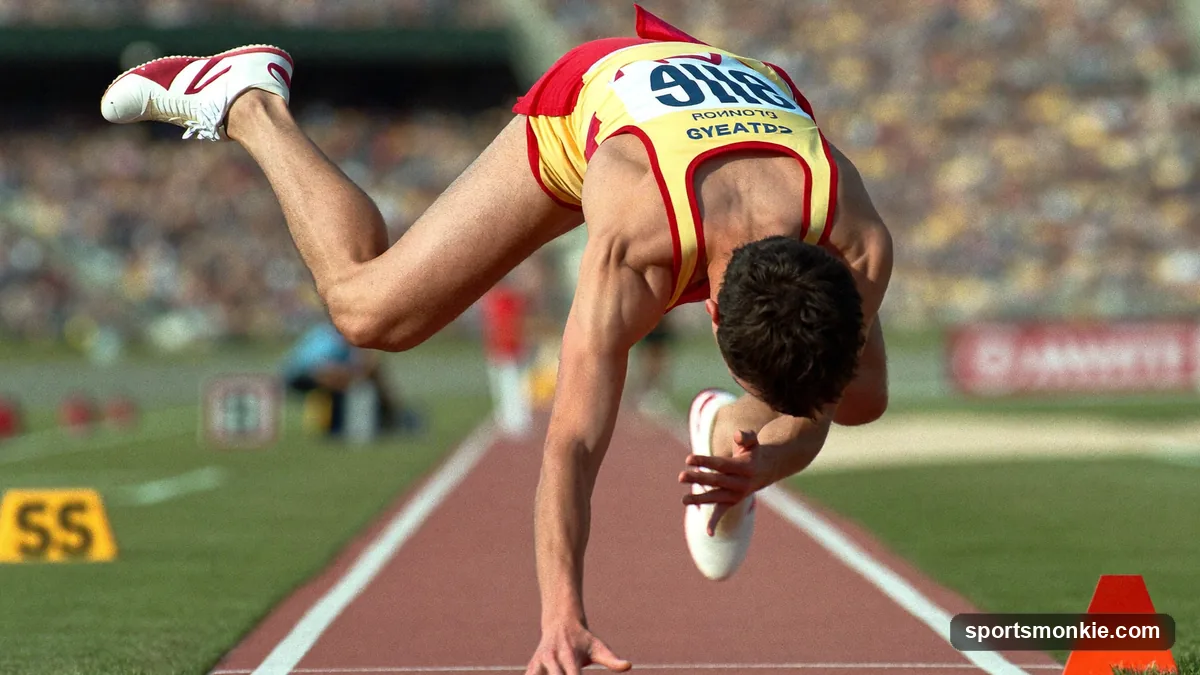
On this page10
- 01What Is the Triple Jump?
- 02How Does the Hop-Step-Jump Sequence Work?
- 03How Far Is the Triple Jump Board From the Pit?
- 04What Are the Official Triple Jump Rules and Fouls?
- 05How Is a Triple Jump Measured?
- 06What Is the Ideal Phase Ratio Between Hop, Step, and Jump?
- 07Triple Jump Technique, Step by Step
- 08Who Holds the Triple Jump World Records?
- 09Who Are the Best Triple Jumpers to Know?
- 10Common Triple Jump Misconceptions
The triple jump is a hop-step-jump sequence: the athlete hops and lands on the same takeoff foot, steps onto the opposite foot, then jumps into the pit, with the total distance measured from the takeoff board. It is track and field’s most technically demanding horizontal jump, nicknamed “power ballet” by coaches because it rewards rhythm and balance as much as raw speed. As of 2026, Jonathan Edwards’ 18.29m from 1995 and Yulimar Rojas’ 15.74m from 2022 remain the standing world records, and neither has come close to falling in over three decades combined.
What Is the Triple Jump?
The triple jump is one of four jumping events on the track and field program, alongside the long jump, high jump, and pole vault. Competitors sprint down a runway, hit a fixed takeoff board, and complete three connected phases, a hop, a step, and a jump, before landing in a sand pit. Unlike the long jump’s single takeoff, the triple jump chains three landings together, so any wobble in the first phase compounds through the next two. For the wider picture of how this event fits alongside the other horizontal and vertical jumps, see our track and field events guide.
How Does the Hop-Step-Jump Sequence Work?
The event’s defining rule, and the one that trips up most newcomers, is the same-leg requirement. Per World Athletics’ technical rules, “the hop shall be made so that an athlete lands first on the same foot as that from which he has taken off; in the step he shall land on the other foot, from which, subsequently, the jump is performed.”
In practice, a right-foot takeoff runs: hop and land on the right foot, step and land on the left foot, then jump and land however the athlete chooses, almost always two feet together to maximize distance. A left-foot takeoff simply mirrors the pattern. Athletes typically pick whichever leg feels stronger off the board and stay with it for their entire career; switching legs mid-competition is rare and usually a sign something has gone wrong technically.
How Far Is the Triple Jump Board From the Pit?
This is the detail most explainers skip, and it is the single biggest physical difference from the long jump. Because the triple jump needs room for three phases instead of one, the takeoff board sits much farther back from the pit. A common senior men’s configuration places boards at roughly 13m, 11m, and 9m marks (used depending on the athlete’s ability level), compared with a long jump board that typically sits only about 3m from the near edge of the pit. Elite men often take off from the board closest to 13m out; women and younger athletes commonly use a board set closer, around 9-11m, so their shorter hop-step combination still lands cleanly in the pit rather than overshooting or falling short of it.
| Event | Typical board-to-pit distance |
|---|---|
| Long jump | ~3 m (10 ft) |
| Triple jump (junior/shorter jumpers) | ~9-11 m (30-36 ft) |
| Triple jump (elite senior men) | ~13 m (43 ft) |
What Are the Official Triple Jump Rules and Fouls?
Beyond the same-leg sequence, the core rules mirror the long jump’s foul system, with a few event-specific wrinkles:
- Board fouls. Any part of the foot breaking the plane beyond the front edge of the board, detected by a plasticine (soft clay) indicator strip, voids the jump.
- Landing-area fouls. A jump that lands outside the marked sand pit lanes, or a jumper who walks back through the pit after landing (rather than exiting to the side), does not count.
- Sequence fouls. Failing to hop on the takeoff foot or step on the opposite foot as described above will typically produce a short, awkward landing rather than an automatic foul call, though extreme technique breakdowns can be judged illegal by an official.
- Wrong-leg touches. Modern rules no longer automatically foul a jumper simply for brushing the non-landing leg on the ground mid-phase; officials focus on where the feet actually land, not incidental contact.
- Time limit. Athletes must begin their attempt within the allotted clock time once called, same as in the long jump.
How Is a Triple Jump Measured?
Officials measure from the front edge of the takeoff board to the nearest indentation the athlete leaves in the sand, whether that is a heel, a trailing hand, or a backward fall. Distance is recorded to the nearest centimetre. In championship formats, each athlete typically gets three qualifying attempts, with the top eight (or top 12, depending on the meet) advancing to three more attempts in the final; only the single best legal jump from all attempts decides the ranking.
What Is the Ideal Phase Ratio Between Hop, Step, and Jump?
Coaches call this the “phase ratio,” and it is the technical detail separating world-class jumpers from everyone else. The widely cited target splits total distance roughly 35-36% hop, 29-30% step, and 34-36% jump, an intentionally balanced rhythm rather than one dominant phase. Beginners almost always get this wrong in the same direction: they hop too big, often a 40%+ share, because the hop feels the most explosive phase to attack. That oversized, flat hop kills momentum, collapsing the step into a short recovery stumble and forcing the final jump to overcompensate from a weak, decelerated position. The fix coaches use is deliberately shortening and flattening the hop’s trajectory so more speed survives into the step and jump.
Triple Jump Technique, Step by Step
- The approach. A full sprint down the runway, typically 40-45 metres for elite athletes, building to near-maximum controllable speed while hitting the board on stride without visibly chopping steps.
- The hop. Takeoff and landing on the same foot, with a relatively flat, low trajectory that preserves forward speed rather than height, which is the opposite instinct from long jump.
- The step. Landing on the opposite foot, absorbing the hop’s impact while driving the free leg forward to set up the final phase; this is the shortest phase and the easiest to collapse if the hop was too aggressive.
- The jump. The most vertical of the three phases, both arms driving up and forward, legs extending out ahead of the body (the “hitch-kick” or “hang” style) before landing two feet together as far forward as possible.
Who Holds the Triple Jump World Records?
Both current world records have stood for years, an unusually long time by modern field-event standards.
| Athlete | Mark | Year | Location | Note | |
|---|---|---|---|---|---|
| Men’s world record | Jonathan Edwards (GBR) | 18.29 m | 1995 | Gothenburg, Sweden | Outdoor; set at the World Championships |
| Women’s world record | Yulimar Rojas (VEN) | 15.74 m | 2022 | Belgrade, Serbia | Set indoors; also her outright best, ahead of her 15.67m outdoor mark from Tokyo 2021 |
The Rojas mark is worth a second look because it is genuinely unusual: it is a world indoor record that also happens to be the best triple jump, indoor or outdoor, by any woman ever, since it beat her own 15.67m Olympic gold-medal jump from the Tokyo 2020 Games. Edwards’ 18.29m has now outlasted every men’s world record in the other three jumping and throwing “long” events set in that same mid-1990s stretch, and remains, per World Athletics, the oldest standing men’s field-event world record still on the books.
Who Are the Best Triple Jumpers to Know?
Beyond the two current record holders, a handful of names define the event’s modern history. Kenny Harrison (USA) beat Edwards for Olympic gold in Atlanta 1996 despite Edwards holding the world record. Christian Taylor (USA) is a two-time Olympic champion (2012, 2016) and the second-farthest jumper in history at 18.21m. Pedro Pichardo, competing for Portugal after switching from Cuba, won Olympic gold in Tokyo 2021 and remains one of the sport’s most consistent 17.90m+ jumpers into the mid-2020s. On the women’s side, Caterine Ibargüen (Colombia) won Olympic gold in Rio 2016 and dominated the event for most of the 2010s before Rojas took over as the sport’s benchmark.
Common Triple Jump Misconceptions
- “You can hop and step on either foot.” False — the hop must match the takeoff foot exactly, and the step must be the opposite foot; only the final jump is free-choice.
- “Touching the ground with the wrong leg is always a foul.” Not anymore — modern rules judge where the feet actually land, not incidental contact from the trailing leg.
- “A bigger hop is always better.” The opposite is usually true; an oversized hop is the most common technical flaw among developing jumpers, since it steals speed the step and jump both need.
- “Rojas’s world record is only an indoor mark.” It is an indoor record, but it is also her best jump ever, indoor or outdoor, making 15.74m the true outright global standard for the women’s event.
Compared with its jumping siblings, the long jump rewards a single explosive takeoff and pure speed, while the high jump tests a completely different, vertical skill set. The triple jump sits between them technically: it needs long jump-level speed but demands the rhythm and durability to survive three landings instead of one, which is exactly why coaches still call it the most unforgiving event in the jumps program.
Frequently asked questions
What is the triple jump in track and field?+
The triple jump is a horizontal jumping event where an athlete sprints down a runway and performs three connected phases, a hop, a step, and a jump, landing in a sand pit. The total distance travelled across all three phases is measured from the takeoff board, and the longest legal jump wins.
What is the hop-step-jump rule?+
The hop-step-jump rule requires an athlete to land the hop on the same foot they took off from, land the step on the opposite foot, and then land the final jump however they choose, usually two feet together. Landing the hop or step on the wrong foot does not foul the jump by itself, but it usually wrecks the distance.
How far is the triple jump takeoff board from the pit?+
It varies by level, but a common senior men's setup places the board roughly 13 metres (about 43 feet) from the near edge of the pit, noticeably farther than a long jump board, which typically sits about 3 metres out. The extra distance gives elite jumpers room to complete three phases before landing.
What is the world record in the triple jump?+
Jonathan Edwards of Great Britain holds the men's world record at 18.29 metres, set in Gothenburg in 1995. Yulimar Rojas of Venezuela holds the women's world record at 15.74 metres, set indoors in Belgrade in 2022, a mark that also stands as her outright best over her own outdoor record.
How is a triple jump measured and scored?+
Officials measure from the front edge of the takeoff board to the nearest mark left in the sand by any part of the athlete's body, including a hand or backward fall. Each competitor gets a set number of attempts, and only the single longest legal jump counts toward the final ranking.
What counts as a foul in the triple jump?+
The most common foul is overstepping the takeoff board, which officials detect using a plasticine indicator strip. Other fouls include landing outside the sand pit's marked lanes, walking back through the pit after landing, or taking more than the allotted time to begin the attempt.
What is a good phase ratio in the triple jump?+
Coaches generally target roughly 35-36% of the total distance from the hop, 29-30% from the step, and 34-36% from the jump, sometimes summarized as a balanced hop-step-jump rhythm. Beginners often hop too big and too flat, which collapses the step and forces a weak, rushed final jump.
Is the triple jump harder to learn than the long jump?+
Most coaches consider the triple jump technically harder because it demands controlling speed and balance across three connected landings instead of one, with each phase's rhythm and lean angle affecting the next. The long jump rewards raw speed and a single takeoff, while triple jump rewards timing, rhythm control, and durability through repeated impact.
Sources
Play & tools
Free browser games and tools — no account, no download.
- Play today's Sports Connections — Today's Sports Connections — daily hints, answers, and play the grid.
- Play Guess the NFL Player — A new mystery NFL player every day. Eight guesses, with a clue on each — plus free unlimited mode.
- Explore all our games →
Related guides
High Jump Explained: Rules, Technique, and World Records
High jump explained: the J-shaped approach, Fosbury Flop technique, three-attempt rules, countback ties, and the current men's and women's world records.
Long Jump Explained: Rules, Technique & World Records
Long jump explained: the 40m runway, plasticine take-off board, how jumps are measured, hang vs hitch-kick technique, fouls, and the world records.

Discus Throw Explained: Rules, Technique, Dimensions & Records
Discus throw explained: the 2 kg/1 kg discus, 2.5m circle, 1.5-turn rotational technique, cage rules, and current world records (2026).
Javelin Throw Explained: Rules, Technique & World Records
Javelin throw explained: weight, runway rules, throwing technique, the 1986 redesign, and world records — men's 98.48m, women's 72.28m, as of 2026.
Pole Vault Explained: Rules, Technique, Equipment and World Records
Pole vault explained: how the runway, pole and box work, the six phases of a vault, scoring rules, and current world records as of 2026.
Shot Put Explained: Rules, Technique, Dimensions & Records
Shot put explained: official weights, the 2.135m circle, glide vs. spin technique, foul rules, and the current world records (2026).