
Shot Put Explained: Rules, Technique, Dimensions & Records
On this page7
- 01What Are the Official Shot Put Dimensions and Weights?
- 02Why Is It Called a “Put” and Not a “Throw”?
- 03What Are the Two Shot Put Techniques?
- 04How Do You Throw a Shot Put, Step by Step?
- 05What Are the Shot Put Fouls and Common Misconceptions?
- 06Who Holds the Shot Put World Records?
- 07Famous Shot Putters Worth Knowing
Shot put is a track and field throwing event in which an athlete “puts” — pushes, never throws — a heavy metal ball from the shoulder for maximum distance, releasing it from inside a 2.135 m circle into a 34.92° landing sector. As of 2026, the sport’s benchmark marks are Ryan Crouser’s men’s world record of 23.56 m, set in Eugene, Oregon in May 2023, and Natalya Lisovskaya’s women’s world record of 22.63 m, which has stood since 1987. Shot put looks simple — throw a ball far — but it is one of the most technically demanding events in athletics, governed by strict rules on grip, release, and circle geometry. This guide covers every dimension, rule, and technique you need to actually understand the event, alongside the men’s and women’s discus throw and javelin throw, the other two throwing events on the track and field program.
What Are the Official Shot Put Dimensions and Weights?
Every shot put competition is built around a fixed set of measurements set by World Athletics:
- Throwing circle: 2.135 m (7 ft) in diameter, made of concrete or another firm, non-slip surface.
- Stop board: a curved board, 10 cm high and 11.2 cm wide, fixed to the front rim of the circle so throwers have something to brake against without stepping out.
- Landing sector: 34.92° wide, measured from the center of the circle — this was narrowed from 40° in 2004 for spectator and official safety.
- Men’s shot: 7.26 kg (16 lb), 110-130 mm in diameter.
- Women’s shot: 4 kg (8.82 lb), 95-110 mm in diameter.
- Shot material: solid iron, brass, or another metal no softer than brass; indoor competition shots are sometimes rubber- or plastic-coated for surface protection.
Youth and masters divisions scale the weight down or up (commonly 3-6 kg), but the circle and sector dimensions stay identical across age groups so technique transfers directly to the senior implement.
Why Is It Called a “Put” and Not a “Throw”?
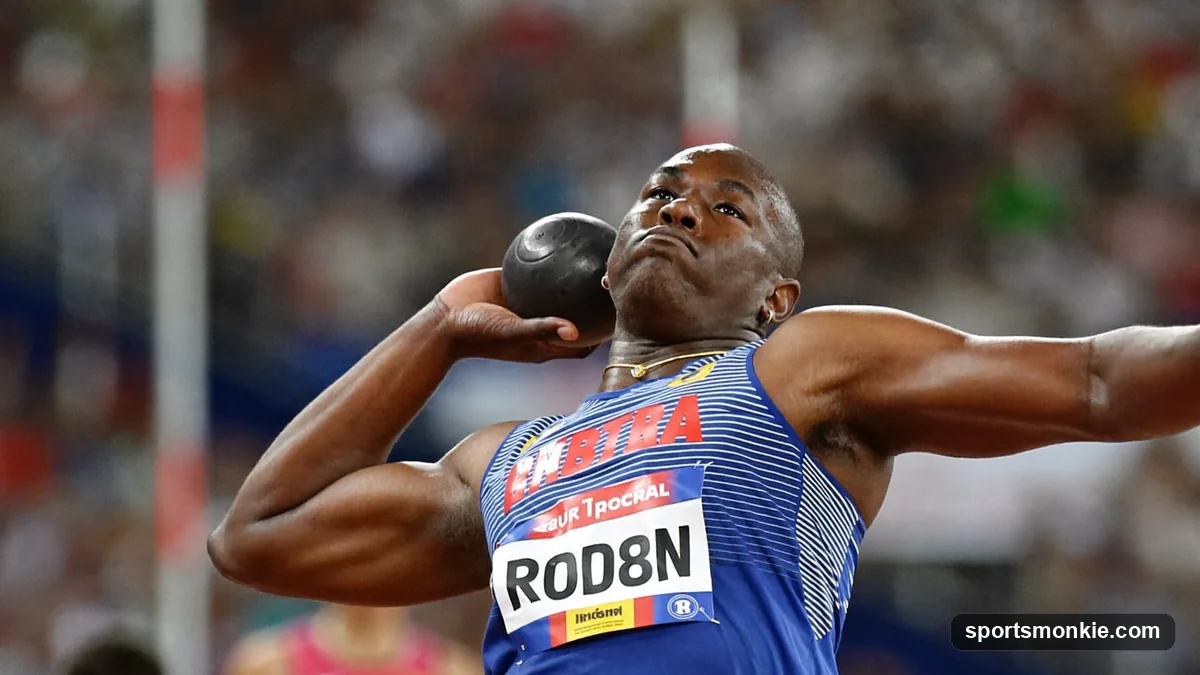
The name is literal and it’s also the event’s central rule. A legal put must be pushed from a position at or near the shoulder and neck, released with one hand only, with the shot never dropping below shoulder height during the delivery. If an athlete winds up and throws the shot overhand like a baseball, that attempt is an automatic foul — no distance is recorded. This rule is what forces the compact, explosive “punching” release you see at the top of both the glide and the spin, rather than a full throwing motion.
What Are the Two Shot Put Techniques?
There are two accepted ways to build momentum before the release, and both remain live at the elite level in 2026.
The glide (O’Brien technique). Invented by two-time Olympic champion Parry O’Brien in 1951, the glide starts with the thrower facing the back of the circle, then drives backward and rotates 180° in a short, low, linear slide across the circle before planting and releasing. It’s the more classical, teachable technique and still favored by many top throwers for its consistency.
The spin (rotational technique). Pioneered by Soviet coach Viktor Alexeyev (some sources credit American Brian Oldfield’s popularization) in the 1970s, the spin borrows the discus’s turning footwork — the thrower rotates roughly 1.5 times around the circle to build angular momentum before the release. It generates higher entry speed but is technically harder to control and more prone to fouls.
Neither technique is objectively “better” — Ryan Crouser, the current world record holder, throws with the glide, while many other elite men and women use the spin. The choice usually comes down to an athlete’s build, footwork background, and coaching.
How Do You Throw a Shot Put, Step by Step?
Using the glide as the reference technique:
- Grip. Rest the shot on the base of the fingers (not the palm), balanced against the neck below the jaw, elbow up and out to the side.
- Start position. Stand at the back of the circle facing away from the sector, weight on the right leg (for a right-handed thrower), left leg lifted.
- Drive/glide. Push off the right leg in a short, powerful slide across the circle, staying low, while the left leg reaches for the front of the circle.
- Power position. Land with the right foot near the center and the left foot near the stop board, hips already starting to rotate ahead of the shoulders and throwing arm.
- Release. Extend the legs and hips first, then the torso, then finally the arm — driving the shot upward and outward at roughly 35-40° above horizontal with the wrist snapping through for backspin.
- Reverse/recovery. Absorb the remaining momentum by quickly swapping the feet (a “reverse”) so the body doesn’t cross the stop board or exit the front of the circle before the shot lands.
The spin technique replaces steps 2-3 with a discus-style rotation but follows the same sequencing principle after that: legs, hips, torso, arm, in that order — a kinetic chain that generates far more force than the arm alone could produce.
What Are the Shot Put Fouls and Common Misconceptions?
An attempt is ruled a foul (recorded as a scratch, no distance) if any of the following happen:
| Foul | What it means |
|---|---|
| Touching the top of the stop board | The stop board may be pushed against on its inner face, but touching its top surface voids the attempt |
| Touching the ground outside the circle | Any body part contacting outside the circle rim during the attempt is a foul |
| Leaving the circle before the shot lands | Athletes must stay inside until the shot has landed in the sector |
| Exiting from the front half | Athletes must leave from the back half of the circle, after the shot lands, in a controlled manner |
| Shot lands outside the sector | Even a huge put is a foul if it lands outside the 34.92° lines |
| Dropping the shot below shoulder height mid-delivery, or throwing overhand | Violates the “put” requirement — this is the rule most casual viewers don’t realize exists |
A common misconception is that any step outside the circle is a foul — it’s specifically contact with the ground outside the circle, or the top of the stop board, that’s illegal; brushing the inner face of the stop board with a foot is legal and expected on a hard glide or spin. Another misconception is that gloves are allowed for grip — they are not; only chalk or resin on the hands is permitted.
Who Holds the Shot Put World Records?
| Category | Holder | Mark | Year / Venue |
|---|---|---|---|
| Men’s outdoor | Ryan Crouser (USA) | 23.56 m | 2023, Eugene, USA |
| Men’s indoor | Ryan Crouser (USA) | 22.82 m | 2021, Fayetteville, USA |
| Women’s outdoor | Natalya Lisovskaya (URS) | 22.63 m | 1987, Moscow, USSR |
Crouser is also the only shot putter — man or woman — to win three consecutive Olympic gold medals, doing it at Rio 2016 (22.52 m, then an Olympic record), Tokyo 2020/2021 (23.30 m, a new Olympic record), and Paris 2024 (22.90 m). Lisovskaya’s 1987 mark is track and field’s longest-standing world record still on the books; the closest anyone has come since is Larisa Peleshenko’s 21.46 m in 2000, and no woman has topped 21 m in the 2020s — active throwers like Chase Jackson and Jessica Schilder have been putting in the 20.0-20.6 m range.
Famous Shot Putters Worth Knowing
Beyond Crouser, a handful of names defined the event’s history. Parry O’Brien not only invented the glide technique but won back-to-back Olympic golds in 1952 and 1956 and set 10 world records across his career. Randy Barnes still holds a controversial but ratified men’s mark predating Crouser’s rise. On the women’s side, New Zealand’s Valerie Adams won two Olympic golds (2008, 2012) and four straight world titles using a dominant glide technique, proving the “older” style still wins at the highest level even as spin technique became more common among her rivals. Understanding these names — and the technique each used — is a quick way to see why shot put rewards more than raw strength: leverage, sequencing, and circle management decide medals as much as muscle does.
Frequently asked questions
Is shot put thrown or pushed?+
It's pushed, not thrown — that's the whole point of the name. The rules require the shot to stay in contact with or near the neck/shoulder until the final release, so the arm extends in a punching motion rather than a windup throw. A true overhand throw is an automatic foul.
How much does a shot put weigh?+
The men's implement weighs 7.26 kg (16 lb) and the women's weighs 4 kg (8.82 lb) in senior international competition. High school and youth divisions use lighter shots (commonly 4 kg for boys and 3 kg for girls in the US), and both indoor and outdoor rules use the same weights.
How big is the shot put circle?+
The throwing circle is 2.135 m (7 ft) in diameter, ringed by a metal or wood stop board 10 cm high at the front. Athletes must release the shot and exit from the back half of the circle without touching the top of the stop board, the rim, or the ground outside it.
What counts as a foul in shot put?+
The most common fouls are touching the top of the stop board or ground outside the circle during the attempt, leaving the circle before the shot lands, exiting from the front half instead of the back, and the shot landing outside the 34.92° sector. Any of these voids the mark to a scratch (no distance recorded).
Who holds the shot put world record?+
American Ryan Crouser holds the men's outdoor world record at 23.56 m, set in Eugene in May 2023 — he also owns the indoor record (22.82 m, 2021). The women's record has stood since 1987, when the Soviet Union's Natalya Lisovskaya threw 22.63 m in Moscow.
What is the difference between the glide and spin techniques?+
The glide (invented by Parry O'Brien in 1951) starts with the back to the throwing sector and slides linearly across the circle before a short push. The spin, or rotational technique, borrows footwork from the discus, rotating 1.5 times to build angular momentum before release. Both are legal; elite throwers use either.
Why do shot putters yell when they throw?+
The shout (or forced exhale) is a technique called the Valsalva maneuver in athletic form — bracing the core and diaphragm under load helps stabilize the spine and can add a small amount of extra power to the release, similar to grunting in tennis or weightlifting.
How far do professional shot putters throw?+
Elite men typically throw 20-23 m, with Ryan Crouser's 23.56 m the outer limit of the event. Elite women typically throw 18-20 m; the current world top is well below Lisovskaya's 1987 mark, with 2020s throwers topping out around 20.5-20.6 m.
Sources
Play & tools
Free browser games and tools — no account, no download.
- Play today's Sports Connections — Today's Sports Connections — daily hints, answers, and play the grid.
- Play Guess the NFL Player — A new mystery NFL player every day. Eight guesses, with a clue on each — plus free unlimited mode.
- Explore all our games →
Related guides

Discus Throw Explained: Rules, Technique, Dimensions & Records
Discus throw explained: the 2 kg/1 kg discus, 2.5m circle, 1.5-turn rotational technique, cage rules, and current world records (2026).

High Jump Explained: Rules, Technique, and World Records
High jump explained: the J-shaped approach, Fosbury Flop technique, three-attempt rules, countback ties, and the current men's and women's world records.
Javelin Throw Explained: Rules, Technique & World Records
Javelin throw explained: weight, runway rules, throwing technique, the 1986 redesign, and world records — men's 98.48m, women's 72.28m, as of 2026.
Long Jump Explained: Rules, Technique & World Records
Long jump explained: the 40m runway, plasticine take-off board, how jumps are measured, hang vs hitch-kick technique, fouls, and the world records.
Pole Vault Explained: Rules, Technique, Equipment and World Records
Pole vault explained: how the runway, pole and box work, the six phases of a vault, scoring rules, and current world records as of 2026.
Relay Race Explained: 4x100m, 4x400m, Baton Rules & World Records
How a relay race works: the 30m exchange zone, blind vs visual baton passes, DQ rules, and the 4x100m/4x400m world records, as of 2026.