
Discus Throw Explained: Rules, Technique, Dimensions & Records

On this page7
- 01What Are the Official Dimensions, Weights, and Cage Rules?
- 02What Is the 1.5-Turn Rotational Technique?
- 03How Do You Throw a Discus, Step by Step?
- 04Why Does Wind Affect the Discus So Much?
- 05What Counts as a Foul in Discus Throw?
- 06Who Holds the Discus Throw World Records?
- 07Famous Discus Throwers Worth Knowing
Discus throw is a track and field throwing event in which an athlete spins one and a half times inside a 2.5 m circle to release a weighted disc — 2 kg for men, 1 kg for women — as far as possible into a 34.92° landing sector. As of 2026, the benchmark marks are Mykolas Alekna’s men’s world record of 75.56 m, set in Ramona, Oklahoma in April 2025, and Gabriele Reinsch’s women’s world record of 76.80 m, which has stood since 1988 — one of the longest-surviving records in all of athletics. Of the three throwing events on the track and field program, discus is the only one where aerodynamics matter as much as raw power: the disc’s flight, unlike a shot put’s or a javelin’s, behaves like a spinning wing. This guide covers every dimension, rule, and technique detail you need to actually understand the event.
What Are the Official Dimensions, Weights, and Cage Rules?
World Athletics fixes every measurement in discus competition:
| Element | Specification |
|---|---|
| Throwing circle | 2.5 m (8 ft 2¼ in) diameter, recessed slightly into concrete |
| Landing sector | 34.92°, measured from the circle’s center |
| Men’s discus | 2 kg (4.4 lb), 219-221 mm diameter |
| Women’s discus | 1 kg (2.2 lb), 180-182 mm diameter |
| Protective cage | U-shaped, minimum 4 m high at its lowest points, opening toward the sector |
| Circle stop board | None — unlike shot put, discus has no board; athletes stay behind the rim entirely |
The circle is noticeably bigger than shot put’s 2.135 m ring, giving throwers the extra floor space a full 1.5-turn rotation demands. There’s also no stop board to brake against, since the discus technique relies on rotational speed rather than a linear drive into a fixed point.
What Is the 1.5-Turn Rotational Technique?
Every elite thrower uses some version of the same rotational technique, refined since it replaced older standing throws in the early 20th century. The name comes from the amount of rotation: the athlete completes one and a half full turns across the circle before releasing the discus, generating angular momentum that a standing throw could never match. The four phases are the wind-up (pre-rotation swings to set rhythm), the entry (the first turn, building speed while staying low and balanced), the drive (crossing the circle’s middle with the hips leading the shoulders), and the release (final extension and the discus rolling cleanly off the index finger with backspin). Getting the sequencing wrong — arm ahead of hips, or standing up too early — is the single biggest technical fault at every level of the sport.
How Do You Throw a Discus, Step by Step?
- Grip. The discus rests along the last joints of the fingers, spread evenly around the rim, with the thumb resting flat on top for control — never gripped in the palm.
- Wind-up. Standing at the back of the circle facing away from the sector, the thrower swings the discus back and forth across the body to establish rhythm and load the throwing side.
- Entry turn. Pivoting on the balls of the feet, the thrower spins through roughly 540° (one and a half turns), staying low with the discus trailing behind the body’s rotation.
- Power position. Landing with the feet roughly shoulder-width apart, hips already turned toward the sector ahead of the shoulders and arm — the classic “torque” position that stores elastic energy in the trunk.
- Release. The legs and hips fire first, then the torso, then finally the arm whips through, and the discus rolls off the index finger at roughly 35-40° above horizontal with heavy spin for stability.
- Recovery. The thrower reverses the feet to absorb momentum and avoid crossing the front of the circle before the discus lands — stepping out early is an automatic foul even on a legal-distance throw.
Why Does Wind Affect the Discus So Much?
This is the one thing that separates discus from the other throws and trips up most explainer content: because the discus is aerodynamic — essentially a heavy flying disc — its flight is shaped by lift and drag, not just gravity and launch velocity. A favorable tailwind or a discus released with slight positive attack angle can carry noticeably farther than the same throw in dead air, while into a headwind the disc can balloon upward and stall, killing distance. That’s why you’ll see elite throwers change their release angle throw-to-throw based on wind reading — a technique adjustment that shot put and javelin, which are far less wind-sensitive, don’t require in the same way.
What Counts as a Foul in Discus Throw?
An attempt is ruled a foul (a scratch, no distance recorded) if any of the following occur:
| Foul | What it means |
|---|---|
| Touching the top of the circle rim | The inside face can be touched, but the top surface cannot |
| Touching the ground outside the circle | Any body part contacting outside the rim during the attempt |
| Leaving the circle before the discus lands | Athletes must stay inside until the mark is made |
| Exiting from the front half | Must leave from the rear half of the circle, under control |
| Discus lands outside the sector | Even a huge throw is void if it lands outside the 34.92° lines |
| Wearing gloves or grip aids | Only chalk or single-finger tape for injury protection is permitted |
A common misconception is that any part of the foot crossing the circle’s painted edge is a foul — it’s specifically ground contact outside the physical rim that counts; grazing the inside of the rim with a foot mid-spin is legal and happens on almost every big throw.
Who Holds the Discus Throw World Records?
| Category | Holder | Mark | Year / Venue |
|---|---|---|---|
| Men’s world record | Mykolas Alekna (LTU) | 75.56 m | 2025, Ramona, Oklahoma |
| Women’s world record | Gabriele Reinsch (GDR) | 76.80 m | 1988, Neubrandenburg |
| 2024 Olympic champion (men) | Roje Stona (JAM) | 70.00 m | Paris, Olympic record |
| 2024 Olympic champion (women) | Valarie Allman (USA) | 69.50 m | Paris, back-to-back gold |
| 2025 World champion (men) | Daniel Ståhl (SWE) | 70.47 m | Tokyo |
| 2025 World champion (women) | Valarie Allman (USA) | — | Tokyo |
Reinsch’s 1988 mark, along with several other late-1980s East German marks, is treated by many in the sport as effectively unbreakable under current testing standards, making it one of track and field’s most enduring records. Alekna’s rise has been the opposite story: he broke the men’s world record twice in 13 months (74.35 m in April 2024, then 75.56 m in April 2025) at the same Oklahoma meet, both throws coming from a 20-year-old who inherited the event from his father, a two-time Olympic medalist.
Famous Discus Throwers Worth Knowing
Beyond Alekna and Reinsch, a handful of names define the modern event. Valarie Allman of the USA became the first American woman to win back-to-back Olympic discus golds (Tokyo 2020, Paris 2024) and added the 2025 World Championship title, building the most dominant active résumé in women’s discus. Sweden’s Daniel Ståhl, the 2020 Olympic and 2025 World champion, is known for one of the sport’s most explosive single-turn entries. Jamaica’s Roje Stona delivered his country’s first-ever Olympic discus medal — and its color was gold — with a 70.00 m Olympic record at Paris 2024. And Virgilijus Alekna, Mykolas’s father, won Olympic gold in 2000 and 2004, meaning the current world record now sits with the son of a two-time Olympic champion — a rare father-son pairing at the top of any track and field event.
Frequently asked questions
How much does a discus weigh?+
The senior men's discus weighs 2 kg (4.4 lb) with a diameter of 219-221 mm, and the senior women's discus weighs 1 kg (2.2 lb) with a diameter of 180-182 mm. Both have a metal rim and a smooth, slightly convex profile designed for lift. Youth and masters divisions use lighter or heavier implements depending on age group.
How big is the discus throwing circle?+
The discus circle is 2.5 m (8 ft 2¼ in) in diameter, larger than the shot put's 2.135 m circle to give throwers room for a full 1.5-turn rotation. Unlike shot put, there is no stop board — athletes must stay entirely inside the rim and exit from the rear half after the discus lands.
Why do discus throwers use a cage?+
A U-shaped protective cage, at least 4 m high on its lowest sections, surrounds the circle because a 2 kg discus released at high speed can travel wildly off-target on a bad throw or slip. The cage protects officials, other athletes, and spectators; it opens only toward the legal 34.92° landing sector.
What is the discus throw technique called?+
It's called the rotational or 1.5-turn technique: the thrower starts facing away from the sector, winds up, then spins counter-clockwise (for right-handers) one and a half revolutions across the circle before driving the hips and releasing the discus off the index finger with a flat, spinning trajectory.
Does wind affect the discus throw?+
Yes, significantly more than shot put or javelin, because the discus is aerodynamic and behaves like a flying disc. A tailwind or crosswind can add or subtract several meters depending on the disc's angle and spin, while a strong headwind lifts and stalls it — elite throwers adjust their release angle by feel for the day's conditions.
What is a foul in discus throw?+
Common fouls include touching the top of the circle rim or the ground outside it during the attempt, leaving the circle before the discus lands, exiting from the front half instead of the back, and the discus landing outside the 34.92° sector lines. Any of these voids the attempt with no distance recorded.
Who holds the discus throw world record?+
Lithuania's Mykolas Alekna holds the men's world record at 75.56 m, set on 13 April 2025 in Ramona, Oklahoma — he broke his own 2024 record of 74.35 m at the same meet. The women's record has stood since 1988, when East Germany's Gabriele Reinsch threw 76.80 m in Neubrandenburg.
How far do elite discus throwers throw?+
Elite men typically throw 63-70 m, with only a handful of athletes ever clearing 70 m; Alekna's 75.56 m sits well clear of the pack. Elite women typically throw 60-70 m, though the current world top is still short of Reinsch's 1988 mark — 2025 world champion Valarie Allman's best sits in the high 60s to low 70s.
Sources
Play & tools
Free browser games and tools — no account, no download.
- Play today's Sports Connections — Today's Sports Connections — daily hints, answers, and play the grid.
- Play Guess the NFL Player — A new mystery NFL player every day. Eight guesses, with a clue on each — plus free unlimited mode.
- Explore all our games →
Related guides
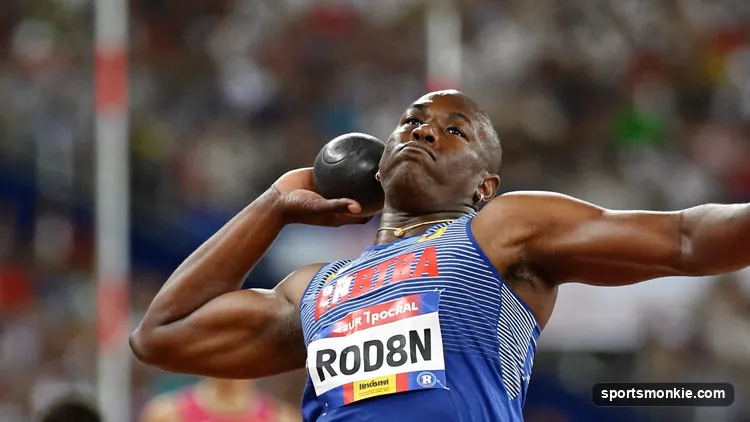
Shot Put Explained: Rules, Technique, Dimensions & Records
Shot put explained: official weights, the 2.135m circle, glide vs. spin technique, foul rules, and the current world records (2026).

Javelin Throw Explained: Rules, Technique & World Records
Javelin throw explained: weight, runway rules, throwing technique, the 1986 redesign, and world records — men's 98.48m, women's 72.28m, as of 2026.

High Jump Explained: Rules, Technique, and World Records
High jump explained: the J-shaped approach, Fosbury Flop technique, three-attempt rules, countback ties, and the current men's and women's world records.

Long Jump Explained: Rules, Technique & World Records
Long jump explained: the 40m runway, plasticine take-off board, how jumps are measured, hang vs hitch-kick technique, fouls, and the world records.

Pole Vault Explained: Rules, Technique, Equipment and World Records
Pole vault explained: how the runway, pole and box work, the six phases of a vault, scoring rules, and current world records as of 2026.
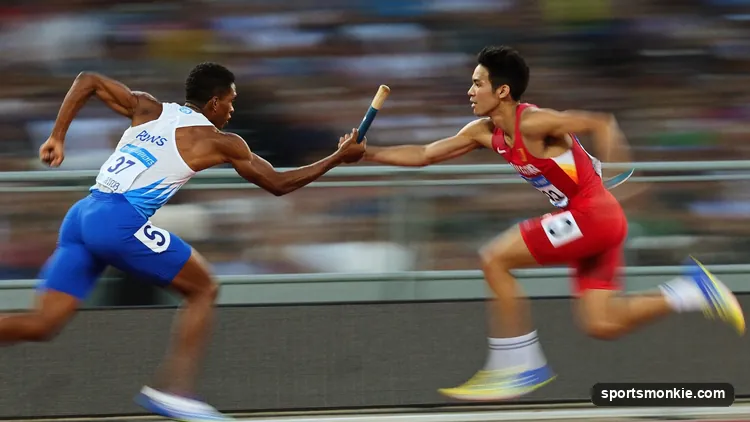
Relay Race Explained: 4x100m, 4x400m, Baton Rules & World Records
How a relay race works: the 30m exchange zone, blind vs visual baton passes, DQ rules, and the 4x100m/4x400m world records, as of 2026.