
Relay Race Explained: 4x100m, 4x400m, Baton Rules & World Records
On this page9
- 01What is a relay race?
- 024x100m vs 4x400m: what’s actually different?
- 03What is the exchange zone, and where’s the go-mark?
- 04Blind pass vs visual pass: how the handoff actually works
- 05Step by step: executing a clean baton exchange
- 06What disqualifies a relay team?
- 07Relay world records, as of 2026
- 08Famous relay teams and legs
- 09The mixed 4x400m relay
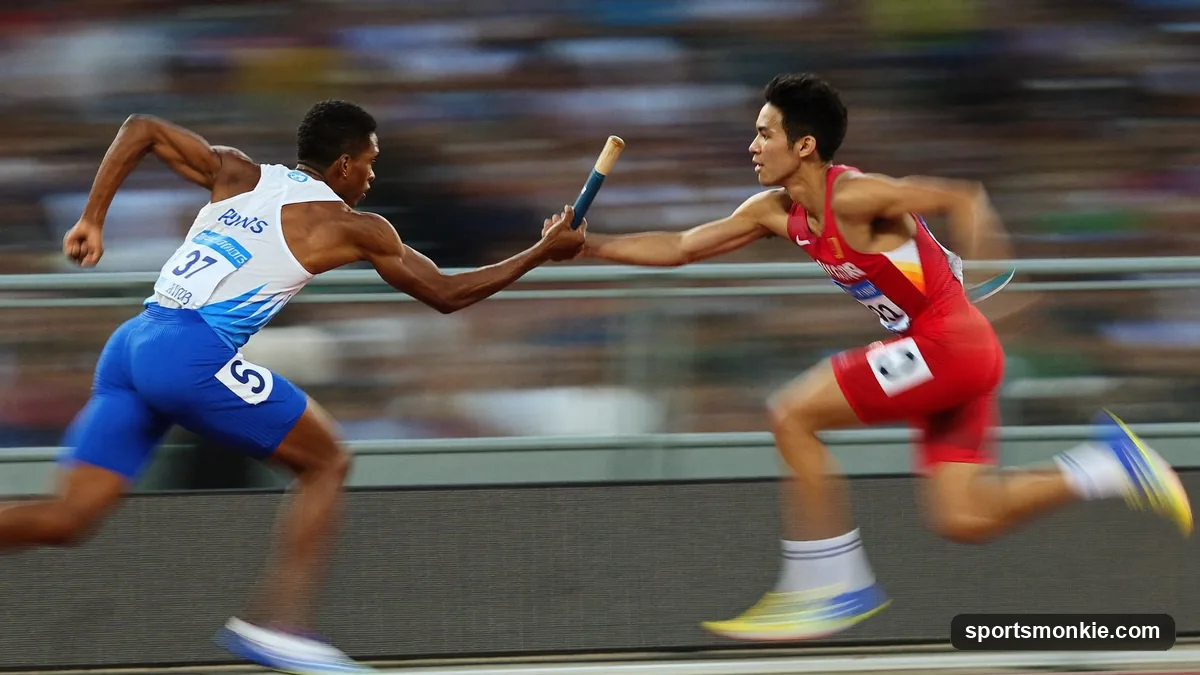
A relay race is a team track event where four athletes each run a fixed distance and hand off a baton to the next runner inside a 30-meter exchange zone — the two Olympic standards are the 4x100m (world record 36.84 seconds, Jamaica, 2012) and the 4x400m (world record 2:54.29, USA, 1993). Unlike almost every other track event, a relay is won or lost as much on the exchanges as on raw speed — a clean 30-meter handoff can be worth more than a tenth of a second, and a botched one can end a race regardless of who’s running.
What is a relay race?
A relay race splits one total distance across a team of four runners, each covering an equal leg and passing a baton — a rigid, hollow tube about 30cm long — to the next teammate before that teammate’s leg counts. The two events on the Olympic and World Championship program are the 4x100m and 4x400m relays, plus the mixed-gender 4x400m added at the Tokyo 2020 Olympics. Every runner besides the anchor (final leg) hands off; every runner besides the lead-off receives.
4x100m vs 4x400m: what’s actually different?
The two relays share a format but almost nothing else in execution. The 4x100m is run entirely in lanes, each leg is a flat-out 100m sprint, and the baton is passed blind — the outgoing runner never turns around. The 4x400m is a full lap per leg, runners break out of their lanes into a shared pack after the first turn of the second leg, and fatigue makes a blind pass too risky, so the exchange is done visually, with the outgoing runner watching the incoming teammate arrive. The mixed 4x400m uses the same visual-pass mechanics but allows any order of two men and two women on a team; the USA ran 3:07.41 to set the world record at the 2024 Paris Olympics.
What is the exchange zone, and where’s the go-mark?
Every relay handoff happens inside a marked changeover box painted on the track. Under current World Athletics rules, that box totals 30 meters: a 20-meter zone where the baton must legally change hands, preceded by a 10-meter acceleration zone the outgoing runner can use to get up to speed before receiving it. The baton itself must be exchanged inside the 20-meter section — arriving early, from the acceleration zone, or leaving late both risk a foul.
To time their start, the outgoing runner places a strip of tape on the track behind them called the go-mark. When the incoming runner’s foot hits that mark — set during practice based on both athletes’ speeds — the outgoing runner takes off, aiming to hit near-top speed exactly as the incoming runner closes the gap inside the zone. Move the go-mark too early and the gap never closes before the zone ends; too late and the incoming runner catches up mid-stride, killing the exchange’s speed advantage.
Blind pass vs visual pass: how the handoff actually works
- Blind / push pass (4x100m): The outgoing runner drives out of the zone without looking back, arm extended low and behind with palm up. On a verbal cue (“stick!” or similar) from the incoming runner, they close the hand around the baton as it’s pushed up into the palm. This is the fastest handoff method because neither runner loses stride, but it demands hundreds of repetitions to sync.
- Visual pass (4x400m, medleys): The outgoing runner watches the incoming teammate the entire approach and reaches back to take the baton directly, adjusting their hand position in real time. It costs a fraction of a second in exchange speed but is far more forgiving of a tired incoming runner’s uneven stride.
Step by step: executing a clean baton exchange
- Outgoing runner sets up in the acceleration zone, checking the go-mark distance against the incoming runner’s known split.
- Incoming runner sprints in, calling out (or visually signaling in the 4x400m) as they close the distance.
- Outgoing runner drives out of the mark, building to near full speed before the 20-meter legal zone begins.
- Baton is transferred hand-to-hand fully inside the 20-meter zone — underhand push (4x100m) or direct reach (4x400m).
- Incoming runner decelerates and exits their lane cleanly without impeding the next exchange further down the track.
What disqualifies a relay team?
- Baton passed outside the 30-meter zone — either too early (before the 20m mark) or too late (after it ends).
- Dropped baton that impedes another team — a drop itself isn’t automatically a DQ (only the runner who dropped it may retrieve it, and the clock keeps running), but interference with another lane is.
- Lane infringement — cutting into another team’s lane during a live handoff, or in the 4x400m, breaking to the inside before the legal point (the back straight of the second leg).
- Illegal baton transfer method — throwing, rolling, or tossing the baton instead of a direct hand-to-hand pass is not permitted under World Athletics rules.
A common misconception: fans often assume any dropped baton ends the race. It doesn’t — teams that fumble but recover cleanly (same runner picks it up) can and do finish, they just lose the time it took to recover it.
Relay world records, as of 2026
| Event | Record holder | Time | Year / Venue |
|---|---|---|---|
| Men’s 4x100m | Jamaica (Carter, Frater, Blake, Bolt) | 36.84 s | 2012, London Olympics |
| Women’s 4x100m | USA (Madison, Felix, Knight, Jeter) | 40.82 s | 2012, London Olympics |
| Men’s 4x400m | USA (Valmon, Watts, Reynolds, Johnson) | 2:54.29 | 1993, World Champs, Stuttgart |
| Women’s 4x400m | Soviet Union (Ledovskaya, Nazarova, Pinigina, Bryzgina) | 3:15.17 | 1988, Seoul Olympics |
| Mixed 4x400m | USA (Norwood, Little, Deadmon, Brown) | 3:07.41 | 2024, Paris Olympics |
Both the men’s and women’s 4x400m marks predate the modern doping-control era by decades and remain among the longest-standing records in the sport, while the men’s and women’s 4x100m records were both set at the same 2012 Games and remain unbroken as of 2026, with the USA’s 37.38 at the 2023 World Championships the closest recent challenge to the men’s mark.
Famous relay teams and legs
No single leg in relay history is more famous than Usain Bolt’s anchor for Jamaica in the 2012 London final, taking a baton already in the lead from Yohan Blake and extending it to the still-standing 36.84 world record. On the 4x400m side, Michael Johnson’s anchor leg for the USA’s 1993 world-record team came the same year he began rewriting the men’s individual 200m and 400m record books, and his relay teammates — Andrew Valmon, Quincy Watts and Butch “Harry” Reynolds — remain the standard reference quartet for the event. The Soviet Union’s 1988 women’s 4x400m team has now held its world record for well over three decades, longer than any other relay mark on this list. Athletes who thrive in relays often come from sprint or hurdles backgrounds, since both events demand the same explosive acceleration a good exchange requires.
The mixed 4x400m relay
Introduced for the Tokyo 2020 Olympics and now a fixture at the World Athletics Championships and World Relays, the mixed 4x400m lets each national team choose any combination of two men and two women, in any running order — a tactical wrinkle the single-gender relays don’t have. The current world record, 3:07.41 by the USA at the 2024 Paris Olympics (Vernon Norwood, Shamier Little, Bryce Deadmon, Kaylyn Brown), was actually set in the heats, not the final, underscoring how fast the event has developed since its introduction.
Frequently asked questions
How long is a relay race exchange zone?+
The exchange zone, officially called the changeover box, is 30 meters long in both the 4x100m and 4x400m relays. It splits into a 20-meter zone where the baton must legally change hands and a 10-meter acceleration zone before it where the outgoing runner can start moving to build speed before the pass.
What is a blind pass in a relay race?+
A blind pass, used in the 4x100m relay, is a baton handoff where the outgoing runner never looks back. They sprint on a pre-practiced go-mark and hold a hand back to receive the baton by feel, either underhand (push pass) or overhand. It's faster than looking back but requires exact timing between two sprinters.
Why do 4x400m runners look back for the baton?+
In the 4x400m relay, fatigue after a full lap makes blind handoffs unreliable, so runners use a visual pass: the outgoing runner watches the incoming teammate approach and times their reach to grab the baton directly. It sacrifices a fraction of a second for a much lower risk of a dropped or missed exchange.
What disqualifies a team in a relay race?+
The most common relay DQs are passing the baton outside the 30-meter exchange zone, dropping the baton in a way that impedes another team, running outside your assigned lane during a live handoff, and obstructing another runner. A dropped baton itself is not an automatic DQ if the same runner recovers it cleanly.
What is the fastest 4x100m relay time ever?+
The men's 4x100m world record is 36.84 seconds, set by Jamaica (Nesta Carter, Michael Frater, Yohan Blake, Usain Bolt) at the 2012 London Olympics. The women's record is 40.82 seconds, set by the United States (Tianna Madison, Allyson Felix, Bianca Knight, Carmelita Jeter) at the same Games.
How many meters does each runner cover in a relay?+
In the 4x100m relay, each of the four runners covers 100 meters for a 400-meter total. In the 4x400m relay, each runner covers a full 400-meter lap for a 1,600-meter total. A relay team's overall time is always faster than the sum of the runners' individual best times, thanks to the flying-start handoffs.
Can you touch pass a baton in track relays?+
No. World Athletics rules require the baton to be physically carried and handed from runner to runner by hand inside the exchange zone; it cannot be thrown, rolled, or tossed. If a runner drops the baton, only the runner who dropped it may pick it up, and the clock keeps running.
What order do runners go in a relay race?+
The classic lineup is second-fastest runner leads off, third-fastest runs the tricky turn-heavy second leg, the slowest runs the third leg (usually the most protected position), and the fastest runner anchors and closes the race. Coaches vary this based on curve-running ability and handoff chemistry.
Sources
Play & tools
Free browser games and tools — no account, no download.
- Play today's Sports Connections — Today's Sports Connections — daily hints, answers, and play the grid.
- Play Guess the NFL Player — A new mystery NFL player every day. Eight guesses, with a clue on each — plus free unlimited mode.
- Explore all our games →
Related guides

High Jump Explained: Rules, Technique, and World Records
High jump explained: the J-shaped approach, Fosbury Flop technique, three-attempt rules, countback ties, and the current men's and women's world records.
Long Jump Explained: Rules, Technique & World Records
Long jump explained: the 40m runway, plasticine take-off board, how jumps are measured, hang vs hitch-kick technique, fouls, and the world records.

Pole Vault Explained: Rules, Technique, Equipment and World Records
Pole vault explained: how the runway, pole and box work, the six phases of a vault, scoring rules, and current world records as of 2026.

What Is a Steeplechase? The Water-Jump Race
A steeplechase is a distance race, 3,000m at the Olympics, run over fixed barriers and a water jump. Runners clear 28 barriers and 7 water jumps in all.

Discus Throw Explained: Rules, Technique, Dimensions & Records
Discus throw explained: the 2 kg/1 kg discus, 2.5m circle, 1.5-turn rotational technique, cage rules, and current world records (2026).
Javelin Throw Explained: Rules, Technique & World Records
Javelin throw explained: weight, runway rules, throwing technique, the 1986 redesign, and world records — men's 98.48m, women's 72.28m, as of 2026.