
What Is a Steeplechase? The Water-Jump Race

On this page7
A steeplechase is a distance running race contested over solid barriers and a water jump. The standard event, run at the Olympics and World Championships, is the 3,000 metres steeplechase, in which runners clear 28 barriers and 7 water jumps over the course of the race. It is one of track and field’s most demanding events, combining endurance with the obstacle skill of hurdling.
The word “steeplechase” and the odd water pit both trace back to horse racing, which explains a lot about why the event looks the way it does. Here is what actually happens in the race, the exact obstacle count, and how it differs from ordinary hurdles.
The 3,000m steeplechase, by the numbers
The senior championship distance is 3,000 metres, run on a standard track with fixed obstacles set around the lap. World Athletics defines the event precisely.
| Element | Specification (3,000m) |
|---|---|
| Race distance | 3,000 metres |
| Total barriers cleared | 28 |
| Total water jumps | 7 |
| Barrier height (men) | 0.914 m |
| Barrier height (women) | 0.762 m |
| Obstacles per lap | 5 (four barriers plus the water jump) |
Each full lap contains five obstacles: four plain barriers and the one barrier that sits in front of the water pit. Over the roughly seven-and-a-half laps of the 3,000m, that adds up to the 28 barriers and 7 water jumps that define the event. There is also a 2,000m version used in some junior and other competitions with fewer obstacles.
What makes the barriers different
The most important thing to understand is that steeplechase barriers are not like sprint hurdles. Hurdles are light and tip over when struck. Steeplechase barriers are heavy, fixed and do not move, which changes how athletes attack them.
Because the barrier will not fall, a runner is allowed to plant a foot on top of it and push off, a technique that is especially useful at the water jump. Most elite runners hurdle the plain barriers cleanly to save time, but step on the barrier before the water to control their landing.
The water jump
The water jump is the signature obstacle. A barrier sits at the near edge of a pit of water, and the pit is deepest right at the barrier, then slopes gradually up to track level.
That slope is deliberate. Runners plant a foot on the barrier and push out as far as they can, aiming to land in the shallower water toward the far end rather than splashing straight down into the deep part. Landing well saves energy and momentum; landing badly loses both, and over 3,000 metres those small losses stack up. The water recreates the streams that horses jumped in the sport’s origins.
Where the name comes from
The event’s name has nothing to do with running itself. In 18th-century Ireland and Britain, riders raced their horses cross-country between towns, and because a church steeple was the tallest, most visible landmark around, they used a distant steeple as the finish point, hence “steeplechase.” Those races crossed streams, walls and hedges.
When athletics organised the event on a track, it kept the obstacles, the water and the name. That heritage is why the steeplechase is the only standard track race with a permanent water hazard.
Race tactics: where steeplechases are won and lost
A steeplechase is rarely won by the fastest runner on the flat alone; it is won by the athlete who loses the least at the obstacles. Every barrier and every water jump breaks a runner’s rhythm and costs a fraction of momentum, and over 35 obstacles those fractions add up.
The two decisive skills are hurdling economy and traffic management. Elite runners clear the plain barriers with barely a change in stride, while less efficient athletes chop their steps to set up each jump and bleed energy. In a crowded pack, getting boxed in behind slower runners at a barrier can be disastrous, so positioning going into each obstacle matters as much as raw speed. The water jump in particular tends to string the field out, because a clean, far-reaching landing carries momentum that a heavy splash does not.
Distances and who competes
While the 3,000m is the championship standard for senior athletes, the event has other versions. A 2,000m steeplechase with fewer obstacles is used for junior competition and some other meets, and youth categories scale the barrier heights and distances down further.
Steeplechasers occupy a niche between the middle-distance and long-distance ranks. They typically have the endurance base of a 5,000m runner combined with the coordination to hurdle at speed while fatigued, a rare pairing that makes the event one of athletics’ most specialised. East African nations have long dominated the men’s and women’s fields, though strong steeplechasers emerge from many countries.
A unique test of the distance runner
The steeplechase asks for a rare mix: the aerobic engine of a 3,000m runner plus the rhythm and coordination to clear 35 obstacles without breaking stride. A pure distance runner who cannot hurdle loses time at every barrier; a pure hurdler without endurance fades badly over the distance. That blend is why steeplechase specialists are a distinct breed within the world’s greatest male sprinters and distance runners, and why the event is a highlight of the most popular Olympic sports.
The short version: a steeplechase is a distance race over fixed barriers and a water jump, run at 3,000m in championships, with 28 barriers and 7 water jumps in total. The barriers are solid so runners can step on them, and both the water and the name come from cross-country horse racing.
Frequently asked questions
Why is it called a steeplechase?+
The name comes from 18th-century Irish and British horse racing, where riders raced across open country using a distant church steeple as the finish marker, since steeples were the tallest landmarks visible for miles. Those cross-country horse races jumped natural obstacles like streams and walls, and the athletics event borrowed both the name and the obstacles.
What's the difference between a steeplechase and a hurdle race?+
Hurdles tip over when hit and are evenly spaced with no water; steeplechase barriers are solid and immovable, so runners can hurdle or step on them, and one is followed by a water pit. A steeplechaser also runs much farther, 3,000m, versus 110m or 400m for the sprint hurdles.
Why is there a water pit in the steeplechase?+
The water jump recreates the streams that horses cleared in the original cross-country steeplechases. In athletics it adds a distinct test: the pit is deepest at the barrier and slopes up, so runners plant a foot on the barrier and push out to land in shallower water, saving energy over 3,000 metres.
How high are the steeplechase barriers?+
Under World Athletics rules the barriers are 0.914 metres high for men and 0.762 metres for women, matching the respective hurdle heights. They are heavy and fixed rather than free-standing, which is why athletes are allowed to place a foot on top of them to clear the barrier and the water beyond it.
Sources
Play & tools
Free browser games and tools — no account, no download.
- Play today's Sports Connections — Today's Sports Connections — daily hints, answers, and play the grid.
- Play Guess the NFL Player — A new mystery NFL player every day. Eight guesses, with a clue on each — plus free unlimited mode.
- Explore all our games →
Related guides

High Jump Explained: Rules, Technique, and World Records
High jump explained: the J-shaped approach, Fosbury Flop technique, three-attempt rules, countback ties, and the current men's and women's world records.
Long Jump Explained: Rules, Technique & World Records
Long jump explained: the 40m runway, plasticine take-off board, how jumps are measured, hang vs hitch-kick technique, fouls, and the world records.
Pole Vault Explained: Rules, Technique, Equipment and World Records
Pole vault explained: how the runway, pole and box work, the six phases of a vault, scoring rules, and current world records as of 2026.
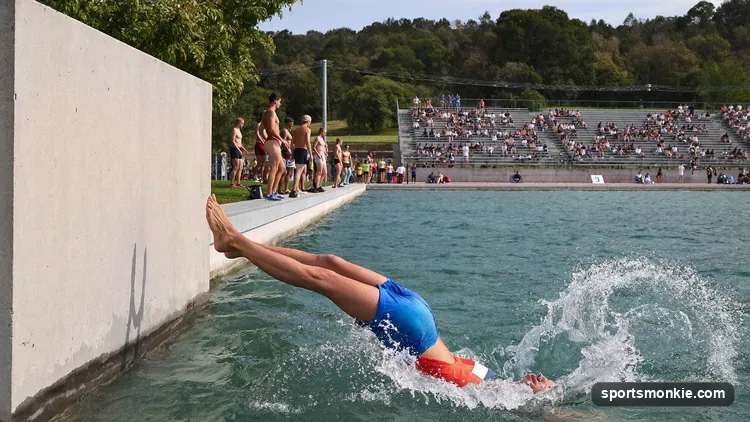
Steeplechase Explained: Rules, Barriers, Water Jump & World Records
Steeplechase explained: 28 barriers, 7 water jumps over 3000m, barrier heights, technique, and the current men's and women's world records.
Relay Race Explained: 4x100m, 4x400m, Baton Rules & World Records
How a relay race works: the 30m exchange zone, blind vs visual baton passes, DQ rules, and the 4x100m/4x400m world records, as of 2026.
Heptathlon Events Explained: Order, Rules and Scoring
The heptathlon has seven events over two days. See the event order, scoring, false-start rules, tie rule, records and beginner training notes.