
Heptathlon Events Explained: Order, Rules and Scoring
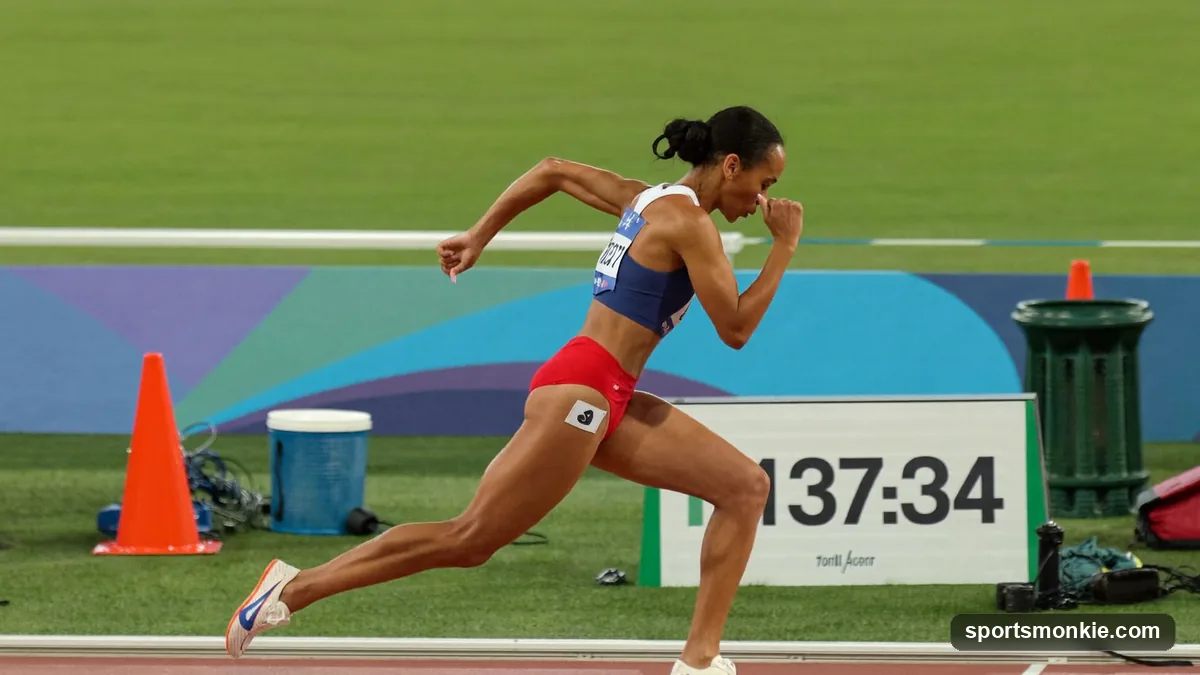
On this page11
- 01What are the 7 heptathlon events, in order?
- 02How does the heptathlon day 1 vs day 2 schedule work?
- 03How does heptathlon scoring work?
- 04What rules are different in the heptathlon?
- 05What happens during a tie in heptathlon?
- 06What is the heptathlon world record?
- 07How is the heptathlon different from the decathlon?
- 08How does each heptathlon event work?
- 09What should beginner heptathletes train first?
- 10What gear does a heptathlete actually need?
- 11Who are today’s top heptathletes?
The heptathlon is a women’s combined-events competition made up of seven track-and-field events over two days: 100m hurdles, high jump, shot put and 200m on day one, then long jump, javelin throw and 800m on day two. The winner is the athlete with the highest points total, not the athlete who wins the most individual events.
Every performance is converted into points on World Athletics combined-events tables. A hurdle time, a high jump clearance, a shot put distance and an 800m time all feed into the same final score. That is why a heptathlon can feel simple on paper and brutal in real life: one poor event can undo six strong ones.
If you want to go deeper after the event order, use our heptathlon scoring guide, heptathlon training guide, heptathlon technique guide, Olympic heptathlon history and records and track-spike buying guide for heptathletes. Those pages split the cluster into scoring math, beginner preparation, event technique, record context and equipment choices so this page can stay focused on the seven-event format.
What are the 7 heptathlon events, in order?
The outdoor women’s heptathlon always follows the same order. Day one leans on speed and explosive power, while day two asks athletes to jump, throw and then survive the 800m with tired legs.
| Order | Day | Event | Type |
|---|---|---|---|
| 1 | Day 1 | 100m hurdles | Sprint hurdles |
| 2 | Day 1 | High jump | Jump |
| 3 | Day 1 | Shot put | Throw |
| 4 | Day 1 | 200m | Sprint |
| 5 | Day 2 | Long jump | Jump |
| 6 | Day 2 | Javelin throw | Throw |
| 7 | Day 2 | 800m | Middle distance |
The order matters because fatigue builds in a predictable way. A fast hurdler can start the competition with a lead, a strong high jumper can add a huge second-event score, and a good 800m runner can still change the medal order in the final race. For the wider family of events around it, see our track and field events explained guide.
How does the heptathlon day 1 vs day 2 schedule work?
Day one has four events: 100m hurdles, high jump, shot put and 200m. Day two has three events: long jump, javelin and 800m. The competition is held across two consecutive 24-hour periods, so it is not just seven separate events. It is also a recovery test.
The first day usually creates the shape of the leaderboard. Hurdlers and jumpers can score heavily early, and a weak shot put can cost enough points to change the whole weekend. The second day is more volatile. Long jump fouls, javelin inconsistency and the final 800m can move athletes by several places even after six events.
Men’s indoor heptathlon is different. It is an indoor combined event with 60m, long jump, shot put, high jump, 60m hurdles, pole vault and 1000m. Outdoor Olympic heptathlon is the women’s seven-event format covered in this guide.
How does heptathlon scoring work?
Heptathlon scoring converts marks into points. The basic idea is straightforward: faster times are worth more in running events, while longer or higher marks are worth more in jumping and throwing events. Placings inside an individual event do not directly decide the final standings.
World Athletics publishes combined-events scoring tables, and the federation’s heptathlon guide gives these approximate 1,000-point benchmarks:
| Event | Mark worth about 1,000 points |
|---|---|
| 100m hurdles | 13.85 seconds |
| High jump | 1.82 m |
| Shot put | 17.07 m |
| 200m | 23.80 seconds |
| Long jump | 6.48 m |
| Javelin throw | 57.18 m |
| 800m | 2:07.63 |
A world-class heptathlete does not need seven 1,000-point events to win, but she needs very few disasters. At Paris 2024, Nafissatou Thiam won Olympic gold with 6,880 points. At the 2025 World Championships in Tokyo, Anna Hall won with 6,888. Those totals show the standard at the very top: roughly 6,800 to 7,000 points is usually gold-medal territory at a major championship, while 7,000 remains rare.
What rules are different in the heptathlon?
Most heptathlon rules come from the individual events, but combined events add a few important conditions.
| Rule area | What it means in heptathlon |
|---|---|
| Event completion | An athlete must start or make a trial in every event to stay in the competition. |
| Event order | The seven events must be contested in the prescribed order over two consecutive days. |
| False starts | One false start is allowed in a combined-events race. A second false start in that race means disqualification. |
| Jump and throw attempts | Athletes get three attempts in long jump, shot put and javelin. |
| Ties | If athletes finish with the same total points, World Athletics records it as a tie. |
The false-start rule is a useful example. In a standalone sprint, the first false start can remove the athlete responsible. In combined events, the race gets one warning. After that, the next false starter is disqualified from that race, even if she was not responsible for the original false start.
What happens during a tie in heptathlon?
If two or more athletes finish with the same number of points, the result is listed as a tie. There is no extra 800m, no countback by event wins and no hidden medal-count style rule in the standard World Athletics explanation.
Paris 2024 gave a clean example. Martha Araujo, Xénia Krizsán and Emma Oosterwegel all finished on 6,386 points, and World Athletics listed all three in seventh place. That is a good reminder that heptathlon standings are a points table first, not a sequence of head-to-head wins.
What is the heptathlon world record?
Jackie Joyner-Kersee’s 7,291 points at the 1988 Seoul Olympics remains the world record. It is one of athletics’ longest-standing records, and it is still far ahead of the modern field.
| Athlete | Points | Year | Meet |
|---|---|---|---|
| Jackie Joyner-Kersee (USA) | 7,291 | 1988 | Seoul Olympics |
| Carolina Klüft (SWE) | 7,032 | 2007 | World Championships, Osaka |
| Anna Hall (USA) | 7,032 | 2025 | Götzis Hypo-Meeting |
| Nafissatou Thiam (BEL) | 7,013 | 2017 | Götzis Hypo-Meeting |
| Katarina Johnson-Thompson (GBR) | 6,981 | 2019 | World Championships, Doha |
Hall’s 7,032 in Götzis made the current era more interesting because it matched Carolina Klüft’s best-by-athlete mark behind Joyner-Kersee. Still, the record chase is steep. A heptathlete can be the best in the world today and remain hundreds of points short of 7,291.
How is the heptathlon different from the decathlon?
The outdoor heptathlon is the women’s seven-event combined competition. The outdoor decathlon is the men’s 10-event combined competition. Both use points, both run over two days, and both reward range rather than one-event dominance.
| Competition | Usual outdoor elite format | Events |
|---|---|---|
| Heptathlon | Women, two days | 100m hurdles, high jump, shot put, 200m, long jump, javelin, 800m |
| Decathlon | Men, two days | 100m, long jump, shot put, high jump, 400m, 110m hurdles, discus, pole vault, javelin, 1500m |
| Indoor heptathlon | Men, two days | 60m, long jump, shot put, high jump, 60m hurdles, pole vault, 1000m |
| Indoor pentathlon | Women, one day | 60m hurdles, high jump, shot put, long jump, 800m |
Historically, women’s combined events moved from pentathlon to heptathlon in the early 1980s, and the heptathlon made its Olympic debut at Los Angeles 1984. Men’s outdoor combined events kept the decathlon as the main global format.
How does each heptathlon event work?
The seven events test different athletic qualities. The best heptathletes usually have two or three standout events, one manageable weakness and no complete collapse.
- 100m hurdles: Athletes sprint over ten hurdles set 8.5m apart. Hitting a hurdle is not an automatic foul, but it costs rhythm and time. See our hurdles in track explainer for the basic mechanics.
- High jump: Athletes clear a bar and stay alive until three consecutive misses. Approach rhythm, takeoff angle and body position decide most of the event.
- Shot put: The women’s implement is 4kg. Athletes put the shot from a circle using a glide or rotational technique, and three attempts count toward the best mark.
- 200m: This is a half-lap sprint from staggered lanes. Bend running matters because athletes are carrying fatigue from hurdles, jumps and shot put.
- Long jump: Athletes sprint into a takeoff board and try to land as far into the sandpit as possible. A foul at the board scratches the attempt.
- Javelin throw: The throw uses a running approach, crossover steps and an overhand release. The javelin has to land tip-first inside the sector.
- 800m: Two laps close the competition. It is often the most painful event because many heptathletes are built more for speed and power than middle-distance running.
What should beginner heptathletes train first?
A beginner should train movement quality before chasing seven personal bests at once. Hurdle rhythm, sprint mechanics, safe jumping takeoffs, basic throwing positions and simple 800m pacing will matter more than copying an elite training plan.
For high school athletes, the practical route is usually to build from events they already know. A hurdler or jumper can add throws gradually. A sprinter can learn long jump and the 200m quickly, then spend more time on the technical throws. The big mistake is treating heptathlon as a fitness challenge only. It is a skill collection, and the weakest technical event can drain hundreds of points.
What gear does a heptathlete actually need?
At minimum, a heptathlete needs legal competition spikes, comfortable training shoes and event-specific access to hurdles, a high jump area, a shot put circle, a long jump runway, a javelin runway and a track. Beginners do not need a separate specialist shoe for every event on day one.
The smart first buying decision is a safe all-round spike or a sprint-jump setup that works for hurdles, 200m and long jump, then adding more specific shoes only when the athlete’s events and budget justify it. Throwing shoes, high jump shoes and premium long jump spikes can help the right athlete, but they should come after coaching, rule checks and fit. That is why the next heptathlon cluster should include a dedicated gear guide, not a quick product list.
Who are today’s top heptathletes?
Anna Hall is the current world champion after winning the 2025 World Championships in Tokyo with 6,888 points. Her 7,032 at Götzis earlier in 2025 also tied Carolina Klüft’s best-by-athlete mark behind Joyner-Kersee.
Nafissatou Thiam remains the modern Olympic benchmark. She won Rio 2016, Tokyo 2020 and Paris 2024, becoming the first combined-events athlete to win three Olympic heptathlon gold medals. Katarina Johnson-Thompson is still one of the defining names of the era, with world titles in 2019 and 2023 and Olympic silver in Paris. Kate O’Connor’s 2025 world silver and Taliyah Brooks’ 2025 world bronze also keep the current field deep.
Frequently asked questions
What are the 7 events in a heptathlon in order?+
Day one is 100m hurdles, high jump, shot put and 200m. Day two is long jump, javelin throw and 800m. That is the outdoor women's order used at the Olympics, World Championships and other major combined-events meetings.
How many throws or jumps do you get in a heptathlon?+
Heptathletes get three attempts in the long jump, shot put and javelin throw. In high jump, they get three attempts at a height and are eliminated after three consecutive misses, just as they would be in a normal high jump competition.
How is heptathlon scored?+
Each time, height or distance is converted into points using World Athletics combined-events tables. Faster times score more in running events, and bigger marks score more in jumps and throws. The seven point scores are added together, and the athlete with the highest total wins.
What happens if two heptathletes finish with the same points?+
World Athletics treats the result as a tie when athletes finish the heptathlon with the same total. Paris 2024 showed that in practice, with three athletes listed in seventh place on 6,386 points.
What is the false-start rule in heptathlon?+
Combined-events races allow one false start in the race. After that, a second false start leads to disqualification, even if a different athlete caused the first one. That matters in the 100m hurdles, 200m and 800m.
Who holds the heptathlon world record?+
Jackie Joyner-Kersee of the United States holds the world record with 7,291 points, set at the 1988 Seoul Olympics. Anna Hall and Carolina Klüft share a 7,032-point mark, but Joyner-Kersee's record remains well clear.
What is the difference between heptathlon and decathlon?+
The outdoor heptathlon is the women's seven-event combined competition. The outdoor decathlon is the men's 10-event combined competition and adds 100m, 400m, 110m hurdles, discus and pole vault while removing the women's 100m hurdles and 800m structure.
Is there a men's heptathlon?+
Yes, but mainly indoors. The men's indoor heptathlon uses 60m, long jump, shot put, high jump, 60m hurdles, pole vault and 1000m over two days. It is not the Olympic outdoor combined event.
Sources
Play & tools
Free browser games and tools — no account, no download.
- Play today's Sports Connections — Today's Sports Connections — daily hints, answers, and play the grid.
- Play Guess the NFL Player — A new mystery NFL player every day. Eight guesses, with a clue on each — plus free unlimited mode.
- Explore all our games →
Related guides

Decathlon Events in Order: All 10
The decathlon's 10 events run over two days in order: 100m, long jump, shot put, high jump, 400m, then 110m hurdles, discus, pole vault, javelin, 1500m.
High Jump Explained: Rules, Technique, and World Records
High jump explained: the J-shaped approach, Fosbury Flop technique, three-attempt rules, countback ties, and the current men's and women's world records.
Javelin Throw Explained: Rules, Technique & World Records
Javelin throw explained: weight, runway rules, throwing technique, the 1986 redesign, and world records — men's 98.48m, women's 72.28m, as of 2026.
Long Jump Explained: Rules, Technique & World Records
Long jump explained: the 40m runway, plasticine take-off board, how jumps are measured, hang vs hitch-kick technique, fouls, and the world records.
Pole Vault Explained: Rules, Technique, Equipment and World Records
Pole vault explained: how the runway, pole and box work, the six phases of a vault, scoring rules, and current world records as of 2026.
Steeplechase Explained: Rules, Barriers, Water Jump & World Records
Steeplechase explained: 28 barriers, 7 water jumps over 3000m, barrier heights, technique, and the current men's and women's world records.