
Steeplechase Explained: Rules, Barriers, Water Jump & World Records
On this page7
- 01How Many Barriers and Water Jumps Are There?
- 02How Tall Are the Barriers, and How Big Is the Water Jump?
- 03Are Steeplechase Barriers the Same as Hurdles?
- 04How Do Athletes Clear the Water Jump Without Losing Time?
- 05What Are the Rules and Common Misconceptions?
- 06Who Holds the World Records, and Who Are the Sport’s Biggest Names?
- 07How Does the Steeplechase Fit Into the Rest of Track and Field?
The steeplechase is a 3000m distance race in which athletes clear 28 fixed barriers and 7 water jumps over about seven and a half laps of a 400m track — the only track event that combines endurance running with obstacle clearance. Barriers stand 0.914 m tall for men and 0.762 m for women, and unlike hurdles, they don’t fall over when struck, so runners can hurdle them or step directly on top. As of 2026, the world records belong to Ethiopia’s Lamecha Girma (7:52.11, men, 2023) and Kenya’s Beatrice Chepkoech (8:44.32, women, 2018). This guide covers every rule, dimension, and technique detail behind track’s toughest race — and how it fits into the wider track and field events program.
How Many Barriers and Water Jumps Are There?
A full 3000m steeplechase includes 28 fixed barriers and 7 water jumps — 35 total obstacle clearances. Each complete 400m lap contains five obstacles: four ordinary barriers spaced evenly around the track, plus one water jump. Because the race starts partway around the track (to keep the total distance at exactly 3000m), the opening stretch to the first barrier is shorter than a full lap, which is why the event is often described as “seven laps plus a bit” rather than a clean seven or eight. The water jump position is fixed on the infield side of the home straight or back straight depending on the track, and every athlete — regardless of lane at the start — funnels toward the same single water pit each lap.
How Tall Are the Barriers, and How Big Is the Water Jump?
| Element | Men | Women |
|---|---|---|
| Barrier height | 0.914 m (36 in) | 0.762 m (30 in) |
| Number of barriers (non-water) | 28 total across the race | 28 total across the race |
| Water jumps per race | 7 | 7 |
| Water pit length | 3.66 m (12 ft), same for both | 3.66 m (12 ft), same for both |
| Water depth at barrier | ~70 cm, sloping up to track level | ~70 cm, sloping up to track level |
| Race distance | 3000 m (standard); a 2000m version exists at some youth/indoor meets | 3000 m (standard) |
The water jump is really a barrier plus a landing pool: athletes clear the same height of barrier they face elsewhere on the track, then land in a pit that’s deep right at the barrier and rises gradually to ground level over its 3.66 m length. Clear it well and you land near the shallow end with barely wet feet; misjudge the jump and you land in the deep section, soaked to the shin or knee, losing crucial momentum.
Are Steeplechase Barriers the Same as Hurdles?
No — this is the most common mix-up for new fans. Hurdles (used in the 100mH, 110mH, and 400mH) are designed to tip over if an athlete clips them, to limit injury risk during a full-speed sprint. Steeplechase barriers are the opposite: solid, rigidly fixed to the track, and built to bear an athlete’s full body weight, because the tactic of stepping on top of the barrier (rather than clearing it in one stride) is a legal and common technique — especially at the water jump, where a controlled footstrike sets up the landing distance into the pit. World Athletics rules require barrier tops to be padded with no sharp edges, and each barrier must extend at least 30 cm beyond the inside edge of the track to prevent runners from dodging around the end.
How Do Athletes Clear the Water Jump Without Losing Time?
Elite technique breaks into three phases. First, the approach: runners hold their stride pattern through the last few steps rather than over-accelerating too far out, since burning speed early just to “attack” the barrier wastes energy across a 3000m race. Second, the takeoff: most steeplechasers plant one foot on top of the barrier — a true footstrike, not a bounding hurdle-style clearance — using it as a springboard to project forward and down into the pit. Third, the landing: the goal is to land as far into the pit as possible, ideally near the shallow end, minimizing both the depth of water contact and the braking effect of landing in standing water. A poorly judged water jump — landing short, in the deep section — can cost half a second to a full second per lap, which compounds into several seconds lost across seven jumps in a race often decided by fractions of a second.
What Are the Rules and Common Misconceptions?
- Barriers can’t be knocked down deliberately, but a stumble isn’t a foul. Unlike some obstacle sports, there’s no disqualification for clipping or falling over a barrier — only for going around it or exiting the track boundary to avoid it.
- Falling in the water isn’t an automatic DQ. Athletes who stumble into the pit are expected to get up and keep racing; the penalty is time lost, not elimination, unless the fall causes them to leave the track illegally.
- “Two-footing” the water jump is legal but slow. Landing with both feet simultaneously in the water (rather than a running stride through it) is a common technical error among beginners — it’s not against the rules, but it kills forward momentum.
- The steeplechase is not a hurdles race with extra obstacles. It’s a distance event first — most competitive steeplechase pace management resembles 5000m pacing more than sprint-hurdles pacing, with the barrier clearances layered on top of an endurance effort.
- Women’s steeplechase is younger than men’s on the Olympic program. Men have raced the steeplechase at the Olympics since 1920; the women’s 3000m steeplechase wasn’t added to the Olympic program until 2008, decades after most other distance events achieved gender parity.
Who Holds the World Records, and Who Are the Sport’s Biggest Names?
| Record | Athlete | Mark | Year | Location |
|---|---|---|---|---|
| Men’s 3000m steeplechase world record | Lamecha Girma (Ethiopia) | 7:52.11 | 2023 | Paris, Diamond League |
| Women’s 3000m steeplechase world record | Beatrice Chepkoech (Kenya) | 8:44.32 | 2018 | Monaco, Diamond League |
Kenya has dominated men’s Olympic steeplechase for decades, and Conseslus Kipruto (2016 Rio Olympic champion) and Soufiane El Bakkali of Morocco (2020 Tokyo and 2024 Paris Olympic champion, the first non-Kenyan to win Olympic gold in the event since 1980) represent the event’s modern rivalry at the top. Kipruto’s compatriots have supplied the bulk of the event’s Olympic and World Championship medals since the 1960s, while El Bakkali’s back-to-back Olympic titles broke a run of Kenyan dominance that had lasted more than 40 years. On the women’s side, Chepkoech’s 2018 world record has survived multiple serious challenges — Bahrain’s Winfred Yavi and Uganda’s Peruth Chemutai have both run within a few seconds of it at recent Diamond League meets, keeping the record under constant pressure without breaking it.
How Does the Steeplechase Fit Into the Rest of Track and Field?
The steeplechase sits in the same technical family as the hurdles events, sharing barrier-clearance skill with the 110mH, 100mH, and 400mH, but it’s classified and paced as a distance event because of its 3000m length and endurance demands. It’s the only event on the standard track and field program that combines a fixed obstacle count with a middle/long-distance running effort, which is why steeplechase specialists typically train as much like 5000m runners as like hurdlers — building the aerobic base first, then layering barrier technique and water-jump repetitions on top.
Frequently asked questions
How many barriers and water jumps are in the steeplechase?+
The standard 3000m steeplechase has 28 fixed barriers and 7 water jumps — five obstacle clearances per full 400m lap (four barriers plus one water jump) across seven laps, with a shorter opening stretch before the first obstacle that keeps the total race distance at exactly 3000 metres.
How tall are steeplechase barriers?+
Men's barriers are 0.914 m (36 inches) tall and women's are 0.762 m (30 inches) tall — the same heights used in the men's 400m hurdles and women's 400m hurdles, respectively. Unlike hurdles, steeplechase barriers are rigid and do not tip over if struck.
How deep is the steeplechase water jump?+
The water pit is deepest right at the barrier, roughly 70 cm (about 27.5 inches), and slopes gradually upward over its 3.66 m length until it reaches track level at the far end. Runners who land short get soaked to the knee or hip; runners who clear the pit's full length barely get wet.
Can you step on the steeplechase barriers?+
Yes. Unlike hurdles, steeplechase barriers are solid, fixed, and built to support body weight, so athletes are allowed to place a foot on top of the barrier and push off, rather than clearing it in one full stride like a hurdle. Most elite runners still hurdle the four dry barriers and only step on the water-jump barrier, since a footstrike there controls the landing distance into the pit.
Why is it called steeplechase if there are no horses?+
The name comes directly from 19th-century British horse racing, where riders raced cross-country toward a visible church steeple, jumping hedges, fences, and streams along the way. Oxford University students adapted the idea to a foot race in the 1850s, replacing the natural obstacles with fixed barriers and a water pit — the format that became the modern track event.
Who holds the steeplechase world record?+
As of 2026, Ethiopia's Lamecha Girma holds the men's 3000m steeplechase world record at 7:52.11, set in Paris in 2023. Kenya's Beatrice Chepkoech holds the women's record at 8:44.32, set in Monaco in 2018. Both remain the fastest times ever run in the event.
How many laps is the steeplechase?+
The 3000m steeplechase covers roughly seven and a half laps of a standard 400m track. Runners start on a staggered line, cover a shorter first stretch to the initial barrier, then complete seven full laps that each include four barriers and one water jump before finishing.
What happens if you fall in the steeplechase water jump?+
There's no automatic penalty or disqualification for falling into the water — athletes get up and keep running, though a fall usually costs several seconds and often the placement they were fighting for. Disqualification only happens if a runner deliberately goes around an obstacle instead of over it, or steps outside the track boundary while doing so.
Sources
Play & tools
Free browser games and tools — no account, no download.
- Play today's Sports Connections — Today's Sports Connections — daily hints, answers, and play the grid.
- Play Guess the NFL Player — A new mystery NFL player every day. Eight guesses, with a clue on each — plus free unlimited mode.
- Explore all our games →
Related guides
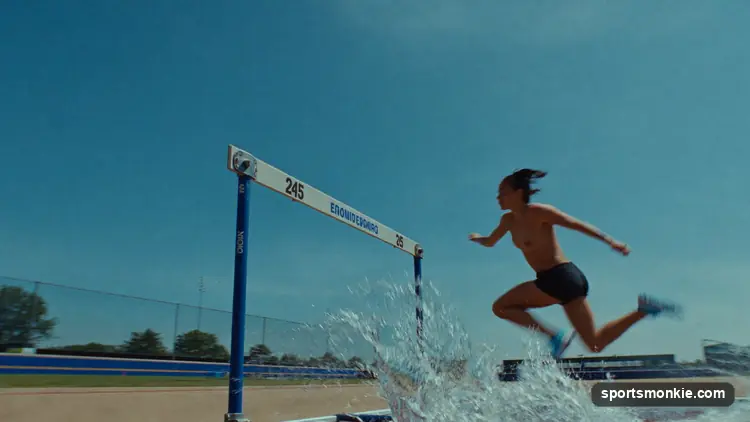
What Is a Steeplechase? The Water-Jump Race
A steeplechase is a distance race, 3,000m at the Olympics, run over fixed barriers and a water jump. Runners clear 28 barriers and 7 water jumps in all.
Heptathlon Events Explained: Order, Rules and Scoring
The heptathlon has seven events over two days. See the event order, scoring, false-start rules, tie rule, records and beginner training notes.
Track and Field Events Explained: The Complete Guide to Every Event
All track and field events explained by group — sprints, distance, hurdles, relays, jumps, throws, combined events, race walks — plus current world records.

Decathlon Events in Order: All 10
The decathlon's 10 events run over two days in order: 100m, long jump, shot put, high jump, 400m, then 110m hurdles, discus, pole vault, javelin, 1500m.
High Jump Explained: Rules, Technique, and World Records
High jump explained: the J-shaped approach, Fosbury Flop technique, three-attempt rules, countback ties, and the current men's and women's world records.
Long Jump Explained: Rules, Technique & World Records
Long jump explained: the 40m runway, plasticine take-off board, how jumps are measured, hang vs hitch-kick technique, fouls, and the world records.