
Hurdles in Track: Heights, Rules, and How Hurdling Works
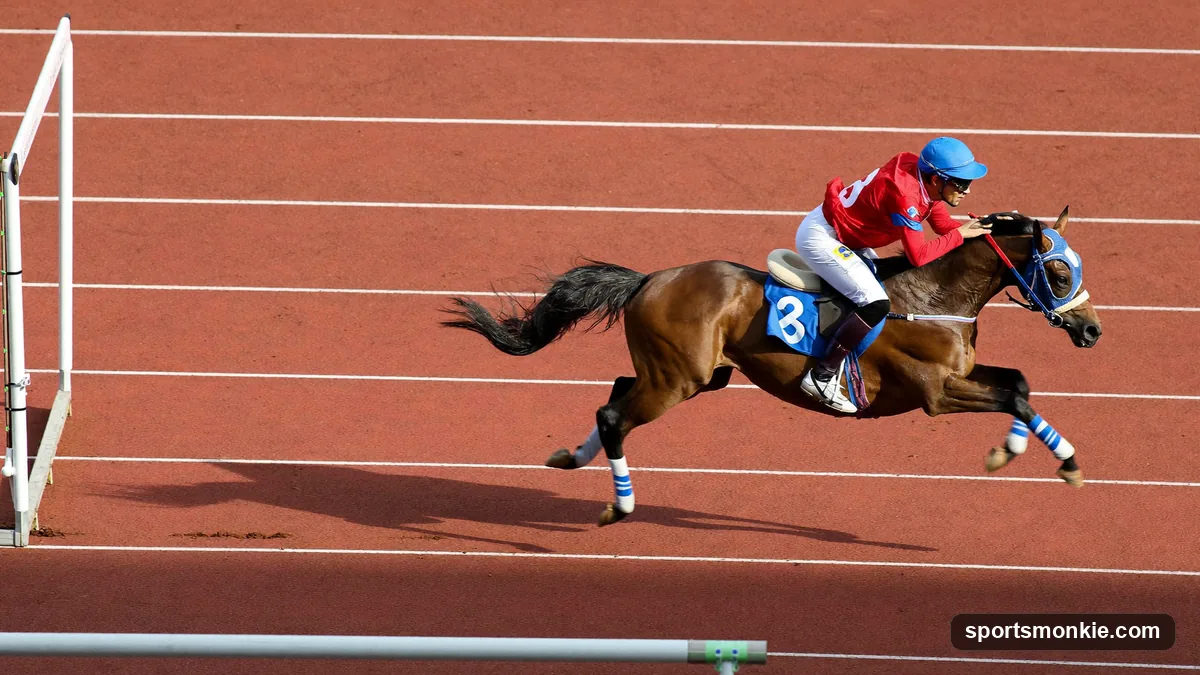
On this page8
- 01What are the different hurdle races in track and field?
- 02How tall are the hurdles, and how many are there?
- 03How does the 3-step rhythm work in sprint hurdles?
- 04How do you clear a hurdle: lead leg and trail leg technique
- 05What happens if you knock a hurdle down? Is it a disqualification?
- 06Who holds the hurdle world records?
- 07How do hurdles fit into relay races?
- 08Common misconceptions about hurdles
Hurdles in track are timed sprint races run over 10 fixed barriers that tip over if struck, at heights ranging from 0.762m to 1.067m depending on the event and gender. The three standard events are the men’s 110m hurdles, the women’s 100m hurdles, and the 400m hurdles (both sexes), and all three are decided as much by rhythm and technique as by raw speed. Get the stride count wrong between barriers and even the fastest sprinter in the field will lose the race.
This guide covers exact heights and spacing for every event, how the “3-step” and “15-step” rhythms actually work, what happens when a hurdle goes down, and the real records and athletes that define the discipline going into 2026.
What are the different hurdle races in track and field?
Track and field runs three championship hurdle distances outdoors, plus a shorter indoor sprint hurdle:
- 110m hurdles (men) — the “high hurdles,” the tallest barriers in sprint hurdling.
- 100m hurdles (women) — the women’s sprint hurdle equivalent, over a shorter distance and lower barriers.
- 400m hurdles (men and women) — the “intermediate hurdles,” a full lap of the track combining hurdling technique with 400m speed endurance.
- 60m hurdles — an indoor-only sprint event using the same barrier heights as the 110m/100m outdoor races, just over a shorter, five-hurdle course.
There is no women’s 110m hurdles or men’s 100m hurdles at the senior level; the sprint hurdle events are split by gender onto different distances, a legacy of how the women’s event was standardized separately in the 20th century.
How tall are the hurdles, and how many are there?
Every senior hurdle race — 110m, 100m, and 400m — uses exactly 10 hurdles. Heights and spacing differ sharply by event, which is the single most misunderstood fact about hurdling: the “same” race name does not mean the same barrier.
| Event | Hurdle height | Hurdles | Start to hurdle 1 | Hurdle spacing | Last hurdle to finish |
|---|---|---|---|---|---|
| 110m hurdles (men) | 1.067 m (42 in) | 10 | 13.72 m | 9.14 m | 14.02 m |
| 100m hurdles (women) | 0.838 m (33 in) | 10 | 13.00 m | 8.50 m | 10.50 m |
| 400m hurdles (men) | 0.914 m (36 in) | 10 | 45 m | 35 m | 40 m |
| 400m hurdles (women) | 0.762 m (30 in) | 10 | 45 m | 35 m | 40 m |
Notice that the men’s and women’s 400m hurdles share identical spacing — only the hurdle height changes, which is why the women’s race allows a more consistent stride pattern deeper into the race than the men’s does. Source: World Athletics competition rules for 110m, 100m, and 400m hurdles.
How does the 3-step rhythm work in sprint hurdles?
In the 110m and 100m hurdles, elite sprinters run three strides between every hurdle, always driving off the same lead leg. Combined with roughly eight steps from the blocks to the first hurdle, that rhythm lets a hurdler treat the whole race as one continuous sprint rather than 10 separate jumps.
The 3-step pattern is only possible at a specific stride length and speed; shorter or less powerful athletes sometimes run a 4-step or 5-step pattern between hurdles, alternating lead legs, which costs time but keeps the stride manageable. Losing the 3-step count mid-race — “chopping” or “stuttering” into an extra half-step — is one of the most common and costly technical breakdowns in the event, because it kills acceleration into the next barrier.
The 400m hurdles works on a longer, evolving version of the same idea: elite men often go out at 13 strides between the first few hurdles, then drift to 14, 15, or more as fatigue builds over the back half of the lap. That’s why switching lead legs (see below) matters so much more here than in the sprint hurdles.
How do you clear a hurdle: lead leg and trail leg technique
Hurdling is best understood as running over an obstacle, not jumping it — the goal is to spend as little time in the air as possible and get back to a full sprinting stride immediately.
- Attack the hurdle. The lead leg drives up and forward with the knee high and the foot flexed (toes pulled back toward the shin), while the opposite arm punches forward for balance, mirroring a normal sprint arm action.
- Lead leg snaps down. As the lead leg clears the bar, it snaps down aggressively on the far side rather than reaching out and landing flat-footed — a long, floating landing kills speed.
- Trail leg whips through. The back (trail) leg drives forward bent sharply at the knee, staying close to the body and low to the hip, then drives through to the front rather than swinging wide around the side.
- Touchdown and sprint away. The athlete lands on the lead leg’s foot roughly under the hips, already accelerating into the next stride — ideally within about one hurdle-length of clearing the bar — and resumes the 3-step count to the next barrier.
Good hurdlers lean their torso forward through the barrier, similar to a sprinter’s forward lean out of the blocks, which keeps the center of gravity moving forward instead of rising and falling over each hurdle.
What happens if you knock a hurdle down? Is it a disqualification?
No — knocking over a hurdle is not a disqualification. Modern hurdles are designed to tip forward under a set amount of force specifically so contact doesn’t end a race. This wasn’t always true: before a 1935 rule change, a competitor could be disqualified for knocking down more than three hurdles.
Today, the only hurdle-related disqualifications are:
- Trailing a leg or foot outside the hurdle’s vertical plane instead of clearing it over the top.
- Deliberately knocking down a hurdle, whether your own or another athlete’s, to gain an advantage or disrupt a competitor.
- Running in the wrong lane or interfering with another competitor’s hurdle.
Accidentally clipping or flattening a hurdle simply costs the runner time and balance — the “pull-over weight” built into the hurdle’s base resists tipping just enough to punish sloppy technique without ending the race. It’s common to see finalists in major championships knock down one or two hurdles and still win.
Who holds the hurdle world records?
As of 2026, the headline records are:
| Event | Record holder | Mark | Year |
|---|---|---|---|
| Men’s 110m hurdles | Aries Merritt (USA) | 12.80s | 2012 |
| Men’s 110m hurdles (pending ratification) | Ja’Kobe Tharp (USA) | 12.75s | 2026 |
| Women’s 100m hurdles | Tobi Amusan (Nigeria) | 12.12s | 2022 |
| Men’s 400m hurdles | Karsten Warholm (Norway) | 45.94s | 2021 |
| Women’s 400m hurdles | Sydney McLaughlin-Levrone (USA) | 50.37s | 2024 |
Aries Merritt’s 12.80s, run at the 2012 Brussels Diamond League final, stood as the official men’s 110m hurdles world record for over a decade. In June 2026, college sprinter Ja’Kobe Tharp ran 12.75s at the NCAA Outdoor Championships in Eugene — the first world record set at that meet since 1976 — but the mark remained pending World Athletics ratification as of this writing. Tobi Amusan set the women’s 100m hurdles record of 12.12s in the semifinals of the 2022 World Championships in Oregon before winning gold later that same day. In the 400m hurdles, Karsten Warholm’s 45.94s from the Tokyo Olympic final and Sydney McLaughlin-Levrone’s 50.37s from the Paris Olympic final both came in head-to-head Olympic showdowns against fierce rivals, exactly the kind of pressure that tends to produce hurdling’s fastest times.
For a wider view of every event on the oval, see our complete guide to track and field events, and for the sport’s other obstacle race — solid barriers, no tipping, plus a water jump — read our breakdown of the steeplechase.
How do hurdles fit into relay races?
Hurdles themselves aren’t used in relay races — World Athletics runs the 4x100m and 4x400m relays on a flat track — but hurdlers frequently double into flat relay legs at major championships because the speed and composure that make a good hurdler also make a strong open sprinter. Some of the same technical qualities, particularly a clean, low-wasted-motion stride, carry over directly to a fast baton exchange. If you’re new to how those handoffs and legal exchange zones work, see our guide to how relay races work.
Common misconceptions about hurdles
- “Hurdlers jump over the hurdle.” Elite hurdlers run over the hurdle with a flat, fast trajectory — a true jump wastes time in the air and disrupts the sprint rhythm.
- “Knocking a hurdle down ends your race.” It doesn’t, unless it’s deliberate or you fail to clear the bar with both legs; it only costs time and balance.
- “The men’s and women’s sprint hurdles are the same race at different heights.” They’re run over different distances too — 110m for men, 100m for women — with different spacing to first hurdle and between hurdles, not just a height change.
- “400m hurdlers always lead with the same leg.” The best ones deliberately train a two-legged lead specifically because their stride count between hurdles changes as they fatigue.
Frequently asked questions
How many hurdles are in a hurdle race?+
Every standard hurdle race uses exactly 10 hurdles, whether it's the 110m, 100m, or 400m event. The spacing and heights differ by race, but World Athletics fixes the count at 10 across all senior sprint and intermediate hurdle distances, from indoor 60m sprints down through the full outdoor lineup.
How tall are the hurdles in track and field?+
Heights vary by event: men's 110m hurdles are 1.067m (42 in), women's 100m hurdles are 0.838m (33 in), and the 400m hurdles are 0.914m (36 in) for men and 0.762m (30 in) for women. All heights are set by World Athletics and used identically at every level of senior international competition.
Is it a disqualification if you knock over a hurdle?+
No. Since a 1935 rule change, knocking a hurdle down accidentally carries no penalty beyond the lost momentum and pull-over drag of the hurdle itself. A runner is only disqualified for deliberately knocking hurdles out of another competitor's lane or for trailing a leg or foot outside the vertical plane of the hurdle instead of clearing it.
What is the 3-step rhythm in hurdling?+
The 3-step rhythm is taking exactly three running strides between each hurdle in the sprint hurdles (110m/100m), always leading with the same leg. It lets a sprinter attack every barrier at full speed without breaking stride; losing that rhythm, known as 'stuttering' or switching to a 4-step pattern, is one of the biggest time-costers in the event.
What's the difference between the lead leg and trail leg?+
The lead leg is the first leg driven over the hurdle, snapping down quickly on the far side to minimize time in the air; the trail leg is the back leg, which whips forward bent at the knee and low to the hip rather than swinging wide. Good technique treats hurdling as 'running over' the barrier, not jumping it.
Why do 400m hurdlers switch their lead leg?+
Over 400m the stride pattern stretches from around 13-15 steps early in the race to 17 or more as fatigue sets in, so an athlete who can only lead with one leg is forced into an awkward stutter-step near the final hurdles. Elite hurdlers train a two-legged lead to keep full stride length as their step count changes.
What's the difference between hurdles and the steeplechase?+
Hurdles are light and tip over when struck, spaced evenly with no water hazard, over 110m/100m or 400m. The [steeplechase](/steeplechase-explained/) uses solid, fixed barriers that don't fall, is run over 3,000m, and includes a water jump on one barrier each lap. They are separate events that share only the basic idea of clearing an obstacle at speed.
Who holds the world records in the hurdles?+
As of 2026, Aries Merritt's 12.80s (2012) remains the ratified men's 110m hurdles world record, though Ja'Kobe Tharp ran 12.75s at the 2026 NCAA Championships pending official ratification. Tobi Amusan holds the women's 100m hurdles record at 12.12s (2022), Karsten Warholm the men's 400m hurdles at 45.94s (2021), and Sydney McLaughlin-Levrone the women's 400m hurdles at 50.37s (2024).
Sources
Play & tools
Free browser games and tools — no account, no download.
- Play today's Sports Connections — Today's Sports Connections — daily hints, answers, and play the grid.
- Play Guess the NFL Player — A new mystery NFL player every day. Eight guesses, with a clue on each — plus free unlimited mode.
- Explore all our games →
Related guides

How Heptathlon Scoring Works: Formula, Tables and Examples
Heptathlon scoring converts all seven marks into points. See the formulas, event coefficients, 1,000-point benchmarks and worked examples.

Track and Field Events Explained: The Complete Guide to Every Event
All track and field events explained by group — sprints, distance, hurdles, relays, jumps, throws, combined events, race walks — plus current world records.

How the PLL Draft Works
The PLL draft is the Premier Lacrosse League's annual college draft, where its teams pick eligible players in reverse order of standings. How it works.
How Lacrosse Scoring Works: Goals, Assists and Points
In lacrosse, every goal is worth one point in almost every version of the game. The lone modern exception is the PLL's 2-point arc. Here is how scoring works.

What Is a False Start in Track? Rules and Disqualification
A false start happens when a sprinter begins before the legal starting signal or reacts early enough to violate the competition’s reaction-time rule.
What Is the Individual Medley in Swimming? Order and Rules
The individual medley combines butterfly, backstroke, breaststroke, and freestyle in one race, in that order.