
Track and Field Events Explained: The Complete Guide to Every Event

On this page13
- 01What Are the Official Groups of Track and Field Events?
- 02What Are the Sprint Events?
- 03What Are the Middle-Distance Events?
- 04What Are the Long-Distance and Marathon Events?
- 05What Are the Hurdles and Steeplechase Events?
- 06What Are the Relay Events?
- 07What Are the Jumping Events?
- 08What Are the Throwing Events?
- 09What Are the Combined Events?
- 10What Are the Race Walk Events?
- 11How Is Every Event Actually Scored?
- 12What Are the Most Common Rules and Misconceptions?
- 13Who Are the Athletes Defining the Sport in 2026?
Track and field (athletics) is built from roughly 24 distinct events organized into eight groups: sprints, middle distance, long distance, hurdles/steeplechase, relays, jumps, throws, combined events, and race walks — all governed worldwide by World Athletics. Every event is decided one of two ways: by time (running and walking) or by distance/height (jumps and throws), with combined events like the decathlon and heptathlon scoring both types on a single points table. As of 2026, the sport is in an unusually hot stretch of record-breaking: Kenya’s Sabastian Sawe ran the first legal sub-two-hour marathon (1:59:30) at the London Marathon in April, and 20-year-old American Ja’Kobe Tharp broke the 110m hurdles world record (12.75) at the NCAA Championships two months later. This guide maps every event on the program, with the current world records and links to a full breakdown of each one.
What Are the Official Groups of Track and Field Events?
World Athletics organizes the sport into eight groups. The table below is the full map — use it to jump to any event’s detailed rules and technique.
| Group | Events | Decided by |
|---|---|---|
| Sprints | 100m, 200m, 400m | Time |
| Middle distance | 800m, 1500m | Time |
| Long distance | 3000m, 5000m, 10,000m, marathon (42.195 km) | Time |
| Hurdles & steeplechase | 110mH (men) / 100mH (women), 400mH, 3000m steeplechase | Time |
| Relays | 4x100m, 4x400m, mixed 4x400m | Time |
| Jumps | Long jump, triple jump, high jump, pole vault | Distance / height |
| Throws | Shot put, discus, hammer, javelin | Distance |
| Combined events | Decathlon (men, 10 events), heptathlon (women, 7 events) | Points |
| Race walks | 20 km, 35 km | Time |
Every event on this list also has an indoor equivalent contested at a shorter distance where the outdoor version doesn’t fit a 200 m indoor oval (no steeplechase or javelin indoors, for example), but the outdoor list above is the sport’s core, Olympic-program set.
What Are the Sprint Events?
Sprints are the 100m, 200m, and 400m — pure speed races run entirely in one lane, decided by reaction time, acceleration, top-end speed, and (in the 400m) speed endurance. The 100m is the shortest and most-watched event in the sport; the current men’s world record is Usain Bolt’s 9.58 seconds, set at the 2009 World Championships in Berlin, where he also ran the 200m world record of 19.19 seconds. The women’s 100m and 200m records have both stood since 1988, when Florence Griffith-Joyner ran 10.49 and 21.34. The 400m is the outlier of the group — long enough that pure speed alone doesn’t win it, which is why coaches call it “the hardest race in track”: Wayde van Niekerk (South Africa) holds the men’s mark at 43.03 (2016), while Marita Koch’s 47.60 (1985) is the longest-standing sprint record still on the books. Read the full breakdown of the sport’s greatest male sprinters for how these records were built.
What Are the Middle-Distance Events?
The 800m and 1500m sit between sprinting and distance running — athletes need a sprinter’s finishing speed and a distance runner’s pacing sense in the same race. Kenya’s David Rudisha ran the men’s 800m world record of 1:40.91 at the 2012 London Olympics, a run many coaches still call the best-paced 800m ever. Morocco’s Hicham El Guerrouj has held the men’s 1500m record at 3:26.00 since 1998. On the women’s side, Faith Kipyegon lowered her own 1500m world record to 3:48.68 in 2025, and Jarmila Kratochvílová’s 1:53.28 in the 800m, set in 1983, remains track and field’s single longest-standing world record of any kind — 43 years and counting.
What Are the Long-Distance and Marathon Events?
Long distance covers the 5000m and 10,000m on the track and the 42.195 km marathon on the road (some programs also run a 3000m). Uganda’s Joshua Cheptegei holds both men’s track records — 12:35.36 in the 5000m and 26:11.00 in the 10,000m, both set in 2020 — while Kenya’s Beatrice Chebet holds the equivalent women’s marks: 13:58.06 (5000m, 2025) and 28:54.14 (10,000m, 2024). The marathon is the sport’s headline distance event, and 2026 rewrote its history: Sabastian Sawe ran 1:59:30 at the London Marathon in April, becoming the first person ever to legally break two hours in a record-eligible race — a barrier previously cracked only by Eliud Kipchoge’s unofficial, pacer-assisted 1:59:40.2 in 2019. The women’s marathon record belongs to Ruth Chepngetich, who ran 2:09:56 at the 2024 Chicago Marathon, the first sub-2:10 in history.
What Are the Hurdles and Steeplechase Events?
Hurdles races run at sprint or one-lap distances over fixed barriers: men race the 110m hurdles (10 barriers at 106.7 cm) and women the 100m hurdles (10 barriers at 84 cm), while both sexes contest the 400m hurdles (10 barriers at 91.4 cm/76.2 cm). The steeplechase is different again — a 3000m distance race over 28 fixed barriers plus 7 water-jump clearances per race. This is the event group producing 2026’s biggest shock: Ja’Kobe Tharp, a 20-year-old college sophomore, ran 12.75 in the 110m hurdles at the NCAA Championships in June 2026, breaking Aries Merritt’s 12.80 from 2012 — the first world record set at the NCAA meet since 1976. Nigeria’s Tobi Amusan holds the women’s 100mH record at 12.12 (2022), Karsten Warholm the men’s 400mH at 45.94 (2021), Sydney McLaughlin-Levrone the women’s 400mH at 50.37 (2024), Ethiopia’s Lamecha Girma the men’s steeplechase at 7:52.11 (2023), and Kenya’s Beatrice Chepkoech the women’s steeplechase at 8:44.32 (2018). Full technical breakdown: hurdles and the steeplechase.
What Are the Relay Events?
Relays are the only team events on the individual athletics program: four runners each carry a baton for one leg, and the exchange must happen inside a 20 m takeover zone or the team is disqualified. The 4x100m rewards raw speed and exchange precision; Jamaica’s 2012 quartet (Nesta Carter, Michael Frater, Yohan Blake, Usain Bolt) ran the men’s world record of 36.84, and the USA’s 2012 London team holds the women’s mark at 40.82. The 4x400m tests repeated speed endurance over four full laps; the USA’s 1993 team holds the men’s record at 2:54.29, and the Soviet Union’s 1988 squad holds the women’s mark at 3:15.17 — both among the oldest records still standing. The mixed 4x400m relay (two men, two women per team, running in any order) was added to the Olympic program in 2021 and remains one of the fastest-evolving events on the calendar. Full rules and exchange-zone mechanics: relay racing explained.
What Are the Jumping Events?
Jumps split into horizontal (long jump, triple jump) and vertical (high jump, pole vault). Long jump and triple jump both use a runway and a takeoff board, measuring how far an athlete travels after takeoff — Mike Powell’s 8.95 m (1991) is the men’s long jump record and Jonathan Edwards’ 18.29 m (1995) the men’s triple jump record, while Galina Chistyakova (7.52 m, 1988) and Yulimar Rojas (15.74 m, 2022) hold the women’s marks. High jump and pole vault instead measure clearance over a bar — Cuba’s Javier Sotomayor has held the men’s high jump record at 2.45 m since 1993, and Bulgaria’s Stefka Kostadinova the women’s at 2.09 m since 1987. Pole vault is the sport’s most active record chase: Sweden’s Armand Duplantis has broken his own world record 15 times, most recently clearing 6.31 m at the Mondo Classic in March 2026; Russia’s Yelena Isinbayeva has held the women’s outdoor mark at 5.06 m since 2009. Full breakdowns of each: long jump, triple jump, high jump, and pole vault.
What Are the Throwing Events?
Four implements, four techniques: shot put (pushed from the shoulder, 7.26 kg men’s / 4 kg women’s), discus (a spinning release of a 2 kg men’s / 1 kg women’s disc), hammer (a wire-and-ball implement swung through 3-4 full turns before release), and javelin (a run-up spear throw, the only implement thrown with a full overhand motion). American Ryan Crouser holds the men’s shot put record at 23.56 m (2023); Lithuania’s Mykolas Alekna holds the men’s discus record at 75.56 m (2025); Russia’s Yuriy Sedykh has held the men’s hammer record at 86.74 m since 1986; and the Czech Republic’s Jan Železný has held the men’s javelin record at 98.48 m since 1996. On the women’s side, the standing marks are Natalya Lisovskaya’s 22.63 m shot put (1987), Gabriele Reinsch’s 76.80 m discus (1988), Anita Włodarczyk’s 82.98 m hammer (2016), and Barbora Špotáková’s 72.28 m javelin (2008).
What Are the Combined Events?
The decathlon (men, 10 events over two days: 100m, long jump, shot put, high jump, 400m, then 110mH, discus, pole vault, javelin, 1500m) and heptathlon (women, 7 events over two days: 100mH, high jump, shot put, 200m, then long jump, javelin, 800m) are the sport’s ultimate all-around tests, scoring every discipline on a shared points table so speed, power, technique, and endurance can be compared directly. France’s Kevin Mayer holds the decathlon world record at 9,126 points, set in Talence in 2018 — beating the previous mark held by 2× Olympic champion Ashton Eaton. American Jackie Joyner-Kersee has held the heptathlon world record at 7,291 points since the 1988 Seoul Olympics, one of the longest-standing records in the entire sport. See the full decathlon events in order and heptathlon events explained guides for the exact two-day schedule and scoring tables.
What Are the Race Walk Events?
Race walking looks like running but is governed by a strict, judged technique rule: one foot must appear to maintain contact with the ground at all times, and the advancing leg must straighten from the moment of contact until it passes under the body. Violating either rule earns a red-card infraction, and three red cards from separate judges disqualify the athlete. The senior program covers the 20 km and 35 km (the 50 km was dropped from the Olympic program after Tokyo 2020 and replaced by the 35 km in 2022). Japan’s Toshikazu Yamanishi holds the men’s 20 km world record at 1:16:10 (2025) and Italy’s Massimo Stano the men’s 35 km record at 2:20:43 (2025); China’s Yang Jiayu holds the women’s 20 km record at 1:23:49 (2021).
How Is Every Event Actually Scored?
- Running, hurdling, and race walking: decided purely by elapsed time, timed electronically to 1/100th of a second (1/1000th for photo-finish review). Wind-assisted marks in the 100m, 200m, and horizontal jumps (a following wind over +2.0 m/s) can still win the race but don’t count as records.
- Jumping and throwing: decided by the single best legal distance or height across a fixed number of attempts (typically 3-6, fewer at smaller meets). Only the best mark counts, not the average — an athlete can foul five times and still win on one clean attempt.
- Combined events: each of the 10 (decathlon) or 7 (heptathlon) disciplines converts its raw mark into points using World Athletics’ scoring tables, which are individually calibrated per event so that similar levels of difficulty produce similar point totals; the athlete with the highest two-day point sum wins, not the athlete who wins the most individual disciplines.
What Are the Most Common Rules and Misconceptions?
- False starts are a single-strike disqualification. Since 2010, any athlete who leaves the blocks before the gun (reaction time under 0.1 seconds) is disqualified immediately — there is no longer a “one warning for the field” rule.
- A “personal best” and a “world record” aren’t graded the same way. Wind-legal (≤2.0 m/s following wind), record-eligible marks are the only ones that can be ratified as world records; a wind-aided 100m or long jump can still win a race but is footnoted, not record-eligible.
- Field events don’t always finish in event order. In jumps and throws, the field is often cut after three rounds to the top 8 athletes, who then get three more attempts — so the “best of six” format means a slow starter can still win late.
- The steeplechase water jump is the deepest part of the track, not a shallow puddle. It’s roughly 70 cm deep at the barrier, sloping up to track level — clearing it short is a major, race-defining mistake, not a minor stumble.
- Track and field is not the same as “athletics” being a synonym for all sports. Outside North America, “athletics” refers specifically to this sport (running, jumping, throwing); “track and field” is the common US/Canada term for the identical discipline.
Who Are the Athletes Defining the Sport in 2026?
Usain Bolt’s 100m (9.58) and 200m (19.19) marks from 2009 remain the sport’s most iconic records, still unbeaten after 17 years despite a generation of sub-9.8 sprinters chasing them. Armand Duplantis has turned the pole vault into track and field’s most reliable record-breaking spectacle, raising the bar 15 times by 2026. Faith Kipyegon and Beatrice Chebet have rewritten the women’s middle- and long-distance record book across 2024-2025. And two 2026 breakthroughs reset expectations for what’s still possible in the sport’s oldest events: Sabastian Sawe’s sub-two-hour marathon proved a barrier scientists debated for decades was breakable in a legal race, and Ja’Kobe Tharp’s 110m hurdles world record — set by a 20-year-old college sophomore — showed that even century-old sprint hurdle marks aren’t safe. Whichever event pulls you in first, every one of them traces back to the same eight groups on this page.
Frequently asked questions
How many events are there in track and field?+
The World Athletics Championships program covers 49 individual medal events once men's, women's, and mixed disciplines are all counted, but the core list of distinct event types is about 24: three sprints, two middle-distance runs, three-plus long-distance runs (plus the marathon), three hurdle races, one steeplechase, three relay types, four jumps, four throws, two combined events, and two race walks.
What are the four types of track events?+
Track events split into sprints (100m-400m, explosive speed), middle/long distance (800m up to the marathon, endurance-paced), hurdles and steeplechase (sprint or distance speed plus obstacle clearance), and relays (team races run in baton-carrying legs). Field events — jumps and throws — are contested off the track entirely, in the infield.
What is the difference between track events and field events?+
Track events are races run on the oval or road and decided by time — the fastest athlete wins. Field events are jumps and throws contested in the infield and decided by distance or height — the longest or highest mark wins. Combined events like the decathlon and heptathlon blend both into a single points-scored competition.
What sport is track and field also called?+
Internationally it's simply called athletics, and World Athletics (formerly the IAAF) is the sport's global governing body. "Track and field" is the common American term because it separates the on-track running events from the off-track jumping and throwing events held in the infield.
What is the hardest event in track and field?+
The decathlon is widely considered the hardest single competition — ten events across two days demand elite speed, power, and endurance in one body, which is why its winner is informally called "the world's greatest athlete." Among single events, the 400m and 400m hurdles are notorious for combining sprint speed with a brutal lactic-acid endurance demand.
What is the oldest track and field event?+
The stadion sprint (roughly 192 m) was the sole event at the first recorded ancient Olympics in 776 BC, making sprinting the sport's oldest discipline. The marathon, by contrast, was invented for the 1896 Athens Olympics to commemorate the legendary run of Pheidippides — the youngest of the classic events by origin, despite now being the longest on the program.
Why do some events have both men's and women's versions with different specs?+
World Athletics sets different hurdle heights, implement weights, and combined-event line-ups for men and women to reflect average physiological differences in strength and leverage — men clear 106.7 cm hurdles in the 110mH while women clear 84 cm hurdles in the 100mH, and men throw a 7.26 kg shot versus the women's 4 kg. Running distances, relays, and race walks stay identical for both sexes.
What new track and field world records were set in 2026?+
2026 produced two landmark records: Kenya's Sabastian Sawe ran 1:59:30 at the London Marathon in April, the first legal sub-two-hour marathon in history, and American college sprinter Ja'Kobe Tharp ran 12.75 in the 110m hurdles at the 2026 NCAA Championships in June, breaking Aries Merritt's 12.80 mark from 2012. Armand Duplantis also extended his own pole vault world record to 6.31 m in March 2026.
Sources
Play & tools
Free browser games and tools — no account, no download.
- Play today's Sports Connections — Today's Sports Connections — daily hints, answers, and play the grid.
- Play Guess the NFL Player — A new mystery NFL player every day. Eight guesses, with a clue on each — plus free unlimited mode.
- Explore all our games →
Related guides

Steeplechase Explained: Rules, Barriers, Water Jump & World Records
Steeplechase explained: 28 barriers, 7 water jumps over 3000m, barrier heights, technique, and the current men's and women's world records.
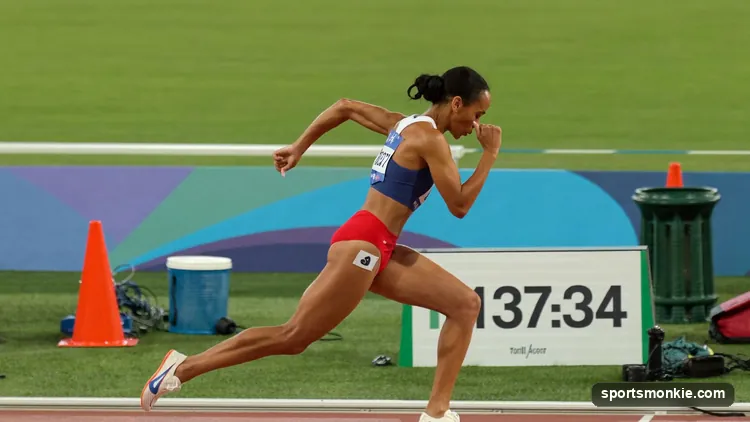
Heptathlon Events Explained: Order, Rules and Scoring
The heptathlon has seven events over two days. See the event order, scoring, false-start rules, tie rule, records and beginner training notes.

Decathlon Events in Order: All 10
The decathlon's 10 events run over two days in order: 100m, long jump, shot put, high jump, 400m, then 110m hurdles, discus, pole vault, javelin, 1500m.
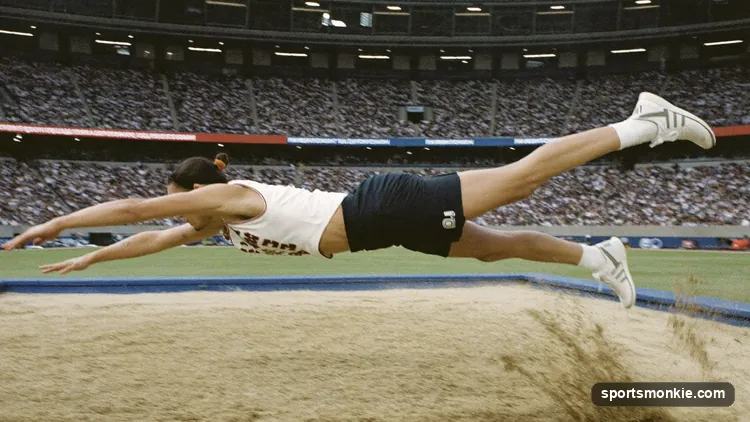
Long Jump Explained: Rules, Technique & World Records
Long jump explained: the 40m runway, plasticine take-off board, how jumps are measured, hang vs hitch-kick technique, fouls, and the world records.
Hurdles in Track: Heights, Rules, and How Hurdling Works
Hurdles in track and field are 10 barriers over 110m/100m or 400m. Heights run 0.762m-1.067m; knocking one down isn't a DQ. Full rules and records.

Referee Hand Signals Explained: Every Major Sport's System
Referee hand signals let officials call fouls, scores, and timing decisions silently. See how NFL, NBA, MLB, NHL, and soccer signals compare.