
Javelin Throw Explained: Rules, Technique & World Records
On this page9
- 01How much does a javelin weigh and how long is it?
- 02What are the rules for a legal throw?
- 03What is the runway and the foul line?
- 04How is javelin thrown, step by step?
- 05Why was the men’s javelin redesigned in 1986?
- 06What are the current world records?
- 07Who are javelin’s biggest stars today?
- 08How does javelin compare to shot put and discus?
- 09Common misconceptions about javelin throw
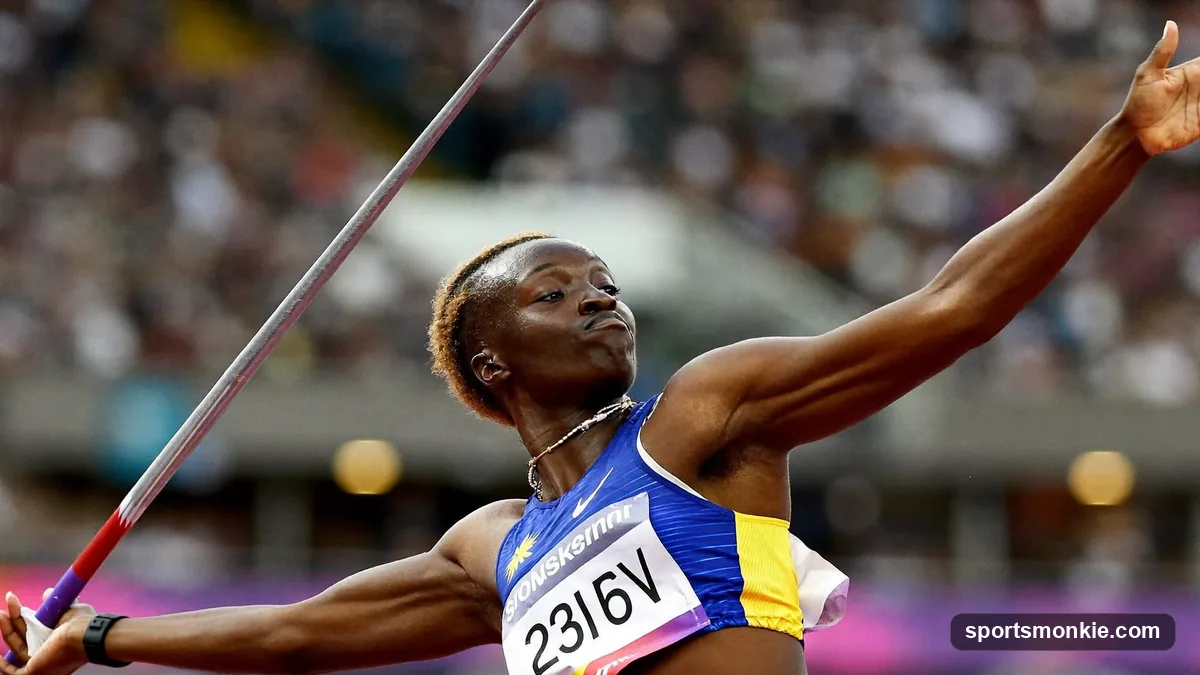
Javelin throw is a track and field event in which athletes sprint down a runway and hurl a spear-like implement — 800g for men, 600g for women — as far as possible, with the throw only counting if it lands tip-first inside a marked sector and the thrower doesn’t cross the foul line. It’s one of the oldest events in athletics, tracing back to the ancient Olympics, and one of the most technical: elite throwers combine 100m-sprinter speed with a whip-like upper-body release to launch the javelin over 90 metres.
The men’s world record, 98.48m by Jan Železný, has stood since 1996. That is no accident — a rule change in the 1980s deliberately made the men’s javelin fly shorter, and understanding why is the key to understanding the modern event.
How much does a javelin weigh and how long is it?
A regulation men’s javelin has a minimum mass of 800 grams and measures 2.6 to 2.7 metres long. The women’s javelin is lighter and shorter: a minimum of 600 grams and 2.2 to 2.3 metres long. Both implements are made of metal or a metal-and-fibreglass composite and taper to a sharp metal tip. A cord grip roughly 150mm wide is wound around the shaft at the javelin’s centre of gravity — that grip is the only part of the shaft the rules allow an athlete’s hand to touch during the throw.
What are the rules for a legal throw?
For a throw to count, four conditions all have to be met:
- The javelin must be held at the grip, in one hand.
- It must be thrown over the shoulder or upper part of the throwing arm — no sidearm slings, spins, or underhand releases are allowed, unlike discus or hammer.
- The tip of the javelin must strike the ground before any other part of the implement, and it must land inside the marked landing sector.
- The athlete must not step on or beyond the foul line, and must not leave the runway, until the javelin has landed.
Break any of these and the throw is a foul, recorded as no distance. Each athlete gets three throws in the qualifying/preliminary round; the top competitors (usually the top 8, plus ties) advance to three more attempts in the final, and only the single best legal throw across all six counts.
What is the runway and the foul line?
The approach is a straight runway at least 30m long (up to 36.5m at major championship venues) and 4m wide, painted with a white foul line at its end — actually a short curved arc with a 8m radius, not a straight line, so the athlete’s front foot has a consistent boundary to judge no matter where across the runway’s width they cross it. Beyond that arc is the landing sector, a wedge-shaped grass or turf area marked out at an angle of 28.96° from the arc’s centre point, wide enough to hold throws that drift left or right of dead centre.
How is javelin thrown, step by step?
Coaches generally break the javelin throw into four phases:
- Grip and carry. The athlete holds the javelin with one of three common grips — the Finnish grip (index finger behind the cord), the American grip (thumb and index finger pinch the cord), or the V-grip (javelin rests between the first two fingers) — and carries it above the shoulder, tip angled slightly down and forward, throughout the run-up.
- Run-up. A straight sprint of roughly 10-15 strides builds horizontal speed, similar to a 100m start.
- The crossover steps (withdrawal). Over the final 4-6 strides, the thrower rotates their hips sideways to the direction of the throw while drawing the javelin back with a straight arm — this is the “impulse stride” or crossover phase that converts running speed into throwing power.
- Plant and release. The non-throwing leg blocks hard into the ground (the “block”), stopping the lower body’s forward motion instantly and whipping the hips, shoulder, and finally the arm through in sequence — the classic kinetic-chain transfer that lets a ~75kg athlete move an 800g javelin at over 30 metres per second. The javelin is released at roughly 30-35 degrees above horizontal for optimal distance.
A common misconception is that arm strength alone drives distance. In reality, run-up speed and the timing of the block-and-whip sequence contribute more to elite distance than raw shoulder power — it’s why fast, athletic throwers with good sprint mechanics often out-throw stronger but slower rivals.
Why was the men’s javelin redesigned in 1986?
This is the single most important piece of javelin history to understand, and most casual explainers skip it. Through the early 1980s, javelin distances kept climbing as athletes got faster and technique improved. In 1984, East Germany’s Uwe Hohn threw 104.80m — a distance nobody has matched since, because it never got the chance to be broken.
Hohn’s throw, and others approaching triple-figure territory, created two serious problems: javelins were increasingly landing flat rather than tip-first (making legal/foul judging inconsistent), and throws were flying far enough to threaten the infield events, officials, and even spectators at some stadiums, which typically aren’t built to safely hold a 100m+ flight path inside the field. In 1986, what is now World Athletics redesigned the men’s javelin, shifting its centre of gravity roughly 4cm forward and adjusting the surface area (less in front, more behind), which forces the nose to drop sooner in flight. The change cut average distances by about 10% and restored consistent, judgeable tip-first landings. The women’s javelin got an equivalent redesign in 1999 for the same reasons, after Trine Hattestad and others began pushing marks that raised similar concerns. This is also why Uwe Hohn’s 104.80m remains the longest javelin throw ever recorded by a human, even though it isn’t the “official” world record under the current implement.
What are the current world records?
| Category | Athlete | Mark | Year | Location |
|---|---|---|---|---|
| Men (current javelin) | Jan Železný (Czech Republic) | 98.48m | 1996 | Jena, Germany |
| Men (pre-1986 javelin, unofficial best-ever) | Uwe Hohn (East Germany) | 104.80m | 1984 | Berlin |
| Women (current javelin) | Barbora Špotáková (Czech Republic) | 72.28m | 2008 | Stuttgart, Germany |
Železný’s mark, thrown almost 30 years ago, is one of the oldest surviving records in the entire sport — a direct legacy of the 1986 redesign making the event harder to push forward. Špotáková’s 72.28m has now stood since 2008.
Who are javelin’s biggest stars today?
Neeraj Chopra of India is the sport’s most prominent current figure: 2020 Olympic champion, 2022 World champion, and the first Indian to win an Olympic gold in athletics, with a personal best of 90.23m set in 2025. His rivalry with the Czech Republic’s Jakub Vadlejch (personal best 90.88m), a two-time Olympic medallist, has been one of the event’s headline storylines through the 2020s, with both men regularly trading Diamond League and championship podiums. Neither is within 8 metres of Železný’s record, underlining just how durable the mark has become.
How does javelin compare to shot put and discus?
Javelin is the only throwing event that uses a runway and run-up rather than a fixed circle, and the only one released overhand instead of spun. For the full picture of how it fits alongside the other throws and the rest of the sport, see our guide to track and field events explained. If you want the mechanics of the other two major throws, shot put is pushed from the shoulder inside a small circle rather than run into, while discus throw is spun through one and three-quarter turns and released sidearm — both very different skill sets from javelin’s sprint-and-whip action.
Common misconceptions about javelin throw
- “It’s just about arm strength.” Run-up speed and the block/whip sequence matter more than shoulder power alone; see the technique section above.
- “Any overhand throw counts.” The javelin must land tip-first inside the sector — a flat landing, even a legal-position throw, is measured as a foul if the tip doesn’t strike first.
- “The record keeps getting broken like other throws.” It hasn’t, on purpose — the 1986/1999 redesigns were built to cap distances for safety, which is why Železný’s 98.48m has outlasted almost every other world record in the sport.
Frequently asked questions
How much does a javelin weigh?+
A men's javelin weighs a minimum of 800 grams and is 2.6 to 2.7 metres long; a women's javelin weighs a minimum of 600 grams and is 2.2 to 2.3 metres long. Both have a cord grip roughly 150mm wide wrapped around the shaft at the implement's centre of gravity, which is what the athlete's hand actually holds during the throw.
What is the world record for javelin throw?+
As of 2026, the men's world record is 98.48 metres, set by Jan Železný of the Czech Republic in Jena, Germany in 1996. The women's world record is 72.28 metres, set by Barbora Špotáková of the Czech Republic in Stuttgart in 2008. Both marks have stood for close to or over 20 years, making javelin one of the longest-standing world records in track and field.
Why was the men's javelin redesigned in 1986?+
World Athletics (then the IAAF) moved the men's javelin's centre of gravity about 4cm forward in 1986 after Uwe Hohn of East Germany threw 104.80m in 1984, a distance so long it threatened to fly out of stadium infields and endangered officials, other athletes, and spectators. The new design made the javelin nose-dive sooner, cutting distances by roughly 10% and ending the flat, gliding landings that had made close throws hard to judge fairly. The women's javelin received an equivalent redesign in 1999 for the same reasons.
What makes a javelin throw a foul?+
A throw is a foul, and scores zero, if the athlete steps on or beyond the foul line (the curved arc at the end of the runway) before the javelin lands, if the javelin does not land tip-first within the marked landing sector, or if the athlete does not carry the javelin in an over-the-shoulder or upper-arm throwing position. Athletes also may not leave the runway after starting their approach until the javelin has landed and been marked, and only three fair throws (from six attempts in finals) count.
How far does a javelin get thrown?+
Elite men typically throw 80-90 metres, with the very best in the world clearing 90m; India's Neeraj Chopra, the 2020 Olympic and 2022 World champion, has a personal best of 90.23m. Elite women typically throw 60-70 metres. Distances at youth and club level are much shorter, often 30-50 metres, since technique, run-up speed, and release angle matter as much as raw strength.
What is the difference between javelin and other throwing events?+
Javelin is the only track and field throw that uses a runway and a run-up approach rather than throwing from a fixed circle, and it is the only one released overhand rather than spun or pushed. Shot put is pushed from the shoulder inside a 2.135m circle, discus is spun and released sidearm from a circle, and hammer throw is spun through several full rotations before release — javelin's sprint-and-throw motion is closer to a cricket or baseball throw than to any of the other three.
Do javelins get shorter throws on purpose?+
Yes. Since 1986 for men (1999 for women), the javelin's centre of gravity has been deliberately shifted forward so it noses down and lands sooner, which was a safety fix, not a technique limitation. Modern elite throwers are arguably as powerful and fast as ever, but they are throwing an implement engineered to travel roughly 10% less far than the pre-1986 design, which is a major reason the current world records have lasted so long.
What grip do javelin throwers use?+
Most elite throwers use one of three grips: the Finnish grip (index finger behind the cord, thumb along the shaft), the American grip (thumb and index finger pinching behind the cord), or the V-grip (javelin sits between the first two fingers). All three grips serve the same purpose — controlling the release and imparting spin for flight stability — and the choice comes down to hand size and personal comfort rather than one being objectively faster.
Sources
Play & tools
Free browser games and tools — no account, no download.
- Play today's Sports Connections — Today's Sports Connections — daily hints, answers, and play the grid.
- Play Guess the NFL Player — A new mystery NFL player every day. Eight guesses, with a clue on each — plus free unlimited mode.
- Explore all our games →
Related guides
Pole Vault Explained: Rules, Technique, Equipment and World Records
Pole vault explained: how the runway, pole and box work, the six phases of a vault, scoring rules, and current world records as of 2026.
High Jump Explained: Rules, Technique, and World Records
High jump explained: the J-shaped approach, Fosbury Flop technique, three-attempt rules, countback ties, and the current men's and women's world records.
Long Jump Explained: Rules, Technique & World Records
Long jump explained: the 40m runway, plasticine take-off board, how jumps are measured, hang vs hitch-kick technique, fouls, and the world records.
Discus Throw Explained: Rules, Technique, Dimensions & Records
Discus throw explained: the 2 kg/1 kg discus, 2.5m circle, 1.5-turn rotational technique, cage rules, and current world records (2026).
Heptathlon Events Explained: Order, Rules and Scoring
The heptathlon has seven events over two days. See the event order, scoring, false-start rules, tie rule, records and beginner training notes.

Decathlon Events in Order: All 10
The decathlon's 10 events run over two days in order: 100m, long jump, shot put, high jump, 400m, then 110m hurdles, discus, pole vault, javelin, 1500m.