
High Jump Explained: Rules, Technique, and World Records
On this page8
- 01What Is the World Record in the High Jump?
- 02How Does the Curved J-Approach Work?
- 03What Is the Fosbury Flop, and Why Did It Replace the Straddle?
- 04How Many Attempts Do You Get, and What Counts as a Foul?
- 05How Are Ties Broken in High Jump?
- 06What Are the Official Bar, Mat, and Runway Dimensions?
- 07Step-by-Step: How to Execute a Fosbury Flop
- 08Who Are the Greatest High Jumpers in History?
The high jump is a track and field event where athletes sprint a curved approach, take off from one foot, and try to clear a horizontal bar without knocking it down — a discipline dominated since the 1970s by the backward-arching Fosbury Flop, with a men’s world record of 2.45 m (Javier Sotomayor, 1993) and a women’s world record of 2.10 m (Yaroslava Mahuchikh, 2024). Every elite jumper today uses the same basic shape: a J-curved run-up, a single explosive take-off, and a mid-air arch that carries the body — but not the center of mass — over the bar. Here’s exactly how the event works, from the run-up to the countback rule that decides ties.
What Is the World Record in the High Jump?
As of 2026, the record book looks like this. Sotomayor’s 2.45 m clearance in Salamanca, Spain on July 27, 1993 is the longest-standing record in the men’s event — no one has gotten within 6 cm of it in over three decades. The women’s record changed far more recently: Mahuchikh cleared 2.10 m at the Meeting de Paris on July 7, 2024, finally breaking Stefka Kostadinova’s 2.09 m mark from the 1987 World Championships in Rome, a record that had stood for 37 years.
| Record | Holder | Mark | Year & Location |
|---|---|---|---|
| Men’s outdoor | Javier Sotomayor (Cuba) | 2.45 m | 1993, Salamanca, Spain |
| Women’s outdoor | Yaroslava Mahuchikh (Ukraine) | 2.10 m | 2024, Paris, France |
| Men’s indoor | Javier Sotomayor (Cuba) | 2.43 m | 1989 |
| Women’s indoor | Kajsa Bergqvist (Sweden) | 2.08 m | 2006 |
How Does the Curved J-Approach Work?
Jumpers don’t run straight at the bar. The classic approach is J-shaped: the first several strides are run in a straight line to build horizontal speed, then the final four or five steps bend into a curve. Leaning into that curve lets the athlete drop their center of gravity before take-off — without bending the knee as much as a straight approach would require — which buys extra time to convert that speed into an upward push at the plant. The curve also naturally rotates the jumper’s shoulders and hips so their back faces the bar exactly as they leave the ground, setting up the flop without any wasted mid-air twisting.
What Is the Fosbury Flop, and Why Did It Replace the Straddle?
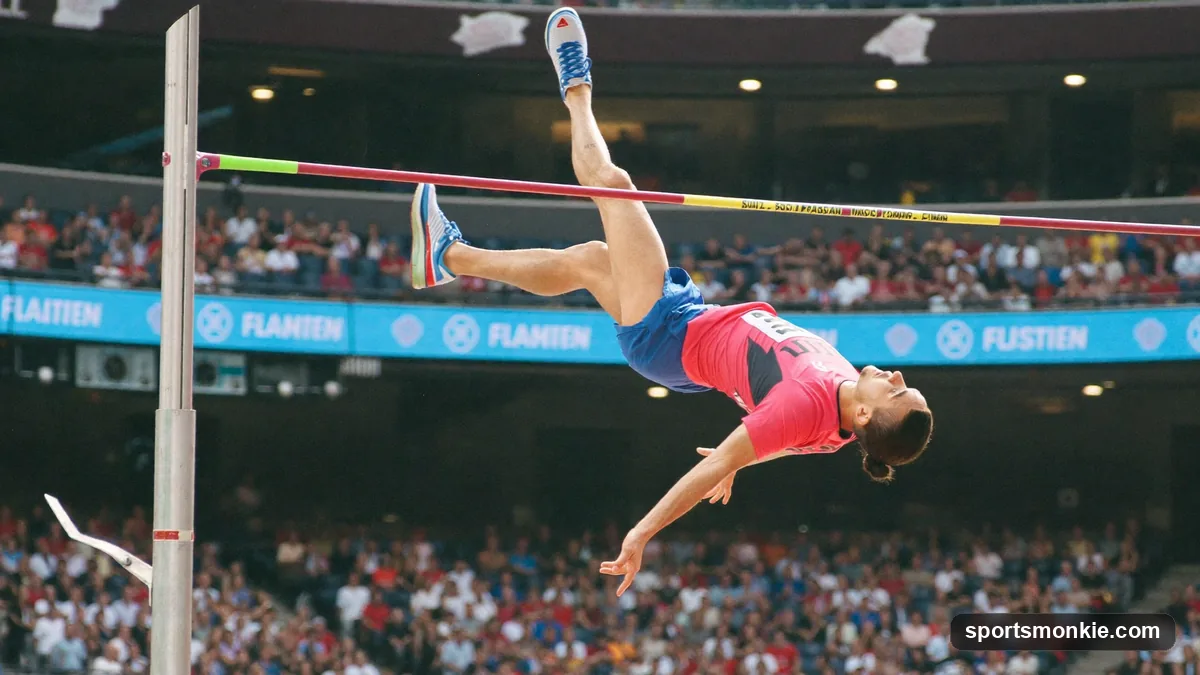
The Fosbury Flop is the technique of taking off facing away from the bar and arching backward over it, head and shoulders first, landing on the upper back. Oregon State student Dick Fosbury introduced it at the 1968 Mexico City Olympics and won gold; by the 1972 Munich Games, 28 of 40 finalists had switched to it. Before Fosbury, the dominant technique was the straddle — face-down, rolling over the bar chest-first — which itself had replaced the earlier western roll, eastern cut-off, and scissors styles used through the early 1900s.
The flop won out for a simple physics reason: because the jumper’s body curves around the bar at the top of the jump, their center of mass can pass below the bar even while every part of their body clears above it. Straddle and scissors jumpers had to lift their entire center of mass over the bar, which wastes vertical effort the flop simply doesn’t need. The technique only became possible once foam and air-filled landing mats replaced sand and sawdust pits, since landing on your back requires real cushioning.
How Many Attempts Do You Get, and What Counts as a Foul?
Each athlete gets three attempts at any given height, but misses carry forward: three consecutive failures at any height or combination of heights eliminates the jumper, even if those misses happened at three different bar heights. A jump fails if the athlete dislodges the bar, takes off from both feet instead of one, or touches the ground or landing area beyond the vertical plane of the bar before clearing it. Athletes are also allowed to “pass” — decline an attempt at the current height to save attempts for a taller bar later, a common tactic once the bar reaches heights unlikely to be missed.
How Are Ties Broken in High Jump?
World Athletics uses a countback system. If two or more athletes clear the same final height, the tie goes first to whoever had fewer misses at that specific height, then to whoever had fewer total misses across the whole competition. If competitors remain tied for first place after both checks, they go to a jump-off — alternating single attempts at rising heights (or, in some formats, a falling bar) until one clears and the other doesn’t.
Countback decided real Olympic history: at the Paris 2024 Games, Mahuchikh won gold over Australia’s Nicola Olyslagers after both cleared 2.00 m, with Mahuchikh holding fewer misses. And at the Tokyo 2020 Olympics, Mutaz Barshim of Qatar and Gianmarco Tamberi of Italy both cleared 2.37 m with identical records and, facing a jump-off, chose instead to share the gold medal — a decision that became one of the most talked-about moments of the Games.
What Are the Official Bar, Mat, and Runway Dimensions?
| Element | Specification |
|---|---|
| Crossbar length | 3.98 m – 4.02 m |
| Crossbar diameter | 25 mm – 30 mm (lightweight, e.g., fiberglass) |
| Crossbar weight | Maximum 2 kg |
| Landing mat (World Athletics) | Minimum 6 m × 4 m, roughly 0.7 m thick |
| Minimum runway (approach) length | 15 m, ideally 25 m or more |
| Take-off | Single foot only |
Step-by-Step: How to Execute a Fosbury Flop
- Approach — 8 to 12 strides, straight for the first two-thirds, curving into a J for the final 4–5 steps, accelerating the whole way.
- Plant — the take-off foot (the one farther from the bar) plants firmly, almost flat, at roughly a 90-degree angle to the bar rather than pointed at it.
- Take-off — a powerful upward drive off that single foot, arms swinging up to help vertical lift, hips already starting to rotate away from the bar.
- Arch — at peak height, the jumper’s back arches over the bar, head and shoulders leading, hips lifting last, chin tucked toward the chest to keep the hips clear.
- Clearance and kick-out — as the hips pass over, the knees and lower legs whip upward and over to avoid brushing the bar on the way down.
- Landing — the jumper lands flat on their upper back and shoulders on the mat, never on the neck or head.
Who Are the Greatest High Jumpers in History?
Beyond the two current world-record holders, a handful of names define the modern era. Mutaz Essa Barshim of Qatar owns a personal best of 2.43 m — the second-highest mark ever recorded — and is a three-time world champion (2017, 2019, 2022) along with that shared Tokyo 2020 Olympic gold. On the women’s side, Mahuchikh’s 2024 world record capped a run that also included Olympic gold in Paris and the world outdoor title, cementing her as the sport’s dominant current jumper. Stefka Kostadinova’s 2.09 m from 1987 remains the second-best women’s mark ever recorded, still unbeaten by anyone other than Mahuchikh nearly four decades later.
The high jump is one piece of a much larger discipline — see our full track and field events guide for how it fits alongside sprints, throws, and the other jumps. It’s most directly comparable to two other vertical and horizontal jumping events: the pole vault, which uses a pole to clear a far higher bar, and the long jump, which trades vertical clearance for horizontal distance off a similar sprint approach.
Frequently asked questions
What is the current high jump world record?+
The men's outdoor world record is 2.45 m (8 ft 1⁄4 in), set by Javier Sotomayor of Cuba on July 27, 1993, in Salamanca, Spain — the longest-standing record in the event. The women's record is 2.10 m (6 ft 10½ in), set by Yaroslava Mahuchikh of Ukraine on July 7, 2024, in Paris, breaking Stefka Kostadinova's 37-year-old mark of 2.09 m from 1987.
Why do high jumpers jump backwards?+
Jumping backwards over the bar — the Fosbury Flop — lets an athlete arch their back around the bar at the peak of the jump, so their center of mass can actually pass under the bar even while their body clears over it. That's more efficient than facing the bar, which is why every elite jumper has used the flop since Dick Fosbury introduced it at the 1968 Olympics.
How many attempts do you get in the high jump?+
Each athlete gets three attempts at any height, and those attempts carry over across heights — three consecutive misses at any height or combination of heights, not just the current one, ends the competition for that athlete. A jumper can also choose to pass a height entirely to save attempts for a later bar.
What happens when there's a tie in the high jump?+
Ties are broken by countback: first, whoever had fewer misses at the height where the tie occurred wins; if still tied, whoever had fewer total misses across the whole competition wins. If it's a tie for first place and still level, the jumpers go to a jump-off, clearing single attempts at rising or falling heights until only one succeeds — unless, as Mutaz Barshim and Gianmarco Tamberi famously did at the Tokyo 2020 Olympics, both athletes agree to share the gold instead.
Can you take off with two feet in the high jump?+
No. World Athletics rules require a single-foot take-off; pushing off with both feet is a foul and the attempt doesn't count, regardless of whether the bar stays up. This is one of the few technique rules in the event — beyond the one-foot take-off, athletes are free to use any jumping style.
What counts as a failed jump in high jump?+
A jump fails if the athlete dislodges the bar from the supports, takes off from two feet, or touches the ground or the landing mat beyond the vertical plane of the bar (including with a foot) without first clearing it. Simply grazing the bar without knocking it off, or brushing the standards, does not count as a failure.
How is high jump scored in the decathlon and heptathlon?+
In combined events, the high jump uses the same three-attempts-per-height format as the standalone event, but the height achieved converts to points using a fixed World Athletics scoring table instead of being judged as a win or loss. It's one of ten events in the men's decathlon and one of seven in the women's heptathlon.
What is the qualifying standard for high jump at the Olympics?+
Olympic qualifying standards change each cycle. For the Paris 2024 Games, World Athletics set the entry standard at 2.29 m for men and 1.97 m for women, with the remaining field spots filled via world ranking if not enough athletes hit the standard.
Sources
Play & tools
Free browser games and tools — no account, no download.
- Play today's Sports Connections — Today's Sports Connections — daily hints, answers, and play the grid.
- Play Guess the NFL Player — A new mystery NFL player every day. Eight guesses, with a clue on each — plus free unlimited mode.
- Explore all our games →
Related guides
Long Jump Explained: Rules, Technique & World Records
Long jump explained: the 40m runway, plasticine take-off board, how jumps are measured, hang vs hitch-kick technique, fouls, and the world records.
Pole Vault Explained: Rules, Technique, Equipment and World Records
Pole vault explained: how the runway, pole and box work, the six phases of a vault, scoring rules, and current world records as of 2026.

What Is a Steeplechase? The Water-Jump Race
A steeplechase is a distance race, 3,000m at the Olympics, run over fixed barriers and a water jump. Runners clear 28 barriers and 7 water jumps in all.
Javelin Throw Explained: Rules, Technique & World Records
Javelin throw explained: weight, runway rules, throwing technique, the 1986 redesign, and world records — men's 98.48m, women's 72.28m, as of 2026.
Relay Race Explained: 4x100m, 4x400m, Baton Rules & World Records
How a relay race works: the 30m exchange zone, blind vs visual baton passes, DQ rules, and the 4x100m/4x400m world records, as of 2026.
Heptathlon Events Explained: Order, Rules and Scoring
The heptathlon has seven events over two days. See the event order, scoring, false-start rules, tie rule, records and beginner training notes.