
Long Jump Explained: Rules, Technique & World Records
On this page7
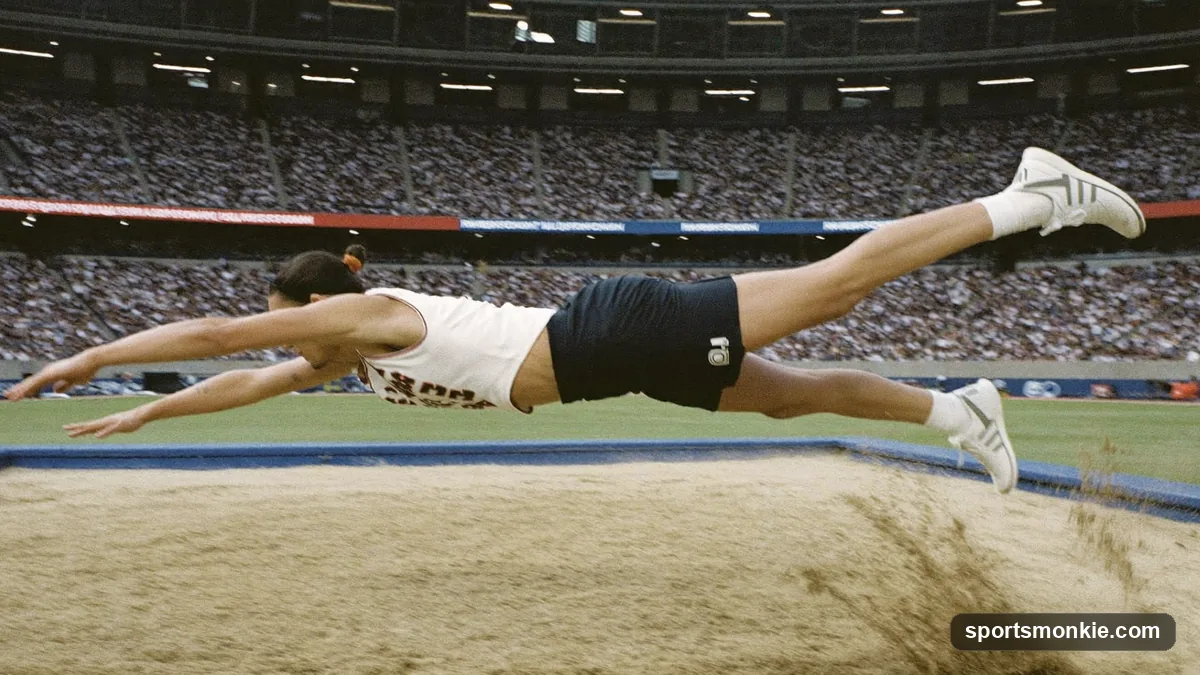
The long jump is a track-and-field event where an athlete sprints down a runway, takes off from a marked board, and is scored on the distance from that board to the nearest mark they leave in the sand — and as of 2026, the sport’s benchmark is still Mike Powell’s 8.95m, set in 1991. It looks simple on television, but the event is governed by a precise setup (a 40m runway, a plasticine foul strip, a sand pit) and a genuine in-air technique battle against rotation. Here is exactly how it works, based on World Athletics’ technical rules, along with the records and the athletes currently redefining the event.
How is a long jump measured?
Every jump is measured from the foul line, the front edge of the take-off board, to the nearest break in the sand caused by any part of the athlete’s body or uniform. That last detail matters: if a jumper lands cleanly but then falls backward and their hand or hip touches the sand behind their heels, the distance is measured to that closer mark, not to the footprints. This is exactly why elite jumpers are coached to fall or roll forward on landing rather than sit back — a backward hand-plant can cost 10-20cm off an otherwise excellent jump.
Officials use a steel tape (or, at major championships, an electronic/laser measuring device calibrated against a tape) to take the distance perpendicular to the foul line, and it is always rounded down to the nearest centimetre.
What are the runway, board, and pit dimensions?
| Element | Specification |
|---|---|
| Runway length | Approximately 40 metres, minimum 1.22m wide |
| Runway surface | Rubberised track surface, same as the sprint track |
| Take-off board | 20cm (8 in) wide, wood or synthetic, set flush with the runway |
| Foul indicator | A strip of plasticine (soft, moulded material) set in a raised board just beyond the take-off line; leaves a visible footprint if a jumper oversteps |
| Landing area | A pit of soft, damp sand, level with the runway surface |
| Wind limit for records | 2.0 metres per second maximum following wind |
The plasticine strip is the classic foul-detection method: it is recessed just past the board so that if any part of the jumper’s foot lands on or past it, the soft material takes a visible imprint and the jump is disallowed. Many major meets have supplemented or replaced plasticine with high-speed cameras and laser/optical sensors, but the underlying rule is unchanged.
What is the step-by-step long jump technique?
- Approach run — Elite jumpers take roughly 20-22 strides down the runway, accelerating to close to top sprint speed while precisely hitting the same stride pattern every attempt so their final step lands on the board.
- Last two strides — The athlete lowers their centre of gravity slightly and adjusts stride length to set up an aggressive, fast final plant on the board without slowing down.
- Take-off — The jumper drives off the board at roughly 18-22 degrees, punching the free knee and both arms upward to convert horizontal speed into height and distance.
- Flight (the technique phase) — This is where the hang, hitch-kick, or sail comes in, all designed to fight the forward rotation that a fast, low take-off angle naturally creates:
- Hang: the body arches with the legs trailing beneath the hips, delaying rotation, before both legs whip forward together just before landing.
- Hitch-kick (“running in the air”): the legs keep cycling through one and a half to two and a half extra strides mid-flight, most commonly used by top elite jumpers today.
- Sail: the simplest style, legs held together and raised toward the toes; effective for beginners but weaker against rotation at high speed.
- Landing — Both feet (and arms) are thrust forward together, and the jumper aims to fall or roll forward through the mark rather than back into it, to protect the measured distance.
What counts as a foul in the long jump?
A jump is a foul, and is not measured at all, if the athlete’s foot touches the ground beyond the foul line at the front of the board at take-off — even by a fraction of a centimetre, and even if the rest of the jump was legal and long. Taking off from well behind the board is legal but wastes distance, since the jump is always measured from the board itself, not from where the athlete’s foot actually left the ground. A common misconception is that athletes are penalized for jumping short of the board; they are not penalized, they simply lose the unused space between their foot and the board as “wasted” distance.
Who holds the long jump world records?
| Record | Athlete | Mark | Year | Location |
|---|---|---|---|---|
| Men’s world record | Mike Powell (USA) | 8.95 m | 1991 | World Championships, Tokyo |
| Women’s world record | Galina Chistyakova (URS) | 7.52 m | 1988 | Leningrad |
Both records have stood since before most current competitors were born — Powell’s for 35 years and Chistyakova’s for 38 as of 2026 — making them two of the most durable records in the entire sport. Powell’s mark famously came in a head-to-head duel with Carl Lewis at the 1991 Worlds, where Lewis actually jumped further on a wind-aided attempt that didn’t count for record purposes.
Who are the best long jumpers today?
On the men’s side, Miltiadis Tentoglou of Greece is the reigning Olympic champion, having successfully defended his title at the Paris 2024 Games with 8.48m to become the first man in the 21st century to win back-to-back Olympic long jump golds. At the 2025 World Championships in Tokyo, Italy’s Mattia Furlani took the world title with 8.39m, edging out Jamaica’s Tajay Gayle.
On the women’s side, Malaika Mihambo of Germany, the Tokyo 2020 Olympic champion and multiple world champion, remains one of the sport’s most consistent competitors; at the 2025 World Championships she took silver behind American Tara Davis-Woodhall, who won gold with 7.13m. None of the current elite marks are within half a metre of Powell’s or Chistyakova’s all-time records — a reminder of just how far ahead of their eras those two jumps were.
Long jump vs. triple jump: what’s the difference?
Both events share the same runway, board, and pit, and both fall under the broader category of track and field jumping events, but they are scored very differently. The long jump is a single leap: sprint, take off, land. The triple jump adds a hop and a step before the final jump, following a strict hop-step-jump sequence off the same board, which is why triple jump winning distances (usually 17-18m for elite men) look longer than long jump distances despite testing a related but distinct skill set. Jumpers sometimes compete in both events, but the technique, rhythm, and training emphasis differ enough that most athletes specialize in one. The long jump’s closest technical cousin for judged mechanics is actually the high jump, which shares the same foul-line and measurement philosophy even though the athlete clears a bar instead of covering ground.
Together, the long jump, triple jump, and high jump make up the horizontal-and-vertical jumping trio at the heart of every track and field program, from school meets to the Olympics.
Frequently asked questions
What is the world record for the long jump?+
As of 2026, the men's world record is 8.95 metres, set by Mike Powell of the USA at the 1991 World Championships in Tokyo. The women's world record is 7.52 metres, set by Galina Chistyakova of the Soviet Union in Leningrad in 1988. Both marks are among the longest-standing records in track and field, at 35 and 38 years old respectively, and neither has been seriously threatened in the modern era.
How is a long jump measured?+
Officials measure from the foul line at the front edge of the take-off board to the nearest break or mark in the sand made by any part of the athlete's body, including a hand or heel that lands behind the main footprints. This is why jumpers try to fall or roll forward on landing, since the closest mark counts, not the farthest. Measurements are taken with a steel tape or laser device and rounded down to the nearest centimetre.
What is a foul in the long jump?+
A jump is fouled, and not measured, if any part of the athlete's foot goes past the front edge of the take-off board at the moment of take-off. Officials detect this using a strip of plasticine (or, at elite meets, cameras and laser sensors) fixed just beyond the board, which leaves a visible mark if the jumper's shoe touches it. Stepping short of the board is legal but costs distance, since the jump is measured from the board regardless.
What is the difference between the hang and the hitch-kick technique?+
The hang keeps the body extended and the legs trailing behind the hips through most of the flight, delaying forward rotation before the legs snap forward just before landing. The hitch-kick, sometimes called running in the air, keeps cycling the legs mid-flight as if still sprinting, using one and a half to two and a half strides to cancel out rotation. Both aim to land with legs extended forward; the hitch-kick is generally considered the more effective technique at elite level.
How long is a long jump runway?+
A regulation long jump runway is approximately 40 metres long and at least 1.22 metres wide, giving elite athletes room for a full sprint approach of around 20 to 22 strides. It is surfaced with the same rubberised material as the running track. The runway ends at the take-off board, a 20cm-wide strip set flush with the ground just before the sand pit.
What is the difference between long jump and triple jump?+
The long jump is a single leap from the board into the pit, while the triple jump adds two extra phases, a hop and a step, before the final jump, following a hop-step-jump sequence from the same board. Because the triple jump spreads the effort across three phases, its winning distances are shorter relative to a jumper's speed than a single long jump, but the technique and take-off rules are otherwise closely related.
How many jumps do athletes get in a long jump competition?+
At most elite competitions, including the Olympics and World Championships, every athlete gets three qualifying attempts, and the top eight (sometimes nine, in case of ties) advance to three more attempts in the final. Only an athlete's single best legal jump from all six attempts counts toward the final result and medal standings.
Sources
Play & tools
Free browser games and tools — no account, no download.
- Play today's Sports Connections — Today's Sports Connections — daily hints, answers, and play the grid.
- Play Guess the NFL Player — A new mystery NFL player every day. Eight guesses, with a clue on each — plus free unlimited mode.
- Explore all our games →
Related guides
High Jump Explained: Rules, Technique, and World Records
High jump explained: the J-shaped approach, Fosbury Flop technique, three-attempt rules, countback ties, and the current men's and women's world records.
Pole Vault Explained: Rules, Technique, Equipment and World Records
Pole vault explained: how the runway, pole and box work, the six phases of a vault, scoring rules, and current world records as of 2026.

What Is a Steeplechase? The Water-Jump Race
A steeplechase is a distance race, 3,000m at the Olympics, run over fixed barriers and a water jump. Runners clear 28 barriers and 7 water jumps in all.
Javelin Throw Explained: Rules, Technique & World Records
Javelin throw explained: weight, runway rules, throwing technique, the 1986 redesign, and world records — men's 98.48m, women's 72.28m, as of 2026.
Relay Race Explained: 4x100m, 4x400m, Baton Rules & World Records
How a relay race works: the 30m exchange zone, blind vs visual baton passes, DQ rules, and the 4x100m/4x400m world records, as of 2026.
Heptathlon Events Explained: Order, Rules and Scoring
The heptathlon has seven events over two days. See the event order, scoring, false-start rules, tie rule, records and beginner training notes.