
Dolphin Kick Swimming: Technique, the 15-Meter Rule, and Drills

On this page8
The dolphin kick is a two-legged, undulating kick swum with the feet together, sending a whip-like wave from the chest through the hips and out through the ankles — it’s the kick that powers the butterfly stroke and, swum underwater in a streamline, is often fast enough to be nicknamed swimming’s “fifth stroke.” Every competitive swimmer uses it off the start and off every wall, whether the race above the surface is butterfly, freestyle, or backstroke.
What the Dolphin Kick Actually Is
Unlike the flutter kick used in freestyle and backstroke — where each leg moves independently and alternately — the dolphin kick moves both legs together as a single unit. The motion doesn’t start at the feet. It starts at the chest and core, travels as a wave through the hips, then the knees, and finally snaps through the ankles, the same way energy travels down the length of a real dolphin’s tail or the tip of a cracking whip.
This is one of only two kicks used across the main competitive strokes: the alternating flutter kick (freestyle, backstroke) and the simultaneous dolphin/whip motion (butterfly, and underwater work in every stroke). Breaststroke uses its own distinct whip kick and is not related to the dolphin kick.
Why the Kick Starts in the Core, Not the Legs
The most common mistake swimmers make is trying to generate the dolphin kick from the knees, bicycling the lower legs up and down. That looks busy but produces almost no propulsion and a lot of drag, because it breaks the streamlined bodyline.
A correct dolphin kick is driven by:
- Chest and upper-back initiation — a slight forward press of the chest starts the undulation, like the crest of a wave.
- Core and hip drive — the abs and lower back transmit that wave into the hips, which dip and rise.
- Knee bend as a relay point, not the source — the knees bend to let the wave pass through, absorbing and redirecting energy rather than generating it.
- Ankle snap as the finish — loose, flexible ankles whip the feet through the water last, delivering the final burst of propulsion, similar to the tip-crack of a whip.
Faster swimmers also balance the two phases of the kick evenly: the downbeat (which produces most of the propulsion) and the upbeat (a quicker, more relaxed recovery). Swimmers who linger too long on the upbeat lose speed and rhythm — ankle mobility and flexibility are strongly linked to a stronger, more efficient kick.
Streamline: The Other Half of the Technique
A powerful kick wasted on a poor body position still loses to a modest kick held in a tight streamline. The standard underwater position is:
- Arms locked straight overhead, one hand stacked on top of the other, biceps squeezing the ears.
- Head neutral, eyes down or slightly forward — not craned up, which breaks the line and adds drag.
- Body held as flat and narrow as possible, with the kick contained within that narrow bodyline rather than kicking wide.
Any gap in the streamline — bent elbows, a lifted head, hips that sag — adds drag that can outweigh whatever extra kick power a swimmer generates. This same tight-line discipline carries directly into the push-off after a flip turn in swimming, where the underwater dolphin kick phase begins.
The 15-Meter Underwater Rule
Because underwater dolphin kicking is faster than surface swimming — elite swimmers can hold roughly 2 km/h more pace underwater than on the surface in freestyle — the sport’s governing body limits how much of a race can be swum submerged.
Under World Aquatics rules, in freestyle, backstroke, and butterfly (and on those legs of individual medley events), a swimmer’s head must break the surface of the water no later than 15 meters from the wall, whether off the start or off a turn. Swimming past that mark before surfacing is one of the most common disqualifications in competitive swimming, especially on starts, where the temptation to stay under longer is greatest.
The rule exists for a mix of reasons: it keeps races visible to spectators and officials on the surface, and it limits extended breath-holding at high underwater speed, which carries its own fatigue and safety considerations.
| Stroke | Underwater kick allowed | Surface kick |
|---|---|---|
| Butterfly | Dolphin kick, up to 15m off walls | Dolphin kick (surface) |
| Freestyle | Dolphin kick, up to 15m off walls | Flutter kick |
| Backstroke | Dolphin kick, up to 15m off walls | Flutter kick |
| Breaststroke | One optional pull-down + one dolphin kick allowed off the start/turns | Whip kick |
Why It’s Called the “Fifth Stroke”
Swimming officially recognizes four strokes — freestyle, backstroke, breaststroke, and butterfly. The underwater dolphin kick isn’t a fifth stroke in the rulebook, but it earned the nickname because it has become decisive enough to be treated like one. American swimmer Jesse Vassallo helped popularize extended underwater dolphin kicking off walls in the 1970s, and the technique kept evolving from there. Michael Phelps’s underwater kick was so dominant through the 2000s and 2010s that broadcasters and coaches routinely called it his personal “fifth stroke” — a separate skill trained with the same seriousness as any actual stroke, because it was often the difference between winning and finishing second.
Dolphin Kick Drills
- Vertical kicking: Tread water in the deep end using only a dolphin kick, arms crossed over the chest or held overhead. This isolates the core-driven undulation — a knees-only kick becomes exhausting and obvious almost immediately.
- Kick on the back with a board or hands overhead: Lie flat on your back, dolphin kick with a small, controlled amplitude, and focus on driving the wave from the chest rather than bending sharply at the knees.
- Streamline kick off the wall: Push off in a tight streamline and count how many kick cycles you can hold before the line breaks down; rebuild the count over successive sets rather than muscling through with bad form once fatigued.
- Underwater 15-meter build: From a dive or push-off, kick underwater and time how close you get to (without exceeding) the 15-meter mark, gradually building both speed and the discipline of surfacing legally.
- Single-fin or monofin kicking: Where allowed, a monofin exaggerates the undulation and forces a hip-and-core-driven kick, since a knees-only kick simply doesn’t move a monofin efficiently.
Common Dolphin Kick Mistakes
Even strong swimmers develop habits that quietly cap their kick speed:
- Kicking too wide: Letting the knees or feet break outside the bodyline adds frontal drag and slows the whole underwater phase.
- Rigid ankles: Stiff, flexed ankles turn the kick’s final whip into a flat push instead of a snap — ankle flexibility work pays off directly in kick speed.
- Bent elbows in streamline: Even a slightly bent arm widens the profile pushing through the water and undercuts an otherwise strong kick.
- Surfacing late out of habit rather than need: Riding the 15-meter limit on every single length, even in practice, builds a habit that becomes a disqualification risk in competition.
The Bottom Line
The dolphin kick is deceptively simple to describe — legs together, undulate, repeat — and genuinely difficult to do well, because real speed comes from the core and hips, not from thrashing the lower legs. Combined with a tight streamline and used up to the legal 15-meter limit off every start and wall, it’s become one of the most trainable, race-deciding skills in the sport, which is exactly why it earned the “fifth stroke” nickname in the first place.
Frequently asked questions
What is the dolphin kick in swimming?+
The dolphin kick is a two-legged, whole-body kick where the legs stay pressed together and move as one unit in an undulating, wave-like motion — down and up together, mimicking a dolphin's tail. It is the kick used in the butterfly stroke and is also swum underwater after starts and turns in every stroke.
Why is the underwater dolphin kick called the fifth stroke?+
Swimming has four recognized strokes — freestyle, backstroke, breaststroke, and butterfly — but the underwater dolphin kick is often treated as a distinct fifth skill because it is fast enough, and technically demanding enough, to decide races on its own. Michael Phelps's underwater kick became so dominant it was nicknamed his 'fifth stroke.'
How does the dolphin kick work technically?+
The kick starts in the core and chest, travels through the hips as a wave, and finishes with a whip-crack snap through the knees and ankles. The downbeat generates most of the propulsion; the upbeat is a quicker, relaxed recovery that resets the legs for the next downbeat, all while the arms stay locked in a tight streamline overhead.
What is the 15-meter rule for the dolphin kick?+
World Aquatics rules limit how far a swimmer may travel underwater off a start or turn in freestyle, backstroke, and butterfly (and on those legs of individual medley races): the head must break the surface no later than 15 meters from the wall. Swimming past that mark before surfacing is a disqualification.
Why is underwater dolphin kicking faster than swimming on the surface?+
Underwater, a swimmer avoids wave drag and surface turbulence created by the body moving through the air-water interface. Elite swimmers can hold roughly 2 km/h faster pace underwater than they can on the surface in freestyle, which is why so much race-deciding speed now comes off the walls rather than mid-pool.
Do you kick from the knees or the hips in a dolphin kick?+
From the hips and core, not the knees. A kick driven mainly from the knees looks like frantic paddling and creates drag; a kick driven from the hips sends a smooth wave down the body that only whips through the knees and ankles at the very end, the way a whip cracks at its tip.
What's a good beginner dolphin kick drill?+
Vertical dolphin kicking in deep water — treading water using only a dolphin kick with arms crossed over the chest — is one of the most effective beginner drills because it isolates the core-driven undulation and makes a knees-only kick immediately obvious and exhausting.
Can you use a dolphin kick in freestyle or backstroke races?+
Yes, but only underwater. Swimmers use several dolphin kicks off the start and off every wall in freestyle and backstroke before breaking out into their normal stroke, staying within the 15-meter limit. On the surface, freestyle and backstroke use an alternating flutter kick, not the dolphin kick.
Sources
Play & tools
Free browser games and tools — no account, no download.
- Play today's Sports Connections — Today's Sports Connections — daily hints, answers, and play the grid.
- Play Guess the NFL Player — A new mystery NFL player every day. Eight guesses, with a clue on each — plus free unlimited mode.
- Explore all our games →
Related guides
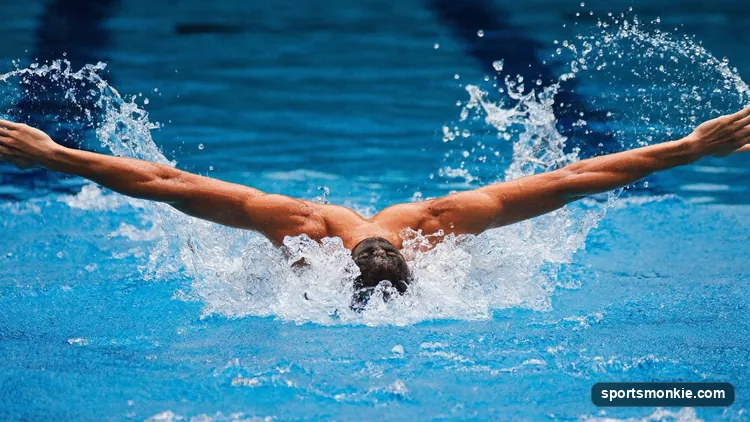
Butterfly Stroke: Technique, Kick Timing, and Drills Explained
The butterfly stroke pairs a simultaneous over-water arm recovery with two dolphin kicks per cycle, making it swimming's hardest, second-fastest stroke.
Breaststroke Swimming: Technique, Timing, and Drills Explained
Breaststroke swimming is the slowest competitive stroke, built on a pull-breathe-kick-glide rhythm and a whip kick. Learn the timing, pull-out, and fixes.
Backstroke Swimming: Technique, Start, and Drills Explained
Backstroke swimming is the only competitive stroke swum face-up. Learn the flutter kick, arm recovery, body roll, start, and drills to swim it correctly.
Freestyle Swimming: Technique, Drills, and Common Mistakes Explained
Freestyle swimming (front crawl) is the fastest competitive stroke. Learn the arm pull, flutter kick, breathing, and drills that fix common mistakes.
How to Swim: Complete Technique Guide for All 4 Strokes
Learn how to swim with correct technique for freestyle, breaststroke, backstroke, and butterfly. Body position, breathing, kick, and drills to swim farther and faster.
Types of Swimming Strokes: Freestyle, Backstroke, Breaststroke & More
The main types of swimming strokes are freestyle, backstroke, breaststroke, butterfly, sidestroke, and elementary backstroke — each built for a different job.