
Backstroke Swimming: Technique, Start, and Drills Explained
On this page7
Backstroke swimming is the only one of the four competitive strokes swum on the back, driven by a continuous flutter kick and an alternating straight-arm recovery that is timed to a steady roll of the hips and shoulders. It sits alongside freestyle, breaststroke, and butterfly as one of the four strokes tested in individual medley events, and it is unique because racers start in the water instead of diving from the blocks. Mastering it comes down to four things: a still head, a narrow flutter kick, a well-timed body roll, and a relaxed, straight-arm recovery. If you are still working out the basics of stroke mechanics, our guide to the types of swimming strokes is a useful starting point before you dive into backstroke specifics.
Body Position: The Foundation of Backstroke
Everything in backstroke starts with a flat, streamlined body position. Lie back with your ears in the water, chin slightly tucked, and hips near the surface — think of resting your head on a pillow rather than craning it forward. A slight downward slope from head to hips is normal and keeps the legs deep enough for the kick to stay effective, but if the hips drop too far, drag increases sharply and the whole stroke slows down.
The single biggest position error is lifting the head to look around. Keep your eyes fixed on the ceiling or sky and let the flags and stroke count tell you where the wall is, not your eyes. A still head keeps the hips up and the body aligned; a bobbing head drags the hips down every time.
The Flutter Kick
Backstroke uses the same flutter-kick family as freestyle, but it runs continuously rather than pausing during recovery. Key points:
- Kick from the hips, not the knees, with legs relatively straight and only a slight, relaxed bend.
- Keep the kick narrow — roughly 12 to 18 inches of vertical travel per leg — since a wide kick adds drag instead of propulsion.
- Point the toes and let the ankles stay loose; a stiff, flexed ankle kills the “whip” that generates forward push.
- Keep kicking through arm recoveries; backstroke rarely has the timing gaps that trip up freestyle kickers, so a steady beat (commonly six kicks per arm cycle in sprint racing) is the target.
Arm Stroke and Recovery
The backstroke arm cycle alternates: while one arm pulls underwater, the other recovers straight overhead. Break it down step by step:
- Entry — The recovering arm enters the water pinky-finger first, directly in line with the shoulder, roughly shoulder-width from the head.
- Catch — Once submerged, bend the elbow to set an early vertical forearm, positioning the forearm and hand to press water backward rather than downward.
- Pull — Pull through in an S-shaped path past the hip, keeping the pulling arm’s elbow bent through the middle of the stroke for maximum surface area on the water.
- Exit and recovery — The arm exits the water near the hip, thumb first, then sweeps straight up and over in a relaxed arc back to the entry point, staying in line with the shoulder rather than swinging wide.
- Repeat opposite side — As one arm finishes its recovery and enters, the other arm should be starting its pull, keeping propulsion continuous.
Body Roll and Timing
Body roll is what separates smooth backstroke from a flat, arm-only slog. As one arm lifts into recovery, rotate the shoulders and hips toward that same side; this shortens the reach needed for a strong catch and reduces shoulder strain. The common mistake is rotating too early, before the recovering arm enters the water, which disrupts the pulling arm’s grip on the water. Time the rotation so it peaks just as the recovering hand enters — that alignment is what lets swimmers extend their reach and generate power from the hips and core rather than the shoulders alone. This same principle of relying on rotation and rhythm rather than raw arm strength shows up across strokes; the pull mechanics used in freestyle swimming rely on a nearly identical catch-and-roll relationship, just face-down instead of face-up.
The Backstroke Start and Flags
Backstroke is the only competitive stroke that starts in the water rather than with a dive. Swimmers grip the wall or the starting-block handles with both hands, plant their feet on the wall below the surface, and pull their body into a tucked position. On the starting signal, they release the grip, arch back, and drive off the wall explosively into a streamlined glide, transitioning into the underwater dolphin-kick phase before surfacing to begin the flutter kick and arm stroke.
Because swimmers can’t see the wall while racing on their back, pools string backstroke flags 5 meters (5 yards in short-course-yards pools) from each end. Swimmers count their personal stroke number from the flags to the wall so they know exactly when to begin their turn or finish without craning their neck to look — a habit worth building early, since anyone new to the sport benefits from locking in these fundamentals; see our broader tips to start swimming for beginner-friendly groundwork that applies across all four strokes.
Common Mistakes and How to Fix Them
| Mistake | Why it hurts your stroke | Fix |
|---|---|---|
| Lifting the head to sight | Drops the hips, adds drag | Keep eyes fixed upward; count strokes from the flags instead |
| Wide, bent-arm recovery | Loses reach, breaks shoulder-line alignment | Recover with a straight arm directly over the shoulder |
| Rotating too early | Pulling arm loses its grip on the water | Time the roll to peak as the recovering hand enters |
| Wide, sloppy kick | Adds drag instead of propulsion | Kick from the hips with a narrow, straight-leg action |
| Sinking hips | Slows the whole stroke down | Engage the core; keep a slight head-to-hip downward slope, not a bent-at-the-waist posture |
Drills to Improve Backstroke
- Single-arm backstroke — Swim with one arm at your side while the other does the full stroke cycle, isolating catch, pull, and recovery mechanics one side at a time.
- Kick-on-back with streamline — Push off in a tight streamline and kick only, focusing on a still head and narrow, hip-driven kick.
- 6-kick switch drill — Hold a streamline position on each side and kick six times before switching arms, reinforcing rotation and balance.
- Flag-count practice — Deliberately count strokes from the flags to the wall at varying speeds so the number becomes automatic under race fatigue.
Backstroke rewards patience: swimmers who rush the arm recovery or fight the water with a wide kick usually swim slower than those who stay relaxed and let rotation do the work. Compare that rhythm-first approach to the timing demands of breaststroke swimming, where glide and kick timing play a similarly outsized role — both strokes punish swimmers who try to muscle through instead of syncing their motion.
Frequently asked questions
What is backstroke swimming?+
Backstroke is the only competitive swimming stroke swum on the back, using a continuous flutter kick and alternating straight-arm recovery over the water while the body rolls from side to side. It is one of the four strokes swum in individual medley and stroke-specific events.
Why is backstroke harder than freestyle for many swimmers?+
Backstroke removes visual reference to the wall and pool bottom, so swimmers must rely on rhythm, body roll, and overhead flags instead of sight. It also demands more shoulder flexibility for the straight-arm recovery and a stronger core to keep the hips from sinking.
How do you start a backstroke race?+
Backstroke is the only stroke that starts in the water. Swimmers grip the wall or starting-block handles with both hands, place their feet on the wall below the surface, and on the starting signal pull, then push explosively off the wall into a streamlined glide before beginning the kick.
What are the backstroke flags for?+
The backstroke flags are strung 5 meters (or 5 yards in short-course-yard pools) from each wall so swimmers can count strokes to the wall without turning their head to look, helping them time turns and finishes accurately.
How many strokes should you take between the flags and the wall?+
It varies by swimmer height, speed, and stroke length, so most coaches recommend counting your own personal number in practice (often 3-6 strokes) rather than copying a fixed number from someone else.
What is the most common backstroke mistake?+
Lifting the head to look for the wall or breathing pattern is the most common error; it drops the hips, increases drag, and throws off the body roll. Keeping the head still with eyes on the ceiling fixes most of the resulting problems.
Is backstroke good for beginners?+
Yes. Because the face stays out of the water, backstroke removes the breathing coordination that trips up many new swimmers, making it a useful stroke to build confidence and body position before tackling freestyle or breaststroke.
How do backstroke turns work?+
At the flags, swimmers count strokes to the wall, roll onto their front for one arm pull, tuck into a somersault (a flip turn), plant the feet on the wall, and push off on the back to continue the underwater phase before resurfacing.
Sources
Play & tools
Free browser games and tools — no account, no download.
- Play today's Sports Connections — Today's Sports Connections — daily hints, answers, and play the grid.
- Play Guess the NFL Player — A new mystery NFL player every day. Eight guesses, with a clue on each — plus free unlimited mode.
- Explore all our games →
Related guides
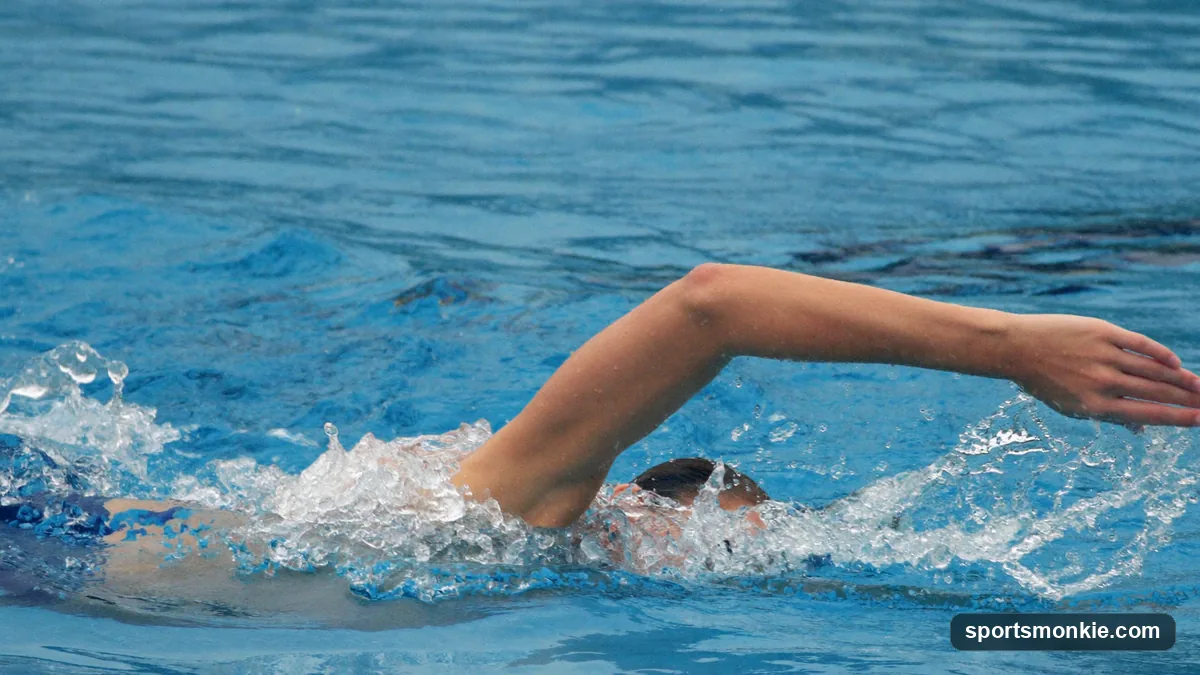
Freestyle Swimming: Technique, Drills, and Common Mistakes Explained
Freestyle swimming (front crawl) is the fastest competitive stroke. Learn the arm pull, flutter kick, breathing, and drills that fix common mistakes.
Breaststroke Swimming: Technique, Timing, and Drills Explained
Breaststroke swimming is the slowest competitive stroke, built on a pull-breathe-kick-glide rhythm and a whip kick. Learn the timing, pull-out, and fixes.
Butterfly Stroke: Technique, Kick Timing, and Drills Explained
The butterfly stroke pairs a simultaneous over-water arm recovery with two dolphin kicks per cycle, making it swimming's hardest, second-fastest stroke.

Dolphin Kick Swimming: Technique, the 15-Meter Rule, and Drills
The dolphin kick swimming technique explained: core-driven undulation, streamline, the 15-meter underwater rule, and drills to build a faster fifth stroke.
How to Swim: Complete Technique Guide for All 4 Strokes
Learn how to swim with correct technique for freestyle, breaststroke, backstroke, and butterfly. Body position, breathing, kick, and drills to swim farther and faster.
What Is the Individual Medley in Swimming? Order, Distances & Rules
Individual medley swimming has one swimmer race all four strokes in a fixed order: butterfly, backstroke, breaststroke, freestyle. Here's how it works.