
How to Play Darts: Rules and 501 Scoring
On this page6
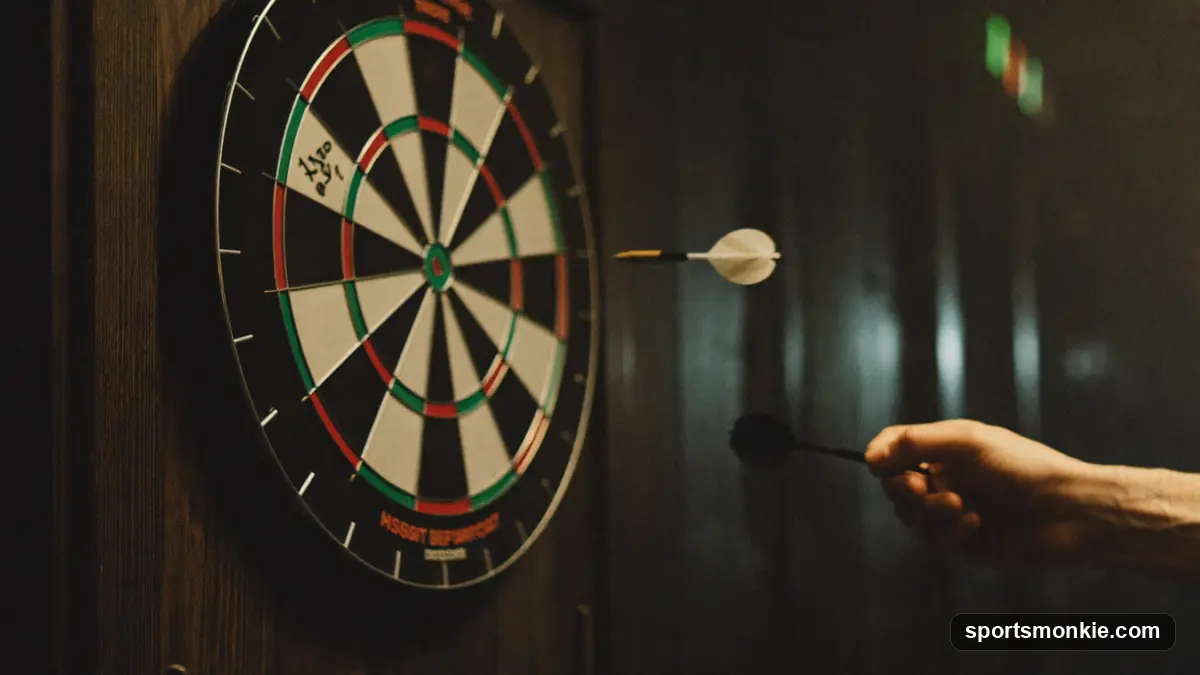
The standard game of darts is 501. Both players start with 501 points, take turns throwing three darts, and subtract each turn’s total from their running score. The first to reach exactly zero wins, and the final dart has to land in a double or the bullseye to close it out.
That double-out finish is what makes darts a game rather than a math race, and it trips up every beginner at first. Below is the full setup, how scoring works, how a leg of 501 actually plays, and how to land your first checkout.
Setting up: board height and throwing distance
Before the first dart, the board and the throwing line have to be right, and the measurements are standardized worldwide.
| Measurement | Official spec |
|---|---|
| Bullseye height from floor | 5 ft 8 in (1.73 m) |
| Throwing distance (oche) | 7 ft 9.25 in (2.37 m) |
| Diagonal, floor to bull | 9 ft 7.5 in (2.93 m) |
| Darts per turn | 3 |
Measure the 7 ft 9.25 inches horizontally from the face of the board to the throwing line, called the oche. Your feet stay behind that line. You can lean over it, but stepping on or past it makes the throw a foul.
How the dartboard scores
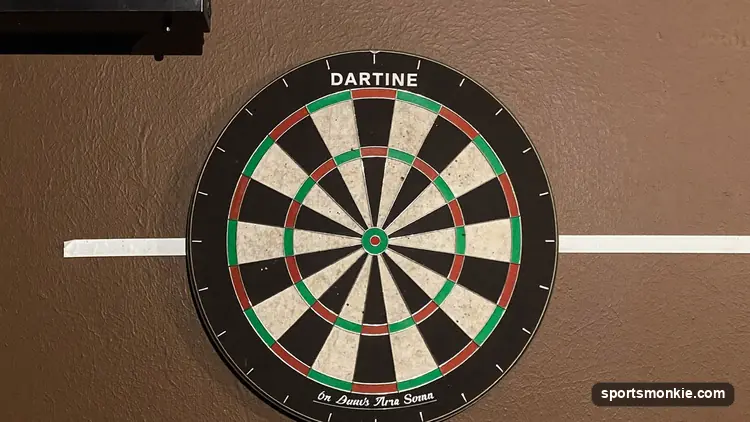
The board is split into 20 numbered segments, plus the central bull. Where your dart lands in a segment decides the multiplier.
- Single: the large area of a segment scores its face value (a single 20 is 20).
- Treble: the thin inner ring scores triple (treble 20 is 60, the highest single-dart score).
- Double: the thin outer ring scores double (double 20 is 40).
- Outer bull: the green ring is 25.
- Bullseye: the red center is 50, and it counts as a double for finishing.
The numbers are arranged so big scores sit next to small ones, with 20 at the top flanked by 1 and 5. Miss the treble 20 and you are punished with a 1 or a 5, which is the board’s built-in penalty for going for the biggest score.
Playing a leg of 501
Each turn, throw three darts and add up what they score, then subtract that from your total. A strong turn is 60 (treble 20) added up three times for 180, though most players score somewhere in the double digits per dart.
The bust rule is the key wrinkle. You cannot overshoot zero, and you cannot land on exactly one, because you would have no double to finish on. If a turn busts, your score snaps back to where it was before that turn and your opponent throws. So once you drop below about 170, you stop firing at the treble 20 and start planning a finish.
Your first checkout
A checkout is finishing the leg, and it always ends on a double. The habit that makes checkouts easier is leaving yourself an even number, because most doubles are even and a missed dart keeps you even.
Here are clean finishes worth memorizing as a beginner:
| Score left | Finish |
|---|---|
| 40 | Double 20 |
| 36 | Double 18 |
| 32 | Double 16 |
| 24 | Double 12 |
| 16 | Double 8 |
| 50 | Bullseye |
Double 16 is the classic target to aim for. Miss it high or wide and you often land in the single 16, leaving 16, which is another double, so a single mistake does not wreck your finish. That is why experienced players steer toward 32 rather than an odd number.
Other darts games worth learning
501 is the standard, but a few other games are worth knowing, especially if you are practicing alone or playing with mixed skill levels.
- 301: the same rules as 501 over a shorter distance, faster and good for beginners. Some house rules also require a double to start (double-in) as well as to finish.
- Cricket: players race to “close” the numbers 15 through 20 and the bull by hitting each three times, then score points on numbers they have closed but their opponent has not. It rewards accuracy across the board rather than just the treble 20.
- Around the Clock: hit every number from 1 to 20 in order. It is a pure practice game that forces you to aim at parts of the board you would otherwise ignore.
Playing cricket in particular builds the all-around accuracy that a 501 player leans on when they are forced off the 20 and have to score or check out from an awkward number.
The trick to throwing well
The best return for a beginner is a repeatable motion, not a hard one. Set a stable stance with your throwing-side foot forward and your weight slightly onto it. Bring the dart back to the same point near your eye each throw, keep your elbow up and still, and follow through toward the segment you want. Grouping three darts tightly, even in the wrong spot, is a fixable problem; a different motion every time is not.
For a deeper look at technique, our guide to the best ways to throw darts breaks down grip, stance and release, and you can see it all executed at the top level in our rundown of the greatest darts players. If you enjoy the precision-and-practice loop, how to rack pool balls covers another table-and-pub classic that rewards the same repeatable habits.
Start on 501, throw three darts a turn, and finish on a double. Learn a handful of checkouts, aim for even leaves, and groove one throwing motion. That is the whole game, and everything else is refinement.
For a closer look at a related topic, see What Is a 9-Darter in Darts?.
Frequently asked questions
What are the basic rules of darts?+
Each player throws three darts per turn from behind the oche. In 501, you subtract your turn's total from your score and race to exactly zero, finishing on a double. Only darts that stick in the board count. If a dart bounces out or misses, it scores nothing and cannot be re-thrown that turn.
What happens if you go below zero or can't finish on a double?+
You 'bust.' If a turn takes you below zero, leaves you on exactly one, or reaches zero without the last dart being a double, the whole turn is void. Your score reverts to what it was at the start of that turn, and play passes to your opponent. This is why players leave an even number to finish.
What is the trick to throwing darts?+
Consistency beats power. Keep a still stance with your throwing-side foot forward, bring the dart to the same spot near your eye each time, and follow through toward the target rather than snapping your wrist. A smooth, repeatable motion groups your darts far more than trying to throw hard.
What is the highest possible score and checkout?+
The highest score with three darts is 180, from three treble 20s. The highest checkout, the score you can finish from in one turn, is 170: treble 20, treble 20, then the bullseye. Anything above 170 cannot be finished in a single three-dart turn.
Sources
Play & tools
Free browser games and tools — no account, no download.
- Play today's Sports Connections — Today's Sports Connections — daily hints, answers, and play the grid.
- Play Guess the NFL Player — A new mystery NFL player every day. Eight guesses, with a clue on each — plus free unlimited mode.
- Explore all our games →
Related guides
How to Play Cricket Darts: Rules & Scoring
How to play cricket darts: hit the numbers 15 through 20 and the bullseye three times each to open them, then score before your opponent closes them.
Darts Checkout Chart: Every Finish From 170
A darts checkout chart shows the dart routes to finish a 501 leg on a double. Standard finishes from 170 down, bogey numbers, and how to read the notation.
What Is a 9-Darter in Darts?
A 9-darter is a perfect leg: finishing 501 in the fewest possible nine darts. How it's done, common routes, how rare it is, and the famous perfect legs.
Best Ways to Throw Darts: A Complete Technique Guide
The best way to throw darts blends a stable grip, steady stance, and smooth follow-through. Master these three basics to boost accuracy at any distance.

Greatest Darts Players of All Time, Ranked
The greatest darts players ever, ranked by world titles, major wins, peak dominance, longevity and era strength, from Phil Taylor and Eric Bristow to Luke Littler.
Dart Board Height and Distance Explained
Dart board height is 5 ft 8 in to the bullseye and the oche sits 7 ft 9.25 in back. Full PDC/WDF setup for steel-tip and soft-tip darts.