
Dart Board Height and Distance Explained
On this page5
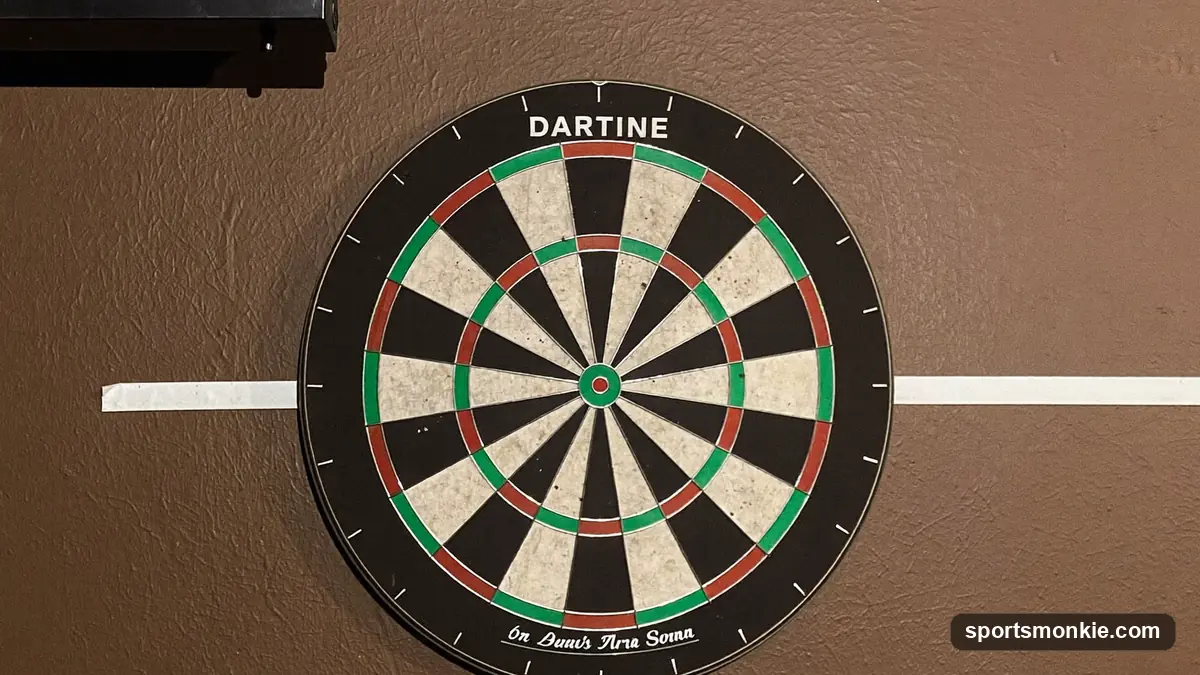
A regulation dart board is hung so the centre of the bullseye is exactly 5 feet 8 inches (1.73 m) above the floor. The throwing line, called the oche, sits 7 feet 9.25 inches (2.37 m) back, measured flat along the floor from the face of the board. Get those two numbers right and everything else about your setup falls into place.
Both figures come from the Professional Darts Corporation (PDC) and the World Darts Federation (WDF), the bodies that run the professional and amateur game. They are the same in a pub, a league hall or a world final. Below is the full setup, a quick-reference table, and the differences you will hit with soft-tip boards.
The two numbers that matter
Everything starts with the bullseye, not the edge of the board. Measure to the centre of the bull and set it at 5 feet 8 inches. Then measure the throwing distance horizontally along the floor, not on a slant, from the point directly below the board’s face.
- Board height: centre of the bullseye 5 ft 8 in (1.73 m) from the floor.
- Throwing distance (oche): 7 ft 9.25 in (2.37 m), measured flat from the face of the board.
- Diagonal check: 9 ft 7.5 in (2.93 m) from the bull to the oche, used to confirm both other measurements.
The oche is the line you cannot step over while throwing. You can lean across it, but a foot on or beyond the line means the throw does not count in match play.
Full setup measurements
Here is the standard steel-tip setup in both imperial and metric, plus the soft-tip variation used on electronic boards.
| Measurement | Steel-tip (PDC/WDF) | Soft-tip (electronic) |
|---|---|---|
| Bullseye height from floor | 5 ft 8 in (1.73 m) | 5 ft 8 in (1.73 m) |
| Throwing distance (oche) | 7 ft 9.25 in (2.37 m) | 8 ft 0 in (2.44 m) |
| Diagonal (bull to oche) | 9 ft 7.5 in (2.93 m) | 9 ft 9.5 in (2.98 m) |
| Board diameter | 18 in (45.72 cm) | 15.5 in (typical) |
The height never changes between the two formats. The main difference is the throwing line, which sits a few inches further back for soft-tip play. That small gap is why players who switch between formats sometimes feel their range is slightly off for a game or two.
How to hang the board correctly
Measure to the bull first, mark the wall, then set the bracket so the finished board lands on that mark. A common mistake is measuring to the top of the board or to the number ring, which leaves the bull too high or too low. If you are new to the whole setup, our guide on how to play darts walks through scoring and stance once the board is up.
For the oche, drop a plumb line or lay a straightedge from the face of the board straight down to the floor, then measure back from that point. Measuring from the wall instead of the board face adds the depth of the board and cabinet, which throws the distance off by an inch or more.
Once both are set, use the 9 ft 7.5 in diagonal as a final check. Run a tape from the centre of the bull down to the throwing line. If it reads 9 ft 7.5 in, your height and distance are both correct. If it does not, one of them is off.
Why the standard exists
The 5 ft 8 in height traces back to the early 20th-century British pub game, where the number roughly matched eye level for the average adult player of the day. The 7 ft 9.25 in distance is the metric conversion settling point of 2.37 metres, which is why the imperial figure has that odd quarter-inch on the end.
Standardising both meant a player could practise at home and walk into any venue with the same muscle memory. That consistency is the whole point: the throw you groove in your garage should work in a tournament. It is the same logic behind the fixed cricket darts scoring board, where every player attacks the same numbers from the same spot.
Common setup mistakes
The two errors that ruin a setup are measuring to the wrong point on the board and measuring the oche on a slant. Both are easy to avoid once you know to measure to the bull and to measure the floor distance flat.
Lighting matters too. A board lit from directly above or with a purpose-made surround throws even light across the face and kills the shadows cast by the wire, which otherwise hide part of the double and treble beds. None of that changes the two core numbers, but it changes how well you can aim at them.
Floor markings are the last piece people forget. In a proper setup the oche is a raised strip or a clearly taped line, not a rough guess, because a throw with a foot over the line does not count in league or tournament play. If you are marking a home setup, tape the line at exactly 7 ft 9.25 in and make it wide enough to see from your stance. Once your board is dialled in, the rest is practice, which is where our tips on the best ways to throw darts come in, and where the greatest darts players separate themselves.
The short version: bull at 5 ft 8 in, oche at 7 ft 9.25 in for steel-tip or 8 ft for soft-tip, and a 9 ft 7.5 in diagonal to confirm you got both right.
Frequently asked questions
How far do men stand from a dart board?+
The throwing distance is the same for everyone. Men, women and juniors all throw from the same 7 feet 9.25 inches in the standard steel-tip game. There is no separate men's distance in PDC or WDF play. Some youth leagues shorten the height and distance for very young players, but the adult standard does not change by gender.
What happens if a dartboard is hung too high?+
A board hung too high tilts your throw upward and pushes darts high on the board, so you drift toward the 20 and the top of the scoring area. It also strains your shoulder over a long session. The fix is to measure to the bullseye, not the top or bottom of the board: the bull must sit at 5 feet 8 inches, no higher.
What is the distance for American darts?+
American darts is a regional game, mostly around eastern Pennsylvania, played on a smaller wooden board with its own house rules and no standard national distance. The game most Americans call darts is actually the standard steel-tip game, thrown from the same 7 feet 9.25 inches used worldwide.
Why is the diagonal measurement 9 feet 7.5 inches?+
The 9 feet 7.5 inches is a diagonal check line from the bullseye down to the oche, not a separate rule. Because the bull is 5 ft 8 in up and the oche is 7 ft 9.25 in back, the straight-line distance between them works out to 9 ft 7.5 in. Fitters use it to confirm both measurements are correct at once.
Sources
Play & tools
Free browser games and tools — no account, no download.
- Play today's Sports Connections — Today's Sports Connections — daily hints, answers, and play the grid.
- Play Guess the NFL Player — A new mystery NFL player every day. Eight guesses, with a clue on each — plus free unlimited mode.
- Explore all our games →
Related guides
How to Play Cricket Darts: Rules & Scoring
How to play cricket darts: hit the numbers 15 through 20 and the bullseye three times each to open them, then score before your opponent closes them.
Darts Checkout Chart: Every Finish From 170
A darts checkout chart shows the dart routes to finish a 501 leg on a double. Standard finishes from 170 down, bogey numbers, and how to read the notation.
What Is a 9-Darter in Darts?
A 9-darter is a perfect leg: finishing 501 in the fewest possible nine darts. How it's done, common routes, how rare it is, and the famous perfect legs.
How to Play Darts: Rules and 501 Scoring
How to play darts: the 501 rules, how scoring works, the double-out finish and your first checkout, plus the official oche distance and board height.

Greatest Darts Players of All Time, Ranked
The greatest darts players ever, ranked by world titles, major wins, peak dominance, longevity and era strength, from Phil Taylor and Eric Bristow to Luke Littler.
Cornhole Distance and Board Dimensions Guide
Regulation cornhole distance is 27 feet from the front of one board to the front of the other. Full ACL board dimensions, hole placement and setup.