
Padel Court Dimensions and Space Needed
On this page13
- 01Padel court dimensions at a glance
- 02Padel court fit calculator
- 03What the 2026 FIP rules say
- 04Net height and posts
- 05Walls, mesh and court enclosure
- 06Clear height, lights and indoor planning
- 07Access openings and out-of-court play
- 08Padel court vs tennis court
- 09Singles and mini padel courts
- 10Surface, drainage and orientation
- 11What most padel court guides miss
- 12Quick planning checklist
- 13Bottom line
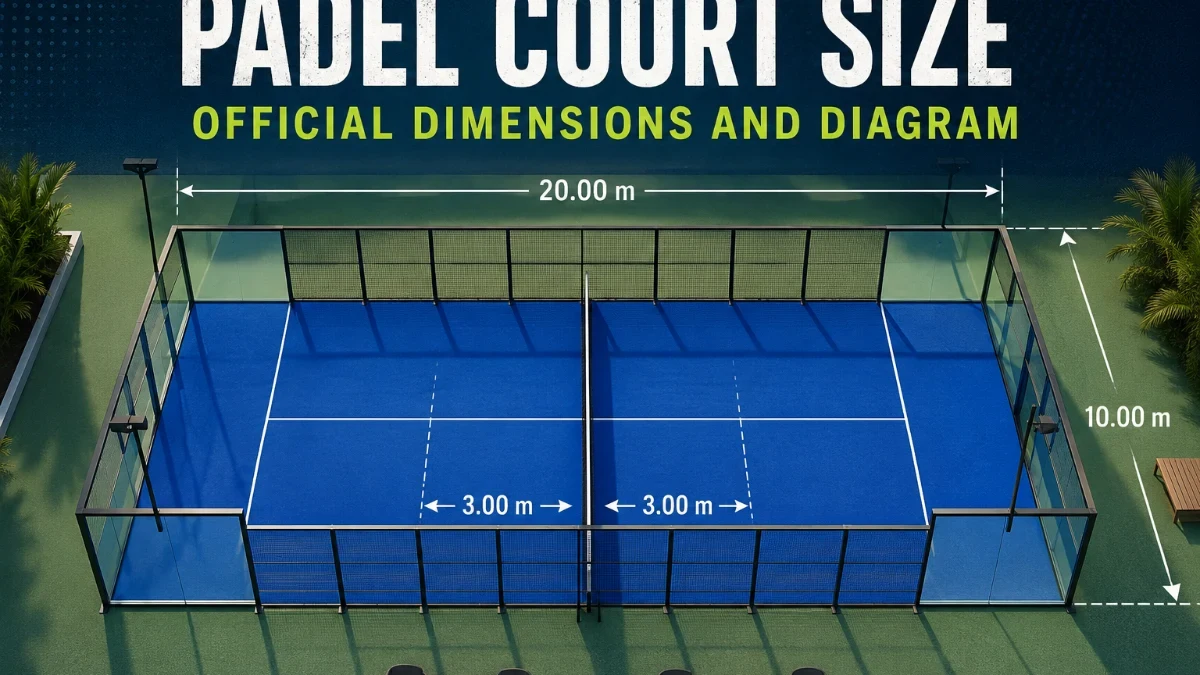
A regulation padel court is 20 metres long by 10 metres wide. In feet, that is about 65 feet 7 inches by 32 feet 10 inches. Those are interior measurements, taken inside the court enclosure.
That 20-by-10-metre box is only the start. Padel also needs glass and mesh walls, a lower centre net, service boxes, safe access openings, lighting and enough clear height for lobs. If you are planning a home court, club court or multi-court venue, the calculator and tables below will help you separate the official playing rectangle from the real site footprint.
Padel court dimensions at a glance
| Measurement | Metric | Feet / inches | Notes |
|---|---|---|---|
| Doubles court length | 20 m | 65 ft 7 in | Interior measurement |
| Doubles court width | 10 m | 32 ft 10 in | Interior measurement |
| Court area | 200 sq m | about 2,153 sq ft | Playing rectangle only |
| Official tolerance | 0.5% | about 4 in over 20 m | For court dimensions |
| Net length | 10 m | 32 ft 10 in | Spans the court width |
| Net height at centre | 0.88 m | 34.6 in | Lowest point |
| Net height at ends | max 0.92 m | 36.2 in | FIP maximum at ends |
| Service line from net | 6.95 m | 22 ft 10 in | On each side |
| Service line to back wall | 3.05 m | 10 ft | Derived from the half-court length |
| Line width | 5 cm | 2 in | White or black preferred |
| Minimum indoor clear height | 6 m | 19 ft 8 in | No lights or beams intruding |
| Suggested clear height for new builds | 8 m | 26 ft 3 in | Better for high lobs |
The current FIP rulebook, reviewed for application from 1 January 2026, uses metric specifications. Imperial values here are conversions for U.S. readers, not a separate rule set.
Padel court fit calculator
Measure the clear space you have, then choose what you are checking. This is a planning aid, not a construction certificate.
For a private backyard court, the 20-by-10-metre interior is the non-negotiable playing answer if you want regulation padel. For a commercial venue, do not stop there. The extra metre or two around the cage, the side access, the drainage plan and the ceiling height usually decide whether the project is comfortable or awkward.
What the 2026 FIP rules say
The FIP Rules of Padel define the court as a rectangle 10 metres wide by 20 metres long, using interior measurements and a 0.5 percent tolerance.
The court is divided in half by the net. On each side, the service line runs parallel to the net at 6.95 metres. A centre service line splits the service area into two boxes and extends at least 20 centimetres beyond the service line.
All court lines are 5 centimetres wide. FIP prefers white or black lines so they contrast clearly with the playing surface.
The simplest way to picture one half of the court is:
| Half-court section | Metric depth | Feet / inches |
|---|---|---|
| Net to service line | 6.95 m | 22 ft 10 in |
| Service line to back wall | 3.05 m | 10 ft |
| Total half-court length | 10 m | 32 ft 10 in |
| Half-court width | 10 m | 32 ft 10 in |
That 3.05-metre back zone is why padel does not feel like short tennis. Players can let the ball pass, read the rebound off the glass and play the next shot after the bounce.
Net height and posts
A padel net is 10 metres long. It is 0.88 metres high at the centre and rises to 0.92 metres at the ends, with a maximum tolerance of 0.005 metres.
The net is lower than a tennis net at the centre. It is also stretched across a walled court where the ball often comes back into play after hitting glass. That combination produces the long, tactical rallies padel is known for.
Net posts or the court structure hold the cable and should not create a player hazard. FIP also says the net must fill the space between the posts and the court surface, but should not be so tense that it plays like a rigid barrier.
If you are coming from pickleball, tennis or squash, compare this page with our pickleball net height, tennis court dimensions and squash court dimensions guides. The numbers are close enough to confuse people, but the games are not built around the same net, wall or rebound behavior.
Walls, mesh and court enclosure
Padel is defined by the enclosure. Without playable walls, it becomes a different sport.
The ends of the court are 10 metres wide and 4 metres high in total. The lower 3 metres is a rebound wall, usually tempered glass but sometimes another solid material. The top metre is metallic mesh.
FIP allows two main side-wall approaches:
| Side enclosure | Basic structure | Practical effect |
|---|---|---|
| Stepped side wall | 3 m high x 2 m long near each end, then 2 m high x 2 m long, with mesh completing the middle | Traditional court look with a visible step-down |
| Panoramic crystal variant | 3 m high wall area x 4 m long at each end, with mesh completing the side | Cleaner spectator view and common on modern premium courts |
The inner face matters because the ball must bounce predictably off rebound surfaces. Mesh is different. When the ball hits the metallic fence, the bounce can be messy, which is part of the sport rather than a flaw.
Clear height, lights and indoor planning
Indoor padel is where many proposed sites fail.
FIP requires a minimum clear height of 6 metres throughout the court. Nothing can obstruct that volume, including beams, ducts, lights or hanging equipment. For new facilities, FIP suggests 8 metres of free height.
That is why a court can fit on the floor plan and still fail in real life. Padel has lobs, smashes and defensive lifts. A low ceiling changes the game fast.
For lights, the same principle applies: they cannot sit where a legal high ball will hit them. FIP material also warns that lighting should not make vision difficult for players, officials or spectators.
Access openings and out-of-court play
Padel courts have side access openings around the net area. Depending on the court model, a side can have one or two openings, with or without doors.
If the court is designed for authorized out-of-court play, the side safety area becomes important. FIP says each side should have two access points, and the outside area must be clear of obstacles for at least 3 metres wide and 4 metres long on either side. Four metres is recommended.
Most casual players will never sprint out of the court to return a ball in a local club match. Still, the access design affects safety. Sharp frames, protruding handles, exposed posts and tight side walkways are the details players notice only after someone clips a shoulder or ankle.
Padel court vs tennis court
Padel is smaller than tennis, but be precise about the comparison.
| Measurement | Padel doubles court | Tennis doubles court |
|---|---|---|
| Playing length | 20 m | 23.77 m |
| Playing width | 10 m | 10.97 m |
| Playing area | 200 sq m | about 261 sq m |
| Net height at centre | 0.88 m | 0.914 m |
| Service line from net | 6.95 m | 6.40 m |
| Walls in play | Yes | No |
Measured only by the painted playing lines, padel is about 77 percent of a tennis doubles court’s area. But full tennis facilities need large run-off space behind the baselines and outside the sidelines, while padel’s playing area is enclosed by walls. That is why venue planners often say two padel courts can fit in the broader footprint used for one full tennis court setup.
For strategy and sport-choice context, see paddle tennis vs pickleball. For build budgeting, the next step is our padel court construction cost guide.
Singles and mini padel courts
The standard padel court is doubles: 20 metres by 10 metres.
Singles and training courts may narrow the court to 6 metres while keeping the 20-metre length. They can work for private homes, coaching or tight facilities, but they are not the normal club or tournament product. Padel’s main game is two against two, and most commercial operators want courts that serve the standard format.
Mini courts for juniors or events are even less standardized. Treat them as coaching spaces, not official match courts.
Surface, drainage and orientation
FIP permits cement, synthetic material or artificial grass when the surface gives a regular bounce. The rulebook also controls level differences and drainage slope. For synthetic and artificial grass, FIP points readers to its court homologation annex.
Outdoor courts need more than the rulebook rectangle. Plan for:
- drainage away from the playing surface
- light placement that does not blind players
- wind exposure
- safe access around glass and mesh
- north-south orientation where practical
- maintenance space for turf, glass and structure
The official court can be the same size indoors and outdoors, but the problems around it are different. Indoors you fight ceiling height. Outdoors you fight weather, drainage and sun angle.
What most padel court guides miss
The top padel dimension pages usually get the 20-by-10-metre number right. The weaker ones miss the decisions that matter before money is spent.
The useful gaps are:
- The 20-by-10-metre dimension is interior playing space, not the whole plot.
- “Smaller than tennis” needs context because tennis line area and tennis facility footprint are different comparisons.
- 6 metres of indoor clear height is a hard practical constraint, and 8 metres is a better new-build target.
- Wall variant, access layout and out-of-court play change the safety area.
- Singles courts exist, but doubles is the commercial and competition default.
If you are building, those details matter more than another repeated court rectangle.
Quick planning checklist
Before you mark, buy or quote a padel court, confirm:
- Interior playing area is 20 metres by 10 metres.
- Court tolerances are within the governing body’s limit.
- Net height is 0.88 metres at centre and no more than 0.92 metres at the ends.
- Service lines are 6.95 metres from the net.
- All lines are 5 centimetres wide and easy to see.
- End walls and side walls match the accepted enclosure type.
- Indoor clear height is at least 6 metres, with 8 metres preferred for a new facility.
- Access openings and side areas are safe for the level of play expected.
- Lighting, drainage, doors and structural hardware do not intrude into play.
- Cost planning includes foundation, turf, glass, mesh, lights and local approvals.
Bottom line
A standard padel court is 20 metres by 10 metres inside the enclosure. The net is 0.88 metres high in the centre, the service lines sit 6.95 metres from the net, and the walls are not decoration. They are part of the game.
For a quick rules answer, remember 20 by 10. For a real build, remember the less glamorous parts: clear height, access, drainage, lighting, wall structure and the space around the cage. That is where a court becomes playable instead of merely drawn correctly.
Frequently asked questions
What are official padel court dimensions?+
A standard doubles padel court is 20 metres long by 10 metres wide, measured inside the enclosure. That is about 65 feet 7 inches by 32 feet 10 inches.
How high is a padel net?+
A padel net is 0.88 metres high at the centre and can rise to 0.92 metres at the ends, with a maximum tolerance of 0.005 metres under the 2026 FIP rules.
How far is the service line from the net in padel?+
The service line is 6.95 metres from the net on each side. The centre service line divides the service area into two boxes and must extend at least 20 centimetres beyond the service line.
How high are padel court walls?+
The end walls are 4 metres high in total, usually 3 metres of rebound surface topped by 1 metre of metallic mesh. Side-wall layouts can use stepped or panoramic variants under FIP rules.
How much space do you need to build a padel court?+
The official interior court is 20 by 10 metres, but a practical plot often needs about 22 by 12 metres once the structure, access and service space are included. Indoor courts also need at least 6 metres of clear height, with 8 metres suggested for new facilities.
Is a padel court smaller than a tennis court?+
Yes, but the comparison depends on what you measure. The padel playing rectangle is 200 square metres, while tennis doubles lines cover about 261 square metres. A full tennis court footprint with run-off is much larger, which is why two padel courts can often fit where one full tennis court facility would sit.
Is there an official singles padel court size?+
Some singles or training courts are built at 20 metres by 6 metres, but the standard FIP competition court is the 20-by-10-metre doubles court. Most clubs and tournaments use doubles courts.
Sources
Play & tools
Free browser games and tools — no account, no download.
- Play today's Sports Connections — Today's Sports Connections — daily hints, answers, and play the grid.
- Play Guess the NFL Player — A new mystery NFL player every day. Eight guesses, with a clue on each — plus free unlimited mode.
- Explore all our games →
Related racket sports guides
View all →
Pickleball Court Dimensions and Space Needed
Official pickleball court dimensions: 20 x 44 ft lines, 30 x 60 ft minimum playing surface, 34 x 64 ft preferred space, kitchen, net and layout.
Squash Court Dimensions and Space Needed
Official squash court dimensions: 9.75m x 6.40m singles court, line heights, tin height, service boxes, clear height and build space.
Volleyball Court Dimensions and Space Needed
Official volleyball court dimensions: indoor court size, beach court size, attack line, service zone, free zone, net height and backyard setup.
Tennis Court Dimensions and Space Needed
Official tennis court dimensions: 78 ft long, 36 ft wide for doubles, 27 ft for singles, plus total space needed, net height, lines and run-off.
Padel vs Tennis: Court, Rules and Equipment Differences
Padel and tennis share a racket-sport foundation but differ in court size, walls, scoring context, equipment and usual doubles play.
Bowling Lane Dimensions: Length, Width, Boards and Space Needed
Regulation bowling lane dimensions from USBC: 60 ft to the head pin, 41.5 in lane width, 39 boards, approach, arrows, gutters and space calculator.