
Padel Racket Buying Guide: Shape, Core, and Price
On this page8
- 01How to choose a padel racket by level
- 02Round, teardrop, or diamond: which shape suits you?
- 03EVA or FOAM core: what is inside the racket
- 04Carbon or fibreglass face: is carbon worth it?
- 05Weight and balance: how heavy should it feel?
- 06Fix the racket to the symptom: a quick rule of thumb
- 07Padel racket vs pickleball paddle vs tennis racket
- 08The bottom line on buying a padel racket
Pick your padel racket by shape and core first, everything else second. A round head with a soft EVA core and a fibreglass face is the right beginner racket; a teardrop with a medium core is the improver’s upgrade; a diamond head with a hard carbon face is a power tool for advanced players only. Match those two specs to your level and you will out-buy most people spending twice as much. Below is how each choice plays, what it costs in 2026, and how to read a spec sheet without the marketing.
How to choose a padel racket by level
The fastest way to a good buy is to start from your standard of play, then let that dictate shape, core, face, and weight together. These specs interact, so buying them as a set beats optimizing any single one.
| Level | Shape | Core | Face | Weight | Budget (2026, USD) |
|---|---|---|---|---|---|
| Beginner | Round | Soft EVA | Fibreglass | 350–365g | $80–$130 |
| Improving intermediate | Teardrop | Medium EVA | Hybrid / 3K carbon | 355–370g | $170–$280 |
| Advanced / power | Diamond | Hard EVA | 12K–18K carbon | 360–375g | $250–$350+ |
The pattern is simple: as you improve, shape shifts the sweet spot upward for power, cores get firmer, faces get stiffer, and prices climb. Skip levels and the racket fights you. A beginner in a diamond carbon frame gets less power and a sorer arm, not more pop, because the stiff tip only rewards a fast, repeatable swing they do not have yet.
Where does the money actually go? Below about $50 to $70 you get thin foam and inconsistent quality that will not last. The real value curve starts at $80 to $130, where a fibreglass beginner racket gives you 12 to 18 months of honest play. Between $170 and $280 you buy a firmer core and partial carbon that widen your options as your game grows. Past $300 you mostly buy tour-tuned stiffness that punishes every mistake, so unless you compete, that last $150 buys you problems, not points.
Round, teardrop, or diamond: which shape suits you?
Shape decides where the sweet spot sits and how forgiving the racket is. Wilson frames it the same way most coaches do:
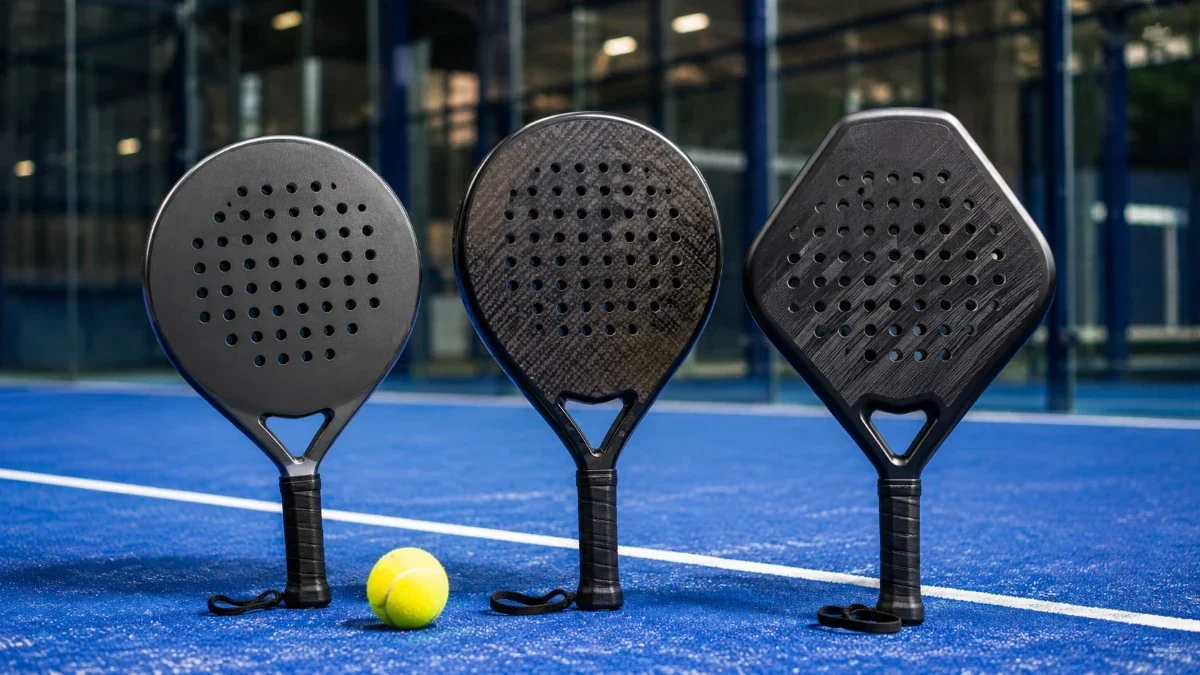
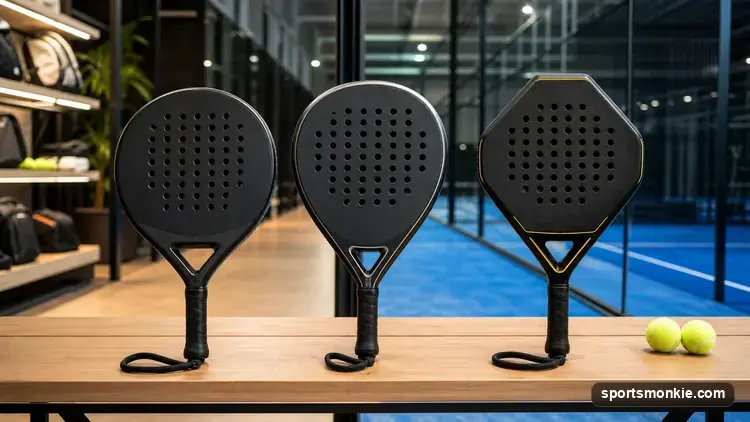
- Round puts the sweet spot dead center over a wide area. It is the most forgiving and the most controllable, which is why it is the default beginner and control-player shape.
- Teardrop shifts the sweet spot slightly higher and blends control with power. It is the true all-rounder and the shape most improving players should own.
- Diamond loads the sweet spot near the tip for maximum power, but shrinks it and makes off-center hits feel dead. It suits aggressive players who reliably strike the ball clean.
If you are unsure, buy the rounder shape. You lose a little top-end power and gain consistency, and consistency is what wins padel points at every level below the pro tour.
EVA or FOAM core: what is inside the racket
The core is the layer under the face, and it controls comfort and rebound more than any logo does. Two families dominate: firmer EVA rubber and softer polyethylene FOAM.
Soft cores (soft EVA or FOAM) flex on contact, cushion vibration, and hand back the ball with less effort, which forgives the shorter, slower swings of newer players. Hard EVA cores need a fast swing to compress and activate; in return they give more power and precision, but they transmit more shock into the elbow. If you play often and feel your arm after sessions, a softer core is the single most protective change you can make.
Carbon or fibreglass face: is carbon worth it?
The face is the outer surface that touches the ball. Fibreglass is softer and flexes, so it is forgiving and comfortable but a touch muted on power. Carbon is stiffer and grades by “K” count, where higher numbers like 12K or 18K mean more rigidity, more power, and more feedback straight into your hand.
Here is the honest trade-off most shops skip: carbon’s stiffness also sends more vibration to the arm, especially on mishits. Plenty of intermediate and even advanced players stay on fibreglass or hybrid faces because the comfort and touch are worth more to them than raw power. Carbon earns its price only when your contact point is predictable enough to use the precision it offers.
Weight and balance: how heavy should it feel?
Most padel rackets weigh 350 to 375 grams, and Babolat and other makers publish the exact figure on every model. But weight alone does not tell you how a racket feels. Balance does.
A low-balanced (handle-heavy) racket feels lighter and more maneuverable and is easier on the arm. A high-balanced (head-heavy) racket concentrates mass toward the tip and hits harder but feels heavier and taxes the elbow. Round rackets tend to sit low-balanced, diamonds high-balanced, teardrops in between, which is another reason shape and the rest of the spec sheet move together. Beginners want light and low; power players accept heavy and high.
Fix the racket to the symptom: a quick rule of thumb
Most rackets that feel wrong are wrong in one specific way. Use the symptom to find the spec to change on your next buy:
- Sore or aching elbow → go softer core, fibreglass face, lighter weight, lower balance.
- Not enough power → move round to teardrop, or teardrop to diamond, before you blame your arm.
- Too many mishits → go rounder and lower-balanced for a bigger, more central sweet spot.
- Racket feels dead and jarring → your carbon face is too stiff for your swing; drop to hybrid or fibreglass.
That single mapping beats most “top 10 rackets” lists, because the right racket is the one that fixes your problem, not the one a pro endorses.
Ready to build out your kit? Explore our full racket sports hub for gear guides across padel, tennis, and pickleball, and if you are buying your very first frame, start with our dedicated guide to padel rackets for beginners.
Padel racket vs pickleball paddle vs tennis racket
These three get lumped together and are not remotely interchangeable. A padel racket is solid, stringless, perforated with holes, and capped by FIP rules at a maximum 45.5cm length, 26cm width, and 38mm thickness. A pickleball paddle is a flat, rectangular, shorter surface for a plastic ball on a small open court. A tennis racket is strung with a long open frame for a much larger court.
The confusion is understandable given how fast all three are growing. Pickleball leads the United States with roughly 24.3 million players as of 2025, while USA Padel tracks padel’s own surge from roughly 160 association members in 2020 to nearly 2,000 by 2024, alongside hundreds of new courts. If padel courts are opening near you, buy a padel racket, not a crossover from another sport. For the court itself, see our breakdown of official padel court size and dimensions.
The bottom line on buying a padel racket
Buy for your level, not your ambition. A round fibreglass racket with a soft core in the $80 to $130 range will help a beginner improve faster than a $300 diamond carbon frame ever could, and you can upgrade to a teardrop once your swing settles. Read the shape, core, face, and weight, ignore the paint job, and let the symptom-to-spec rule guide your next purchase. That gets the right racket in your hand for the least money.
Frequently asked questions
What shape padel racket should I buy?+
Match the shape to your level. Round rackets have a large central sweet spot and suit beginners and control players. Teardrop is the all-round middle ground for improving intermediates. Diamond loads the sweet spot near the tip for maximum power and is only worth it once your contact point is consistent.
Is a round or diamond padel racket better for beginners?+
Round is clearly better for beginners. Its sweet spot sits in the center of the face and covers a wide area, so mishits still clear the net. Diamond rackets push the sweet spot toward the tip and punish off-center contact, which is exactly the inconsistency new players are still ironing out.
What is the difference between carbon and fibreglass padel rackets?+
Fibreglass faces flex on contact, feel softer, and forgive imperfect timing, which suits beginners and comfort-focused players. Carbon faces are stiffer, return more power and precision, but transmit more vibration to the arm and demand a repeatable swing. Many intermediates stay on fibreglass or hybrid faces for the extra comfort.
How much should I spend on a padel racket?+
Beginners get real quality at $80 to $130 as of 2026, and there is no need to exceed $180 while learning. Intermediate players upgrading for power or control usually land between $170 and $280. Tour-level frames above $300 are demanding and rarely worth it below a competitive standard.
What weight should a padel racket be?+
Most padel rackets weigh 350 to 375 grams. Lighter frames near 350g are easier to swing, kinder to the elbow, and better for beginners and many women. Heavier, tip-balanced frames add power but strain the arm. Weight and balance together decide how heavy a racket actually feels in play.
Can you use a padel racket for pickleball or tennis?+
No. A padel racket is solid, stringless, perforated with holes, and capped by FIP rules at 45.5cm long. Pickleball paddles are flat, rectangular, and shorter, while tennis rackets are strung with an open frame. Each sport's gear is built for a different ball and court, and they are not interchangeable.
Sources
Play & tools
Free browser games and tools — no account, no download.
- Play today's Sports Connections — Today's Sports Connections — daily hints, answers, and play the grid.
- Play Guess the NFL Player — A new mystery NFL player every day. Eight guesses, with a clue on each — plus free unlimited mode.
- Explore all our games →
Related racket sports guides
View all →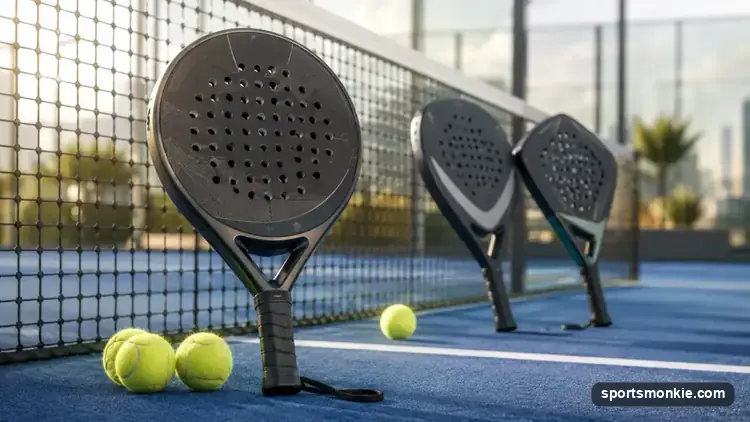
Padel Rackets for Beginners: What to Buy and Avoid
Padel rackets for beginners: buy a round, soft-core racket near 350-365g. What to look for, budget picks with USD and GBP prices, and what to avoid.
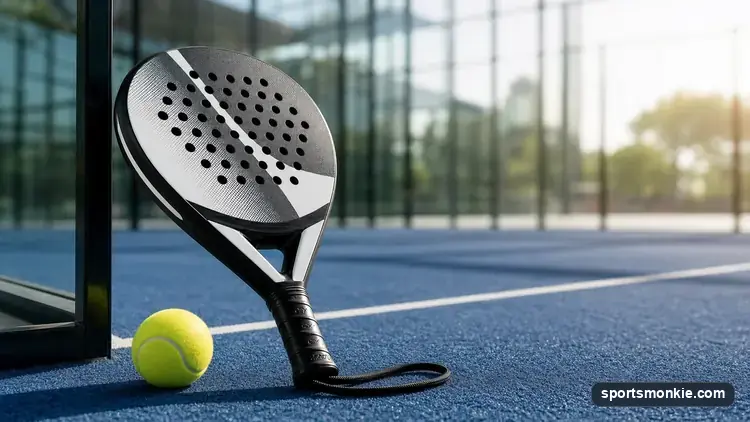
Adidas Padel Rackets: Which Model Should You Buy in 2026
Which Adidas padel racket to buy in 2026: Match for beginners, Cross It or Arrow Hit for control, Metalbone for power. Real prices and a clear pick.
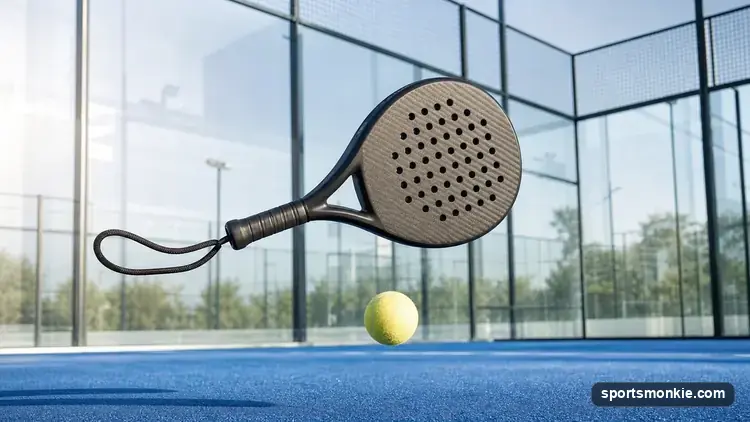
Best Lightweight Padel Rackets: Who Needs One and Why
A lightweight padel racket is under 355g, not FIP-mandated. Who actually benefits, 6 current models with real weights and prices, and the power you give up.
Where to Buy a Padel Racket: Best Places by Country (2026)
Where to buy a padel racket for sale in the US, UK, Australia, and Canada in 2026: named retailers, real price ranges, and how to avoid a counterfeit.
What Is a Smash in Badminton? Power, Angle, and Defense
A badminton smash is a fast attacking shot hit steeply downward to pressure the opponent and create a weak reply.
Padel vs Tennis: Court, Rules and Equipment Differences
Padel and tennis share a racket-sport foundation but differ in court size, walls, scoring context, equipment and usual doubles play.