
Tennis Court Dimensions and Space Needed
On this page13
- 01Tennis court dimensions at a glance
- 02Tennis court fit calculator
- 03Official tennis court size
- 04How much total space does a tennis court need?
- 05Singles vs doubles tennis court dimensions
- 06Service boxes, baseline and no-man’s land
- 07Net, posts, lines and singles sticks
- 08Junior tennis court sizes
- 09Can you build a smaller backyard tennis court?
- 10Tennis vs pickleball, padel and badminton size
- 11What most dimension charts miss
- 12Quick marking checklist
- 13Bottom line
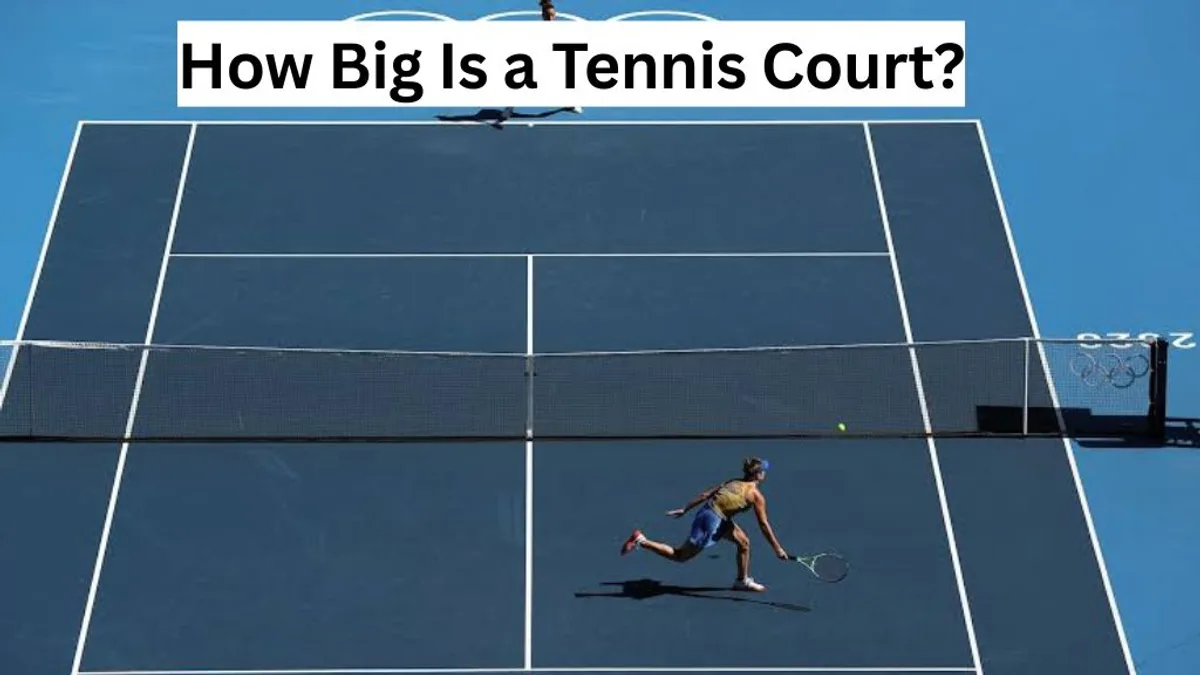
A regulation tennis court is 78 feet long and 36 feet wide for doubles. Singles uses the same 78-foot length but narrows the playable width to 27 feet. The extra 4 feet 6 inches on each side is the doubles alley.
That is only the line area. If you are building, fencing or relining a court, the more useful number is the full footprint with run-off: 56 by 114 feet for recreational and club play, or 60 by 120 feet for the larger international-competition guide. Use the calculator below before you assume a backyard, school pad or old multi-sport slab has enough room.
Tennis court dimensions at a glance
| Measurement | Feet / inches | Metres | What it means |
|---|---|---|---|
| Court length | 78 ft | 23.77 m | Baseline to baseline |
| Doubles width | 36 ft | 10.97 m | Outside doubles sideline to outside doubles sideline |
| Singles width | 27 ft | 8.23 m | Inner sideline to inner sideline |
| Doubles alley, each side | 4 ft 6 in | 1.37 m | Live in doubles rallies, out in singles |
| Net to baseline | 39 ft | 11.89 m | Half of the full court length |
| Net to service line | 21 ft | 6.40 m | Depth of each service box |
| Service line to baseline | 18 ft | 5.49 m | The middle recovery zone behind the service line |
| Service box | 21 ft x 13 ft 6 in | 6.40 m x 4.11 m | One of the four serve targets |
| Net height at centre | 3 ft | 0.914 m | Held down by the centre strap |
| Net height at posts | 3 ft 6 in | 1.07 m | Measured where the net meets the posts or singles sticks |
| Recreational or club footprint | 56 ft x 114 ft | 17.07 m x 34.73 m | ITF suggested minimum clearances for club play |
| International-style footprint | 60 ft x 120 ft | 18.29 m x 36.57 m | Larger ITF suggested clearances |
The International Tennis Federation measures the court to the outside edge of the lines. That means line width is included in the court, and a ball touching the correct line is in.
Tennis court fit calculator
Enter the hard, level area you can dedicate to tennis. This checks the total playing surface, not just the painted 36-by-78-foot doubles rectangle.
If the result only fits the painted lines, it is a marking area, not a comfortable court. Players still need room to serve, recover after a wide ball, chase lobs and stop before the fence.
Official tennis court size
Rule 1 of the 2026 ITF Rules of Tennis fixes the adult court as a 78-foot rectangle. Singles is 27 feet wide. Doubles is 36 feet wide. Those measurements do not change for men, women, juniors playing green or yellow-ball tennis, or any Grand Slam surface.
Two details matter when you mark a court:
- Measurements are taken to the outside edge of the line, not the middle of the paint.
- The lines count as part of the court. If a ball touches the correct boundary line, it is in.
For a line-by-line explanation, use the separate tennis court lines guide. If your main question is the net, the tennis net height guide covers posts, singles sticks, straps and quick measuring checks.
How much total space does a tennis court need?
The 36-by-78-foot doubles court is the legal playing rectangle. The run-off space around it is what turns that rectangle into a usable court.
| Layout | Total footprint | Area | Baseline run-off, each end | Side run-off, each side |
|---|---|---|---|---|
| Singles lines only | 27 x 78 ft | 2,106 sq ft | 0 ft | 0 ft |
| Doubles lines only | 36 x 78 ft | 2,808 sq ft | 0 ft | 0 ft |
| Recreational / club guide | 56 x 114 ft | 6,384 sq ft | 18 ft | 10 ft beyond doubles sideline |
| International guide | 60 x 120 ft | 7,200 sq ft | 21 ft | 12 ft beyond doubles sideline |
For most permanent backyard courts, 60 by 120 feet is the cleaner planning number because contractors, fencing layouts and multi-sport conversions often expect that footprint. The smaller 56-by-114-foot layout can work for club or recreational play, but it leaves less recovery room. If the fence sits close to that smaller pad, the court can feel tight even when the dimensions are technically usable.
Builders may also ask for extra clearance outside the court fence. That space is not part of the ITF playing footprint. It is for grading, drainage, equipment access, landscaping, setbacks and maintenance. If you are budgeting a private build, pair this page with our tennis court cost guide before you price the slab or surface.
Singles vs doubles tennis court dimensions
Singles and doubles share the same baseline and service boxes. The only playable line that changes is the sideline.
| Format | Length | Width | Area |
|---|---|---|---|
| Singles | 78 ft | 27 ft | 2,106 sq ft |
| Doubles | 78 ft | 36 ft | 2,808 sq ft |
The doubles alley is 4 feet 6 inches wide on each side. In singles, a ball landing in that alley is out unless it lands there after crossing the net outside the rally rules in a very specific permanent-fixture situation. In normal play, treat the inner sideline as the singles boundary and the outer sideline as the doubles boundary.
Serves are narrower in both formats. They must land in the diagonal service box between the singles sidelines. The doubles alley does not make the service box wider.
Service boxes, baseline and no-man’s land
Each side of the net has two service boxes. The service line sits 21 feet from the net, and the centre service line splits the 27-foot singles-width area into two equal boxes.
| Zone | Size |
|---|---|
| One service box | 21 ft x 13 ft 6 in |
| Both service boxes on one side | 21 ft x 27 ft |
| Net to baseline | 39 ft |
| Service line to baseline | 18 ft |
The 18-foot strip between the service line and baseline is often called no-man’s land. Coaches warn players not to stand there for long because it is too far back for easy volleys and too far forward for comfortable baseline defense.
Net, posts, lines and singles sticks
A doubles net runs between posts whose centres are 3 feet outside the doubles sidelines. The net is 3 feet 6 inches high at the posts and 3 feet high at the centre.
| Net or marking spec | Official size |
|---|---|
| Doubles net length between post centres | 42 ft |
| Singles net length between post centres | 33 ft |
| Net height at posts or singles sticks | 3 ft 6 in |
| Net height at centre | 3 ft |
| Centre service line width | 2 in |
| Centre mark length | 4 in |
| Most line widths | 1 to 2 in |
| Baseline width | Up to 4 in |
Most public courts are marked for both singles and doubles and use a doubles net. For a singles match on that setup, two singles sticks raise the net to 3 feet 6 inches at points 3 feet outside each singles sideline. That is why official singles play can use a doubles net without moving the permanent net posts.
Junior tennis court sizes
Junior tennis uses smaller courts before players move to the full-size 78-foot court. USTA’s beginner pathway and the ITF rules both recognize smaller Red and Orange stages.
| Stage | Typical court size | Net height | Usual player stage |
|---|---|---|---|
| Red | 36 to 42 ft long, 14 to 20 ft wide | 31.5 to 33 in at centre | Young beginners |
| Orange | 58 to 60 ft long, 20 to 27 ft wide | 31.5 to 36 in at centre | Developing juniors |
| Green / Yellow | 78 ft long, 27 ft singles or 36 ft doubles | 3 ft centre, 3 ft 6 in posts | Advanced juniors and adults |
This is why you may see lighter blended lines on school, park or club courts. They let younger players use court sizes that match their movement and ball speed without changing the full adult lines.
Can you build a smaller backyard tennis court?
You can paint a smaller casual court if everyone understands it is not regulation tennis. That can be useful for children, wall drills, short-court games or a tight family practice space. It should not be sold or described as a regulation full-size court.
For adult play, the first compromise should usually be amenities, not the run-off. A court with no recovery space behind the baseline gets frustrating fast. A court with a fence too close to the sideline can also become unsafe during wide balls and doubles play.
If your available space cannot reach 56 by 114 feet, consider a pickleball court, padel build or multi-use sport court instead of squeezing a full tennis court into a bad footprint. A dedicated pickleball court needs far less room, while padel court size is constrained by walls and a different rule set.
Tennis vs pickleball, padel and badminton size
Tennis is much larger than the racket-sport courts people often compare it with.
| Court | Playing lines | Common total footprint |
|---|---|---|
| Tennis doubles | 36 x 78 ft | 56 x 114 ft or 60 x 120 ft |
| Pickleball | 20 x 44 ft | 30 x 60 ft minimum, 34 x 64 ft preferred |
| Padel | 10 x 20 m | Walls are part of the court system |
| Badminton doubles | 20 x 44 ft | Indoor hall clearance varies |
That size difference explains why clubs can convert one tennis enclosure into several smaller racket-sport courts. The hard part is not drawing rectangles. It is preserving safe run-off, clear sightlines and readable line colors. Squash is even more compact and wall-defined, which is why its court dimensions are better compared by playable volume than by painted floor area alone.
What most dimension charts miss
Most tennis court guides answer the easiest question first and stop there: 78 by 36 feet. That is correct, but it is not enough for someone marking a school surface or deciding whether a backyard build makes sense.
The missing pieces are usually practical:
- Whether the number refers to painted lines or the full fenced area.
- How much run-off sits behind the baseline and outside the doubles sideline.
- Whether a “USTA spec” contractor quote means regulation lines, a 60-by-120-foot enclosure or a larger work area.
- How junior blended lines fit without replacing the full-size adult court.
- Why a court that barely fits the tape measure can still feel cramped once fencing, drainage, seating and lighting are added.
Use the ITF line dimensions for rules questions. Use the full footprint for build planning. Use contractor drawings, permits and local site advice before any permanent surface work begins.
Quick marking checklist
For a combined singles and doubles court, the ITF marking method starts from the net line and checks the corners by diagonal measurement.
- Mark a straight 42-foot doubles net line.
- From the centre, mark the singles sideline crossings at 13 feet 6 inches each way.
- Mark the doubles sideline crossings at 18 feet each way.
- Mark net post centres 21 feet each way from the net-line centre.
- Use 39 feet down the sideline and 53 feet 1 inch on the half-court diagonal to locate each doubles baseline corner.
- Confirm the baseline measures 36 feet and mark the singles sideline points 4 feet 6 inches inside each doubles corner.
- Mark service lines 21 feet from the net and split them with the centre service line.
- Add the 4-inch centre mark inside each baseline.
If you are painting permanent lines, do the diagonal checks before you open the paint. A small error at the first corner will show up across the entire court.
Bottom line
The official adult tennis court is 78 feet long. Doubles is 36 feet wide, and singles is 27 feet wide. For a real playing surface, treat 56 by 114 feet as the compact recreational footprint and 60 by 120 feet as the full, comfortable target. Anything smaller can still be fun for casual play, but it should be labelled as modified tennis, not a regulation court.
All measurements above were checked against the ITF 2026 Rules of Tennis on September 5, 2026. Recheck the current ITF rulebook before construction, resurfacing, court conversion or sanctioned competition work.
Frequently asked questions
What are the official tennis court dimensions?+
A regulation tennis court is 78 feet long. It is 36 feet wide for doubles and 27 feet wide for singles. Those measurements come from Rule 1 of the 2026 ITF Rules of Tennis and are taken to the outside edge of the lines.
How much total space do you need for a tennis court?+
The marked doubles court is 36 by 78 feet, but a useful full court needs run-off around it. ITF guidance lists 56 by 114 feet for recreational and club play, and 60 by 120 feet for international competition. Many builders also want extra working room outside the fence for drainage, access and landscaping.
Is 60 by 120 feet the court size or the whole fenced area?+
It is the common full tennis enclosure with run-off, not the painted playing rectangle. The legal doubles lines are 36 by 78 feet. The extra space gives 21 feet behind each baseline and 12 feet outside each sideline, matching the ITF international-competition guidance.
How wide is a singles tennis court?+
A singles tennis court is 27 feet wide and 78 feet long. On a combined court, singles uses the inner sidelines and ignores the 4-foot-6-inch doubles alley on each side.
How big is one tennis service box?+
Each service box is 21 feet deep and 13 feet 6 inches wide. The service line is 21 feet from the net, and the centre service line splits the singles-width service area into two equal boxes.
How high is a tennis net?+
A tennis net is 3 feet high at the centre and 3 feet 6 inches high at the posts. Doubles net posts sit 3 feet outside the doubles sidelines. Singles sticks are used when a singles match is played with a doubles net.
Are junior tennis courts different sizes?+
Yes. The ITF permits Red courts between 36 and 42 feet long and 14 to 20 feet wide for younger players. Orange courts are 58 to 60 feet long and 20 to 27 feet wide. Green and yellow-ball play use the full-size 78-foot court.
What is the minimum ceiling height for an indoor tennis court?+
The ITF gives 29.6 feet, or 9.0 metres, as the recommended minimum height at the net. That is guidance, but lower roofs can interfere with lobs and high defensive shots.
Sources
Play & tools
Free browser games and tools — no account, no download.
- Play today's Sports Connections — Today's Sports Connections — daily hints, answers, and play the grid.
- Play Guess the NFL Player — A new mystery NFL player every day. Eight guesses, with a clue on each — plus free unlimited mode.
- Explore all our games →
Related tennis guides
View all →
Why Do Tennis Balls Have Fuzz? The Real Aerodynamic Reason
Why do tennis balls have fuzz? The wool-nylon nap doubles aerodynamic drag, slows the ball, grips spin, and meets ITF's 56.0-59.4g spec.
How Much Do Tennis Courts Cost to Build? (2023 Guide)
Building a private tennis court typically costs $25,000 to $100,000+ depending on surface, site prep, fencing, and lighting. Hard courts are the cheapest.
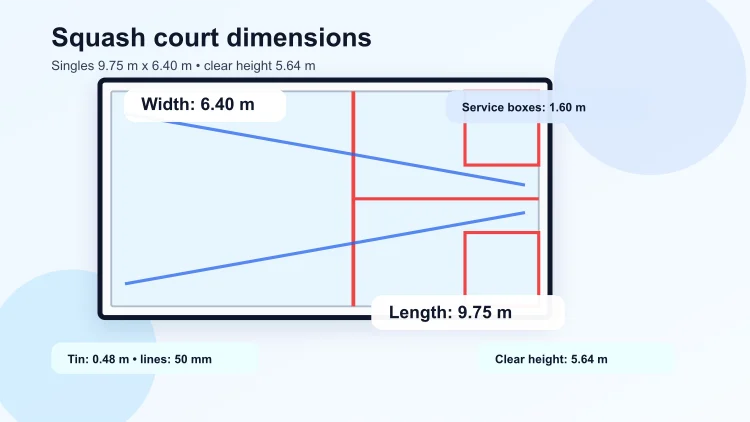
Squash Court Dimensions and Space Needed
Official squash court dimensions: 9.75m x 6.40m singles court, line heights, tin height, service boxes, clear height and build space.
Volleyball Court Dimensions and Space Needed
Official volleyball court dimensions: indoor court size, beach court size, attack line, service zone, free zone, net height and backyard setup.
Clay Court Tennis: Surface, Rules, and Why It Plays So Slow
Clay court tennis is the slowest surface with the highest bounce. See red vs. green clay, sliding, ball marks, upkeep, and why Nadal owns it.
Grass Court Tennis: Why the Fastest Surface Plays So Different
Grass court tennis is the fastest, lowest-bouncing surface in the sport, per ITF's own pace rating. How Wimbledon's ryegrass shapes serve-and-volley play.