
Fastest F1 Cars Ever: The Machines That Redefined Speed
On this page6
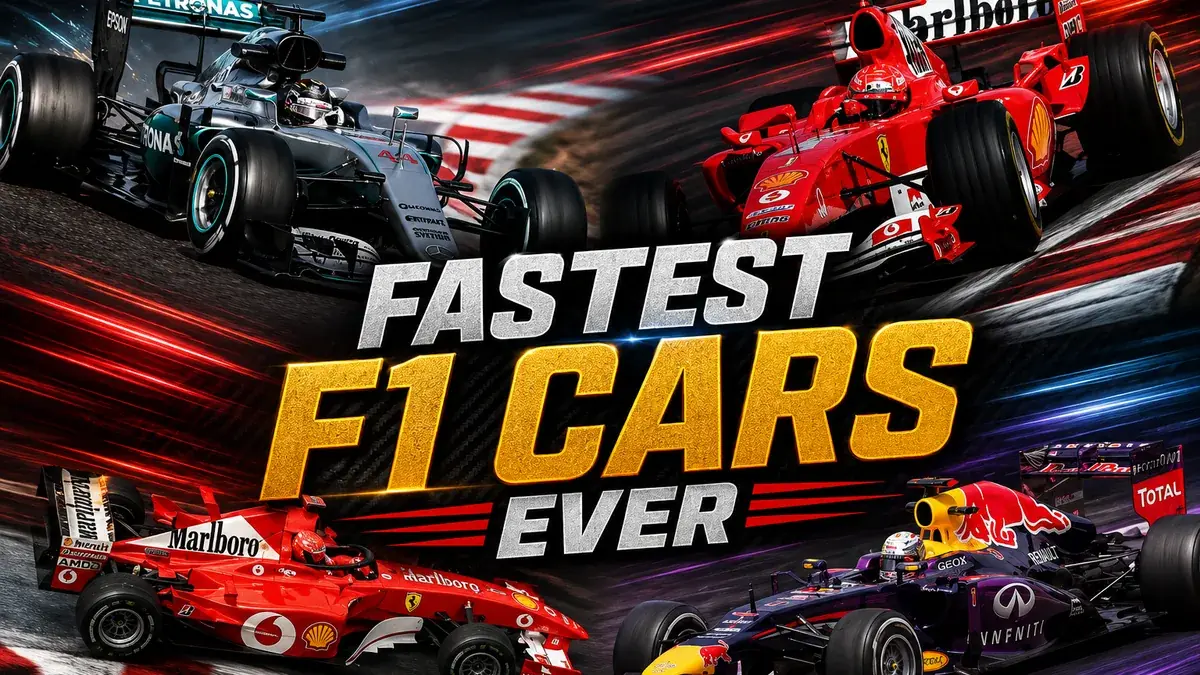
Ask which F1 car was the fastest ever and the honest answer depends on what you measure. By outright dominance it is the Red Bull RB19, which won 21 of 22 races in 2023 — the highest win rate in F1 history. By speed-trap numbers it is the 1980s turbo qualifiers and the Williams that Valtteri Bottas took to a claimed 378 km/h at Baku in 2016. By lap time, today’s ground-effect cars are quickest.
How “fastest” is measured in Formula 1
Speed in F1 is not one number. Defining the fastest car means choosing a metric, and no single machine tops all of them:
- Outright top speed. The highest speed recorded through a speed trap, usually in a slipstream at a low-downforce circuit.
- Qualifying lap time. Raw single-lap pace over one flying lap with minimum fuel.
- Race lap records. The fastest laps set under race conditions, which is the honest average-speed benchmark.
- Season dominance. How far the car pulled ahead of its entire field over a year, measured by win rate.
What follows are the machines that come up most often when the question is asked seriously. For a season-by-season comparison using win rate rather than speed, see the full ranking of the most dominant F1 seasons.
The dominance leaders — the fastest by win rate
Red Bull RB19 (2023)
Adrian Newey’s masterpiece is the most statistically dominant car the sport has produced. Driven by Max Verstappen and Sergio Pérez, the RB19 won 21 of 22 races — a 95.45% win rate that broke the McLaren MP4/4’s 15-of-16 record (93.8%) standing since 1988. Verstappen personally took 19 wins and 21 podiums, both single-season records. Only Ferrari’s Carlos Sainz Jr. denied the clean sweep, winning Singapore.
Ferrari F2004 (2004)
Michael Schumacher’s championship-winning Ferrari delivered one of the most lopsided seasons ever. Schumacher won 13 of 18 races, and the car took 15 wins in total across both drivers, with 12 pole positions. Its blend of aerodynamic refinement and near-total reliability makes it a perennial candidate for the greatest race car ever built.
Mercedes W11 (2020)
The most dominant machine of the hybrid era. Lewis Hamilton and Valtteri Bottas won 13 of 17 races (a 76.5% win rate), with 15 poles and 12 front-row lockouts. Its Dual Axis Steering (DAS) system — a driver-adjustable front toe — showed how far Mercedes was willing to push the regulations before it was banned.
The 1980s turbo qualifiers
In qualifying trim, mid-1980s turbo engines from BMW, Honda, and Renault were run at extreme boost for a single lap, reputedly producing well over 1,000 horsepower. Cars like the Brabham BT52, Ferrari 126C, and Williams FW11 set qualifying times that stood as circuit references for years. Race-day reliability at that boost was minimal, so the raw pace never carried over.
Williams FW14B (1992)
Nigel Mansell won the title with a then-record win tally in the FW14B, which combined active suspension, traction control, and anti-lock brakes into a package a generation ahead of its rivals. The championship was effectively settled by midseason.
Fastest F1 cars leaderboard
| Rank (by win rate) | Car | Season | Win rate |
|---|---|---|---|
| 1 | Red Bull RB19 | 2023 | 21/22 (95.5%) |
| 2 | McLaren MP4/4 | 1988 | 15/16 (93.8%) |
| 3 | Ferrari F2004 | 2004 | 15/18 (83.3%) |
| 4 | Mercedes W11 | 2020 | 13/17 (76.5%) |
| 5 | Williams FW14B | 1992 | 10/16 (62.5%) |
Win rate is the fairest single measure of “fastest against the field of its day,” though raw-speed records (below) tell a different story.
The raw-speed records
Outright top speed is a separate contest from lap dominance. The highest speed ever seen in an official F1 session was Valtteri Bottas’s roughly 378 km/h (234.9 mph) in 2016 Azerbaijan qualifying, achieved with a large tow down Baku’s long straight. The fastest speed set in a Grand Prix itself belongs to Juan Pablo Montoya, at 372.6 km/h (231.5 mph) during the 2005 Italian Grand Prix at Monza. Modern cars are built to trade some straight-line speed for cornering pace, so these trap figures do not translate into lap-record dominance.
Why absolute top speed is misleading
Modern F1 cars run drag-reduction systems and are engineered to optimise cornering over straight-line pace. A 1980s turbo could out-drag a current car down a long straight, but it would lose far more time through a technical section. Lap time, not top speed, is the honest measure — which is why Max Verstappen’s 2025 Monza lap of 1:18.792, the fastest average-speed race lap in F1 history, matters more than any speed-trap number.
The live chase (as of 2026)
The RB19’s 95.45% win-rate record is the mark every future car is measured against, and it may stand for a long time — modern grids are closer than the field the RB19 crushed. That parity has already reshaped the order: as of the 2025 season, Lando Norris won his first Drivers’ Championship, ending Verstappen’s four-year run, while McLaren claimed a second straight Constructors’ title. Whether any single car of the current ground-effect era can approach the RB19’s dominance before the next regulation reset remains the open question.
Want more on the theme? Read What Is a Chicane in F1? Corners That Slow Cars next.
Frequently asked questions
What is the fastest F1 car ever built?+
There is no single answer, because different eras were fastest by different measures. By outright dominance the Red Bull RB19 (2023) won 21 of 22 races, the highest win rate in F1 history. By straight-line speed the mid-1980s turbo qualifiers and Williams's claimed 378 km/h for Valtteri Bottas at Baku in 2016 are the reference points. By lap time around most modern circuits, today's ground-effect cars are quickest of all.
What is the top speed of an F1 car?+
Modern F1 cars typically reach 340 to 360 km/h (210 to 225 mph) on the fastest circuits and go higher at low-downforce tracks like Monza and Baku. Guinness World Records recognises 372.6 km/h (231.5 mph) by Juan Pablo Montoya at the 2005 Italian Grand Prix as the fastest outright speed in a Grand Prix. Williams separately claimed roughly 378 km/h for Bottas at Baku in 2016, a figure the FIA never ratified.
Why were 1980s F1 cars so fast?+
In qualifying trim, 1980s turbocharged engines from BMW, Honda, and Renault were reputed to produce well over 1,000 horsepower for a single flying lap. Teams ran boost levels that could destroy an engine within a handful of laps, which is why the figures were never independently measured on a race weekend and never carried over to Sunday.
Which F1 car had the most dominant single season?+
The Red Bull RB19 in 2023, which won 21 of 22 races (95.45%), edging the McLaren MP4/4's 15-of-16 record (93.8%) from 1988. The Ferrari F2004 and Mercedes W11 rank close behind, with Michael Schumacher taking 13 wins in 2004 and the W11 winning 13 of 17 races in 2020.
Are today's F1 cars the fastest ever?+
By lap time, yes. The quickest lap ever recorded in Formula 1 by average speed is Max Verstappen's 1:18.792 pole lap at Monza in 2025, an average of 264.682 km/h. It is worth being precise: that was a qualifying lap, not a race lap. The fastest lap of the race itself that weekend was Lando Norris's 1:20.901.
What makes an F1 car fast?+
Speed comes from the balance of engine power, aerodynamic downforce, weight, tyres, and mechanical grip. Downforce lets the car carry huge speed through corners, which matters more to lap time than straight-line top speed on most circuits. That is why a car can be slower on the straight yet far quicker over a full lap.
Has an F1 car ever gone faster than 378 km/h?+
Yes, but not in competition. Honda ran a modified RA106 on the Bonneville Salt Flats in 2006 and recorded 397.36 km/h (246.9 mph). The car had an unrestricted engine and a stability fin instead of a normal rear wing, so the run is a land-speed exercise rather than a Formula 1 record and is not comparable to a race-weekend speed trap.
Who won the most recent F1 championships?+
Lando Norris won the 2025 Drivers' Championship by two points from Max Verstappen, ending Verstappen's four-year reign, while McLaren took the Constructors' title for a second year running — its first back-to-back constructors' double since 1991. That closed out the Red Bull era the RB19 defined in 2023.
Sources
Play & tools
Free browser games and tools — no account, no download.
- Play 24-0 — Draft an F1 chassis and two drivers, then chase a perfect 24-0 — win every race on the 24-round calendar.
- Explore all our games →
Related motorsport guides
View all →
Greatest Formula 1 Drivers of All Time, Ranked
The greatest Formula 1 drivers ever, ranked — Hamilton, Schumacher, Senna, Fangio, Verstappen and more, judged on peak, teammates and era-adjusted results.
Verstappen and Hamilton Say F1 Should Not Run Sprints Where Cars Cannot Pass
Singapore sprint winner Max Verstappen and runner-up Lewis Hamilton say street tracks where passing is near impossible are the wrong place for sprint races.
FIA Admits Human Error Gave Some Cars Extra Power in Singapore Sprint Qualifying
The FIA says a Race Control human error switched Overtake Mode on for 27 seconds in Singapore SQ1, giving some cars extra power, and Sainz wants to know why.
FIA to Investigate Software Glitch That Stopped F1 Cars on the Formation Lap in Malaysia
The FIA promised a full review after a software bug cut power to F1 cars on a wet formation lap at Sepang, forcing Hamilton to stop and restart his car.
F1 Ground Effect Explained: The Floor That Sucks Cars Down
F1 ground effect uses the car's floor to create downforce, sucking it to the track. It returned in 2022 via venturi tunnels, and brought porpoising too.
Fastest F1 Pit Stop Ever: The Full Leaderboard (1.80s Record)
McLaren's 1.80-second stop for Lando Norris at the 2023 Qatar GP is the fastest F1 pit stop ever, ratified by Guinness. See the full top-9 leaderboard.