
Lacrosse Field Dimensions: Men's, Women's, Youth and Box
On this page12
- 01Lacrosse field dimensions at a glance
- 02Lacrosse field fit calculator
- 03Men’s lacrosse field dimensions
- 04Women’s lacrosse field dimensions
- 05Lacrosse field vs football field
- 06Bigger: soccer or lacrosse?
- 07Youth lacrosse field dimensions
- 08Sixes lacrosse field dimensions
- 09Box lacrosse field size
- 10How to line a lacrosse field without losing your mind
- 11What most lacrosse field guides miss
- 12Bottom line
A full men’s lacrosse field is 110 yards long by 60 yards wide. The two goal lines are 80 yards apart, which leaves 15 yards behind each goal. That behind-the-goal space is live in lacrosse, and it changes how the attack works.
Women’s, youth, Sixes and box lacrosse use different layouts. The useful answer is not one number. It is the right number for the version you are actually lining, coaching or watching.
Lacrosse field dimensions at a glance
| Format | Field length | Field width | Goal spacing | Goal / crease |
|---|---|---|---|---|
| Men’s field lacrosse | 110 yd | 60 yd | 80 yd | 6 ft x 6 ft goal, 9 ft crease radius |
| Boys’ existing-field allowance | 110 yd | 53 1/3 to 60 yd | 80 yd | 6 ft x 6 ft goal, 9 ft crease radius |
| U.S. women’s field lacrosse | 110 to 140 yd | 60 to 70 yd | 90 to 100 yd | 6 ft x 6 ft goal, 8.5 ft goal-circle radius |
| U.S. women’s optimal new field | 120 yd | 65 yd | 100 yd | 10 yd behind each goal line |
| World Lacrosse women’s events | 100 m | 50 to 60 m | See event rules | 3 m goal circle radius |
| World Lacrosse Sixes | 70 m | 36 m | Smaller Sixes layout | 6v6 Olympic-style format |
| Box lacrosse | Rink floor | Rink floor | Rink-dependent | Smaller box goal, boarded play |
For most U.S. readers, the quick memory hook is simple: men’s field is 110 by 60 yards, women’s field is often planned around 120 by 65 yards, Sixes is much smaller at 70 by 36 metres, and box lacrosse belongs in a rink.
Lacrosse field fit calculator
Enter your available flat space in yards. This checks the field rectangle only. You still need safe run-off, spectator setbacks, benches, table space and your governing body’s current diagram before marking a competition field.
If your field fits only by using football sidelines, confirm the competition rule before you paint. Casual practice can tolerate cones and modified widths. A sanctioned game needs the current rulebook, correct markings and agreement from the responsible authority.
Men’s lacrosse field dimensions
USA Lacrosse’s 2026 men’s field diagram and men’s lining guide use the standard 110-by-60-yard rectangle.
| Men’s field measurement | Size | Why it matters |
|---|---|---|
| Total length | 110 yd | End line to end line |
| Total width | 60 yd | Sideline to sideline |
| Goal spacing | 80 yd | Goal line to goal line |
| Behind each goal | 15 yd | Live space for play at X and feeds |
| Goal opening | 6 ft x 6 ft | Same field goal size used across major field formats |
| Goal crease | 9 ft radius | Protected goalie area |
| Restraining line | 20 yd from each goal line in USA Lacrosse lining guide | Creates attack and defensive areas |
| Center line | Halfway across field | Faceoff and offside reference |
| Goal line width | 2 in | Goal plane between the posts |
| Center line width | 4 in | Must be clear through logos or other markings |
| Other line widths | 2 to 4 in | Keep the selected width consistent |
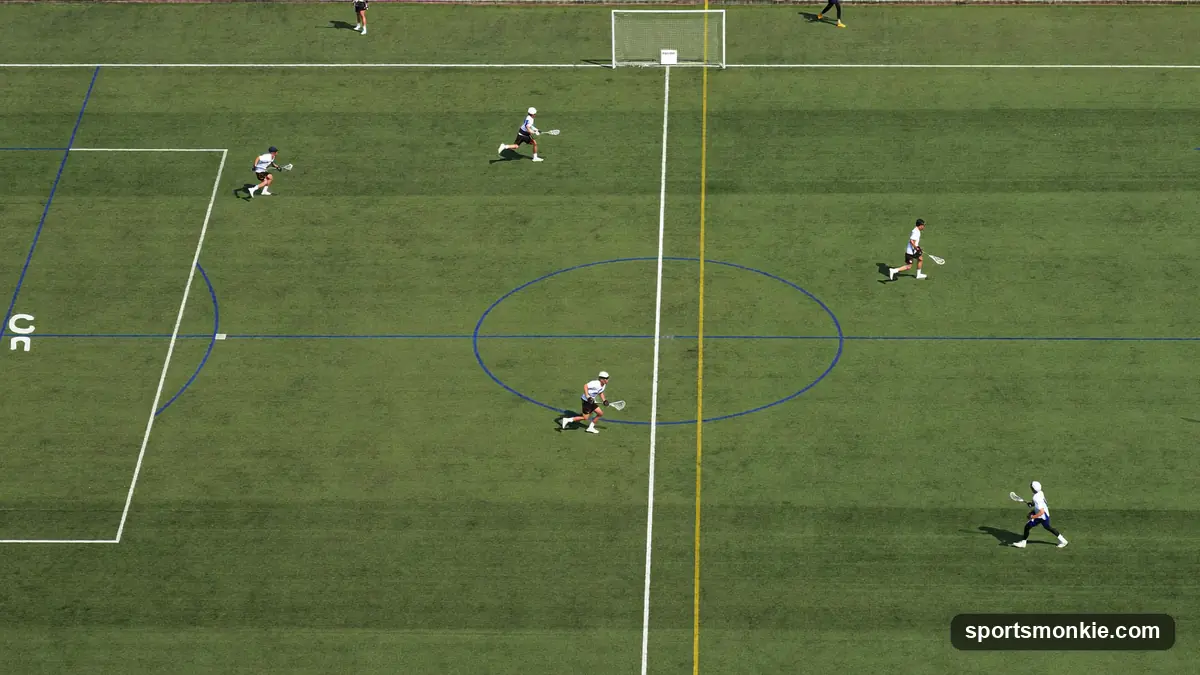
The 15 yards behind the goal are easy to miss if you come from soccer or football. Lacrosse attackers use that area as “X,” the space directly behind the cage. A pass from X can turn a defense around in a second, which is why the goal is not pushed back to the end line.
For the net itself, use the separate lacrosse goal size guide. The short version is that field goals are 6 by 6 feet and sit inside the crease.
Women’s lacrosse field dimensions
U.S. women’s field lacrosse uses a larger range than men’s field lacrosse. The USA Lacrosse women’s lining guide gives these planning numbers:
| Women’s field measurement | Size |
|---|---|
| Field length | 110 to 140 yd |
| Field width | 60 to 70 yd |
| Goal spacing | 90 to 100 yd |
| Space behind each goal line | 10 to 20 yd |
| Optimal new field | 120 yd x 65 yd |
| Optimal goal spacing | 100 yd |
| Optimal space behind each goal | 10 yd |
| Goal circle radius | 8.5 ft |
| Center circle radius | 30 ft |
| Restraining line | 30 yd from each goal line |
| 8-meter arc | 26 ft 4 in |
| 12-meter fan | 39 ft 4 in |
That range is why two “regulation” women’s fields can look different. One may be a compact shared school field. Another may be a purpose-marked college field with wider spacing and cleaner run-off.
International women’s field rules use metric measurements. World Lacrosse events use a 100-metre field length and a 50-to-60-metre width. That is close to 109.4 yards long by 54.7 to 65.6 yards wide. Do not mix that number with the U.S. women’s 110-to-140-yard range unless you are clearly explaining the rule set.
For player roles and why the spacing changes the game, pair this with women’s lacrosse positions and men’s vs women’s lacrosse.
Lacrosse field vs football field
This is the comparison that causes most lining headaches. Football fields are everywhere, and many schools paint lacrosse on the same turf.
| Field | Length | Width | Approx. area |
|---|---|---|---|
| Men’s lacrosse | 110 yd | 60 yd | 6,600 sq yd |
| Boys’ narrow existing-field allowance | 110 yd | 53 1/3 yd | 5,867 sq yd |
| U.S. women’s optimal field | 120 yd | 65 yd | 7,800 sq yd |
| American football, including end zones | 120 yd | 53 1/3 yd | 6,400 sq yd |
| American football, goal line to goal line | 100 yd | 53 1/3 yd | 5,333 sq yd |
A full men’s lacrosse field is shorter than a football field including end zones, but it is wider. If a venue uses football sidelines for boys’ lacrosse, the field can drop to 53 1/3 yards wide under the USA Lacrosse lining-guide note for existing field restrictions. That helps schools share turf, but it should not be treated as the same thing as a full 60-yard-width field.
The practical problem is visual clutter. A multi-sport turf can have football, soccer, men’s lacrosse, women’s lacrosse and field hockey lines all fighting for attention. When possible, use a contrasting color for lacrosse and make the crease, restraining lines, midfield and goal line easy to identify.
Bigger: soccer or lacrosse?
Soccer usually uses the bigger playing area. A common adult soccer pitch around 115 by 75 yards is about 8,625 square yards. A full men’s lacrosse field is 6,600 square yards.
Women’s lacrosse can get closer, especially near the high end of the U.S. field range. A 120-by-65-yard women’s field is about 7,800 square yards, and a 140-by-70-yard maximum rectangle is 9,800 square yards. That upper end is not the everyday school-field picture, but it explains why women’s lacrosse can look more spread out than the men’s game.
If you are planning a shared facility, check the exact sport and rule set instead of copying one “field sport” footprint. Soccer, men’s lacrosse and women’s lacrosse can share grass or turf, but their line logic is different.
Youth lacrosse field dimensions
Youth lacrosse is where parents and new coaches get trapped by bad shortcuts. There is no one youth field size that covers every age, region and league. USA Lacrosse publishes youth and unified field diagrams, and local leagues often modify fields to suit player age, safety and available space.
The reason is sensible. Younger players need more touches and less wasted running. A full adult field can turn a 10U game into a track workout, especially for beginners who are still learning ground balls, spacing and passing.
Use these rules of thumb:
| Youth setup | Common use | Field note |
|---|---|---|
| Small-sided beginner field | 6U to 10U or first-year programs | Often cross-field or cone-marked |
| Unified youth field | Mixed boys’ and girls’ local play | Use the current USA Lacrosse unified diagram |
| Full-size transition field | Older youth and high school prep | Confirm league rules before lining |
| Modified practice grid | Skills, shooting, 7v7 or camp games | Label it as modified, not regulation |
For a real game, do not rely on a blog chart, including this one. Pull the current USA Lacrosse, NFHS, NCAA or league document that governs your age group.
Sixes lacrosse field dimensions
World Lacrosse Sixes is the fast 6v6 format linked to lacrosse’s Olympic return. USA Lacrosse describes Sixes as a smaller-field version played on a 70-by-36-metre field, about 76.5 by 39.4 yards.
Sixes is not box lacrosse outdoors. It has its own rhythm: fewer players, shorter quarters, a shot clock and a compact field. It is useful for Olympics and events because it needs less space than full field lacrosse while still looking like a field game.
If you are building a content or coaching cluster around formats, this page should link naturally with box lacrosse vs field lacrosse, PLL vs NLL and the lacrosse offside rule because field size changes player balance.
Box lacrosse field size
Box lacrosse is played on a boarded indoor floor, usually a hockey-rink style surface after the ice is removed or covered. That makes it much smaller than field lacrosse. A common rink footprint is around 200 by 85 feet, roughly 67 by 28 yards, though exact facilities vary.
The boards change everything. The ball stays in play, the corners are tight, and space behind the goal is nothing like the open X area in field lacrosse. Box also uses a smaller goal and heavier goalie equipment. That is why box players develop quick hands and close-range finishing, while field players have more room for long carries and wide dodges.
How to line a lacrosse field without losing your mind
The official USA Lacrosse lining guides are the documents to use before paint touches grass or turf. The steps below are a practical reading order for those diagrams.
- Choose the rule set first: men’s, women’s, youth, unified, Sixes or box.
- Measure the outer rectangle and square the corners with the 3-4-5 triangle method.
- Mark the center line and center point.
- Place the goal lines at the correct distance apart.
- Confirm the space behind each goal line before drawing end lines.
- Mark each crease or goal circle from the center of the goal line.
- Add restraining lines, attack/defensive areas, wing areas, arcs or fans for the chosen format.
- Check line width. Goal lines are normally narrower than most other field lines.
- Add table, substitution, coaching and team areas only where the rule set calls for them.
- Walk the whole field before play to catch wrong colors, missing cones, unsafe run-off and confusing multi-sport overlaps.
The 3-4-5 method sounds old-school because it is. It still works. If a sideline is not perpendicular to the end line, the whole field slowly turns into a parallelogram, and every later measurement inherits the mistake.
What most lacrosse field guides miss
Most top-ranking pages answer “110 by 60” and move on. That is accurate for men’s field lacrosse, but it does not solve the real questions people bring to this topic.
The recurring gaps are:
- Men’s, women’s, youth, Sixes and box are different field problems.
- A football field overlay can be legal in some boys’ contexts but still narrower than a full men’s field.
- Goal spacing matters more than total length when you are placing the nets.
- Women’s field measurements have ranges, so the governing rule set must be named.
- Youth fields are intentionally smaller, not “wrong.”
- The space behind the goal is live territory, not dead run-off.
- A pretty rectangle is not enough. Creases, restraining lines and arcs control how the game works.
For readers learning the sport, the line vocabulary matters too. “X” is the area behind the goal. “GLE” means goal line extended. The crease is the protected circle around the goal. The restraining line controls player balance. Once those four terms click, the field stops looking like random paint.
Bottom line
Use 110 by 60 yards as the men’s lacrosse field answer. Use 90 to 100 yards between goal lines as the most important U.S. women’s field-planning number. Use 70 by 36 metres for World Lacrosse Sixes. Use rink dimensions for box lacrosse.
If you are painting a field, do not stop at the headline measurement. Choose the right rule set, check the latest USA Lacrosse, NCAA, NFHS or World Lacrosse diagram, square the corners, place the goals correctly and make the crease and restraining lines impossible to miss.
Frequently asked questions
What are the dimensions of a lacrosse field?+
A full men's lacrosse field is 110 yards long by 60 yards wide, with goals 80 yards apart. U.S. women's field lacrosse allows 110 to 140 yards in length and 60 to 70 yards in width, with 90 to 100 yards between goal lines.
Can lacrosse be played on a football field?+
Yes, but the markings matter. A football field is 53 1/3 yards wide, while the full men's lacrosse field is 60 yards wide. USA Lacrosse notes that some boys' fields may vary down to 53 1/3 yards wide to fit existing football sidelines, but competition rules and local approval still control.
Is a lacrosse field bigger than a soccer field?+
Usually no. A men's lacrosse field covers about 6,600 square yards. A common adult soccer pitch around 115 by 75 yards covers about 8,625 square yards. Women's lacrosse at the upper end of its U.S. range can be closer to a soccer pitch.
How far apart are lacrosse goals?+
Men's field lacrosse goals are 80 yards apart, with each goal line 15 yards from the end line. U.S. women's field lacrosse places the goals 90 to 100 yards apart, with 10 to 20 yards behind each goal line.
How big is the lacrosse crease?+
The men's goal crease is a circle with a 9-foot radius. U.S. women's lacrosse uses an 8.5-foot goal circle radius. The field goal itself is 6 feet wide by 6 feet high.
What size field does Sixes lacrosse use?+
World Lacrosse Sixes uses a 70-by-36-metre field, about 76.5 yards long by 39.4 yards wide, with six players per side and a faster Olympic-style format.
Sources
- USA Lacrosse - Field Diagrams
- USA Lacrosse - Men's Field Diagram 2026
- USA Lacrosse - How to Line a Men's Field 2026
- USA Lacrosse - How to Line a Women's Field
- World Lacrosse - Playing Rules
- World Lacrosse - Men's Field
- World Lacrosse - Women's Field
- USA Lacrosse - U.S. Men's Sixes
- NCAA - Men's Lacrosse Playing Rules
- NCAA - Women's Lacrosse Playing Rules
Play & tools
Free browser games and tools — no account, no download.
- Play today's Sports Connections — Today's Sports Connections — daily hints, answers, and play the grid.
- Play Guess the NFL Player — A new mystery NFL player every day. Eight guesses, with a clue on each — plus free unlimited mode.
- Explore all our games →
Related guides

Box Lacrosse vs Field Lacrosse
Box lacrosse is a fast 5-on-5 indoor game; field lacrosse is a 10-on-10 outdoor sport. Rules, field, gear and physicality compared.

NLL Rules: How Box Lacrosse Works
The NLL plays indoor box lacrosse: six a side in an arena, a shot clock, boards and a physical, high-scoring style. The core rules explained.
How Many Players Are on a Lacrosse Team?
Men's field lacrosse plays 10 per side, women's 12, and box lacrosse 6. How many players are on the field and on the roster, by format and level.

Lacrosse Faceoff Rules, Explained
How do lacrosse faceoffs work? The rules explained: how players line up, the clamp, common violations, and how faceoffs differ by level and gender.

Is Lacrosse a Contact Sport? Contact Rules by Version
Is lacrosse a contact sport? It depends which lacrosse. Body checking is legal in men's field and box, banned in the women's game. Rules and injury data compared.

Adult Lacrosse Leagues: How to Find One and What They Cost
Adult lacrosse leagues run roughly $100-250 a season. Here is how to find one near you, what the divisions mean, and whether it's too late to start.