
NLL Rules: How Box Lacrosse Works
On this page7
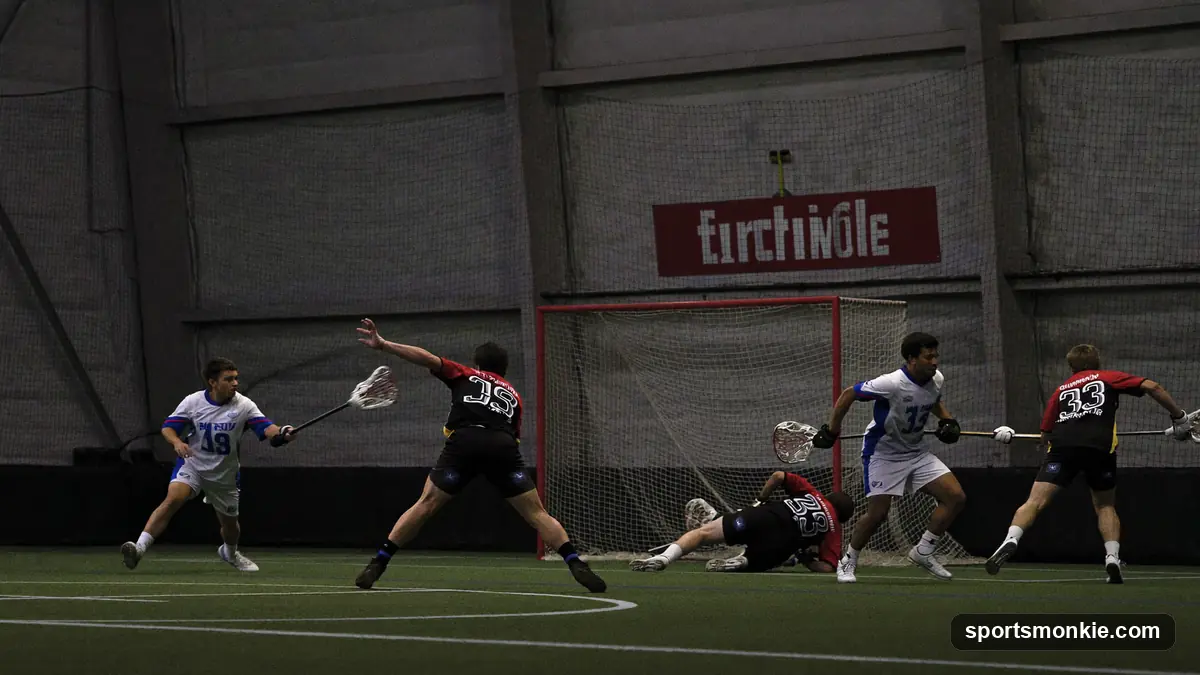
The National Lacrosse League (NLL) plays indoor box lacrosse, a faster and more physical version of the sport contested in an enclosed arena that looks much like an ice-hockey rink. Each team fields six players, five runners and a goalkeeper, rather than the ten used in outdoor field lacrosse, and the tighter space produces a high-scoring, contact-heavy game.
Box lacrosse’s confined boards, shot clock and heavy body contact give the NLL a distinct rhythm that fans often compare to hockey. If your only exposure to the sport is the outdoor field game, the indoor version can feel like a different sport entirely. Here are the core NLL rules and what makes box lacrosse tick.
The arena and the six-a-side setup
Box lacrosse is played inside an arena, frequently a converted hockey rink with the ice covered, surrounded by boards that keep the ball in play. Instead of the sprawling outdoor field, the action is packed into a compact rectangle, which is why the game is so fast and physical.
Each side has six players on the floor: five runners and a goalkeeper. That is four fewer than a field-lacrosse team, and the difference in numbers is one of the biggest contrasts between the codes, as covered in our comparison of box lacrosse vs field lacrosse and our rundown of how many players are on a lacrosse team.
The shot clock and continuous play
A defining NLL rule is the shot clock: once a team gains possession, it has a limited time to get a shot on goal or it surrenders the ball. This forces constant attacking and prevents teams from stalling, a major reason box lacrosse produces so many goals.
Because the boards keep the ball live, play flows continuously, rebounds off the walls stay in, and possession can change in an instant. There is no going out of bounds along the sides the way there is on an open field, which keeps the pace relentless.
Physical contact and penalties
Box lacrosse permits robust body checking within the rules, and the tight quarters mean collisions are frequent. Illegal actions, slashing, cross-checking, tripping, roughing and the like, are punished with time in a penalty box, exactly like hockey. That creates power plays, where the penalized team plays a man down and the opponent has a numerical advantage.
Fighting is against the rules and penalized, but, as in hockey, it does occur, and offenders serve time in the box rather than being automatically ejected the way many other sports would eject them.
NLL box lacrosse versus field lacrosse
The quickest way to grasp NLL rules is to see them next to the outdoor field game.
| Feature | NLL (box) | Field lacrosse |
|---|---|---|
| Players per side | 6 (5 + goalie) | 10 |
| Setting | Enclosed arena with boards | Open outdoor field |
| Ball out of play (sides) | Stays live off boards | Goes out of bounds |
| Shot clock | Yes | Yes (varies by level) |
| Style | Very physical, high-scoring | Physical, more spread out |
| Goalie gear | Larger, hockey-style padding | Lighter, smaller net |
Goals, goalies and scoring
The NLL goal is smaller than a field-lacrosse net, and box goalkeepers wear bulky, hockey-style padding to fill it and block the close-range shots the tight arena produces. Attackers still cannot enter the goal crease, preserving the keeper’s protected zone.
Games are divided into quarters, and every goal counts as one point, with the higher total winning. The combination of a small net, a well-armored goalie and a ticking shot clock is what turns box lacrosse into a rapid-fire, shooting-heavy spectacle. Newcomers who want the broader fundamentals first can start with our lacrosse rules for beginners guide.
Substitutions and specialist roles
Like hockey, box lacrosse uses fast, on-the-fly substitutions through a designated bench area, so players cycle on and off constantly to keep fresh legs in a fast, physical game. Teams typically run offensive and defensive units that swap as possession changes, and specialists, such as sharpshooters and defensive stoppers, are deployed for specific situations.
The transition between offense and defense is a defining rhythm of the NLL. When possession flips, players sprint to change ends and the swapping units create a stop-start flow of full-strength attacks. This constant substitution, combined with the shot clock, is why the indoor game rarely has a dull, static stretch: someone is always attacking, and the clock is always ticking.
The bottom line
NLL rules boil down to box lacrosse: six a side in a boarded arena, a shot clock demanding quick offense, live play off the walls, legal body checking and hockey-style penalty boxes. It is the indoor, high-contact cousin of the field game, built for speed and scoring. Once you picture a hockey rink filled with lacrosse sticks, the NLL’s fast, physical style makes immediate sense.
Frequently asked questions
What are the basic rules of the NLL?+
The NLL plays box lacrosse: six players a side (five runners plus a goalkeeper) in an enclosed arena with boards. Teams must shoot within the shot-clock time or lose possession, the ball stays live off the boards, and body checking is permitted within the rules. Penalties for fouls like slashing or cross-checking put a player in a penalty box, creating power plays much like hockey. Games are divided into quarters, and the team with the most goals wins. The confined space and shot clock make it fast and high-scoring.
What is the minimum salary for NLL players?+
NLL player pay is set by the league's collective bargaining agreement with the players' association, and the minimum has changed over time as new agreements are signed, so the current figure should be checked against the latest CBA or league announcements. Historically, NLL salaries have been part-time in nature, with many players holding other jobs, which is a notable contrast to the higher pay in some other pro leagues. For an accurate, up-to-date minimum, the league's official CBA is the reliable source.
What are 10 basic rules of lacrosse?+
Common core rules include: score by shooting into the goal; each team has a set number of players; play starts with a faceoff (field) or draw; a shot clock limits possession time; you cannot enter the goal crease as an attacker; body and stick checks are allowed within limits; fouls send players to a penalty box or hand over the ball; players must stay onside where required; the goalkeeper has special crease privileges; and games are timed into periods or quarters. Exact rules differ between box (NLL) and field lacrosse, so check the specific ruleset.
Are fights allowed in the NLL?+
Fighting is against the rules and is penalized, but, as in ice hockey, it does happen and players who fight are sent to the penalty box rather than automatically ejected in the way many other sports would eject them. The physical, enclosed nature of box lacrosse makes confrontations more common than in the outdoor field game. So while fighting is not 'allowed' in the sense of being legal, the NLL's penalty structure treats it more like hockey than like sports where any fight means an immediate game ejection.
Sources
Play & tools
Free browser games and tools — no account, no download.
- Play today's Sports Connections — Today's Sports Connections — daily hints, answers, and play the grid.
- Play Guess the NFL Player — A new mystery NFL player every day. Eight guesses, with a clue on each — plus free unlimited mode.
- Explore all our games →
Related guides

NLL Salaries: What Box Lacrosse Pros Earn
What do NLL players earn? National Lacrosse League salaries are modest and part-time. Reported pay ranges, why players keep day jobs, and NLL vs PLL.
Lacrosse Shot Clock Rules: NCAA, PLL and NLL Compared
NCAA men's lacrosse uses an 80-second shot clock, the PLL uses 52 seconds, and box lacrosse (NLL) uses 30. Here's how each works and what resets it.

Box Lacrosse vs Field Lacrosse
Box lacrosse is a fast 5-on-5 indoor game; field lacrosse is a 10-on-10 outdoor sport. Rules, field, gear and physicality compared.
Lacrosse Faceoff Rules, Explained
How do lacrosse faceoffs work? The rules explained: how players line up, the clamp, common violations, and how faceoffs differ by level and gender.

Is Lacrosse a Contact Sport? Contact Rules by Version
Is lacrosse a contact sport? It depends which lacrosse. Body checking is legal in men's field and box, banned in the women's game. Rules and injury data compared.
Lacrosse Field Dimensions: Men's, Women's, Youth and Box
Lacrosse field dimensions by format: men's, women's, youth, Sixes and box lacrosse, with goal spacing, creases, line markings and field-fit calculator.